Bottom Line Up Front (BLUF)
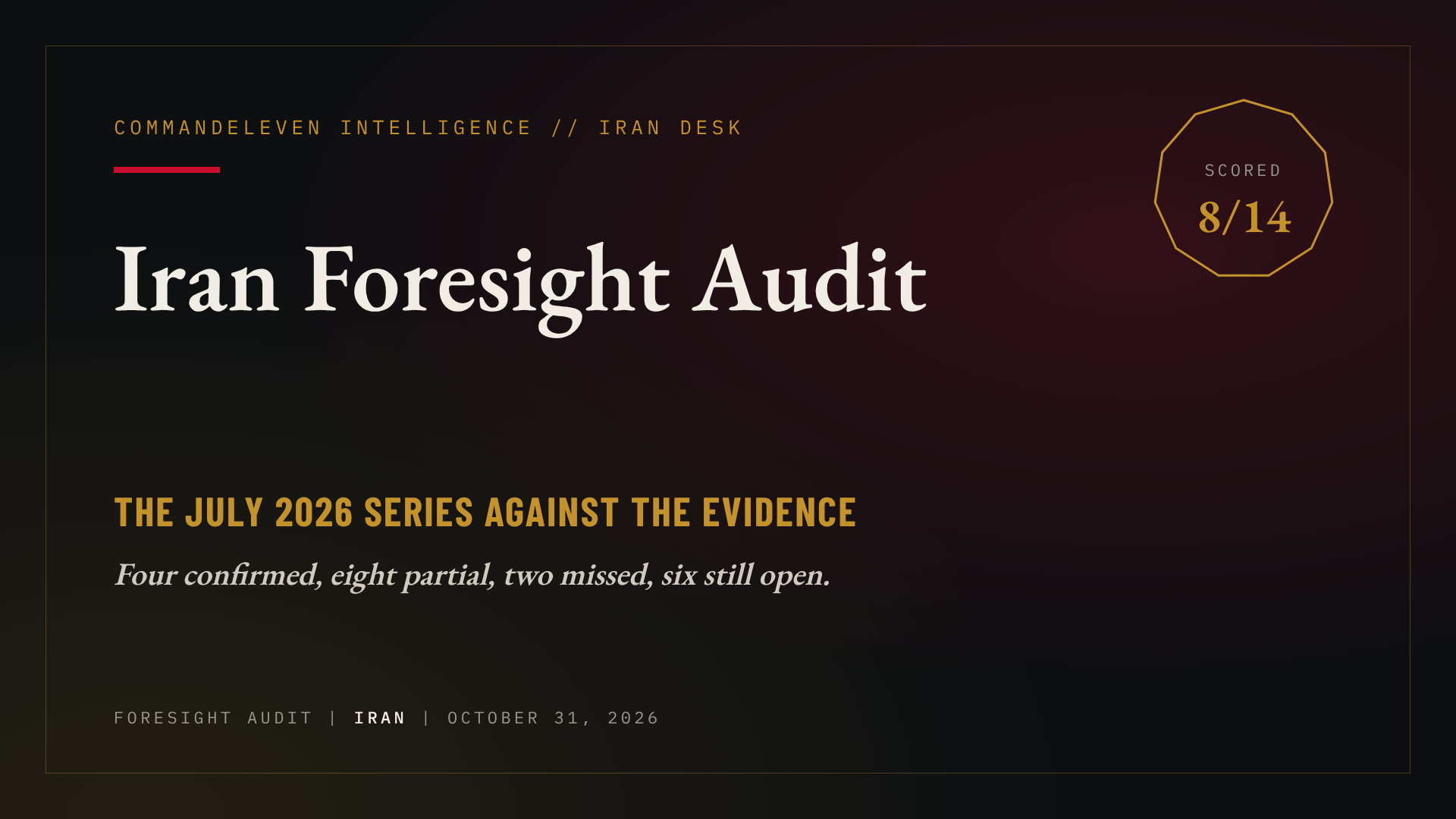
On July 19 and 20, 2026, CommandEleven Intelligence published a six-part doctrinal series on how Iran fights. On September 17 we published a second six-part series, Iran War Doctrine & Strategy, built on dated, sourced evidence for the same six themes. This audit holds the first series against the second and against events through October 30, and publishes the result, misses included.
Twenty checkable claims were extracted from the July series. Four are confirmed, eight partially confirmed, two not confirmed and six not yet resolved. On the 14 claims the evidence can settle, the score is 8.0 out of 14 (57%). The overall pattern the July series described held up: a decentralized, attritional, endurance-based way of war. The detail was weaker. The series framed Iran’s posture as gray-zone conflict when a direct state war was already under way, said nothing about China’s and Russia’s role in supplying Iran, and gave no dated or measurable calls. Most of its claims can be scored for accuracy but not for foresight.
What Is Being Audited, and Why It Is Not a Normal Foresight Audit
Three facts about the July series shape everything below.
- It was written during the war, not before it. The US-Israel strikes began on February 28, 2026 and killed Supreme Leader Ali Khamenei. A ceasefire ran from April 8 to July 8. The July series appeared less than two weeks after it ended and describes “the ongoing Iran-led conflict.” Much of it therefore describes things that were already visible. That is analysis, not prediction, and the audit separates the two.
- It carries no sources, dates or case studies. The six posts are conceptual. Their “Forecasting and Escalation Vectors” sections list indicators to watch, not outcomes with dates. The September series fixed this: every claim there is confidence-tiered and linked.
- Both series are ours. Scoring our own earlier work against our own later work invites the risk of grading to fit. The method section says how we guarded against that.
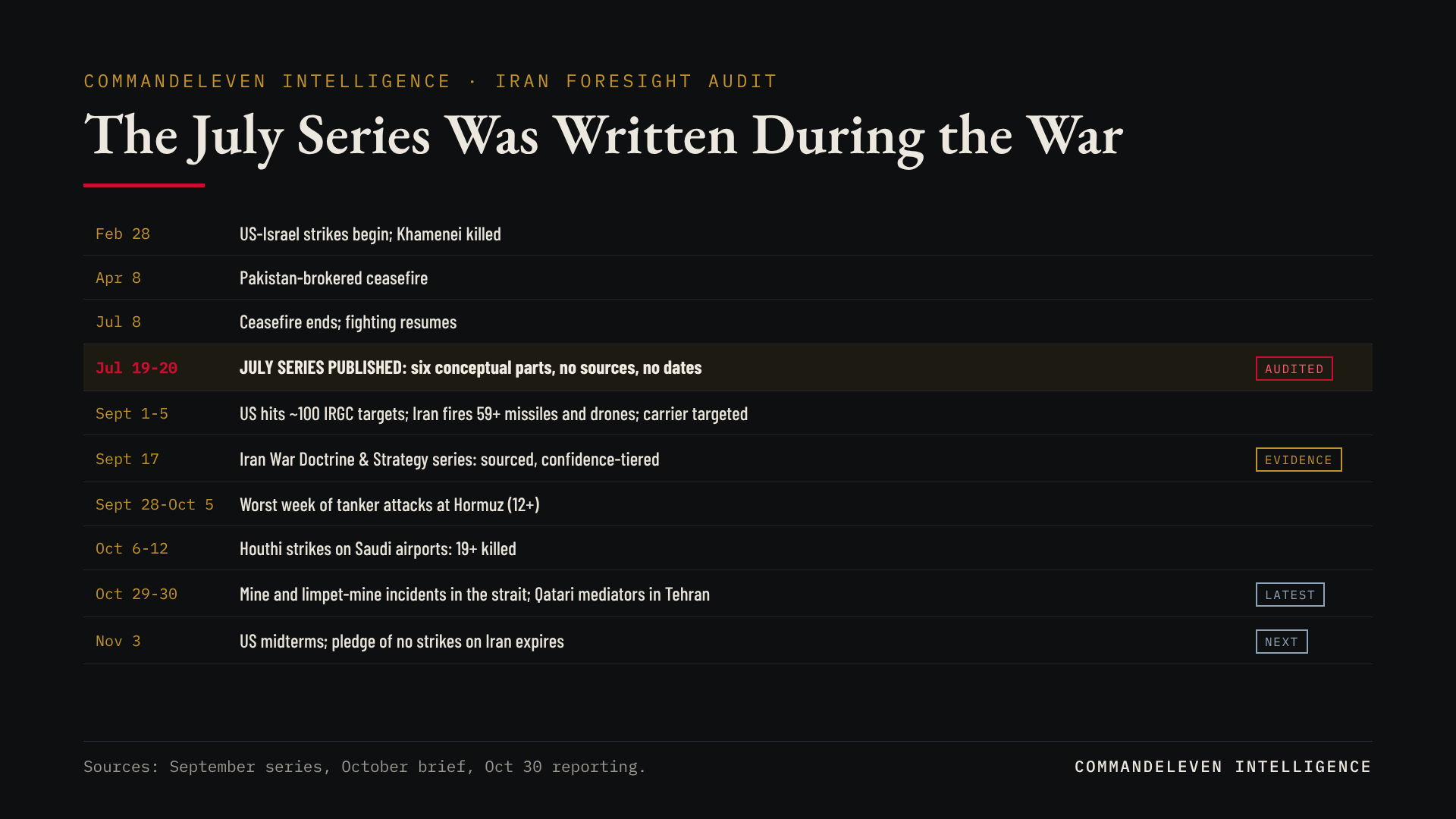
The posts are scored as they read on October 31, 2026. They were last modified on October 10 to 13; the original publication dates are July 19 and 20.
How Is Each Claim Scored?
The scale is the one used in the GCTA Foresight Audit: CONFIRMED (the evidence shows it as stated), PARTIALLY CONFIRMED (the core direction held but a material element was wrong or unproven), NOT CONFIRMED (the evidence points the other way) and NOT YET RESOLVED (the evidence cannot settle it yet). Confirmed counts as 1 point, partially confirmed as 0.5, and unresolved items are left out of the percentage. Because the July series is mostly descriptive, each claim also carries a lead-time tag:
- Forward: the claim is about what would happen after July 20. This is the only kind that counts as foresight.
- Contemporaneous: the claim describes the situation as it already stood. It tests accuracy, not foresight.
Guarding against grading our own work. Scores rest on the primary and secondary sources the September series cites (OFAC and State Department actions, Lloyd’s List Intelligence, NewsGuard, IMO and UKMTO incident reports, Reuters, the New York Times) and on October reporting. They do not rest on the September series’ own conclusions, which are interpretive. That series’ headline reading, that the doctrine is “working as designed,” is not used as evidence. Its Part 2 itself concedes that the absence of a ground invasion may reflect US politics rather than Iranian deterrence. Casualty and damage figures there come from national governments and are not independently verified. Where the only available support is a secondary relay, the score says so and is held down.
The Scorecard
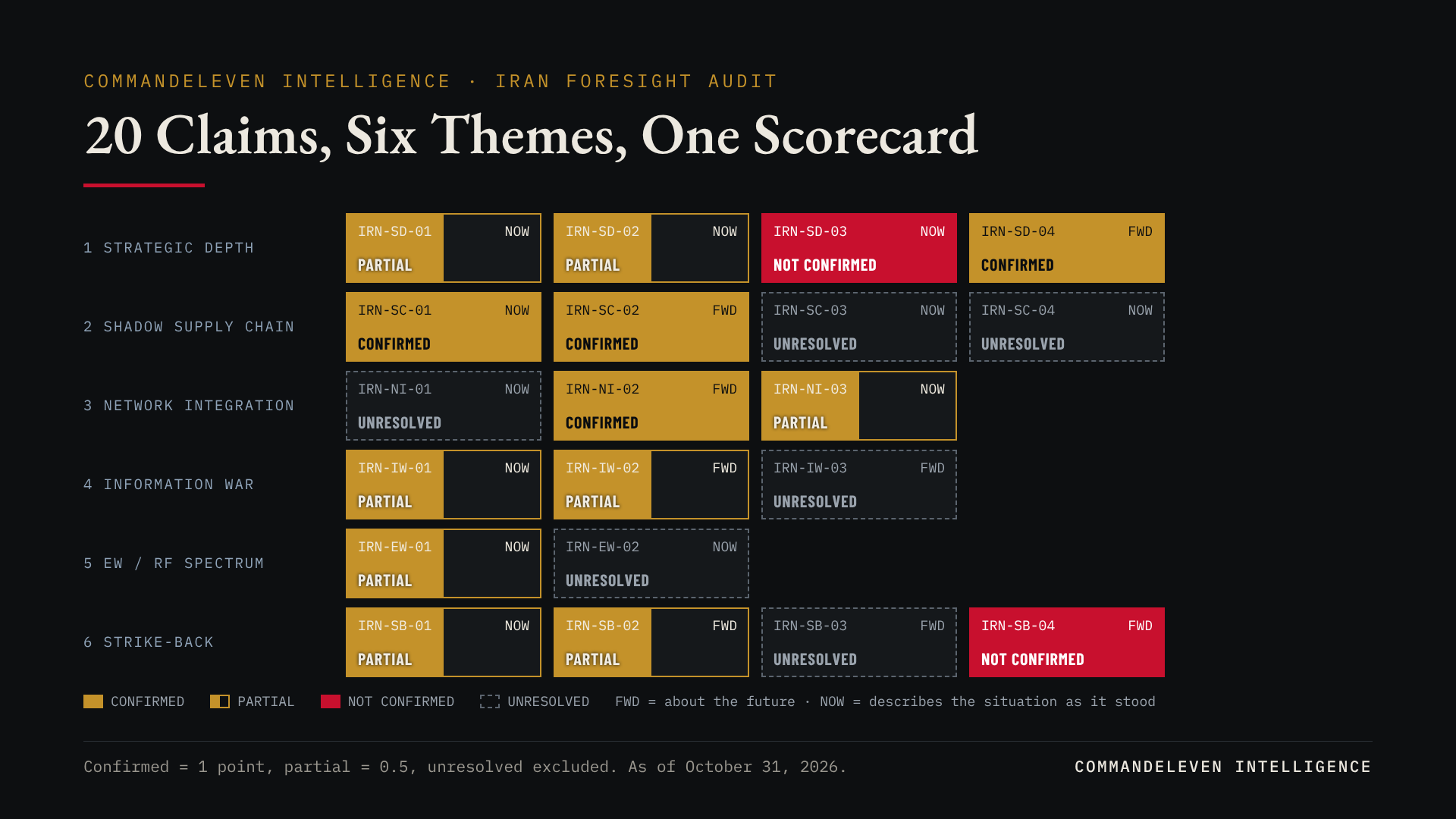
| ID | July claim (short form) | Lead | Score |
|---|---|---|---|
| IRN-SD-01 | The Quds Force moved from territorial defense to proxy-led, network-centric attrition | Contemporaneous | PARTIALLY CONFIRMED |
| IRN-SD-02 | Cheap UAVs and short-range missiles force costly interceptor expenditure | Contemporaneous | PARTIALLY CONFIRMED |
| IRN-SD-03 | Iran operates in the gray zone and its resilience discourages large-scale direct state engagement | Contemporaneous | NOT CONFIRMED |
| IRN-SD-04 | The IRGC is prepared to escalate the attrition tempo and sustain it | Forward | CONFIRMED |
| IRN-SC-01 | A decentralized shadow supply chain sustains Iran under sanctions | Contemporaneous | CONFIRMED |
| IRN-SC-02 | Interdiction raises cost but will not collapse the network, which persists in “semi-permanent degradation” | Forward | CONFIRMED |
| IRN-SC-03 | Hawala-style clearing and barter settle logistics outside the banking system | Contemporaneous | NOT YET RESOLVED |
| IRN-SC-04 | Overland corridors through Iraq and Syria carry guidance components to proxies | Contemporaneous | NOT YET RESOLVED |
| IRN-NI-01 | Lebanon and Yemen operations are synchronized in time and effect | Contemporaneous | NOT YET RESOLVED |
| IRN-NI-02 | The proxy network keeps operating despite disruption (the series’ own test) | Forward | CONFIRMED |
| IRN-NI-03 | Tehran can “dial” intensity up or down across theaters | Contemporaneous | PARTIALLY CONFIRMED |
| IRN-IW-01 | Iran outperforms the US in the information war through speed and decentralization | Contemporaneous | PARTIALLY CONFIRMED |
| IRN-IW-02 | AI-generated media is the next frontier, deployed at the moment of a kinetic crisis | Forward | PARTIALLY CONFIRMED |
| IRN-IW-03 | Influence shifts to unaffiliated influencers, making attribution harder | Forward | NOT YET RESOLVED |
| IRN-EW-01 | Electronic warfare is central to the war and spectrum control decides survivability | Contemporaneous | PARTIALLY CONFIRMED |
| IRN-EW-02 | Specific techniques: adaptive null-steering, frequency hopping, ghost-target masking | Contemporaneous | NOT YET RESOLVED |
| IRN-SB-01 | A three-tier strike-back: drone saturation, precision missiles, long-range ballistic | Contemporaneous | PARTIALLY CONFIRMED |
| IRN-SB-02 | Strike volume surges in the first 12 to 24 hours of an engagement | Forward | PARTIALLY CONFIRMED |
| IRN-SB-03 | Strikes on energy, infrastructure or civilians act as a “collateral trigger” forcing high-intensity retaliation | Forward | NOT YET RESOLVED |
| IRN-SB-04 | Blinding adversary radars and C2 removes back-channel de-escalation and forces a “blind response” | Forward | NOT CONFIRMED |
Totals: 20 claims scored · 4 confirmed · 8 partially confirmed · 2 not confirmed · 6 not yet resolved.
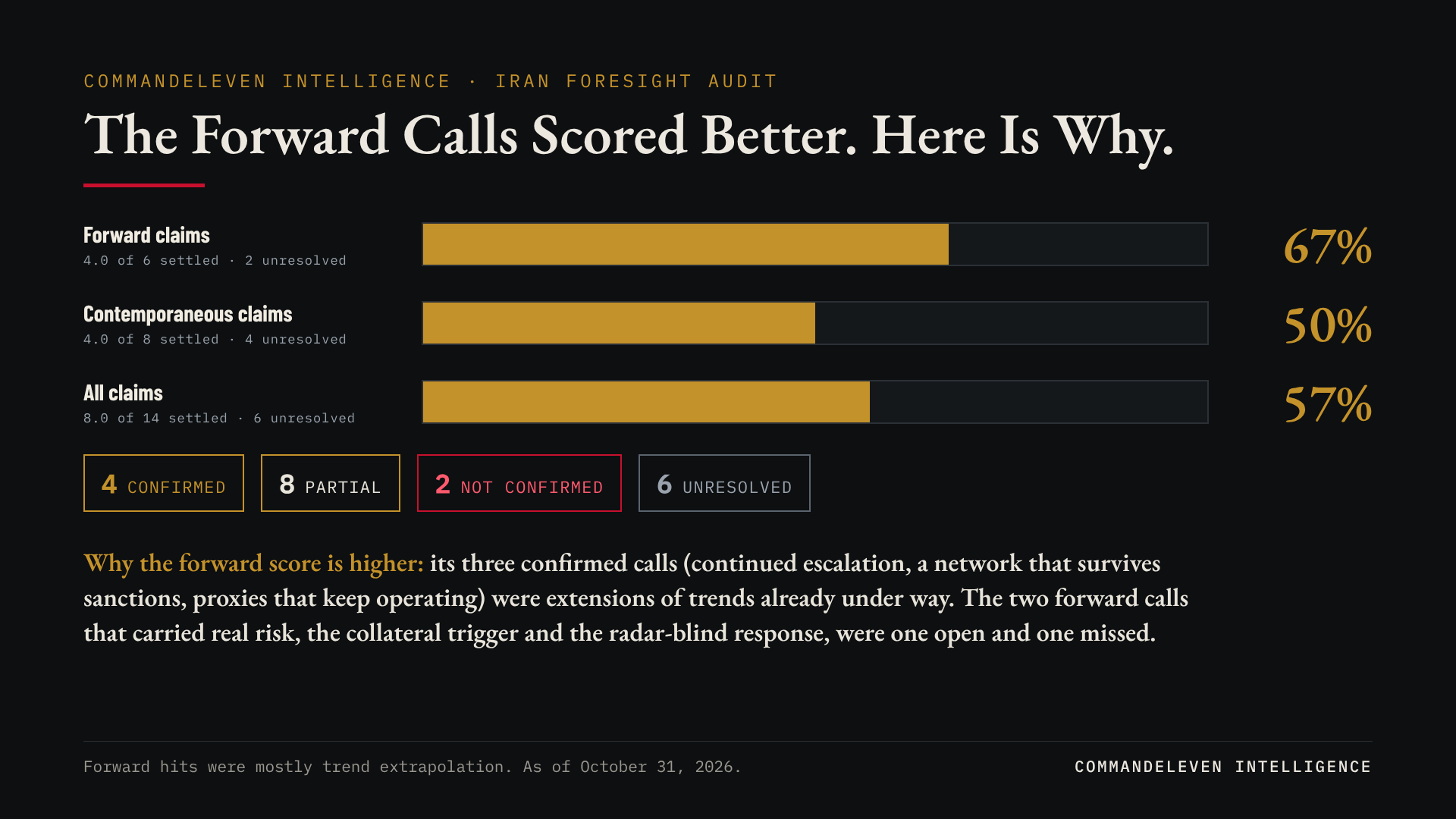
Forward claims (8): 3 confirmed, 2 partially confirmed, 1 not confirmed, 2 not yet resolved. Score on the six resolved: 4.0 of 6 (67%).
Contemporaneous claims (12): 1 confirmed, 6 partially confirmed, 1 not confirmed, 4 not yet resolved. Score on the eight resolved: 4.0 of 8 (50%).
The forward claims score better, but read why. The three that were confirmed (continued escalation, a network that survives sanctions, proxies that keep operating) are extrapolations of trends already in motion. The forward claims that carried real risk were the escalation thresholds. One was not borne out and one is still open.
Theme 1: Strategic Depth and Asymmetric Attrition
July source: Strategic Depth and Asymmetric Attrition – Iran (July 19). September counterparts: Parts 1, 2 and 6.
| ID | What the record shows | Score |
|---|---|---|
| IRN-SD-01 Proxy-led attrition replaced territorial defense | The attrition posture is documented. Since February 28 Iran has fired fewer, more precise strikes at radar and air-defense sites, and Part 6 records the 5th Fleet’s Bahrain base disabled and more than a dozen radar and missile-defense systems hit. But most of that fire was direct Iranian state fire, not proxy fire. On September 2, after US strikes on about 100 IRGC targets, Iran launched at least 59 missiles and drones at Jordan, Bahrain, Kuwait and Iraq (JINSA). The proxies mattered, and the Houthi front against Saudi Arabia opened in October, but “proxy-led” overstated their share. | PARTIALLY CONFIRMED |
| IRN-SD-02 Cheap munitions force costly interceptor use | The cost imposition is real: damage to named Patriot, THAAD, AN/TPY-2 and other radar assets (Wikipedia infobox, government-sourced, as cited in Part 6). The stated mechanism, draining interceptor stocks by volume, is not evidenced. Our sources give no interceptor inventory figures, and the documented method was precision strikes on the sensors themselves. The same claim recurs in Part 6 of the July series and is scored once, here. | PARTIALLY CONFIRMED |
| IRN-SD-03 Gray-zone posture discourages direct state engagement | The record contradicts it, and it already did when the claim was written. The US and Israel killed Khamenei on February 28, ran a 40-day air and missile campaign, agreed a Pakistan-brokered ceasefire on April 8, and struck again after it ended, including about 100 IRGC targets on September 1 (GlobalSecurity). This was large-scale direct state war. Part 3 of the July series repeats the claim as “escalation control” within “managed instability” and is covered by this score. | NOT CONFIRMED |
| IRN-SD-04 The IRGC will escalate the attrition tempo | On September 5 the IRGC fired ballistic missiles at a US carrier and a destroyer; both were evaded. Between September 28 and October 5 there were at least 12 tanker attacks around Hormuz, the war’s worst week (the IMO logged nine; Reuters via gCaptain). On October 29 and 30 the IRGC reported tankers hit by mines in the southern strait, and UKMTO reported a limpet-mine attack on the Louise 1 near Khasab (Euronews). Attribution of individual incidents is not settled. | CONFIRMED |
Theme 2: The Shadow Supply Chain
July source: The Logistics of Resilience: Iranian Shadow Supply Chain (July 20). September counterpart: Part 5.
| ID | What the record shows | Score |
|---|---|---|
| IRN-SC-01 A decentralized shadow chain sustains Iran | On February 25, 2026 Treasury and State designated more than 30 individuals, entities and vessels, describing a closed loop in which shadow-fleet oil revenue funds weapons procurement (State Department). The Jamestown Foundation describes the Chinese side as a “manufacturing plain” of interchangeable micro-enterprises, and Windward counts about 100 LPG carriers in Iranian trades. The core claim is borne out by official action. | CONFIRMED |
| IRN-SC-02 Interdiction raises cost but does not collapse the network | Treasury acted again on April 21 (14 targets) and May 8 (ten entities, mostly in mainland China and Hong Kong), each time acknowledging that Iran kept finding new front companies. On October 9 Bloomberg reported Western officials’ assessment that Iran preserved missile and drone production capacity and is receiving missiles from Russia (via Iran International). Sanctions escalated all year without breaking the network. | CONFIRMED |
| IRN-SC-03 Hawala and barter settle logistics | Part 5 documents trade conducted largely outside the Western financial system (the Atlantic Council’s “Axis of Evasion”) but not the settlement mechanics. Nothing we reviewed shows hawala or barter in these flows. | NOT YET RESOLVED |
| IRN-SC-04 Overland corridors through Iraq and Syria carry guidance components | The documented component flow runs from China and Russia, not through these corridors. We found no evidence either way on the corridors. Data deficit. | NOT YET RESOLVED |
Theme 3: Lebanon-Yemen Network Integration
July source: Asymmetric Network Integration: Lebanon and Yemen (July 20). September counterparts: Part 2 (Lebanon front) and the October status brief (Yemen front).
| ID | What the record shows | Score |
|---|---|---|
| IRN-NI-01 Lebanon and Yemen are synchronized in time and effect | No source we reviewed shows coordinated timing between the two fronts. Israeli ground forces crossed north of the Litani on May 30 and Israel-Hezbollah fire continued into September. The Houthi air campaign against Saudi airports ran October 6 to 12. The two fronts moved, but we have no evidence they moved together. | NOT YET RESOLVED |
| IRN-NI-02 Nodes keep operating despite disruption | The July series set this as its own test. By it the claim passes: Houthi strikes on Saudi airports between October 6 and 12 killed at least 19 and wounded more than 350, and closed Riyadh’s King Khalid International (TIME; Saudi aviation authority via AeroCorner). The Houthis give their own motives for the campaign, so this confirms resilience, not Iranian command. | CONFIRMED |
| IRN-NI-03 Tehran can “dial” intensity | Consistent with the October pattern: the US paused strikes on October 8 while Hormuz attacks and the Houthi campaign continued and Iran kept negotiating. But we cannot show that Tehran controls the dial. Several Hormuz attacks are by “unknown projectiles,” the IRGC disputes at least one US attribution, and Qatari mediators were still carrying proposals to Tehran on October 30 as attacks continued. | PARTIALLY CONFIRMED |
Theme 4: The Information War
July source: The Information War: US vs. Iran Cognitive Warfare (July 20). September counterpart: Part 4.
| ID | What the record shows | Score |
|---|---|---|
| IRN-IW-01 Iran outperforms the US in the information war | Volume and speed are documented: the New York Times counted more than 110 AI-generated images and videos in two weeks, and NewsGuard logged 18 false claims from Iranian state media after February 28 against five in the two weeks before (Euronews). “Winning” is not shown. Many fabrications were debunked within days, and Carnegie argues Iran’s record has damaged the credibility of its genuine claims. No source measures effect on opinion or policy. The July claim that Iran has measurably moved the Western Overton window is unverified. | PARTIALLY CONFIRMED |
| IRN-IW-02 Synthetic media is the next frontier, used at kinetic moments | AI-generated media was already in heavy use when the claim was written. Fact-checkers documented a Ford carrier laundry fire inflated into a flight-deck disaster by AI video. Two parts of the claim are unproven: “catastrophic” degradation of adversary command and control, and the report of pre-staged deepfakes ready within hours of strikes, attributed to Citizen Lab. We have seen that finding only through a secondary relay and could not locate the primary report, so it is not relied on. | PARTIALLY CONFIRMED |
| IRN-IW-03 Influence shifts to unaffiliated influencers | The documented actors are state media and IRGC-linked Telegram channels, which is the opposite of unaffiliated. A viral run of Lego-style AI videos is documented but its origin is not. | NOT YET RESOLVED |
Theme 5: Electronic Warfare and the RF Spectrum
July source: EW and RF Spectrum Contention: Iranian Defensive Architectures (July 20). September counterpart: Part 3.
| ID | What the record shows | Score |
|---|---|---|
| IRN-EW-01 EW is central; the spectrum decides survivability | Central, yes. Lloyd’s List Intelligence logged 1,735 interference events affecting 655 ships off the UAE in the first week (Lloyd’s List data via Kuehne+Nagel), and Iran has invested in jamming and spoofing since 2011. But the July post describes defensive radar countermeasures for protecting mobile launchers. The documented effect is something else: GPS and AIS spoofing of shipping, plus jamming of Starlink terminals. The theme was right and the content was not the one the evidence turned up. | PARTIALLY CONFIRMED |
| IRN-EW-02 Null-steering, frequency hopping, ghost-target masking | The July post cites no source and nothing in open reporting we reviewed corroborates these techniques or their effect. This claim cannot be settled from open sources and may never be. | NOT YET RESOLVED |
Theme 6: Strike-Back Capability and Escalation
July source: Strike Back Capabilities and Escalation Potential (July 20). September counterparts: Parts 2 and 6, and the October brief.
| ID | What the record shows | Score |
|---|---|---|
| IRN-SB-01 Three-tier strike-back architecture | Tiers one and two are visible: mixed missile and drone salvos across four countries on September 2, and ballistic missiles at a carrier on September 5. Tier three, long-range ballistic projection beyond the region, is not evidenced in anything we reviewed. | PARTIALLY CONFIRMED |
| IRN-SB-02 A surge in the first 12 to 24 hours | The September 1 US strikes were answered by Iran’s largest attack since the ceasefire on September 2, so the response was fast. Our sources give no hourly profile, and one episode cannot show the “exponential” curve the July post describes. | PARTIALLY CONFIRMED |
| IRN-SB-03 The “collateral trigger” | The test case has played out but not been closed. A tanker was hit off Qatar with casualties on October 8, and on October 10 a Houthi strike on Riyadh’s airport killed 13, including a US citizen. Trump said the US “may” join strikes on the Houthis, but as of October 30 it has not. The trigger has not fired. Washington’s pledge of no strikes on Iran before November 3 confounds the test, and Axios reports the US and Israel are weighing extensive strikes afterward. We re-score after that window. | NOT YET RESOLVED |
| IRN-SB-04 Blinding radars removes back-channels | More than a dozen coalition radar and missile-defense systems were destroyed or damaged, yet back-channels never closed. Qatar passed Iran’s seven-day Hormuz plan to Washington in September, the US spoke of “productive discussions” in October, and Qatari mediators were in Tehran again on October 30 with a revised proposal. No “blind response” followed. The claim also conflated lost sensors with lost political channels. | NOT CONFIRMED |
What the July Series Did Not Say
A scorecard of what was claimed misses what was left out. The evidence now shows five things that carried the most weight and that the July series did not mention.
- China and Russia as suppliers. The Atlantic Council names China the dominant source of Iran’s drone and missile components, and Western officials report Russian missile deliveries. The July supply-chain post describes routes and settlement but never names the suppliers.
- The GPS and AIS spoofing campaign at Hormuz. It is the best-documented Iranian EW effect of the war and was absent from the July EW post.
- That a direct state war was already under way. The gray-zone framing (IRN-SD-03) was the series’ largest single error.
- Mines and small-boat attacks in the strait. The October incidents involved naval mines and a limpet-mine attack, a different toolkit from the missile-and-drone frame the series used.
- The Houthis as an independent escalator against Saudi Arabia. The July series treats Yemen as a node in an Iranian network. The October air campaign shows a front with its own stated motives.
What We Are Correcting
- Posture: CommandEleven Intelligence no longer describes Iran’s posture as gray-zone conflict. It is a state at war, using proxies and deniable means alongside direct fire.
- Calls: Forecasts in this series now carry a date, a measurable outcome and a source, as in the monthly Iran War Status Brief. Indicator lists alone are not calls.
- Technical claims: We do not publish technical capability claims, such as the EW techniques in IRN-EW-02, without a source.
What Was Not Scored
The July series lists indicators and conditionals that no evidence can settle either way, so they were left out rather than forced into a score: integration density, munition diversity and technological standardization across the proxy network; “cognitive electronic warfare” arriving; hypersonic and stealth platforms making strike-back a preventive option; accidental escalation as the main threat; the “cognitive threshold” where information operations shape tactical outcomes; and the conditional that the IRGC would lower its strike threshold if it judged its deterrent insufficient. These stay on the watch list.
What Could Move These Scores
- After the November 3 US midterms: renewed US or Israeli strikes would test IRN-SB-02 (speed of the Iranian response) and IRN-SB-03 (the collateral trigger).
- Iran’s reply to the revised Qatari proposal would bear on IRN-NI-03 and IRN-SB-04.
- Primary evidence on Russian deliveries, interceptor inventories or overland corridors would move IRN-SD-02, IRN-SC-04 and the supply-chain items.
How Often Is This Audit Reviewed?
The six unresolved items and the eight partial scores are re-checked on November 13 and again in the quarterly review in December 2026. Any score can move in either direction, every change is dated, and earlier scores are never silently overwritten. The eight forward claims are counted in the Foresight Record: 3 confirmed, 2 partially confirmed, 1 not confirmed and 2 open. The 12 contemporaneous claims test accuracy, not foresight, and are not counted there.
Frequently Asked Questions
Was the July series a forecast made before the war?
No. It was published on July 19 and 20, 2026, more than four months after the war began on February 28 and shortly after an April-to-July ceasefire ended. This audit tests its accuracy and, for the eight claims about the future, its foresight.
How accurate was it?
Of 20 claims, four are confirmed, eight partially confirmed, two not confirmed and six not yet resolved. On the 14 that can be settled, the score is 8.0 (57%).
What was the biggest miss?
Describing Iran as operating in the gray zone and avoiding direct state engagement, when the US and Israel had already struck Iran directly and killed its Supreme Leader.
Isn’t it circular to score our own work against our own later work?
It would be if the later series were treated as proof. Scores rest on the underlying primary and secondary sources, not on the September series’ conclusions, and the method section says where those sources are thin.
Why were six claims left unresolved?
The open sources reviewed do not say, or the test case is still running. Unresolved is not a pass; these items are re-checked on a schedule.
Related CommandEleven Intelligence Coverage
- Iran War Doctrine & Strategy: A Six-Part CommandEleven Intelligence Series
- Iran War Status Brief: October 2026
- The GCTA Foresight Audit: Scoring Our 2026 Forecasts Against What Happened
- Strike Back Capabilities and Escalation Potential (July series, Part 6)
Sourcing Base
CONFIRMED – Primary and Official Record
- US Department of State, Sanctions to Disrupt Iran’s Weapons Procurement Networks and Shadow Fleet, February 25, 2026
- JINSA, Iran War Update: September 1-2, 2026
- GlobalSecurity.org, Iran War 2026 – Day 191 Update, September 6, 2026
- Reuters via gCaptain, Attacks on tankers in Hormuz hit highest of any week since start of Iran war, October 7, 2026
- Euronews, Iran’s Revolutionary Guard reports tankers on fire in Strait of Hormuz as talks continue, October 30, 2026 (AFP, UKMTO, Oman Maritime Security Center reporting)
- Lloyd’s List Intelligence, War zone GNSS interference surges across the Middle East Gulf (republished by Kuehne+Nagel)
- Euronews, Iran’s state media ramps up disinformation campaign, March 6, 2026 (NewsGuard figures)
ASSESSED – Credible Secondary and Analytical Reporting
- TIME, Trump Says U.S. May Join Saudi Strikes on Houthis After Riyadh Airport Attacks, October 10, 2026
- Bloomberg via Iran International, Iran retains missile and drone production capacity, October 9, 2026
- Atlantic Council, From drones to rocket fuel, China and Russia are helping Iran through supply chains
- Jamestown Foundation, PRC Supply Chain Ecosystem Behind Iran’s Drone Campaign
- Observer Research Foundation, Signals Before Strikes: Electronic Warfare in the Iran War
- FactNameh, Iran’s Information War: Patterns and Trends in Information and Narrative Manipulation
- CommandEleven Intelligence, the July 2026 doctrinal series and the September 2026 Iran War Doctrine & Strategy series (documents under audit; their cited sources are listed in each part)
Not located: The primary Citizen Lab report on pre-staged deepfake content, cited in the September series through a secondary relay. It is not used as evidence here.