Executive Summary and Strategic Context
The information domain has evolved into the primary theater of conflict between the United States and the Islamic Republic of Iran. This is not merely a contest of narratives, but a sophisticated, multi-domain cognitive warfare campaign intended to erode adversary political willpower, fracture alliance cohesion, and dominate the perception of regional stability. While the United States retains an inherent advantage in mass-media reach and technical infrastructure, Iran has demonstrated a superior capacity for agile, persistent, and decentralized narrative exploitation. This dossier evaluates the strategic metrics of this conflict, analyzing why Tehran’s “asymmetric” approach to information operations (IO) consistently achieves higher tactical resonance than the traditional, institutionally constrained messaging frameworks favored by Western actors.
Doctrine: Asymmetric vs. Conventional Information Postures
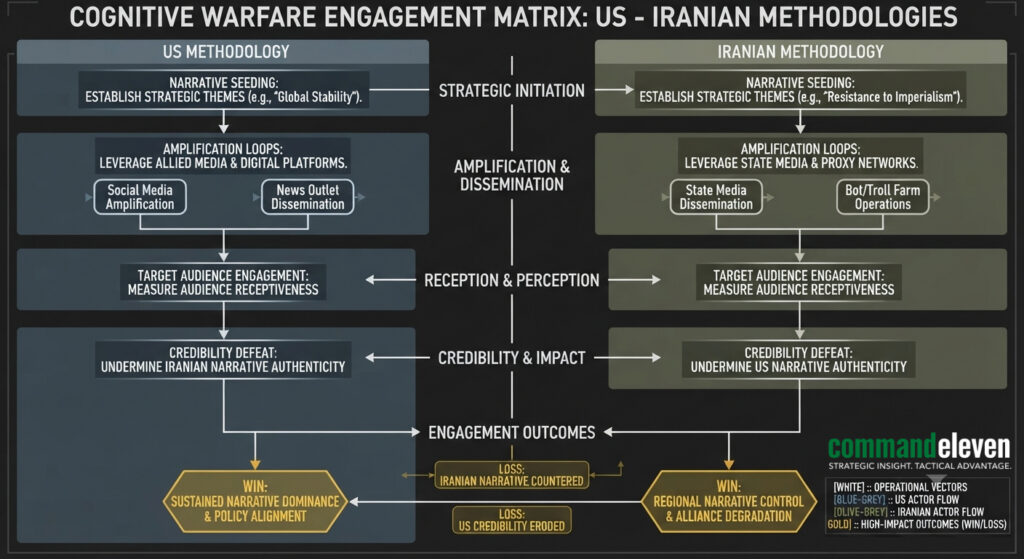
The fundamental disparity between US and Iranian information warfare lies in doctrine, risk tolerance, and institutional agility.
- US Institutional Constraints: Washington operates within a framework dictated by transparency, legal compliance, and a preference for long-term narrative shaping. This methodology is inherently slow and reactive, constrained by the need for multi-agency vetting and alignment with international normative frameworks.
- Iranian Asymmetric Agility: Tehran’s IO doctrine is characterized by a “constant-engagement” model. By leveraging a decentralized ecosystem of state-sponsored media, digital proxy networks, and third-party influencers, Iran can seed, amplify, and pivot narratives within hours. This enables the IRGC to dominate the initial “first-impression” cycle of any kinetic event, effectively establishing the baseline perception before Western institutional responses can be finalized.
Mechanisms of Narrative Contention
The theater of information warfare is defined by how both actors utilize the digital ecosystem to influence strategic outcomes.
- Narrative Seeding: Iran excels at “micro-targeting” specific demographic segments within regional and Western populations. By exploiting existing political fissures (e.g., historical anti-colonial sentiment, skepticism of Western intervention), Iranian IO channels seed narratives that resonate with local concerns, thereby bypassing the skepticism directed toward state-owned media.
- Amplification Loops: Tehran leverages coordinated digital networks—often utilizing automated bot-nets and “sock-puppet” accounts—to create an illusion of consensus. This amplifies specific themes until they cross the threshold into mainstream discourse, forcing Western institutions into a defensive posture where they are compelled to address and “debunk” fabricated or heavily distorted narratives.
- Credibility Defeat: A core objective of Iranian IO is the systematic erosion of trust in Western institutions. By highlighting the contradictions, failures, or selective engagements of Western policy, Tehran effectively discredits the messenger, ensuring that future Western messaging—regardless of its factual accuracy—is met with pre-existing skepticism.
Performance Assessment: Evaluating “Winning”
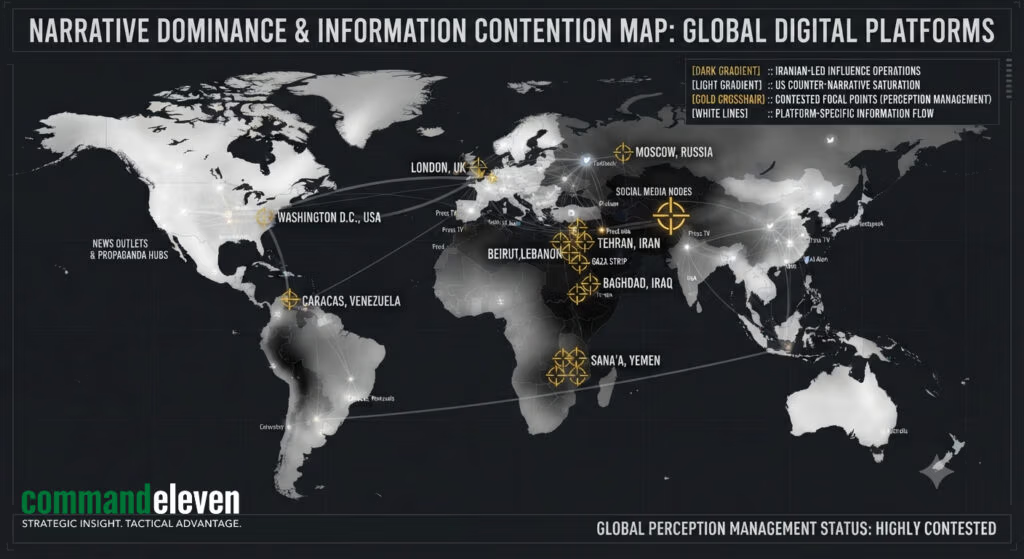
Assessing “victory” in the information war requires looking beyond simple content output to the measurable impact on strategic decision-making and public perception.
- The Resilience of Iranian Narratives: Iran has proven highly effective at insulating its domestic population from Western influence while simultaneously projecting influence into the US political sphere. Tehran’s ability to influence the Western “overton window”—the range of policies acceptable to the mainstream population—has been a measurable success, particularly regarding the perceived legitimacy of US regional presence.
- Western Structural Advantages vs. Tactical Weakness: While the US possesses superior technical capabilities to disrupt Iranian IO infrastructure, the institutional reluctance to fully embrace aggressive “cognitive warfare” results in a strategic mismatch. Washington’s IO strategy often prioritizes the dissemination of objective facts, whereas Tehran prioritizes the curation of emotive, divisive content. In the current global media environment, emotive and divisive narratives possess significantly higher “viral” velocity than neutral, factual reporting.
Forecasting and Escalation Vectors
The trajectory of the US-Iran information war is likely to witness an escalation in technical complexity and cognitive targeting.
- Synthetic Media and Deepfakes: The integration of AI-generated synthetic media represents the next frontier of narrative contention. Iran is actively investing in capabilities to generate highly convincing, fabricated audio and visual content that could, if deployed at the critical moment of a kinetic crisis, catastrophically degrade adversary C2 and public trust.
- Decentralized Influence Networks: Tehran is shifting toward even more decentralized influence models, where individual influencers—unaffiliated with state media but sympathetic to Iranian objectives—carry the narrative. This makes the attribution of IO campaigns increasingly difficult and complicates Western efforts to sanction or disrupt the infrastructure.
- The “Cognitive” Threshold: The ultimate indicator of the conflict’s trajectory will be the point at which cognitive warfare begins to directly shape tactical-level outcomes. If Iranian IO campaigns can successfully induce hesitation, confusion, or division among regional military commanders during a kinetic engagement, the conflict will have crossed from “information warfare” into the realm of direct kinetic influence.
Tehran is currently demonstrating higher tactical efficiency in the information domain, largely due to its willingness to embrace the chaotic, emotive, and asymmetric nature of the digital environment. The United States remains caught in a paradigm that prioritizes factual, centralized messaging, which, while institutionally comfortable, is increasingly ill-suited for the rapid, fragmented information landscape of the 21st century. Winning this conflict will require not more media reach, but a fundamental reassessment of how narrative can be weaponized to achieve strategic effect, acknowledging that in the information war, perception—not fact—is the primary variable of strategic success.
Read the entire series:
- Strategic Depth and Asymmetric Attrition
- The Logistics of Resilience: Iran’s Shadow Supply Chain
- Asymmetric Network Integration: Lebanon and Yemen
- The Information War: US vs. Iran (Cognitive Warfare)
- EW and RF Spectrum Contention: Iranian Defensive Architectures
- Strike Back Capabilities and Escalation Potential
Additionally, CommandEleven Intelligence has published a 6 part Deconstruction of the IRGC breaking down their internal and external operations, as well as front companies, money laundering and trans-shipment structures.