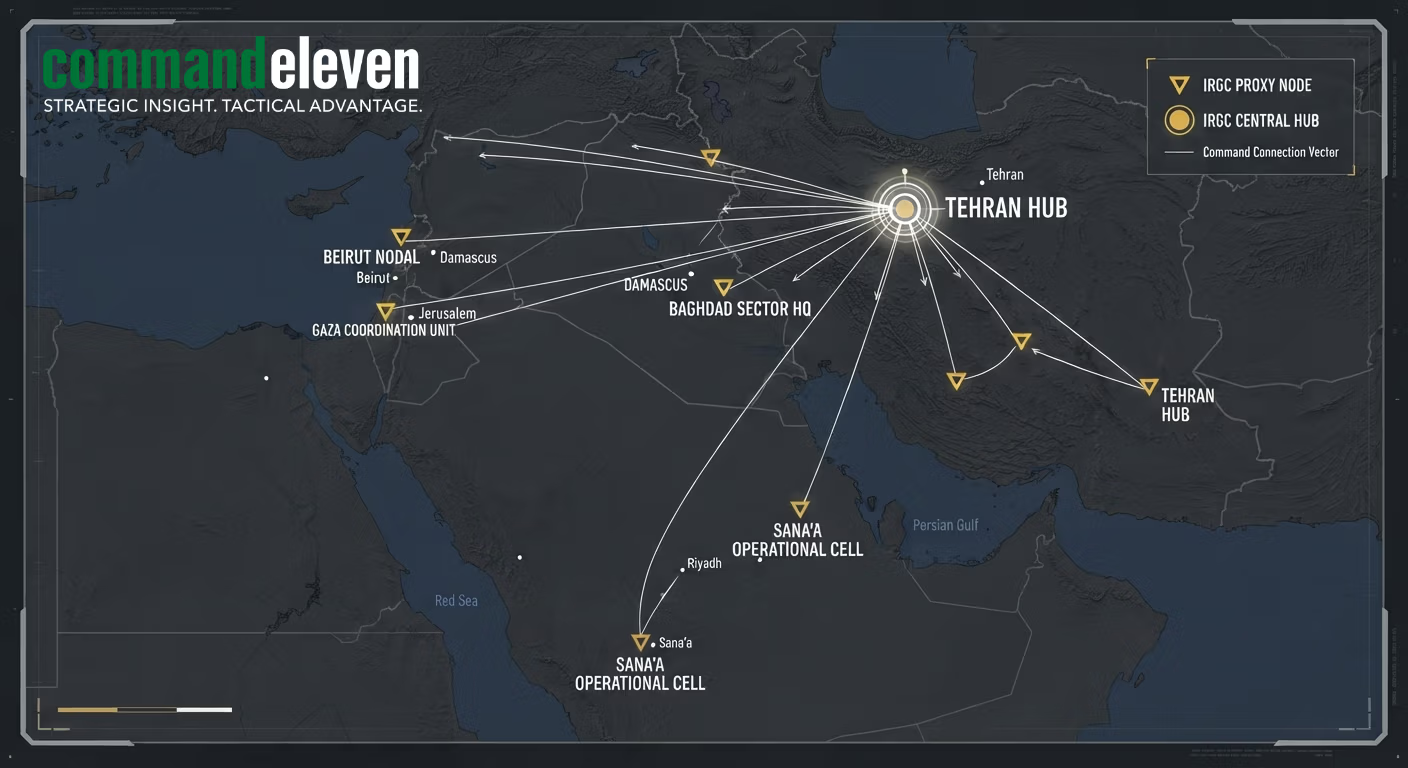
Executive Summary and Strategic Context
The current operational theater in the Levant and the Arabian Peninsula is characterized by a fundamental shift in Iranian strategic doctrine. The Islamic Revolutionary Guard Corps (IRGC) Quds Force has transitioned from a policy of territorial defense—focused on the preservation of sovereign geographic integrity—to a distributed, network-centric model of asymmetric attrition. This “Forward Defense” posture is not merely a tactical preference; it is a calculated response to the conventional kinetic superiority of regional adversaries. By institutionalizing proxy-led asymmetric attrition, Tehran seeks to neutralize adversary ISR (Intelligence, Surveillance, and Reconnaissance) coherence, disperse targeting requirements across non-linear fronts, and impose an unsustainable cost-exchange ratio on opposing forces. This dossier evaluates the structural components of this defense posture and the long-term implications for theater stability.
Infrastructure Analysis: Network Topology
Tehran’s defense architecture is defined by its modularity. Unlike conventional state-actor military structures that rely on centralized logistics and fixed command-and-control (C2) nodes, the Quds Force has optimized a decentralized network of proxies.
- Asymmetric Projection Nodes: Operational cells located in Lebanon and Yemen act as the primary kinetic friction points. These nodes are designed to maintain persistent low-intensity conflict, thereby preventing adversary consolidation of forces.
- Kinetic Absorption Layers: This layer comprises the regional geography and logistical support networks that facilitate the dissipation of incoming strike energy. By embedding military capability within diverse logistical corridors, the IRGC forces adversaries to calibrate their strike-response against the risk of escalating collateral impact.
- Logistical Obfuscation: The network utilizes “shadow” supply chain integration, where military materiel is moved alongside legitimate commercial flows. This structural embedding makes the identification of strike-worthy military nodes prohibitively resource-intensive for conventional sensors.
Cross-Theater Operational Dynamics
The synchronization of the Lebanon-Yemen axis is the linchpin of Iranian asymmetric operations. Operational intelligence suggests that the Quds Force utilizes this multi-front alignment to achieve two primary objectives:
- ISR Saturation: By maintaining concurrent operational activity in disparate theaters, Tehran forces adversary ISR assets to monitor an expansive, fragmented front. This dilution of surveillance coherence increases the probability of undetected movement and staging.
- Resource Depletion: The deployment of low-cost, mass-produced asymmetric munitions—specifically UAVs and short-range ballistic systems—is engineered to force the expenditure of high-cost precision interceptors. The fiscal disparity inherent in this exchange is a core component of Tehran’s attrition calculus, designed to degrade adversary readiness levels over an extended engagement cycle.
Adversary Cost-Benefit Assessment
From the perspective of Tehran’s adversaries, the “Forward Defense” posture creates a strategic dilemma. Conventional military action intended to degrade the network often results in minimal long-term disruption, as the decentralized nature of the proxy nodes allows for rapid reconstitution. Furthermore, the political and economic cost of sustained regional intervention to counter these networks often exceeds the perceived tactical benefit. Tehran exploits this calculus, projecting an image of resilience that discourages large-scale, direct state engagement, preferring instead to operate within the “gray zone” of regional stability.
Forecasting and Escalation Vectors
Predicting the evolution of this defense posture requires monitoring three critical indicators:
- Integration Density: The level of command integration between Quds Force facilitators and local proxy commanders. Increased integration suggests a transition toward higher-intensity, coordinated strike capabilities.
- Munition Diversity: The introduction of advanced anti-access/area-denial (A2/AD) assets into the proxy network would signify a move toward operational saturation of maritime and land corridors.
- Logistical Resilience: The ability of shadow supply chains to withstand sustained interdiction efforts will determine the network’s long-term sustainability.
Tehran’s ultimate strategic goal remains the transformation of the region into a state of permanent, managed instability. As long as this attrition cycle continues to impose significant fiscal and political burdens on adversary states, the Quds Force will continue to expand its asymmetric infrastructure. Future kinetic outcomes will not be determined by singular battlefield victories, but by the ability to endure these cycles of exhaustion. The current operational environment suggests that the IRGC is prepared to escalate the attrition tempo in response to any shift in regional power dynamics, ensuring that the burden of conflict remains squarely on the adversary’s logistical and political leadership.
Read the entire series:
- Strategic Depth and Asymmetric Attrition
- The Logistics of Resilience: Iran’s Shadow Supply Chain
- Asymmetric Network Integration: Lebanon and Yemen
- The Information War: US vs. Iran (Cognitive Warfare)
- EW and RF Spectrum Contention: Iranian Defensive Architectures
- Strike Back Capabilities and Escalation Potential
Additionally, CommandEleven Intelligence has published a 6 part Deconstruction of the IRGC breaking down their internal and external operations, as well as front companies, money laundering and trans-shipment structures.