
Bottom Line Up Front
The last US forces under Operation Inherent Resolve left Iraq on September 30, 2026. Washington called it “a decisive victory over ISIS.” ISIS, and its supporters, read it differently. On September 24, the group’s weekly al-Naba declared a “great victory” and said the return of the “caliphate” was “on the horizon,” urging more attacks while its enemies are divided. ISIS supporters online have celebrated the US departure as a victory for jihad, and MEMRI reports a further al-Naba editorial describing the withdrawal as the start of a new phase in the struggle to restore the caliphate.
ISIS in Iraq is at a historic low in claimed attacks: 16 in all of 2025, down from 1,459 in 2020. But it claimed five attacks in the first three weeks of September 2026, more than in the previous eight months combined, and the warning signs that preceded its last rebuild, killings of informants and village notables, infrastructure sabotage and prison trouble, are reappearing.
CommandEleven Intelligence assesses that ISIS will treat the US exit as a recruitment and propaganda gift globally and as an operational opening in Iraq, with the 5,700 detainees transferred from Syria in January the single largest risk. The precedent is uncomfortable: the 2011 withdrawal was followed three years later by the fall of Mosul. [ASSESSED]
Key Judgments
KJ1: ISIS’s leadership is framing this period as a turning point. The September 24 al-Naba editorial, “Show God the Good in Your Deeds,” called it a “great victory” and placed the caliphate’s return “on the horizon.” Supporters explicitly link that message to the US withdrawal. [CONFIRMED on the editorial; ASSESSED on intent]
KJ2: The network in Iraq is weak in attacks but intact underneath. Arrests of ISIS suspects have fallen more slowly than attacks (about 4.5 a month since late 2024, against 5.6 in 2023–24), which means the network persists below the threshold of violence. [ASSESSED, based on Washington Institute data]
KJ3: The detainees are the biggest single risk. More than 5,700 ISIS-linked men were moved from northeast Syria into Iraqi prisons in January. Reported problems already include guards selling phones to inmates and inmates trying to revive cells. [CONFIRMED on the transfer and reported problems; ASSESSED on risk]
KJ4: The withdrawal’s propaganda value reaches far beyond Iraq. A June video from ISIS’s Sahel “province” told detainees “we shall meet soon in Baghdad.” A US exit framed as retreat strengthens ISIS’s recruiting narrative in Africa, Afghanistan and online. [ASSESSED]
KJ5: Iraq’s forces can fight ISIS alone, but not see it alone. Iraqi forces have shown they can run counter-ISIS operations independently, but much of their capability rested on US intelligence, surveillance and strike support that is now further away. [ASSESSED]
What ISIS Is Saying
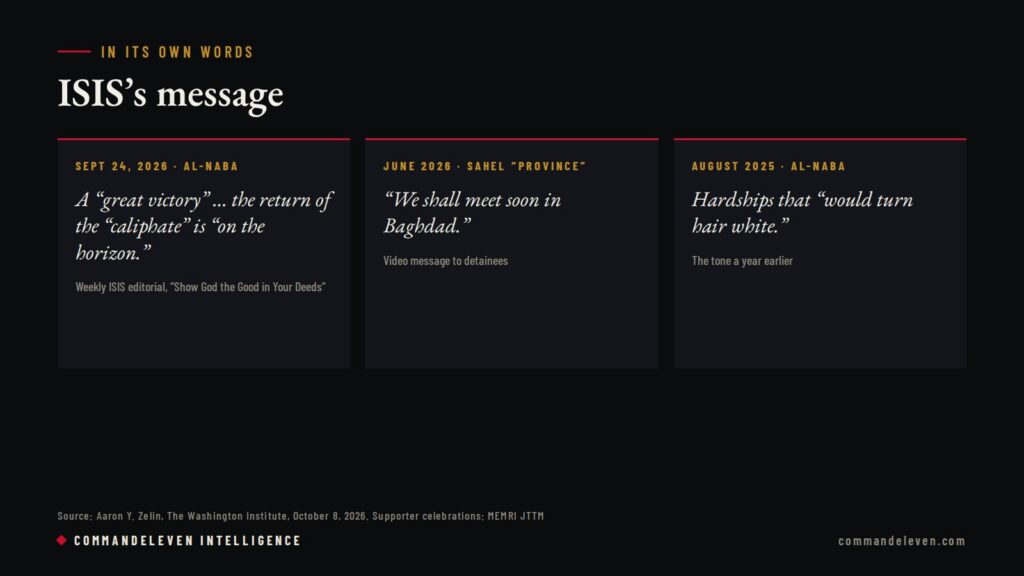
- September 24, al-Naba: a “great victory”; the “caliphate” is “on the horizon”; more outreach and attacks while enemies are divided. The editorial did not name the US withdrawal, but supporters tied it to it.
- Supporters online: ISIS supporters celebrated the US departure as a victory for jihad, according to MEMRI’s Jihad and Terrorism Threat Monitor.
- Withdrawal editorial: MEMRI reports an al-Naba editorial presenting the withdrawal as ushering in a new phase of the struggle to establish the caliphate. [Reported by MEMRI; full text to be verified]
- Contrast with 2025: an al-Naba editorial in August 2025 read like a eulogy, lamenting hardships that “would turn hair white.” The tone has changed.
The Numbers Behind the Rhetoric
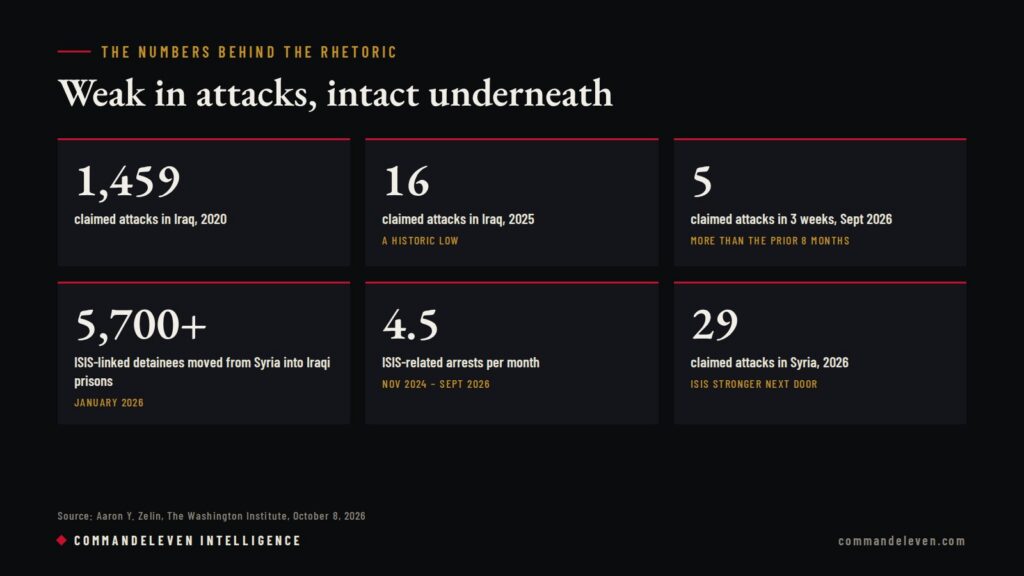
- Attack claims in Iraq: 1,459 (2020) to 16 (2025).
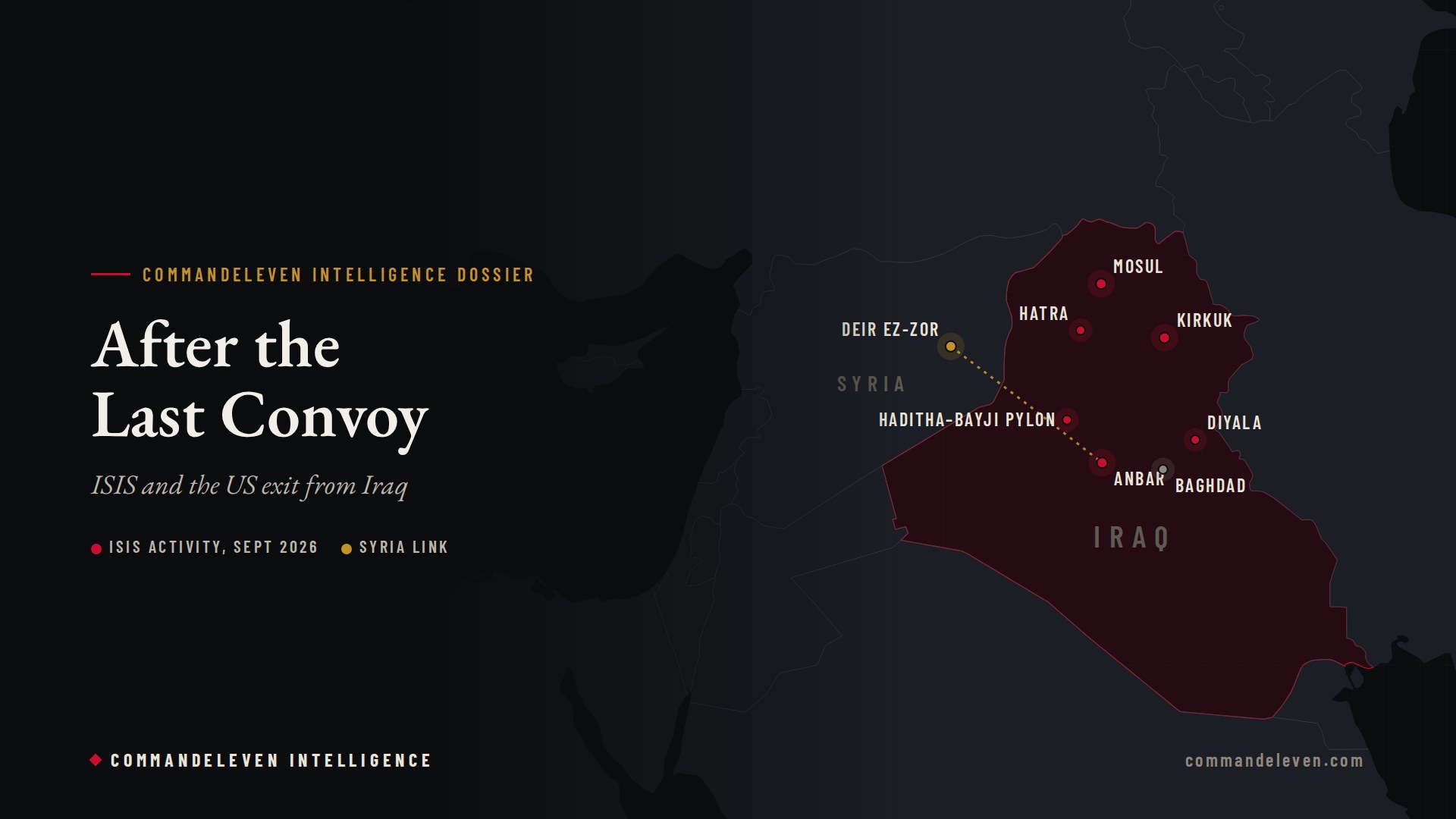
- September 2026: five claimed attacks in three weeks, including against forces in Kirkuk and Anbar and a power pylon between Haditha and Bayji. More activity was reported around Mosul, Hatra, Diyala, Halabja, Sulaymaniyah and Altun Kupri.
- Arrests: about 4.5 a month (November 2024 to September 2026), about a quarter of them now in the Kurdistan Region.
- The attacker profile is changing: caliphate-era veterans, suicide-belt operatives, an Anbar cell producing explosive drones, young people radicalized online, and Syrian nationals.
- Syria: ISIS remains stronger there, with 29 claimed attacks this year, and the Iraq and Syria “provinces” remain administratively linked. Days before Iraq’s foreign minister warned on October 1 that ISIS fighters could cross from Syria, Syrian authorities said they had dismantled an ISIS cell operating across four provinces.
What the US Exit Changes
What leaves. The coalition’s task force headquarters moved to Jordan. US forces left al-Tanf in Syria in February. Iraq’s military spokesman said that after September 30 “not a single foreign soldier will remain anywhere in Iraq,” including the Kurdistan Region.
What stays. CENTCOM says US and coalition forces across the region remain ready to respond to ISIS threats; counter-ISIS operations continue in Syria; and Baghdad plans a bilateral security relationship with Washington, though training and intelligence-sharing arrangements have not been worked out.
What fills the space. Iran-backed militias read the exit as their victory. Kataib Hezbollah threatened to shoot down “hostile” aircraft, and the deadline for militias to disarm has slipped to June 2027. Sectarian militias policing Sunni areas are one of the grievances ISIS has always fed on. [ASSESSED]
The wider force-posture picture is in the companion dossier Project Meridian Meets Fort Irwin.
The Precedent CommandEleven Intelligence Has Seen Before
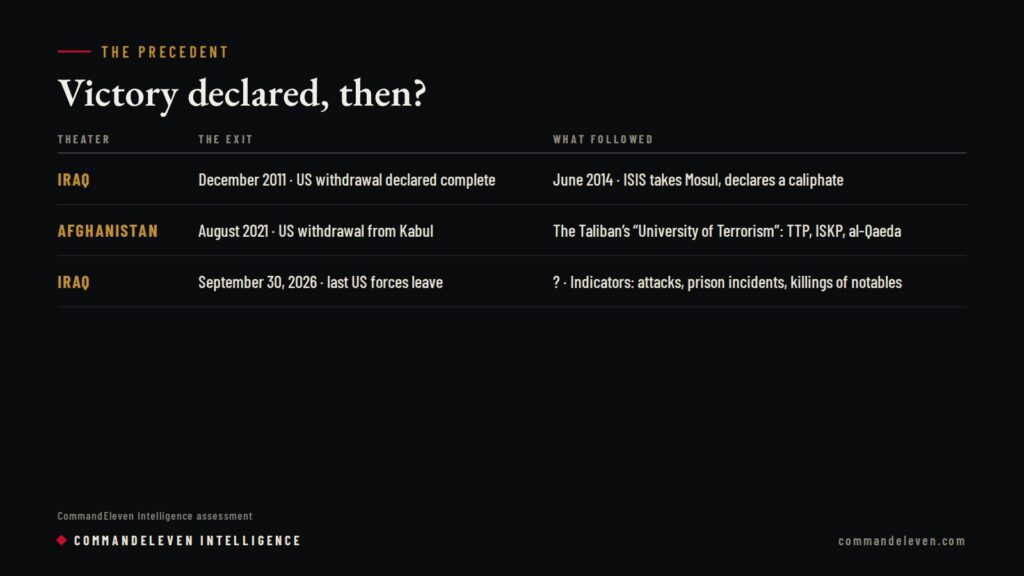
Twice before, a US withdrawal was declared a victory and followed by a resurgence. After the December 2011 exit from Iraq, ISIS seized Mosul and declared a caliphate within three years. After August 2021 in Afghanistan, the Taliban’s return turned the country into what CommandEleven Intelligence has repeatedly called the University of Terrorism, with the TTP, ISKP and al-Qaeda all operating from its soil. CommandEleven Intelligence warned in November 2023, in Regional Insecurity: Assessing Cross-Border Terror Risks, that ISKP camps would “with time” be used to attack regional states.
Iraq in 2026 is not Iraq in 2011: its forces are more capable, ISIS is far weaker, and Damascus now treats ISIS as an enemy. But the pattern of victory declared, attention moved elsewhere and a network left to rebuild in the gaps is the one to watch. [ASSESSED]
Implications for Global Terrorism
- Propaganda. The withdrawal gives ISIS’s global media a “the Americans left” story at the moment its Sahel and Khorasan branches are its most active. Expect it in recruitment material across Africa, Central and South Asia, and online. [ASSESSED]
- The prisoners. A mass break-out or a successful revival of cells inside Iraqi prisons would be the fastest route back to capability, as the 2012–13 “Breaking the Walls” campaign showed. [ASSESSED]
- The Iran war’s distraction. With US, Iraqi and militia attention on the war with Iran, ISIS’s operating space grows in the Anbar–Deir ez-Zor desert corridor and Syria’s Badia, the hardest areas to monitor. [ASSESSED]
Indicators to Watch
- Claimed attacks in Iraq rising above September’s pace.
- Killings of informants and village notables, the signature of the 2019–20 rebuild.
- Prison incidents, especially involving the detainees transferred from Syria.
- Infrastructure sabotage on power lines and pipelines.
- Cross-border movement from Syria into Anbar and Nineveh.
- ISIS global media using the withdrawal in non-Arabic propaganda.
What This Dossier Does Not Claim
- It does not claim ISIS is close to retaking territory in Iraq. Its attack rate remains near historic lows.
- It does not claim the US withdrawal was a mistake; it assesses the risks the withdrawal creates.
Frequently Asked Questions
When did US troops leave Iraq?
The last US forces under Operation Inherent Resolve left on September 30, 2026, ending the counter-ISIS mission that began in 2014. The coalition task force’s headquarters moved to Jordan.
How did ISIS react to the US withdrawal?
ISIS’s weekly al-Naba declared a “great victory” on September 24 and said the caliphate’s return was “on the horizon.” Supporters online celebrated the departure as a victory for jihad.
How strong is ISIS in Iraq now?
Its claimed attacks fell from 1,459 in 2020 to 16 in 2025, but it claimed five in the first three weeks of September 2026, more than in the previous eight months combined.
What is the biggest risk?
The more than 5,700 ISIS-linked detainees moved from Syria into Iraqi prisons in January 2026, where problems including smuggled phones and attempts to revive cells have already been reported.
Sources
- The Islamic State in Iraq After the U.S. Withdrawal, Aaron Y. Zelin, The Washington Institute for Near East Policy, October 8, 2026
- ISIS Editorial Comments On U.S. Withdrawal From Iraq, MEMRI JTTM
- ISIS Supporters Celebrate US Withdrawal Of Iraq, MEMRI JTTM
- US forces complete departure from Iraq as anti-Islamic State mission in Iraq ends, FDD’s Long War Journal, September 30, 2026
- Iraq sounds alarm on terror threat from Syria a day after US troops leave, Fox News, October 2, 2026
- With end of US’s Operation Inherent Resolve in Iraq, counter-ISIS burden shifts, The Jerusalem Post (The Media Line), October 8, 2026
- US Completes Iraq Withdrawal as Iran Allies Celebrate, Experts Warn of ISIS Resurgence, The Media Line, September 30, 2026

