
Bottom Line Up Front
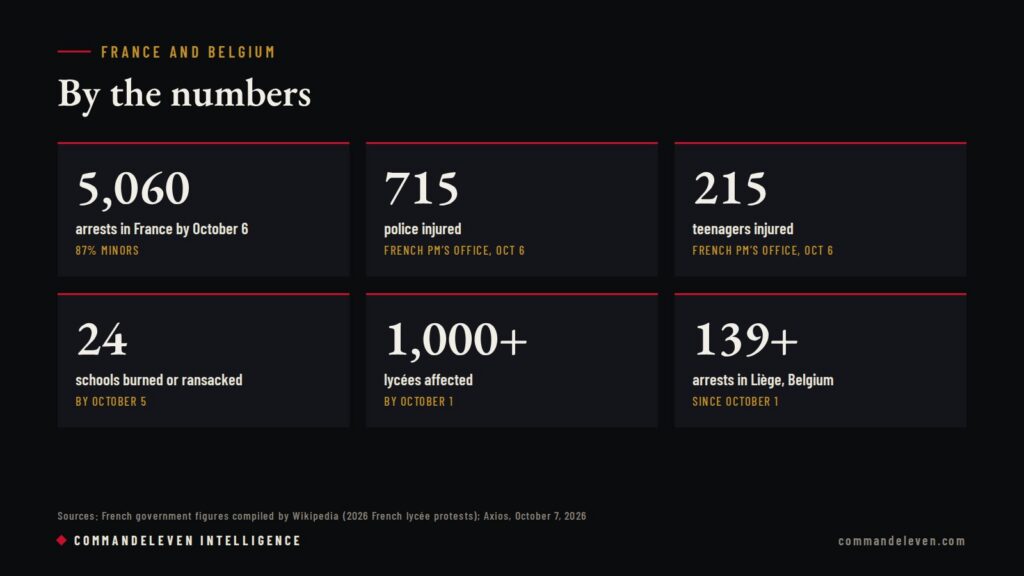
What began on September 21 as a protest by students at one lycée in Créteil, outside Paris, over overcrowded classes and missing teachers has become a nationwide wave of violent unrest that has crossed into Belgium. By October 6, French authorities reported more than 5,000 arrests (87% of them minors), 715 police and 215 teenagers injured, and 24 schools burned or ransacked. Head teachers have been hit by fireworks mortars, school staff splashed with petrol, and a police officer in Belfort beaten badly enough that prosecutors opened an attempted-murder investigation.
The grievances are real, and many French voters say so. But the pattern of the violence, the political organization behind it and the symbols on display point to something more than a school protest. CommandEleven Intelligence assesses that a significant part of this movement has moved from protest to organized political violence, and should be treated by security services as a domestic extremism problem rather than an education dispute. [ASSESSED]
The next test is Saturday, October 17, when students, the returning Yellow Vests and parts of the left are calling for a nationwide “general mobilization.” This report sets out what to watch, and CommandEleven Intelligence will score it afterward.
Key Judgments
KJ1: The violence is organized, not spontaneous. Copycat school blockades spread through social networks within days, and French intelligence services were reported by the prime minister’s office on October 1 to describe the movement as “an operation organised by” La France Insoumise (LFI). About 20 national LFI office-holders took part on September 29, according to the prime minister’s office. [ASSESSED, based on French government statements]
KJ2: Targeting school staff and police moves this past protest. Burning schools, firing mortars at head teachers and pouring petrol near staff are attacks on people and public institutions to force political outcomes, not acts of protest. [ASSESSED]
KJ3: The symbols show a political movement, not a school one. Palestinian flags, Soviet hammer-and-sickle flags, Antifa flags and banners reading “Against imperialist wars” and “Class war” have appeared at marches, alongside LFI and French Communist Party flags. [CONFIRMED that they were displayed; ASSESSED on meaning]
KJ4: Foreign amplification is documented; foreign funding is not. A Fox News Digital analysis found BreakThrough News, an outlet funded by the US-born, Shanghai-based businessman Neville Roy Singham, amplifying the protests, and France has formally rebuked Iran for a “disinformation campaign” about them. No money trail from Singham’s network to French organizers has been publicly documented. [CONFIRMED on amplification and the Iran rebuke; SPECULATIVE on funding]
KJ5: October 17 is a convergence point, which is what makes it dangerous. Students, the decentralized Yellow Vests and parts of the left are converging on the same date, with no single organizer accountable for its conduct. [ASSESSED]
How It Escalated
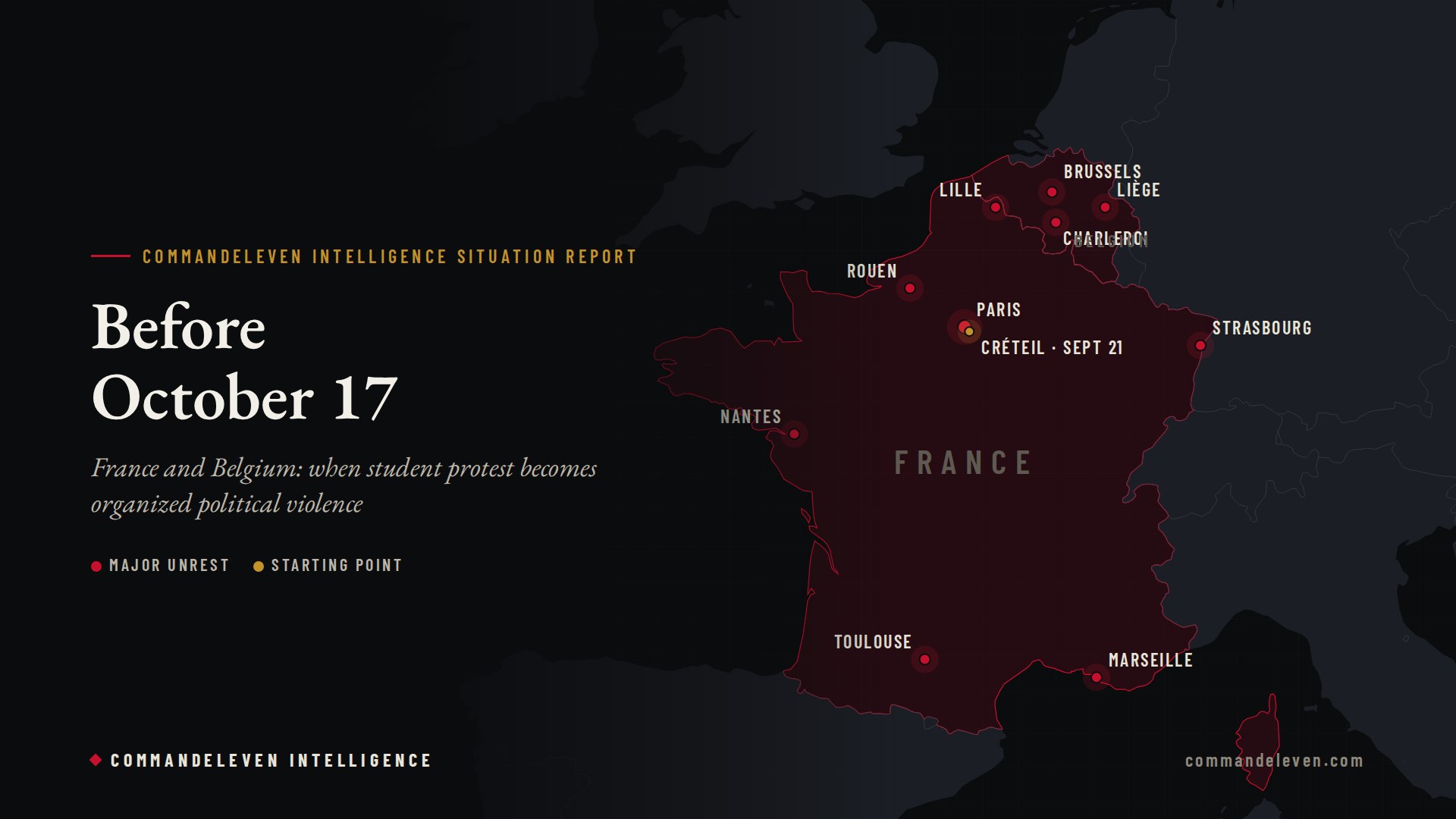
France. A teachers’ strike on September 17 was followed on September 21 by the first lycée protest in Créteil. Within a week the movement had spread to roughly 180 schools; by October 1, more than 1,000 lycées were affected and university students had joined. Arson hit lycées in Paris, Meaux, Nantes, Lille, Rouen, Marseille, Avignon and Toulouse. Interior Minister Laurent Nuñez ordered police to use all available intermediate weapons; a 15-year-old in Lens lost a hand to a police stun grenade, and at least ten cases of alleged police violence have been referred to the police inspectorate. Prime Minister Sébastien Lecornu has called the violence unjustifiable.
Belgium. Protests began in Liège on October 1, aimed at the French-speaking community’s education minister, Valérie Glatigny, and spread to Mons, Charleroi and Brussels. Liège-Guillemins station was closed by riots on October 7, with at least 139 arrests in Liège. On October 9, police and youths clashed in Brussels during a union-backed anti-austerity march.
Beyond. Students in Italy occupied schools under the slogan “Let’s do as in France,” and actions spread to Greece, Austria and Ireland. Axios reported that these are not one coordinated European movement, but they share a model and grievances: overcrowded schools and budget cuts, as France and Belgium each run deficits above 5% of GDP.
The Case for a Domestic-Extremism Lens
French authorities have treated this as public disorder. CommandEleven Intelligence assesses that this is no longer adequate, for three reasons:
- The targets. Schools, head teachers, teachers and police officers are being attacked to force a political outcome. That is the core of how political violence is defined.
- The organization. Blockades spread through coordinated social-media calls, with a political party’s elected officials involved, according to the prime minister’s office. One activist arrested in Saint-Denis said October 17 would be “a thousand times worse than the Yellow Vests.”
- The ideology on display. The flags and banners belong to anti-system and revolutionary movements, not to education campaigns.
The counter-case, stated fairly. A Figaro poll found 62% of French respondents consider the movement justified, and the grievances over school conditions are real and documented. Most of those arrested are minors, and many protests have been peaceful. The domestic-extremism lens applies to the organized violent core, not to every student who walked out of class. [ASSESSED]
The Foreign Dimension
- Amplification (documented). A Fox News Digital analysis published October 9 identified 50 organizations involved in the French protests and found BreakThrough News amplifying them. Singham’s funding of US activist groups, including The People’s Forum and CodePink, was documented by The New York Times in 2023.
- Funding (not documented). Reports that Singham’s network is funding the French unrest are unconfirmed. The Fox analysis shows overlapping amplification and coverage, not money reaching French organizers. CommandEleven Intelligence treats a funding link as a hypothesis to test, not a finding. [SPECULATIVE]
- Iran. France formally rebuked Iran for a “disinformation campaign” about the protests. [CONFIRMED]
Indicators for October 17 (Foresight Entry)
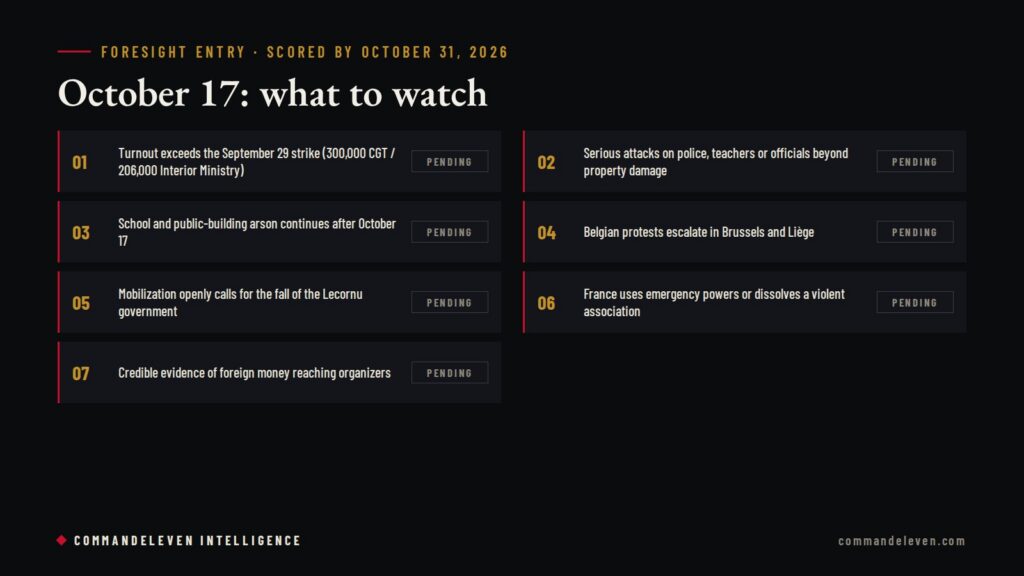
CommandEleven Intelligence will score these by October 31, 2026:
- Turnout. Does October 17 exceed the September 29 public-sector strike (about 300,000 by the CGT’s count, 206,000 by the Interior Ministry’s)?
- Violence against people. Are there serious attacks on police, teachers or public officials, beyond property damage?
- Arson. Do school or public-building arsons continue after October 17?
- Belgium. Do Belgian protests escalate on or around October 17, especially in Brussels and Liège?
- Political demands. Does the mobilization openly call for the fall of the Lecornu government, moving from education to regime-change politics?
- State response. Does France use emergency powers or designate any group under its laws against violent associations?
- Foreign funding. Does any credible evidence of foreign money reaching French or Belgian organizers emerge?
What This Report Does Not Claim
- It does not claim that the student protests as a whole are terrorism, or that most participants support violence.
- It does not claim that Neville Roy Singham or any foreign actor is funding the unrest.
- It does not take a position on French or Belgian education or budget policy.
Frequently Asked Questions
Why are students protesting in France?
The protests began on September 21, 2026, at a lycée in Créteil over overcrowded classes, missing teachers and university admission stress, and spread nationwide within days.
How many people have been arrested?
By October 6, French authorities reported more than 5,000 arrests, 87% of them minors. Belgium reported at least 139 arrests in Liège alone.
What is happening on October 17?
Students, the Yellow Vests movement and parts of the left are calling for a nationwide “general mobilization” on Saturday, October 17, over the cost of living, the 2027 budget and school conditions.
Is a foreign network funding the protests?
A US-based outlet funded by Neville Roy Singham has amplified the protests, and France has rebuked Iran for disinformation about them. No foreign funding of French organizers has been publicly documented.
Related CommandEleven Intelligence Coverage
- The US Domestic Threat Landscape (series, including left-wing violent extremism and Europe as the leading indicator)
- Synthesis: Mobilization, Financing, and the Shape of the Domestic Threat – Part 5
Sources
- 2026 French lycée protests, Wikipedia (timeline compiled from Le Monde, AFP, Le Figaro and French government statements)
- Student protest unrest hits France, Belgium, other EU countries, Axios, October 7, 2026
- October 6, October 17: is France set for a month of protests?, The Connexion, October 5, 2026
- Behind France’s student riots: communists, unions and a global propaganda network, Fox News Digital, October 9, 2026
- Thousands rally for anti-austerity protest in Brussels amid clashes, Al Jazeera, October 9, 2026
- Protesters clash with police in Brussels as unions and students march, Reuters via The Star, October 9, 2026
- France braces for mass October 17 protests, Daily News Egypt, October 10, 2026

