
Bottom Line Up Front
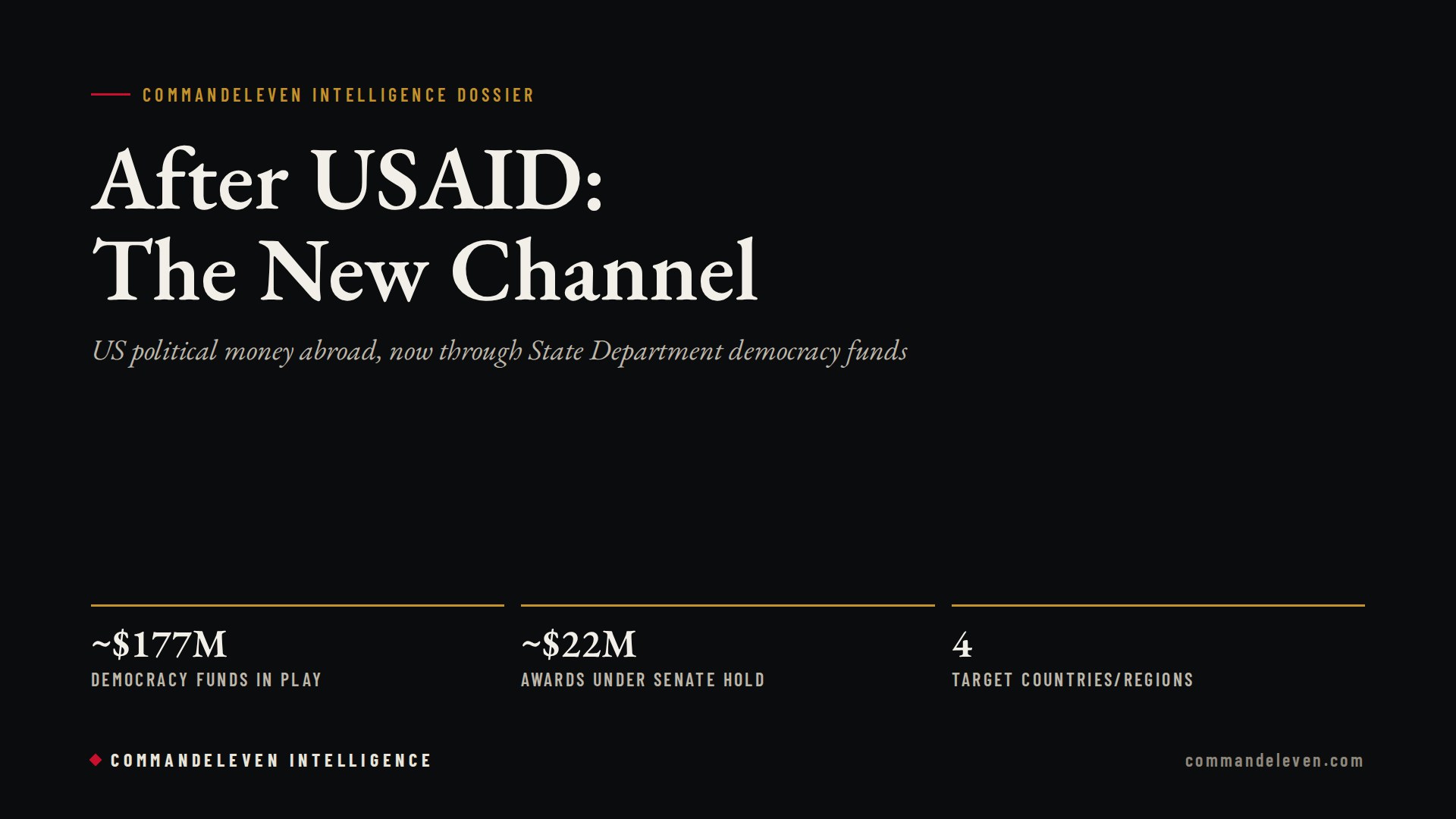
The Trump administration dismantled USAID in 2025, arguing that US foreign aid had been used to push political agendas abroad. In the last days of the 2026 fiscal year, the State Department used a different pot of money to do something similar in the other direction. On October 2, CNN reported that the department directed millions from nearly $177 million in Democracy Funds, money appropriated for human rights work, to causes aligned with the administration’s politics: a program against alleged judicial overreach and censorship in Brazil, Afrikaner rights in South Africa, the alleged persecution of Christians in Nigeria, and a $5 million “civilizational alliance” and anti-migration work in Europe. Secretary of State Marco Rubio reportedly signed off despite congressional holds on about $22 million of the awards. [CONFIRMED as reported]
The State Department says it met its notification requirements and frames the grants as defending free speech and Western civilization. Brazil read it as interference: days before its October 5 first round, its attorney general asked police to investigate. The Federal Police archived the request on October 7, finding no minimal evidence of a crime. [CONFIRMED]
CommandEleven Intelligence assesses that the channel changed, not the practice: Washington still funds political outcomes abroad, now through State Department democracy money aimed at established democracies rather than USAID programs aimed at fragile ones. Two of the four target countries are founding BRICS members, which hands Brasília and Pretoria a sovereignty argument they are already using. [ASSESSED]
Key Judgments
KJ1: The money is real, the effect is not yet shown. The grants, their amounts and their political direction are documented. No evidence has shown that any of the money reached Brazilian candidates or changed a vote. [CONFIRMED on the grants; no evidence of election impact]
KJ2: This is a departure in where democracy money goes. Democracy Funds have typically supported civil society in authoritarian or weakly democratic states. These awards target established democracies and US allies. [CONFIRMED as reported; ASSESSED on significance]
KJ3: Brazil is the sharpest case. The Brazil grant targets the Supreme Court whose justice, Alexandre de Moraes, Washington sanctioned and which convicted Jair Bolsonaro. It arrived as his son, Flávio Bolsonaro, led the first round 47% to 45% ahead of the October 25 runoff. [CONFIRMED on facts; ASSESSED on timing]
KJ4: The BRICS dividend. Lula has made sovereignty a central campaign theme, and South Africa has long accused Washington of misrepresenting the Afrikaner issue. US funding aimed at both governments’ domestic politics strengthens the BRICS case that the US uses its financial reach as a political weapon. [ASSESSED]
Where the Money Went
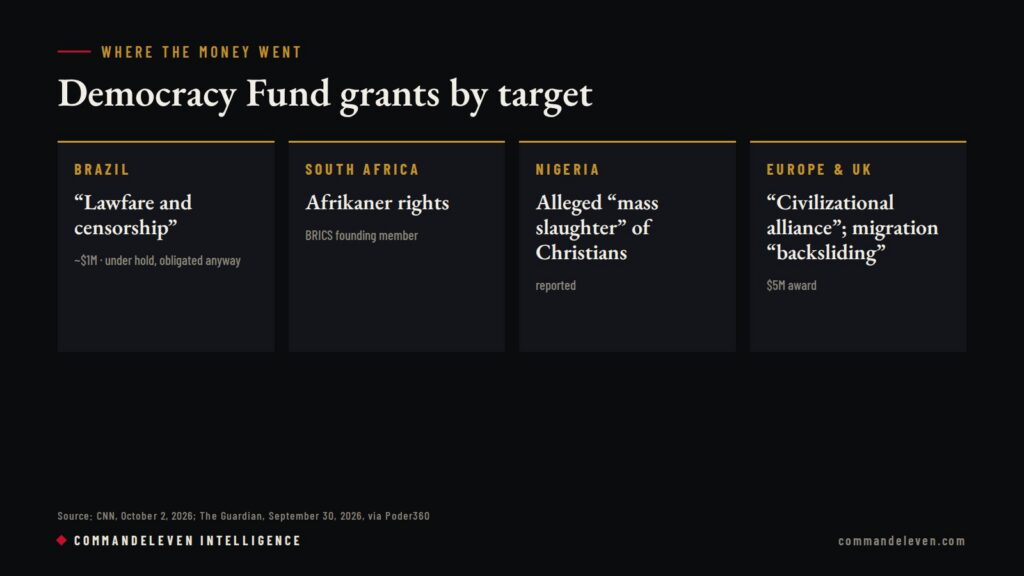
Source: CNN, October 2, 2026; The Guardian, September 30, 2026, via Brazilian reporting. The Guardian put the total redirected to conservative initiatives at more than $175 million.
Brazil: The Probe That Wasn’t
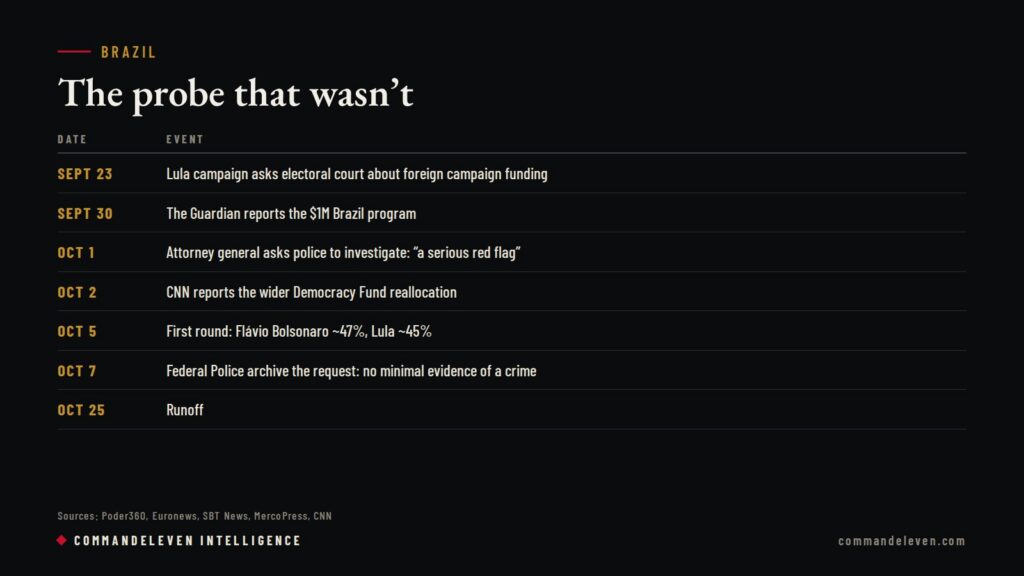
- September 23: Lula’s campaign asks the electoral court to examine possible foreign funding of the 2026 campaign.
- September 30: The Guardian reports the $1 million Brazil program.
- October 1: Attorney General Jorge Messias asks the Federal Police and prosecutors to investigate, calling the report “a serious red flag regarding Brazilian sovereignty.”
- October 2: CNN reports the wider Democracy Fund reallocation.
- October 5: First round: Flávio Bolsonaro about 47%, Lula about 45%. The Federal Police director says the agency will look into the case.
- October 7: The Federal Police archive the request before opening an inquiry, citing no minimal evidence of wrongdoing.
- October 25: Runoff.
The archiving matters: Brazil’s own police found nothing criminal to investigate. That does not settle whether the funding is appropriate; it settles only that, as of now, no Brazilian law is known to have been broken. [CONFIRMED]
The Channel Changed, the Practice Did Not
The 2025 case against USAID was that US taxpayer money was being used to advance one political vision abroad. The Democracy Fund grants apply the same tool to a different vision. For governments on the receiving end, the distinction is not about which side benefits; it is that Washington is again funding one side of their domestic politics. [ASSESSED]
The difference is the target. USAID-era democracy work concentrated on fragile states and authoritarian systems. These grants focus on the courts, elections and migration debates of democracies, including allies in Europe, which is why the Senate Foreign Relations Committee’s top Democrat, Jeanne Shaheen, called it harmful to relations with European allies. [CONFIRMED on the statement]
Why It Feeds the BRICS Argument
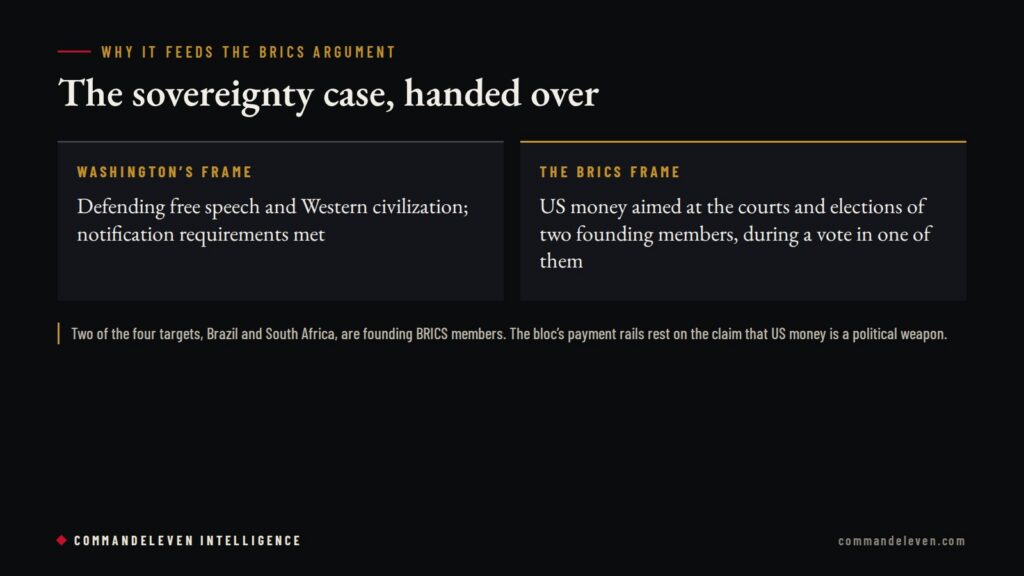
The BRICS+ series has tracked how the bloc builds payment rails to escape US financial leverage. That project rests on a political claim: that Washington uses its money and its financial system to coerce other states. The Democracy Fund grants give that claim a fresh, documented example in two founding members, during an election in one of them. Expect it in BRICS messaging, and in Brazil’s runoff. [ASSESSED]
Indicators to Watch
- Brazil’s runoff on October 25, and whether either campaign or any court revisits the US funding.
- Grant recipients: any public disclosure of who received the Brazil, South Africa and Europe awards.
- Congress: Senate action on the holds the State Department overrode.
- BRICS statements: whether Brasília or Pretoria raises the grants in BRICS or UN forums.
- European reaction: official responses to US-funded programs on migration and “civilizational” themes.
What This Dossier Does Not Claim
- It does not claim US money reached Brazilian candidates or affected the election. Brazil’s police found no evidence of a crime.
- It does not claim the grants are illegal under US law; the State Department says it met its notification requirements.
- It does not take a side on the causes the grants fund. It assesses how foreign governments will read them.
Frequently Asked Questions
What are the State Department’s Democracy Funds?
Money appropriated by Congress for human rights and democracy programs abroad, typically in authoritarian or weakly democratic countries.
What did the State Department fund in 2026?
According to CNN, it directed millions from nearly $177 million in Democracy Funds to programs in Brazil, South Africa, Nigeria and Europe aligned with the administration’s priorities, including about $1 million for a program on “lawfare and censorship” in Brazil.
Did Brazil investigate US election interference?
Brazil’s attorney general asked police to investigate on October 1, 2026. The Federal Police archived the request on October 7, finding no minimal evidence of wrongdoing.
How does this relate to USAID?
USAID was dismantled in 2025 amid claims it funded political agendas abroad. The 2026 grants show US political funding abroad continuing through the State Department instead.
Related CommandEleven Intelligence Coverage
- BRICS+ and the Parallel Financial Order: A CommandEleven Intelligence Series
- BRICS+ Expansion and Financial Architecture: India 2026 – Part 3
- BRICS+ Financial Architecture & De-Dollarization – Part 4
Sources
- Trump administration shifts funds from human rights to supporting far-right causes, Jennifer Hansler, CNN (via KEYT/CNN Newsource), October 2, 2026
- Brazil launches probe into alleged Trump administration plan to fund far-right causes, Euronews, October 2, 2026
- Governo Lula pede investigação sobre verba dos EUA à “extrema direita” (in Portuguese), Poder360, October 1, 2026
- PF arquiva pedido sobre interferência dos EUA nas eleições (in Portuguese), SBT News, October 7, 2026
- Flávio Bolsonaro edges Lula in the first round; both head to an October 25 runoff, MercoPress, October 5, 2026

