
Bottom Line Up Front
BRICS Pay plans to test a corporate payment route in the second half of 2027 that would let banks in participating countries exchange payment instructions directly, settle in local currencies, and pay only the net difference of what they owe each other. Andrey Mikhaylishin, chief executive of JSC BRICS Pay, laid out the plan in early October. At its core is DCMS, a decentralized cross-border messaging system with no single control center, paired with a private blockchain that records mutual obligations so banks can net them.
BRICS Pay’s chief executive insists: “We don’t speak about de-dollarisation.” The design says otherwise. It targets the two chokepoints through which Washington enforces sanctions: the messaging layer that SWIFT dominates, and the correspondent-bank chain that routes trade through dollars and through banks exposed to US law. That is why CommandEleven Intelligence gives BRICS payment infrastructure heavier coverage than its current scale might suggest. [ASSESSED]
But the pilot has not been built, its savings have not been shown, and it leaves the most important vulnerability untouched: the banks that use it will still be exposed to US secondary sanctions. BRICS Pay can shorten the route around the dollar. It cannot yet make the banks on that route safe. [ASSESSED]
Key Judgments
KJ1: The 2027 pilot is the first concrete step from BRICS payment rhetoric to a corporate-grade settlement route. Earlier BRICS Pay work centered on retail and tourist payments; this targets business-to-business trade. [CONFIRMED on the plan; ASSESSED on significance]
KJ2: DCMS is aimed at the messaging layer, not the money. Banks still move the funds, convert currencies and run compliance checks; DCMS only carries the instructions. That makes it a direct alternative to SWIFT’s role, not to the banking system. [CONFIRMED on design]
KJ3: Netting is the most consequential feature. Offsetting opposite flows means fewer, smaller transfers and less need for the hard currency that settles them, which reduces how often trade must touch the dollar system at all. [ASSESSED]
KJ4: Secondary sanctions remain the binding constraint. No messaging system protects a bank from losing access to US markets. The pilot’s reach will be set less by its technology than by which banks are willing to take that risk. [ASSESSED]
KJ5: Expect a narrow start. The likely first phase is selected business routes, a limited number of banks and currencies, and commodity trade, not a switch across BRICS. [ASSESSED, consistent with the company’s own description]
What BRICS Pay Plans to Test
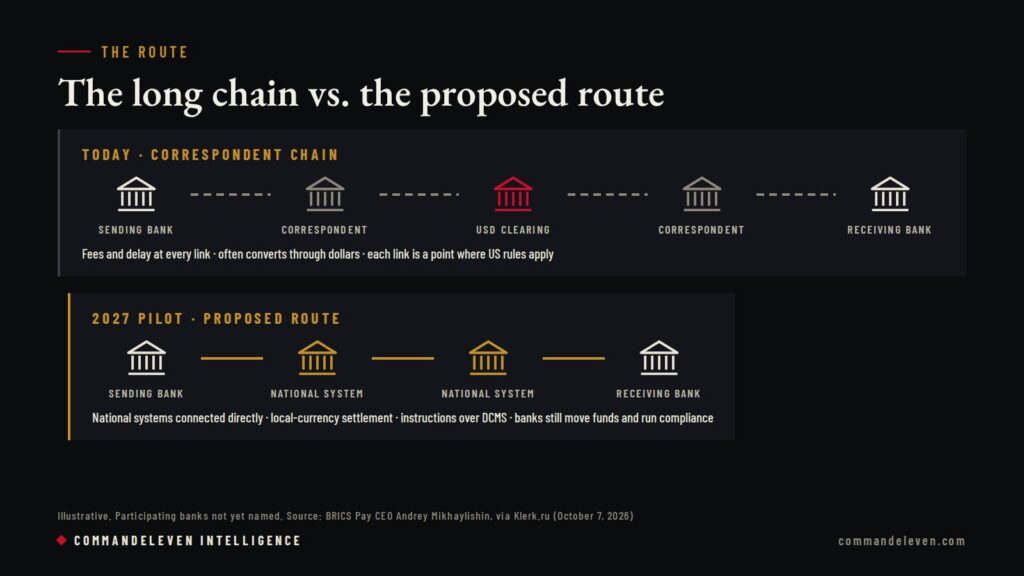
Today, a payment between a Russian fertilizer exporter and an Indian importer typically passes through a chain of correspondent banks, often converting through dollars, with each link adding fees, delays and a point where a third country’s rules apply. The proposed route:
- Connects national payment systems directly, so businesses can settle in their own currencies with fewer intermediaries.
- Runs instructions over DCMS, a decentralized interbank messaging network with no central operator.
- Records obligations on a private blockchain, so participating banks can net what they owe each other and settle only the balance.
- Leaves banks in charge of the actual transfer, currency conversion and compliance.
The expected beneficiaries are exporters of raw materials, metals, fertilizers and food; equipment importers; and transport and logistics companies, the recurring trade flows where intermediary costs pile up. [CONFIRMED on stated targets]
How Netting Changes the Math
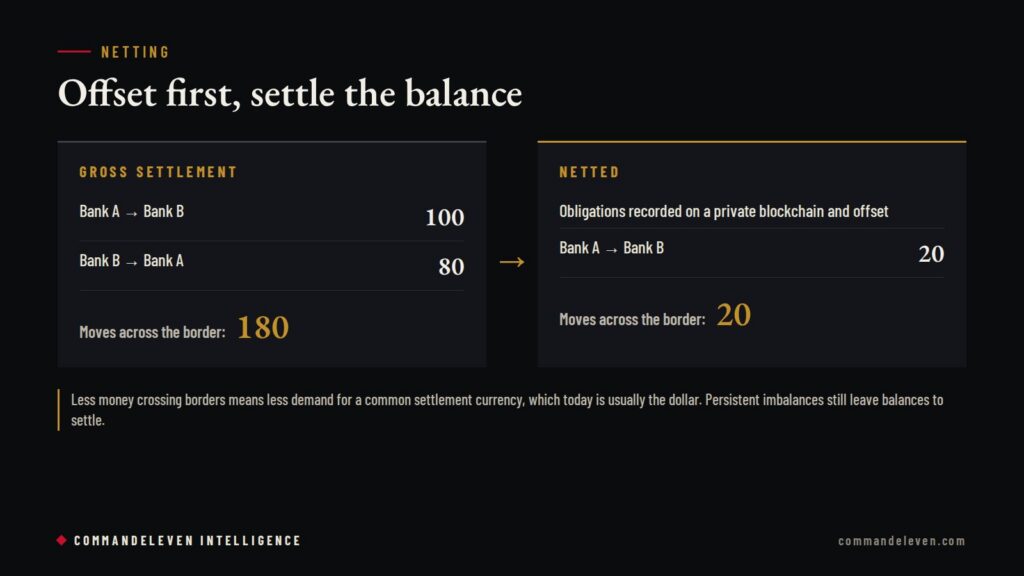
If Bank A’s clients owe Bank B’s clients 100 units this month and Bank B’s clients owe Bank A’s 80, gross settlement moves 180 units across the border. Netting moves 20. Across many banks and currencies, multilateral netting compresses the volume of money that must actually cross borders, and with it the demand for a common settlement currency, which today is usually the dollar. [ASSESSED]
This is where BRICS Pay connects to the rest of the bloc’s architecture. Netting still leaves balances to settle, and persistent imbalances, such as India’s large trade deficit with Russia, leave one side holding currency it cannot easily use. That problem does not disappear with better messaging. [ASSESSED]
What the Pilot Must Prove
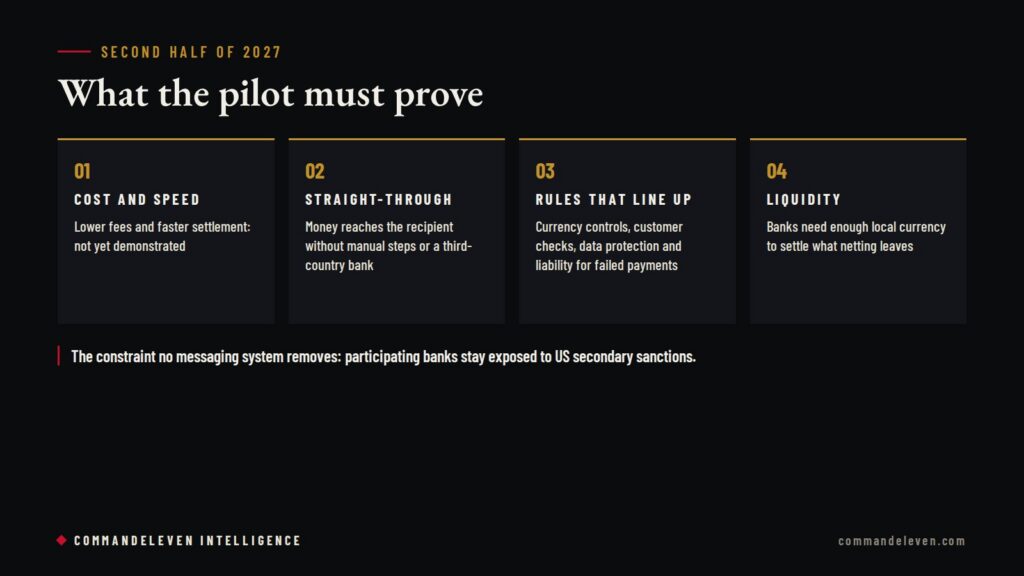
- Lower cost and faster settlement. Neither has been demonstrated for this mechanism yet.
- Straight-through processing. The practical test is whether money reaches the recipient without manual intervention or a third-country bank.
- Rules that line up. Scaling depends on compatible national platforms and agreement on currency controls, customer checks, data protection, and who is liable when a payment fails.
- Liquidity. Banks need enough of each local currency to settle the balances that netting leaves.
Digital currencies such as the digital ruble or e-CNY could eventually connect, but that requires separate regulatory decisions and technical gateways, so their inclusion in the 2027 pilot is uncertain. [CONFIRMED that it is uncertain]
Why It Matters to Washington
US financial pressure works through two layers. The first is information: who is paying whom, carried mostly over SWIFT. The second is access: the correspondent banks, and ultimately the dollar clearing system, that most international trade still passes through. Sanctions bite because a bank that deals with a sanctioned party risks losing access to both. [ASSESSED]
BRICS Pay’s design reduces the first layer and shrinks how often trade needs the second. Combined with China’s CIPS, Russia’s SPFS, India’s UPI links and the mBridge platform covered earlier in this series, it adds another piece to a parallel system that does not have to replace the dollar to weaken Washington’s leverage. It only has to give targeted states and companies a route that works often enough. [ASSESSED]
What it does not do is protect the banks. As long as the participating banks want access to US markets, the threat of secondary sanctions will limit who joins and how much flows through. The September 2026 New Delhi summit declaration reflected that caution: it backed interoperability “while respecting national priorities” and said there is “no one-size-fits-all approach.” [CONFIRMED on the declaration]
Where Part 5 Fits
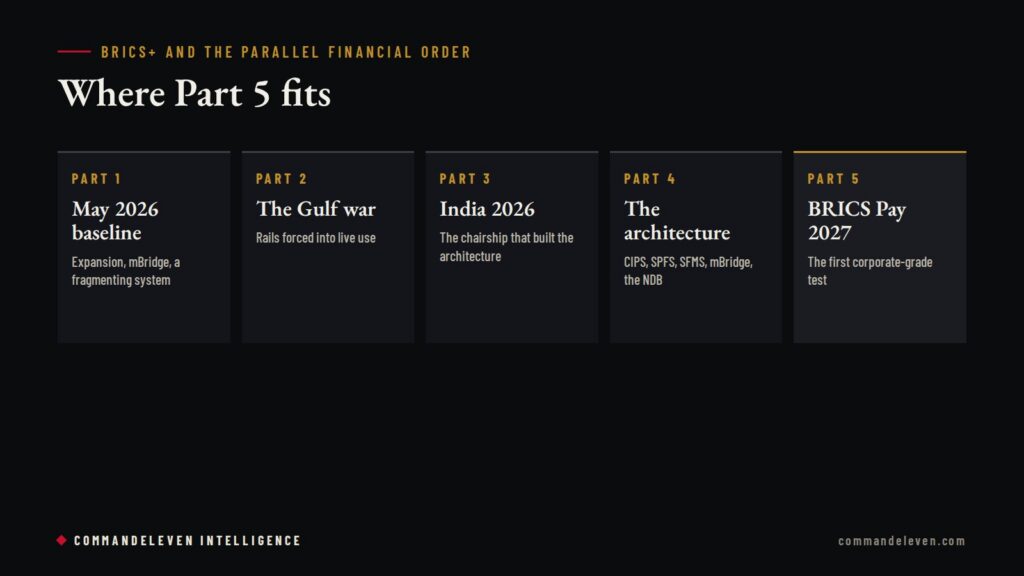
- Part 1 set the May 2026 baseline: expansion, mBridge and a fragmenting financial system.
- Part 2 showed the Gulf war forcing those rails into live use.
- Part 3 covered India’s chairship and the architecture it built.
- Part 4 mapped the institutions and rails.
- Part 5 looks ahead to the first corporate-grade test of a BRICS-wide messaging and netting route.
Indicators to Watch
- Named participants. Which banks and currencies sign up for the 2027 pilot, and whether any Indian, Chinese or Gulf bank with significant US exposure is among them.
- US response. Any Treasury guidance or designation targeting DCMS, JSC BRICS Pay or participating banks.
- India. Progress on the trilateral arrangement linking India’s UPI with Russian payment infrastructure, and India’s official stance on the pilot.
- Digital currencies. Any regulatory gateway connecting a central bank digital currency to the route.
- Proof. Published data on cost and settlement time once the pilot runs.
What This Dossier Does Not Claim
- It does not claim BRICS Pay will replace SWIFT or the dollar. Its own chief executive says that is not the aim.
- It does not claim the pilot will launch on schedule or succeed.
- It does not treat the company’s projected benefits as demonstrated.
Frequently Asked Questions
What is BRICS Pay?
A decentralized payment initiative proposed by the BRICS Business Council in 2018 to link national payment systems so trade and travel payments can be settled in local currencies. It is in pilot and phased rollout, not yet operational across all members.
What is the 2027 BRICS Pay pilot?
A planned test, in the second half of 2027, of a corporate payment route that connects national payment systems over a decentralized messaging system (DCMS) and uses a private blockchain to net banks’ mutual obligations.
What is DCMS?
The Decentralized Cross-Border Messaging System: a network that lets participating banks exchange payment instructions without a single control center. It carries instructions only; banks still move the money and handle compliance.
Can BRICS Pay avoid US sanctions?
It can reduce how often payments pass through SWIFT messaging and dollar correspondent banks, but participating banks remain exposed to US secondary sanctions if they want access to US markets.
Related CommandEleven Intelligence Coverage
- BRICS+ and the Parallel Financial Order: A CommandEleven Intelligence Series
- BRICS 2026: Expansion, mBridge, and Global Financial Fragmentation – Part 1
- BRICS+ Financial Weaponization: 2026 Gulf Conflict – Part 2
- BRICS+ Expansion and Financial Architecture: India 2026 – Part 3
- BRICS+ Financial Architecture & De-Dollarization – Part 4
- Iran Sanctions 2026: Trump’s Toolkit vs. China’s Defiance
Sources
- BRICS Pay will test settlements without a long chain of intermediary banks (in Russian), Klerk.ru, October 7, 2026, reporting the plan announced by BRICS Pay CEO Andrey Mikhaylishin
- What is BRICS Pay, and can it rival the West’s SWIFT payments system?, Al Jazeera, September 16, 2026
- BRICS Pay opens platform to more countries, eyes decentralised payment network, The Tribune (ANI), September 12, 2026
- BRICS Pay, Wikipedia (background)

