OPERATIONAL ARCHITECTURE // COGNITIVE OPERATIONS

Cognitive Operations Division

PERCEPTUAL DOMINANCE & NON-KINETIC MANEUVER //

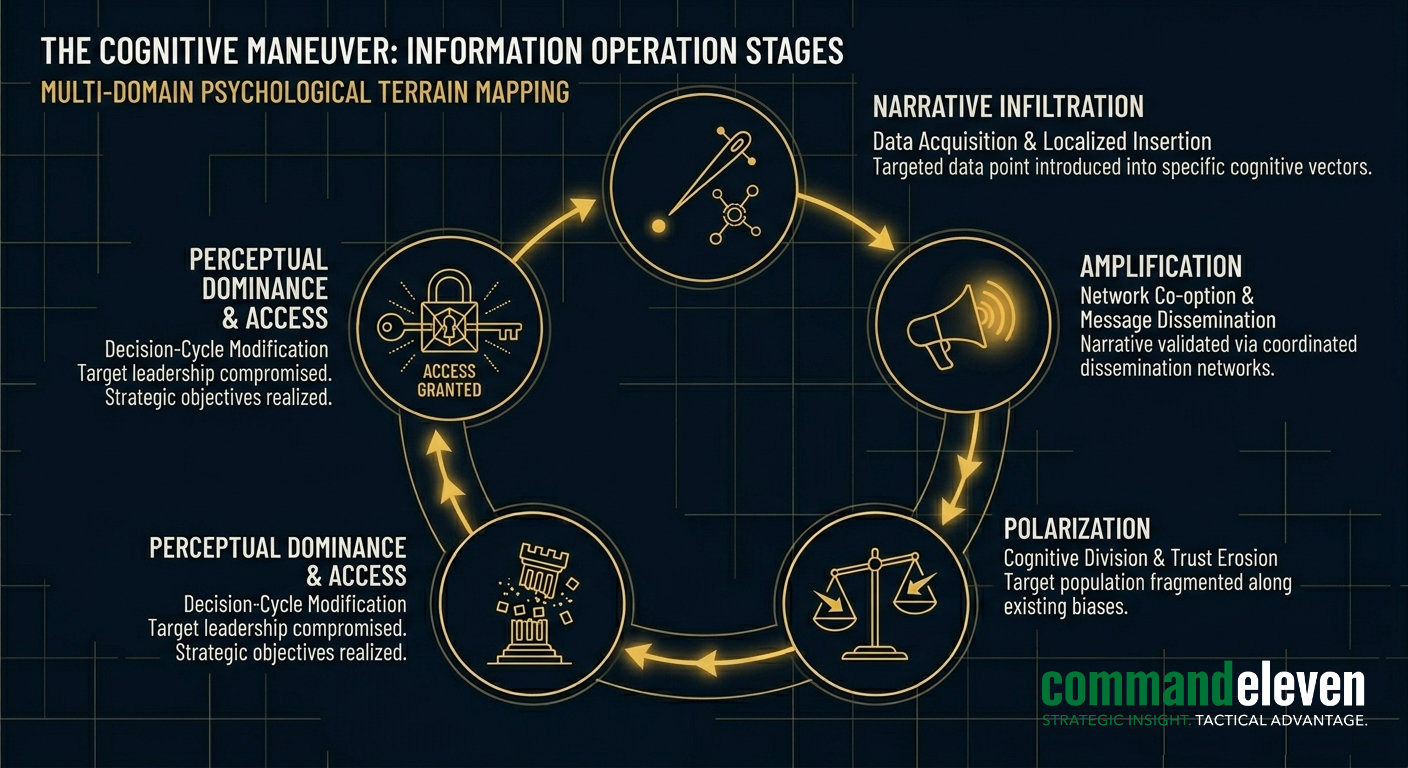
The Cognitive Operations Divsion operates at the intersection of behavioral science, informational warfare, and psychological terrain mapping. We operate on the principle of Perceptual Dominance, recognizing that in the ‘Gray Zone,’ the ultimate objective is the manipulation of the adversary’s decision-making cycle.

Our methodology focuses on the identification and neutralization of influence operations, disruptive intelligence campaigns, and non-kinetic aggression. We do not merely track data; we decode the narrative structures and cognitive biases used by state and non-state actors to destabilize regions. By synthesizing sentiment analysis with ground-truth behavioral monitoring, the Cognitive Directorate provides the tools necessary to maintain informational integrity and maneuver effectively within the cognitive domain.
COGNITIVE OPS SPECIFICATIONS //

FOCUS AREAS //

INTELLIGENCE OUTPUT //

GRAY ZONE INTELLIGENCE //

Analysis of hostile activities that fall below the threshold of open warfare. We identify the subtle synchronization of economic, legal, and informational pressure used to achieve strategic objectives.

NARRATIVE DECONSTRUCTION //

The systematic breakdown of adversarial influence campaigns. We identify core themes, dissemination vectors, and psychological triggers to develop effective counter-narrative strategies.

COGNITIVE TERRAIN MAPPING //

Mapping the psychological landscape of a target population or adversary. We quantify social cohesion, institutional trust, and susceptibility to disruptive intelligence to predict behavioral shifts.

COGNITIVE-AOR SPECIFICATION // INFLUENCE FLOW DIAGRAM

RECENT SECTOR ASSESSMENTS //

Decentralized Tile Segmentation and Frontier Geometric Engineering

The CommandEleven Mosaic Defense Architecture – Border Tile Hardening

A structural guide detailing geometric tile segmentation, autonomous tracking sensors, and cryptographic isolation architectures for permanent border persistence.
Conventional Mass Failures and Vertical Terrain Realities

The Waziristan Paradox – From Conventional Mass to Specialized COIN

An operational study on converting regular conventional infantry into high-agility small units trained to clear subterranean sanctuaries and execute tile
Topographic Friction and Natural Ingress Corridor Mapping

The Khyber-Pass Vulnerability – Kinetic Ingress Modeling

A predictive simulation of terrain friction anomalies, digital database tampering, and peer-to-peer cryptographic mesh networks within mountain defiles.
Signals Intelligence and Network Anchor Tracking

Urban Decapitation – Lessons from the CTD Punjab Offensive

An analysis of data-driven intelligence pre-emption, signal tracking, and internal database countermeasures utilized to isolate embedded sectarian networks.
Shared Logistical Corridors and Infrastructure Pooling

The Asymmetric Triad – Border Transnational Handshakes

A detailed operational assessment tracking pooled infrastructure networks, shared mountain passes, and tactical sanitization dynamics along frontier corridors.
Shadow Governance Mechanisms and Population Co-optation

Sovereign Shadow Systems – Countering Parallel Logistical Oxygen

A clinical evaluation of defensive frameworks designed to collapse parallel proxy municipal infrastructures through utility starvation and ledger disruption.