CommandEleven Intelligence Desk // China Desk, status as of November 18, 2026
Bottom Line Up Front
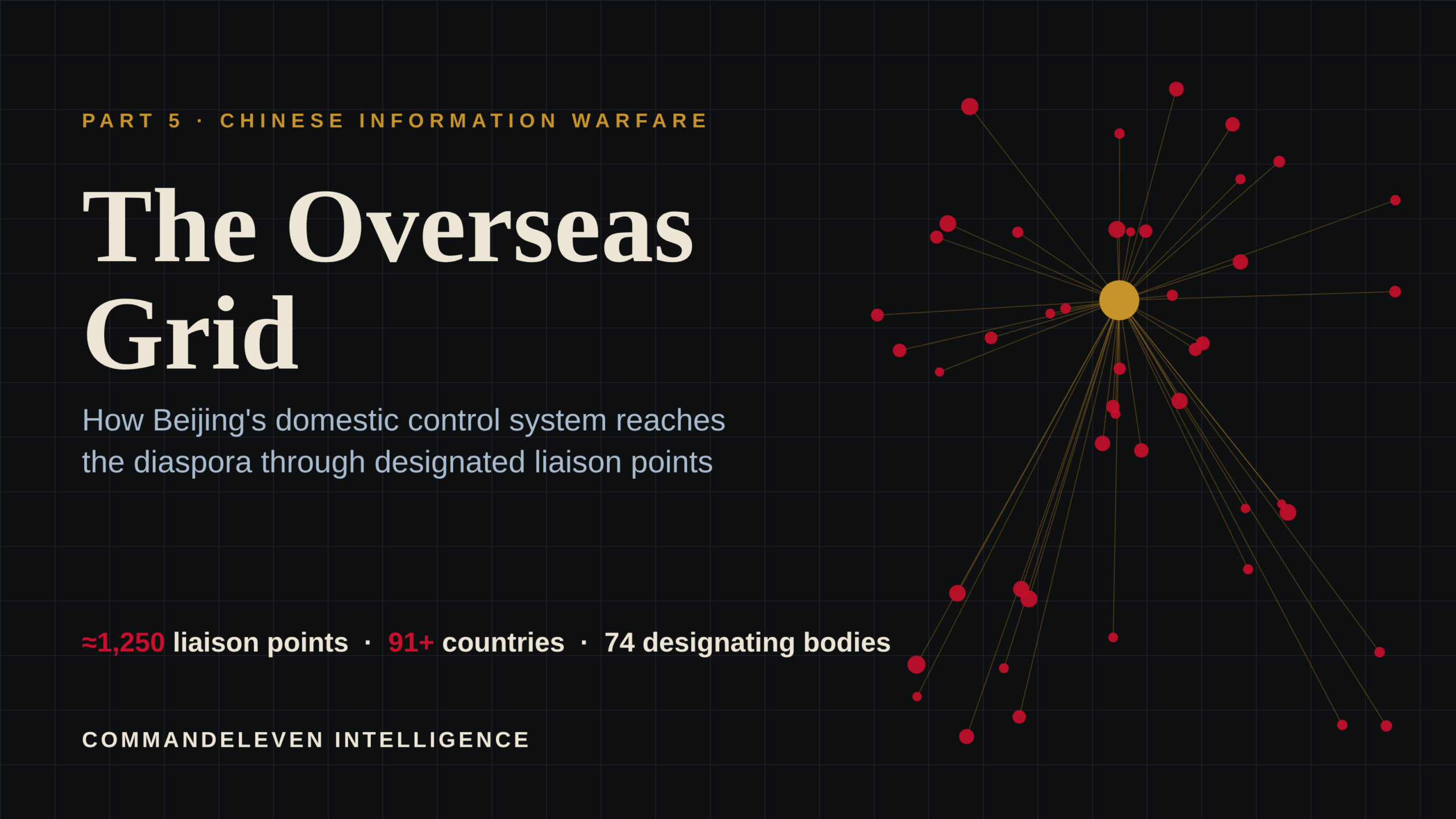
China’s overseas police stations did not close. A November 2026 report by the human rights group Safeguard Defenders says they were one visible piece of a much larger system: the Chinese Communist Party’s domestic grid-management model, extended to the diaspora through nearly 1,250 designated liaison points in at least 91 countries. Our assessment is that the report’s documentary case for expansion is strong, because it rests largely on Chinese official statements. The evidence for what each point does on the ground is thinner, and the report does not claim otherwise.
Key Judgments
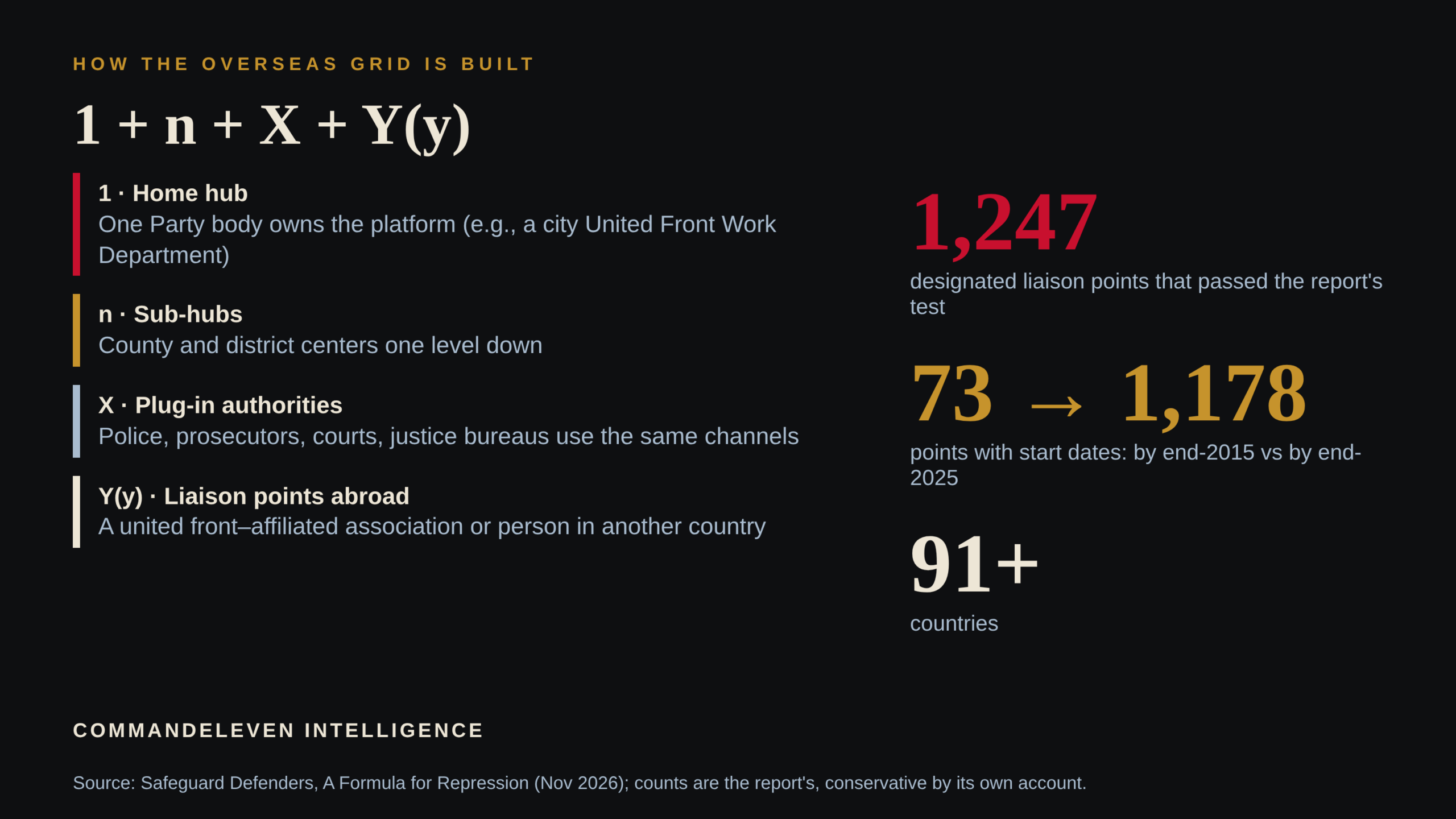
- REPORTED: Safeguard Defenders counts 1,247 designated liaison points abroad run by 74 Chinese bodies, which it groups into 27 systems. The authors call the count conservative.
- ASSESSED HIGH: The report’s evidence does not support Beijing’s 2022 claim that the stations closed. It shows the “police” nameplates came down while the underlying structure of host associations stayed in place.
- ASSESSED MODERATE-HIGH: The network is growing. Of the points with a start date, 73 date to the end of 2015 and 1,178 to the end of 2025, according to the report. Note that the dated subset is not the full count.
- CONFIRMED: A US jury convicted Lu Jianwang in May 2026 of acting as an illegal agent of the PRC over the New York “police station,” according to press reports of the verdict. The report says his co-defendant pleaded guilty in December 2024.
- ASSESSED LOW-MODERATE: The report shows what Chinese authorities say these points do. It does not establish how often any given point is used for surveillance, pressure or coercion. Most of the evidence is the authorities’ own descriptions.
- ASSESSED MODERATE: Host governments have few legal tools aimed at the structure itself. The report says no country has yet applied foreign-interference or foreign-agent rules to united front affiliation as such. We have not independently checked that claim.
What Safeguard Defenders Reports
The report, A Formula for Repression: China’s Global Grid for Community Control, is a follow-up to the group’s 2022 work on overseas Chinese police stations. It was written by Laura Harth with two associate researchers. Its method is to read Chinese Party, government, police, court and prosecutor publications and association websites, and to log every overseas point that a Chinese body formally designated with a nameplate, appointment letter or launch event. Points that passed a test of at least two of the ten tasks in China’s 2017 grid-management standard are counted.
The core argument is that China’s domestic “grid” is the template. At home, each grid covers a few hundred households and has a grid worker who keeps files, screens for “unstable factors” and reports upward. The report says the Party has been applying that logic to overseas Chinese since 2014, working through the United Front Work Department and its everyday arm abroad, the Overseas Chinese Federation. Police, prosecutors, courts and justice bureaus then plug into the same channels.
How the System Is Described
The report reduces the many local nameplates to one formula. A home hub (1) owns a service platform. Sub-hubs (n) sit one level down. Other authorities (X) use the same platform. Associations or individuals abroad (Y) carry the system into other countries. The report’s worked example is Wenzhou’s “Global Link” platform, which it says links a city service hall to overseas liaison points by video and messaging apps.
The report also quotes police in Qingtian, in Zhejiang, describing a network of overseas informants of more than 1,000 people and a goal of “grid-based” stability maintenance among overseas Chinese. In the report’s account, the stated tasks include collecting information, watching people on police watch lists, discouraging protests during leaders’ visits, and persuading suspects to return to China.
What the Report Adds on Scale and Direction
- Policy direction. The report traces a chain of Chinese policy from a 2014 Xi Jinping speech through 2018, when overseas Chinese affairs moved into the Party’s United Front Work Department, to 2026 instructions it describes as calling for “full coverage.”
- Domestic integration. It says the Overseas Chinese Federation now has cooperation agreements with courts in every province and with prosecutors in 29 provinces, and that prosecutors counted nearly 200 prosecutor-overseas-Chinese stations in March 2026.
- Hub shift. It argues the Federation, once a broker for the 2022 police stations, has become the platform the four legal authorities plug into.
- Reach. It notes that the Party counts affiliated associations abroad in the tens of thousands. The mapped points, it says, are a fraction of those potential carriers.
Court Action Already Taken
Two government responses are described. In the United States, the New York “police station” case produced a guilty plea in December 2024 and a jury conviction in May 2026, per the report. The conviction is also covered by AP coverage carried by WTOP. In France, the report says an expulsion order against the head of the Paris host association was upheld by the Conseil d’État in June 2026 and by the Paris administrative court in October 2026. We have not reviewed the French rulings and treat that account as REPORTED.
Recommendations in the Report
The authors recommend that governments treat united front affiliation as the trigger for existing foreign-agent, foreign-influence and transparency rules, and build such instruments where they are missing. They also recommend public advisories to local officials, a single reporting line for approaches from affiliates, and protection for the diaspora as a community. These are the authors’ policy positions. CommandEleven Intelligence reports them without endorsing them.
What To Watch
- Whether any government beyond the United States and France names a united-front-affiliated association in a charge, expulsion or official advisory.
- Whether Beijing responds to the report and how Chinese state outlets describe “police-overseas-Chinese” and Federation mechanisms going forward.
- Further Chinese joint policy documents from the Overseas Chinese Federation, courts and prosecutors, and any new overseas designations announced by Zhejiang, Fujian and Jiangsu bodies.
- Sentencing and appeal steps in the New York case.
Calls We Will Score
- By March 31, 2027: at least one national government other than the United States or France will publicly name a united-front-affiliated association or liaison point in an enforcement action, expulsion or official advisory.
- By June 30, 2027: no government will have adopted a law or registry rule that triggers on united front affiliation as such, the report’s central recommendation.
- By December 31, 2027: Chinese official sources will still be reporting new designated overseas liaison points or new “police-overseas-Chinese” cooperation mechanisms. Expansion will not have visibly reversed.
What This Assessment Does and Doesn’t Establish
It establishes what a respected human rights group reports from Chinese official material, and which parts of that are corroborated by court outcomes. It does not establish that every counted point surveils or pressures anyone. The report counts designations, not verified activity, and says some points may have closed or stopped posting. About 500 entries give numbers without names. The report is also an advocacy document with policy recommendations. Its own text varies slightly on some counts (for example, 26 versus 27 systems), and we cite the figures it gives in its main chapters. Beijing has denied that the stations are police and describes them as volunteer services.
Frequently Asked Questions
Did China close its overseas police stations? China said so in 2022. Safeguard Defenders says the nameplates were removed but the structure remained and has since grown.
What is the Overseas Chinese Federation? A Party-led body that the report calls the United Front’s everyday organizer abroad. It brokers links between Chinese authorities and diaspora associations.
What is grid management? A Chinese domestic system that divides communities into small grids with an appointed worker who collects information, mediates disputes and reports upward.
Is this the same as the 2022 police stations? The 2022 stations are included in the new count, but the report argues they were only one part of a wider system.
Why does it matter for host countries? The report argues the points sit in foreign cities and are run by residents, which makes them reachable by host-country law in a way the hubs inside China are not.
Related CommandEleven Intelligence Reading
- Unrestricted Warfare — Chaoxian Zhan — the Supreme Operational Blueprint
- Doctrinal Roots of The Three Warfares — The Evolution of San Zhan – Part 1
- The Information Support Force (ISF) Restructuring – Part 2
- The Modern MSS and Algorithmic Exploitation – Part 3
- Maritime Coercion & Indian Ocean Power Projection – Part 4
- Master Glossary of PRC Strategic & Technical Terms – Appendix
Sources
- Safeguard Defenders: A Formula for Repression: China’s Global Grid for Community Control (Nov 2026; full report, 156 pages, with endnotes)
- WTOP/AP: Jury convicts man accused of running secret Chinese spy outpost in New York City (May 13, 2026)