Status as of November 18, 2026. Part 3 of 3 in the Gulf at War series. The assessment is ours. IISS is one source among several, and its judgments are attributed. Read the introduction first: The Gulf at War: Eight Months of Iranian Fire, and a Record of Our Own Calls.
Bottom Line Up Front
The Gulf can pay for a war it did not choose, but not an open-ended one, and not every state equally. Saudi Arabia and the UAE have pipelines to ports outside the strait. Qatar, Kuwait and Bahrain do not. The Gulf’s sovereign wealth funds are large, banks held, and the human toll was small. What the war damaged was the Gulf’s economic pitch to the world: that it was safe, connected and open. That is harder to repair than a refinery.
We assess, with moderate confidence, that the Gulf’s fiscal position holds through 2027 if the strait stays contested at current levels, and that the investment and tourism models behind the national visions do not recover to their pre-war trajectory without a settled Hormuz. The settlement, not the budget, is the binding constraint.
Key Judgments
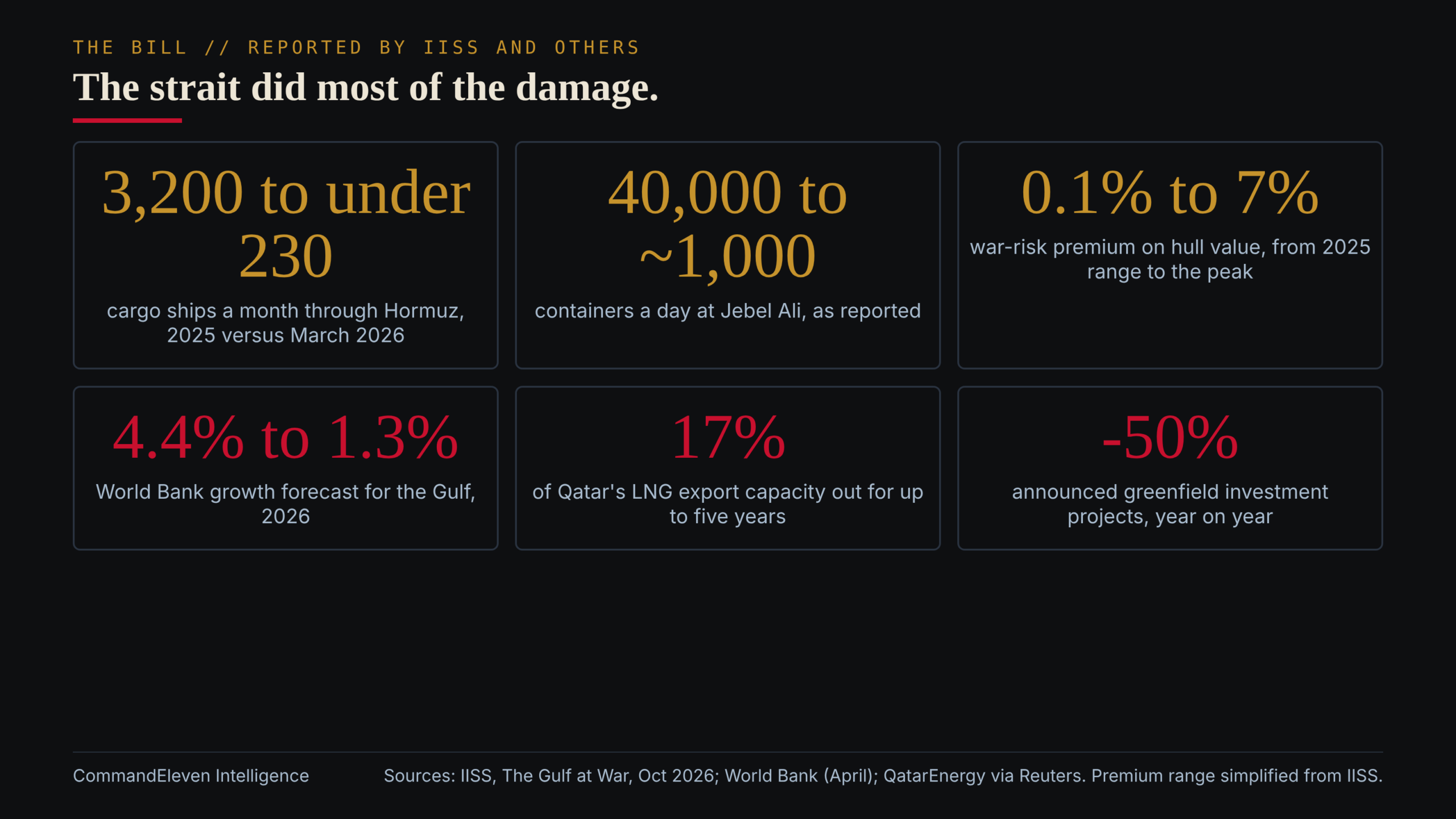
- REPORTED. Energy infrastructure took the heaviest damage. IISS counts more than 80 energy facilities attacked in the first six weeks and more than a third damaged, with repair costs up to $50 billion. Qatar lost 17% of its LNG export capacity for up to five years, about $20 billion a year, after strikes on Ras Laffan. Ruwais, the UAE refinery of 922,000 barrels a day, was shut for about three months.
- REPORTED. Shipping collapsed and has not returned. IISS puts Hormuz transits at more than 3,200 cargo ships a month in 2025 and under 230 in March. Tankers fell from about 100 a day before the war to five a day in March. Our November 15 reading has transits about 65% below pre-war, and the IEA data we cited put Gulf exports in October at 18.4 million barrels a day, about 26% below normal. IISS says it is unlikely that maritime traffic returns to pre-war levels.
- ASSESSED: MODERATE. The ability to bypass the strait divides the Gulf. Saudi Arabia filled its East-West pipeline at 7 million barrels a day in eight days and can ship 5 million barrels a day from Yanbu. The UAE moved crude through its Fujairah pipeline, with a second line planned for 2027. Qatar, Kuwait and Bahrain cannot reroute, and about 80% of Qatar’s fiscal revenue and exports ride on the strait.
- REPORTED. The Red Sea route is not safe. The Houthis declared a naval blockade on Saudi Arabia in July, struck a refinery of 400,000 barrels a day and threatened Yanbu. IISS adds that Iraq-origin attacks hit the East-West pipeline in September, when oil topped $100. Rerouting to the Red Sea is a hedge, not an exit.
- REPORTED. The macro damage is real and uneven. The World Bank cut Gulf growth for 2026 from 4.4% to 1.3% in April on an assumption of a three-month disruption, and the disruption lasted longer. Announced greenfield investment fell by at least half year on year. Jebel Ali fell from about 40,000 containers a day to about 1,000 as cargo moved to Khor Fakkan and overland routes. War-risk premiums went from 0.1% to 0.25% before the war to as high as 7%.
- ASSESSED: MODERATE. Buffers held. Sovereign wealth and foreign-exchange reserves range from 113% of GDP in Saudi Arabia to 606% in Kuwait, and the UAE’s liquid assets are about 365% of GDP. Banks saw little evidence of the deposit flight S&P warned of. Gulf states issued at least $31 billion in bonds, and the UAE sought a US swap line and extended one to Bahrain. Bahrain is the weakest, with debt of 147.6% of GDP in 2025 and foreign-exchange cover of about two months of non-hydrocarbon imports.
- ASSESSED: MODERATE. The national visions are strained, not finished. IISS says they should be built around survivability. We agree, and note that tourism and aviation are where they are most exposed: arrivals at Abu Dhabi, Doha and Dubai fell about 70% in March, and the sectors are 8% to 13% of output in Bahrain, Qatar and the UAE.
- ALLEGED. The UAE took a pragmatic line with Iran after the May 4 Fujairah strike, and onshore energy infrastructure was then largely spared. IISS reports the release of funds as an allegation. The UAE denies it.
What Is Established
Energy: who got hurt, who got out
The IEA called the disruption the largest supply loss in history, with more than 13 million barrels a day lost and a record 400 million barrel stock release on March 11. Brent reached $100 several times by late September. IISS says Saudi Arabia, the UAE and Oman gained relative position from their routes, while Qatar, Kuwait and Bahrain could not. Aramco’s second-quarter net profit was credited at $32.69 billion, up 44%. The UAE left OPEC in the spring, which IISS dates to April and our reporting dated to May 1, and IISS warns of a price war if the Gulf returns to full output.
Qatar is the sharpest case. QatarEnergy declared force majeure on March 4 and extended it in July. By July 6, only 14 LNG cargoes had left the strait against 43 loaded between February 3 and 26. Asian buyers are demanding discounts and replacement cargoes, and the US is doubling its own LNG capacity by 2029.
The Gulf’s routes around the strait
Bypass capacity is the Gulf’s real fiscal insurance. The UAE sent exports of 1.62 million barrels a day from Fujairah in March and used dark-mode tankers to run the strait. IISS says it exported more through Hormuz than any other producer. Fujairah was still hit repeatedly, and mid-March strikes cut its crude exports by about 410,000 barrels a day. Kuwait is in talks for a pipeline to the Red Sea, Oman or Fujairah. Oman is building storage at Ras Markaz and benefits from traffic at Sohar, which rose 40%.
Trade, tourism and the visions
The cost has fallen on trade and services as much as on oil. Jebel Ali’s volumes collapsed, Khor Fakkan saw about 25 times its pre-war volume, and overland transport tripled in cost and raised prices by about 12%. Airlines canceled more than 40,000 flights in the first weeks. The UAE’s hotel occupancy was forecast at about 10% in the second quarter from about 80%. Tens of thousands of expatriates left, and expatriates are 85% to 90% of the populations of Qatar and the UAE.
The technology bets mostly held. IISS says Microsoft’s $15 billion UAE commitment was unshaken and that Amazon reaffirmed its plans, although Iran struck data centers in Bahrain and the UAE. NEOM was already being downsized. IISS places the Gulf’s sovereign funds above $6 trillion and its Saudi and Emirati AI funds above $100 billion each.
Food, water and power
Food and water did not fail. Up to 85% of Gulf food is imported and about 70% of it comes through Hormuz, but IISS reports no major shortages, helped by silos at Fujairah and Hamad Port and by Qatar’s lessons from the 2017 blockade. Desalination plants were hit in Bahrain, Kuwait and the UAE with only limited outages. Kuwait has about four months of rationed water, or two weeks if production stopped, and Bahrain’s Al Hidd plant supplies about 75% of its drinking water. IISS lists the Barakah nuclear plant among the reported attack sites. The UAE denied damage, and we treat that as ALLEGED.
IISS recommends pooling water and power links, noting the constraints: no shared recovery fund, a GCC grid used by Kuwait and Bahrain, a Qatar-Bahrain bridge that has stalled and a regional railway of which only the UAE section is built. We find that persuasive on resilience and unpromising on timing.
Why It Matters
Gulf governments sell stability, and stability is hard to hold when the main export lane is subject to someone else’s decision. The settlement of Hormuz is therefore the most valuable Gulf security asset and the one the Gulf does not control. If the strait stays contested, the Gulf pays through shipping costs, tourism, investment and talent as much as through the budget.
What Would Change Our View
- A Hormuz framework that Iran, the US and Oman all accept and that holds through a US escalation.
- Hormuz transits back above 80% of pre-war levels.
- Qatar lifting force majeure and restoring the lost LNG capacity ahead of the five-year estimate.
- A Gulf state failing to roll over debt or drawing on external support.
What To Watch
- Monthly IEA export data and Hormuz transit counts.
- War-risk premiums and the uptake of the US reinsurance facility.
- The second Habshan-Fujairah pipeline and Kuwait’s bypass talks.
- Bahrain’s debt and reserves, and UAE and Saudi bond issuance.
- Whether the Houthi blockade of Saudi Arabia widens in the Red Sea.
Calls We Will Score
- By March 31, 2027: QatarEnergy’s force majeure on LNG remains in effect.
- Through March 2027: The IEA reports Gulf oil exports below pre-war levels in every monthly report.
- By June 30, 2027: No GCC state announces a funded, pooled water and power interconnection mechanism.
What This Assessment Does and Doesn’t Establish
- It does not establish the UAE-Iran funds allegation, damage at Barakah or the true scale of Gulf casualties.
- Shipping figures are affected by GPS jamming and AIS spoofing, and IISS says true flows may be higher.
- Fiscal buffers are estimates and vary by definition.
- IISS’s judgments are IISS’s, and ours are marked as ours.
Frequently Asked Questions
Can the Gulf afford a long war?
For the next year or two, mostly yes, because of reserves and bypass pipelines. Qatar, Kuwait and Bahrain are more exposed than Saudi Arabia and the UAE, and Bahrain is the weakest.
Why does Qatar suffer more than Saudi Arabia?
Qatar sends most of its exports and fiscal revenue through the strait and has no pipeline around it. Saudi Arabia can use its East-West pipeline to the Red Sea.
Are the national visions dead?
No. IISS and we both find them strained, and the main risk is to tourism, aviation and investor confidence.
Is the Red Sea a safe alternative?
Not at present. The Houthis declared a blockade on Saudi shipping in July, and attacks from Iraq hit the East-West pipeline in September.
Related CommandEleven Intelligence Reading
- The Gulf at War: Eight Months of Iranian Fire, and a Record of Our Own Calls
- Hormuz Shipping Is Still 65% Below Pre-War
- Economic D-Day: The Iran Sanctions Scorecard
- The Garrison State: Fujairah, Part 3
- Iran War Doctrine and Strategy: A Six-Part Series
Sources
- IISS: The Gulf at War: Strategic, Security and Geo-economic Dimensions (Oct 2026)
- CommandEleven Intelligence: Hormuz Shipping Is Still 65% Below Pre-War (Nov 15, 2026)
- CommandEleven Intelligence: Economic D-Day scorecard
Assessments and confidence tiers are CommandEleven Intelligence’s own. We do not reproduce third-party text or graphics. Figures attributed to IISS are IISS’s, summarized. Market and shipping figures are estimates.