A follow-up to CommandEleven Intelligence’s August 21 dossier, Iran Sanctions 2026: Trump’s Toolkit vs. China’s Defiance.
Key Judgments
- [CONFIRMED] None of Treasury Secretary Scott Bessent’s three headline deadlines has been met. Iranian airlines were not grounded worldwide by September 23. Iran did not run out of oil to sell within a week. Tehran has not returned to the table on Washington’s terms.
- [CONFIRMED] The campaign is hurting Iran. Official Iranian figures put September inflation near 90 percent year on year, the rial has traded around 2.7 million to the dollar on the open market, and the economy shrank 10.1 percent year on year between late March and late June.
- [ASSESSED] The gap between damage and outcome is the one CommandEleven Intelligence described in August: the naval blockade does the real work, Treasury designations add friction, and neither closes the routes that the blockade cannot reach. Those routes now run overland and by air, through Türkiye, Pakistan, Iraq, Russia and China.
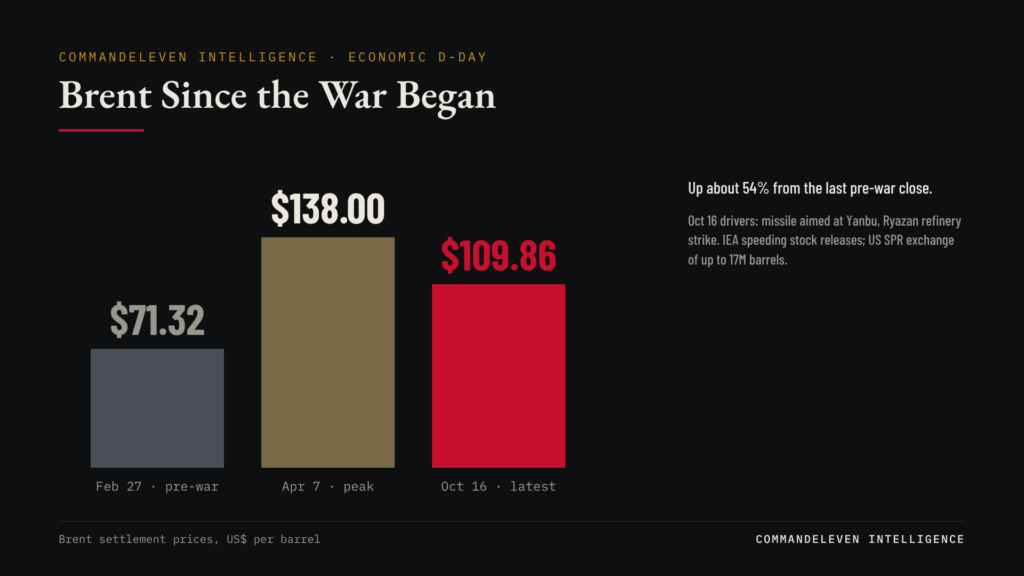
- [CONFIRMED] The cost at home is rising. Brent crude closed at $109.86 on October 16, its highest settlement since May, against $71.32 on the last trading day before the war.
- [ASSESSED] Washington has quietly moved from a weeks-long timetable to a long economic war, with talks now pushed past the US midterms. The next test is Bessent’s October 9 claim that the US is working with Türkiye and Pakistan to close Iran’s land routes.
What Was Promised
Bessent announced the campaign on August 24, comparing it to the 1944 Normandy landings. Former Treasury official Alex Zerden called it “Operation Economic Outcast.” It was billed as an economic onslaught against Iran and anyone still trading with it, built on the naval blockade the US had reimposed in July.
The commitments, as reported by Fortune and The Washington Post:
- Banks. “A major announcement of a financial institution being sanctioned by the end of this week,” every branch of Bank Melli shuttered, and “any entity that facilitates money laundering on behalf of Iran” removed from the US dollar system.
- Airlines. After sweeping aviation sanctions on September 8, Bessent said “all the Iranian airlines will be shut down around the world” by September 23.
- Oil. Bessent said Iran would run out of oil to sell within about a week of his remarks.
- The deal. The pressure was meant to force Tehran back to negotiations on US terms.
US officials met representatives of dozens of countries before the launch, and Treasury teams visited the UAE, Britain and Oman on aviation and banking. Some coverage puts the number of countries above 50. [DATA DEFICIT] CommandEleven Intelligence could not confirm that figure and uses “dozens.”
The Scorecard
| Promise | What happened | Score |
| Iranian airlines grounded worldwide by September 23 | International flights to and from Iran fell by about half in the days after the aviation sanctions. Flights continue. Recent arrivals at Tehran’s Imam Khomeini airport came from Islamabad, Istanbul, Moscow and Shanghai. | Not met |
| Iran out of oil to sell within about a week | Seaborne exports are sharply restricted by the blockade. Iran has kept selling oil it moved out before July: Reuters put its stock outside the blockade at about 20 million barrels. Kpler estimates about 250,000 barrels a day leave by land. | Not met |
| A major bank sanctioned within days; Bank Melli shut | The first move was the UAE branches of Egypt’s Banque Misr, which analysts called underwhelming. Later actions hit the manager of an Emirati Bank Melli branch and Russia’s VTB, and the UAE then blocked all Bank Melli branches from processing Iranian transactions. | Partly met |
| Tehran back at the table | On October 11, Iranian security official Mohsen Rezaei said the US had accepted some of Iran’s seven conditions for reopening the Strait of Hormuz but called the response “inadequate.” President Trump says talks will come after the midterms. | Not met |
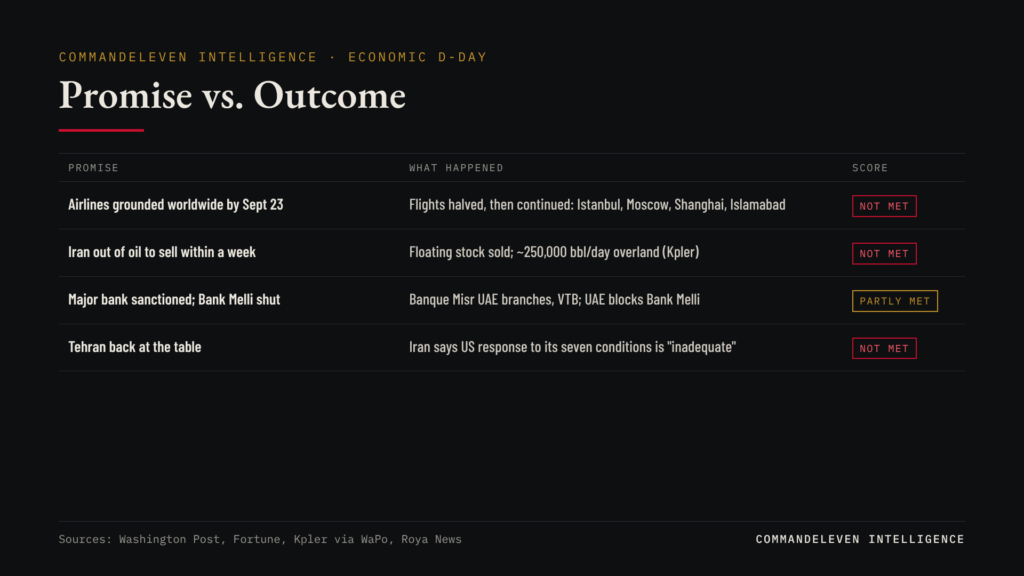
[ASSESSED] The banking result deserves more credit than the deadlines. The UAE’s decision to stop all Bank Melli branches processing Iranian transactions closed a real channel in Iran’s most important regional financial hub. It took weeks rather than days, and it is the kind of result that does not make a headline but does reduce Iran’s room to move money.
Why the Deadlines Slipped
The routes the blockade cannot reach. A naval blockade stops tankers. It does not stop trucks, rail cars or aircraft. Iran’s land borders with Türkiye, Iraq, Pakistan, Afghanistan and the Caucasus, and its air links to Russia and China, were always outside the blockade’s reach. The aviation sanctions were meant to close the air route. They narrowed it.
The buyers who will not comply. As CommandEleven Intelligence reported in August, China invoked its Blocking Statute in May and told its refiners to ignore US sanctions. Fortune reported that China buys about 90 percent of Iran’s oil. Bessent himself has acknowledged that moving too fast and too hard against large financial institutions could destabilize the global financial system. That is the constraint every analyst quoted on this campaign keeps returning to. Leland Miller said meaningful pressure cannot ignore China. Richard Nephew called the targeted entities “meaningful” but asked whether they were “kill shots to the Iranian economy? Probably not.”
The stockpile. Iran moved more than 60 million barrels out of its ports between mid-June and mid-July, during the window before the blockade returned. That oil, sitting in floating storage beyond the blockade, has given Tehran months of sales the deadline did not account for.
[ASSESSED] A senior administration official told The Washington Post that “you’ve really seen that time dynamic shift,” arguing the blockade now denies Iran the oil revenue it relied on before. That may prove right over months. It is a different claim from the one made in August, which promised results in weeks.
The Land Routes, and Pakistan
On October 9, Bessent told Newsmax that Washington is working with Türkiye and Pakistan to cut Iran’s overland trade, as part of an “absolute isolation campaign.” Neither Ankara nor Islamabad commented.
Pakistan’s record on this is careful. In August, Iranian media reported that a Foreign Office spokesperson had said Pakistan was not bound by US unilateral sanctions. Islamabad said the remarks were “misconstrued” and that Pakistan “in principle, doesn’t comment on the US regime of sanctions on Iran,” emphasizing its role as lead mediator. ProPakistani reported in late August that up to $800 million in informal trade with Iran was exposed.
[ASSESSED] On October 16–17, Pakistan’s Commerce Ministry suspended trade with Iran at the Taftan and Gabd-Rimdan crossings, citing smuggling and security, and both governments described the step as temporary and coordinated. The timing, a week after Bessent’s remarks, is notable. CommandEleven Intelligence does not attribute the suspension to US pressure: the stated reasons and the joint framing point elsewhere, and there is no public evidence of a link. Whether it holds is one of the indicators below.
The Cost at Home
[CONFIRMED] Brent closed at $71.32 a barrel on February 27, the last trading day before the war. It peaked at about $138 on April 7, fell back below its pre-war level in late June during the ceasefire window, and closed at $109.86 on October 16, its highest settlement since May. WTI closed at $101.41. That day’s jump followed a ballistic missile aimed at Saudi Arabia’s Red Sea port of Yanbu and a Ukrainian strike that shut a crude unit at Russia’s Ryazan refinery. The International Energy Agency agreed to speed emergency stock releases, and the US Department of Energy sought proposals for an exchange of up to 17 million barrels from the Strategic Petroleum Reserve.
Diesel and fertilizer costs are hitting American farmers, and the administration has eased restrictions on Russian diesel to relieve fuel prices. CommandEleven Intelligence’s annex Diesel Before Victory covers that trade-off, and our Global Food Security series tracks the fertilizer shock region by region.
[ASSESSED] The oil-price line is the campaign’s political clock. Every week the blockade holds and the land routes stay open, Iran absorbs damage while the US absorbs higher fuel prices before the midterms. That symmetry is why Tehran is behaving as though it can wait.
Scoring Our Own August Calls
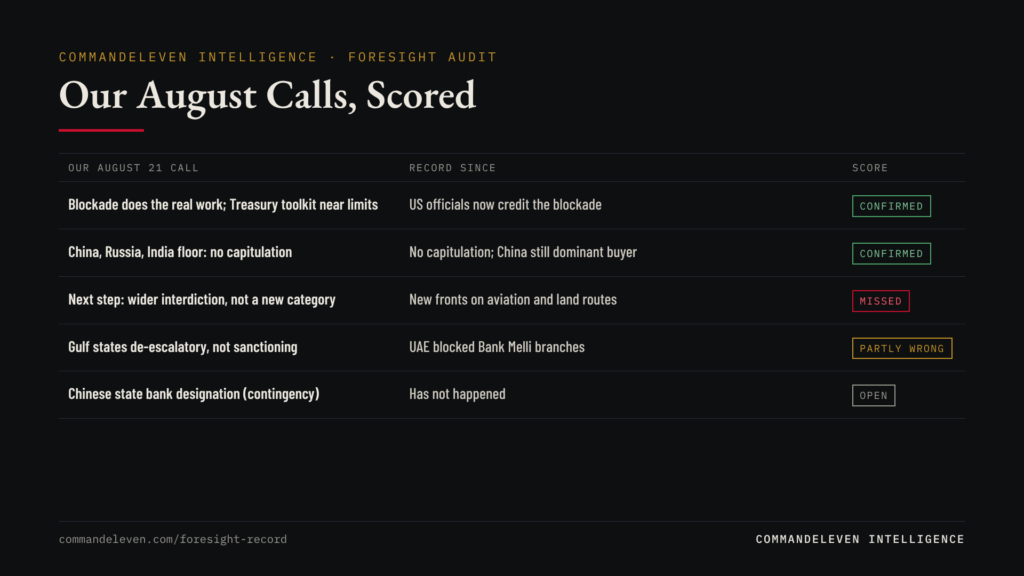
The Foresight Record standard applies to us as well. Here is how the August 21 dossier holds up.
| August 21 call | Record since | Score |
| The blockade, not further Treasury designations, is doing most of the damage, and the Treasury toolkit is near its limits. | Washington’s own officials now credit the blockade with making sanctions bite, and analysts call the new designations meaningful but not decisive. | Confirmed |
| China, Russia and India form a floor under Iran’s economy, so sanctions will not force capitulation. | No capitulation. China remains the dominant buyer. | Confirmed (so far) |
| The next escalation would be wider interdiction under blockade authority, not a new sanctions category. | Washington opened a new front against Iranian aviation and is now targeting land routes. We did not anticipate either. | Missed |
| Gulf states are de-escalatory, not sanctioning. | The UAE moved to block Bank Melli’s branches and said it would cut financial ties with Iran. | Partly wrong |
| A major Chinese state bank could be designated (contingency). | Has not happened. | Open |
| Unrest in Iran grows through 2026 (speculative). | Economic indicators have worsened sharply. Public evidence on unrest is limited by the internet blackout. | Open |
Outlook and Indicators (Foresight Entry)
[ASSESSED] The base case is a long economic war through the US midterms and into 2027: the blockade holds, designations continue, Iran keeps selling oil overland and from floating storage at shrinking volumes, and neither side moves on the seven conditions. CommandEleven Intelligence will score these indicators on the Foresight Record on January 31, 2027:
- Land routes. Do Türkiye or Pakistan publicly restrict Iranian overland trade beyond temporary security measures?
- Aviation. Do scheduled flights between Tehran and Istanbul, Moscow, Shanghai or Islamabad stop?
- China. Is a major Chinese state-owned bank designated for Iran-linked activity?
- Talks. Do US-Iran negotiations resume after the midterms, and on whose terms?
- Price. Does Brent settle above $120 or below $90 before January 31?
Frequently Asked Questions
What is the US “Economic D-Day” against Iran?
A sanctions campaign Treasury Secretary Scott Bessent launched on August 24, 2026, targeting Iran’s banks, airlines and oil trade and the countries that still deal with it, on top of the US naval blockade.
Have Iranian airlines been grounded?
No. Flights fell by about half after the September 8 aviation sanctions but continue, including from Istanbul, Moscow, Shanghai and Islamabad.
Is Iran still exporting oil?
At much lower volumes. Seaborne exports are sharply restricted, but Iran is selling oil it stored outside the blockade and moving roughly 250,000 barrels a day overland, according to Kpler.
How much have oil prices risen?
Brent closed at $71.32 before the war and $109.86 on October 16, an increase of about 54 percent.
Is Pakistan helping close Iran’s land routes?
Bessent says the US is working with Pakistan and Türkiye on it. Pakistan suspended trade at two crossings on October 16–17, citing smuggling and security, in what both governments called a temporary, coordinated step. There is no public evidence linking it to US pressure.
Sourcing Base (Confidence-Tiered, with Links)
CONFIRMED — Reporting and Market Data:
- The Washington Post, After pledging swift results, Trump team prepares for long economic war with Iran, October 9, 2026
- Fortune, Scott Bessent’s ‘D-Day’ Iran sanctions threat to China, UAE and Turkey, August 30, 2026
- Türkiye Today, US working with Türkiye, Pakistan to seal Iran’s land routes, October 11, 2026
- Roya News, Top Iranian official says US response to Tehran’s demands is “inadequate”, October 12, 2026
- Nation Thailand, Brent hits US$110 a barrel on October 16 over supply fears, October 2026
- Politis, Tracking Oil Prices Since the Beginning of the War 100 Days Ago, June 2026
- Geo News, Remarks attributed to Pakistan regarding US sanctions on Iran are ‘misconstrued’, August 27, 2026
- ProPakistani, Pakistan Suspends Trade With Iran Through Taftan, Gabd Border Crossings, October 18, 2026
ASSESSED — Analysis and Context:
- Idaho Public Press, Bessent set hard deadlines for Iran’s economic collapse. Both have slipped., October 2026
- ProPakistani, Pakistan lacks plan as US sanctions on Iran threaten $800 million informal trade, August 28, 2026
Excluded from this dossier: Oil-price figures attributed to Iranian state media, replaced here with market closing prices. The claim that US teams visited more than 50 countries, which could not be confirmed. Any claim that Pakistan’s October border measures were taken at US request.