

This is Part 4 of The Global Food Security Crisis, CommandEleven Intelligence’s region-by-region assessment of the 2026–27 food shock.
Bottom Line Up Front
Europe’s food crisis is hiding in plain sight. Euro-area food inflation was only 1.4% in September, even as energy inflation hit 18.8%. Shoppers have not yet felt much. Farmers have: the cost of their inputs rose 4.7% in a year, with fertilizer up 13.4% and energy up 22%, while the prices they receive for their crops and milk fell 5.8%. Diesel has hit a record EU average of €2.23 a liter.
On top of that, the Black Sea has effectively closed. Ukraine, the EU’s largest corn supplier and the source of 92% of its sunflower oil imports, saw grain exports fall 45% in September. That combination of squeezed farmers, cut fertilizer use and lost Black Sea supply points to Europe’s real risk: not empty shelves this winter, but a weaker 2027 harvest and a second wave of food inflation behind it. The October cyberattack on European supermarket refrigeration showed a third risk: a food system that runs on six days of stock is only as strong as its logistics.
Key Judgments
KJ1: Europe’s food shock is landing on farmers first and consumers later. Input costs are rising while farm-gate prices fall. That gap is not sustainable and will show up in planting and application decisions. [CONFIRMED on data; ASSESSED on effect]
KJ2: The Black Sea closure is Europe’s most direct supply risk. It hits corn, sunflower oil and wheat at once, and the bypass routes through the EU can carry only about half of Ukraine’s normal seaport volume. [CONFIRMED]
KJ3: Unprocessed food is the leading edge. Unprocessed food inflation rose from 2.7% to 4.0% in a month. Processed food follows with a lag. [CONFIRMED on data; ASSESSED on direction]
KJ4: Logistics are the hidden vulnerability. Diesel costs, thin store inventories and the cold-chain attack all point to a system optimized for efficiency rather than resilience. [ASSESSED]
Scorecard
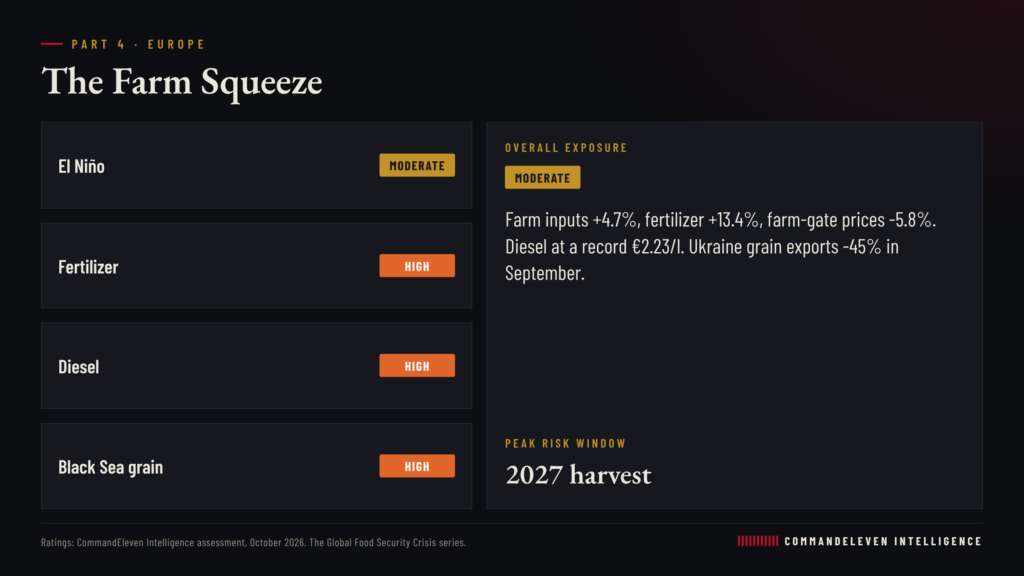
| Driver | Exposure | Why |
|---|---|---|
| El Niño | Moderate | Wetter south and west, drier north; this year’s extreme weather already cut French and German yields |
| Fertilizer | High | Prices up 13.4%; farmers cutting nitrogen |
| Diesel | High | Record €2.23/liter average; European gas oil stocks hit a 25-year low in July |
| Black Sea grain | High | Ukraine is the EU’s top corn and sunflower oil supplier |
| Overall | Moderate | Strong buffers now; rising risk for 2027 |
The Four Drivers
El Niño. The WMO expects a wetter-than-normal autumn in southern Europe and drier conditions in northern Europe, with above-normal temperatures in the south. Europe’s main exposure this year has already happened: extreme weather cut yields in major producers, particularly France and Germany. [CONFIRMED]
Fertilizer. Eurostat data for the second quarter show fertilizer and soil improver prices up 13.4% year on year. European nitrogen producers depend on natural gas, whose price nearly doubled in March, and Europe also imports fertilizer that normally moves through Hormuz. Reports from France since the spring describe farmers planning to cut nitrogen application for the 2026–27 season. Less nitrogen means lower wheat yields and protein. [CONFIRMED on prices; ASSESSED on yield effect]
Diesel. The EU consumption-weighted average diesel price reached a record €2.23 a liter in September, and northwest European wholesale diesel hit its highest level since assessments began in 2007. About 96% of EU trucks run on diesel, and fuel is about a third of a trucking company’s costs. Transport & Environment estimates Europe’s extra road-diesel bill at about €40 billion since late February. Slovenia became the first EU country to ration fuel in March, with a 200-liter daily limit for businesses and farmers. [CONFIRMED]
The Black Sea. Russia’s attacks have all but stopped ship traffic from Ukraine’s ports: 21 ship calls in August, about 90% fewer than a year earlier. Ukraine’s September grain exports fell 45%, wheat 55%. Bypass routes by Danube barge, rail and truck through the EU can carry only 50% to 55% of normal seaport capacity. Ukraine supplies 92% of the EU’s sunflower oil imports and more of its corn than any other country. On the Russian side, Ukrainian strikes have taken most grain export capacity offline. The Euronext wheat premium over Chicago almost tripled in a week in late September. [CONFIRMED]
Import Dependence
The EU is a net food exporter overall and largely self-sufficient in wheat, dairy and meat. Its dependence is on inputs (natural gas, fertilizer, diesel) and on specific imports: corn and sunflower oil from Ukraine, soy for animal feed from the Americas, and fresh produce and fish. Retail logistics run lean: Dutch shops and distribution centers hold about six days of food, replenished by just-in-time IT systems that depend on the power grid. [CONFIRMED]
How Governments Are Responding
- Fuel tax cuts: Germany’s energy tax cut on petrol and diesel from October 1; Latvia’s diesel excise cut; earlier cuts across several member states.
- Rationing: Slovenia’s fuel limits from March.
- Farm aid: small, targeted packages such as Finland’s €8.7 million in EU-funded emergency aid for farms hit by fuel and fertilizer costs.
- Household preparedness: a Clingendael and Erasmus University study for the Netherlands advised households to keep eight days of emergency food instead of three.
These measures cushion prices. None addresses the core problem: what European farmers will plant and how much fertilizer they will apply for the 2027 harvest when their margins are negative. [ASSESSED]
Flashpoints
- Farmer protests. European farmers mobilized across the continent in 2024 over costs and regulation. With input costs rising and farm-gate prices falling, the conditions for a new wave are in place. [ASSESSED]
- Fuel protests. Ireland’s April fuel protests contributed to a no-confidence vote in the government. [CONFIRMED]
- The cold chain. The October 11 attack on refrigeration controllers in about 700 French supermarkets, with affected systems in five more countries, showed how a cyberattack can empty fresh-food aisles overnight. See Critical Infrastructure at Risk: The Cold Chain. [CONFIRMED]
- Ukrainian grain in transit. More Ukrainian grain moving by rail into Poland and its neighbors revives the 2023 disputes over farmers’ prices. Warsaw is already reviewing rules on storing Ukrainian grain in transit. [CONFIRMED on review; ASSESSED on risk]
The 12-Month Outlook
CommandEleven Intelligence expects European food inflation to rise through the winter, led by fresh food, vegetable oils and bakery products as diesel, gas and Black Sea losses pass through. Shortages are unlikely. The larger risk is a smaller and lower-quality 2027 harvest if farmers cut fertilizer and planted area, which would push a second wave of price rises into late 2027. [ASSESSED]
Indicators to watch:
- Eurostat’s unprocessed food inflation figure each month.
- Winter wheat sowing area and autumn nitrogen sales in France and Germany.
- Ukraine’s monthly grain export volumes, and any attacks on the Danube terminals at Izmail and Reni.
- Any negotiated arrangement on Black Sea shipping, such as the safe-passage plan Turkey has drafted.
Frequently Asked Questions
Why are European food prices rising slowly when energy is up so much?
Farmers and food companies are absorbing much of the cost for now. Farm input costs rose 4.7% while prices paid to farmers fell 5.8%. That squeeze is likely to reach consumers with a lag.
How does the Black Sea closure affect Europe?
Ukraine is the EU’s largest corn supplier and provides 92% of its sunflower oil imports. Its grain exports fell 45% in September, and the overland bypass routes can carry only about half of normal volumes.
Sources
- Euro area annual inflation up to 3.8%, Eurostat flash estimate, October 2, 2026
- Rising farming costs could put more pressure on food prices, The Portugal News, September 18, 2026
- Diesel price surge sends shockwaves through European economy, People’s Daily Online (Xinhua), September 29, 2026
- The Black Sea Has Quietly Closed, Modern Diplomacy, October 13, 2026
- How Do the Latest Black Sea Attacks Affect Global Food Security?, CSIS, September 11, 2026
- 2026 Iran war fuel crisis, Wikipedia (compilation of national measures)
- Thousands of supermarket fridges still exposed after cyberattack, Euronews, October 14, 2026
- Climate, wars and fuel shortages foster famine fears, ABC News (Australia), August 25, 2026
The Global Food Security Series
Start with the United States baseline: Food Chain Reaction Revisited and The 12-Month Fuse.
- Global Food Security: North America – Part 1
- Global Food Security: Central America and the Caribbean – Part 2
- Global Food Security: South America – Part 3
- Global Food Security: Europe – Part 4 (you are here)
- Global Food Security: The Middle East and Arab World – Part 5
- Global Food Security: Africa – Part 6
- Global Food Security: East and Southeast Asia – Part 7
- Global Food Security: The Indian Subcontinent – Part 8
- Global Food Security: Australia and the Pacific – Part 9

