
This is Part 2 of The Global Food Security Crisis, CommandEleven Intelligence’s region-by-region assessment of the 2026–27 food shock.
Bottom Line Up Front
Central America is where El Niño has already done its damage. Drought in the Dry Corridor, the arid strip running through Guatemala, Honduras, El Salvador and Nicaragua, has devastated this year’s maize and bean harvests. Honduras, El Salvador and Panama have declared emergencies, about 80% of Honduras has been under drought alert since August, and more than 3.2 million people in Guatemala face acute humanitarian crisis. The World Food Programme expects El Niño to leave 16 million people across Latin America and the Caribbean without enough food.
In the Caribbean, Haiti is the region’s worst crisis: about 5.8 million people, more than half the population, face acute food insecurity, driven by gang violence and made worse by fuel and freight costs from the Iran war. The worst months for the whole region are still ahead, between February and August 2027.
Key Judgments
KJ1: El Niño is the primary driver of hunger in Central America this year. FEWS NET rates it the main cause of acute food insecurity in the region, with the most severe outcomes expected from March to August 2027. [CONFIRMED]
KJ2: Haiti’s crisis is man-made first and climate-driven second. Armed groups control much of the country; El Niño and fuel prices make an existing catastrophe worse. [CONFIRMED]
KJ3: The Caribbean islands are exposed through imports and fuel. Most island states import the large majority of their food and fuel, so diesel and freight costs reach the shelf directly. [ASSESSED]
KJ4: The region’s crisis will be felt in the United States. Crop failure in the Dry Corridor is a long-standing driver of migration north, and a drought-hit Panama Canal would slow grain shipments worldwide. [ASSESSED]
Scorecard
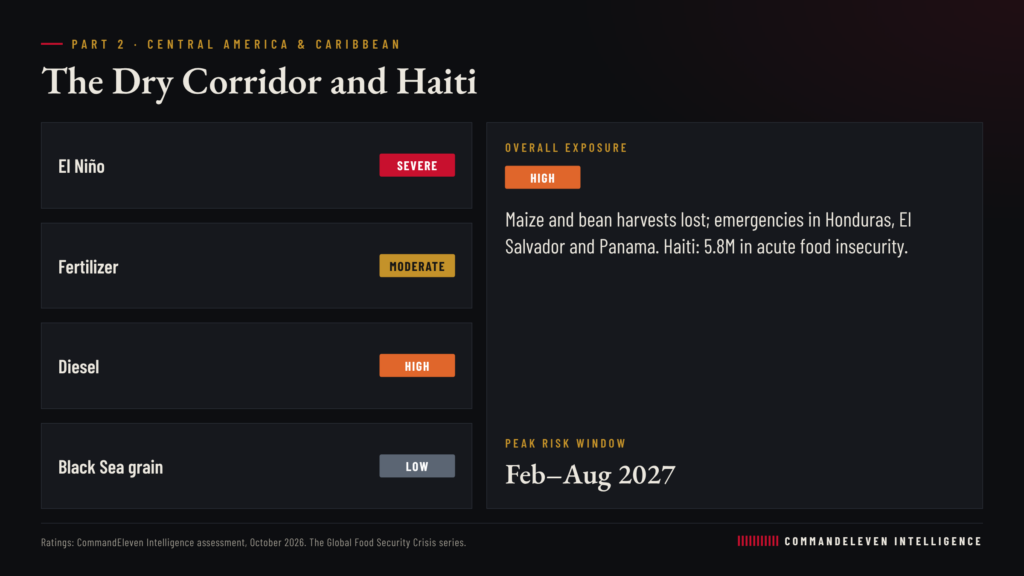
| Driver | Exposure | Why |
|---|---|---|
| El Niño | Severe | Dry Corridor harvests already lost; national emergencies in three countries |
| Fertilizer | Moderate | Smallholders priced out; Guatemala’s crisis worsened by fertilizer costs |
| Diesel | High | Island states and Haiti depend on imported fuel for power, transport and food |
| Black Sea grain | Low | Wheat comes mostly from North America |
| Overall | High | Severe in Haiti and the Dry Corridor |
The Four Drivers
El Niño. The WMO forecasts drier-than-normal conditions over southern Central America and parts of the Caribbean, and above-normal temperatures across the region. The April-to-November rainy season delivered the deepest deficits in the Dry Corridor. The European Commission’s Joint Research Centre reports that severe drought has devastated maize and bean harvests, the staples of rural households, prompting national emergencies in Honduras and El Salvador. Panama has also declared an emergency. UNICEF estimates that at least 25.8 million children in Latin America and the Caribbean are exposed to El Niño-related droughts and floods. [CONFIRMED]
Fertilizer. The Joint Research Centre found that soaring fertilizer and fuel costs linked to the Hormuz closure worsened Guatemala’s crisis. Smallholder farmers who could not afford fertilizer this year planted less or applied less, compounding drought losses. [CONFIRMED]
Diesel. Haiti’s IPC analysis cites the spike in global fuel prices as a driver that raised transport and farming costs. Across the Caribbean, diesel generates much of the electricity and moves food from ports to markets. [CONFIRMED for Haiti; ASSESSED for the wider region]
The Black Sea. The region buys most of its wheat from North America, so the Black Sea closure reaches it mainly through higher world prices. [ASSESSED]
Import Dependence
Central America’s rural poor grow much of their own maize and beans, which is why a failed harvest hits them so hard: they lose both food and income at once, then have to buy food at higher prices. Honduras faces tighter maize supply because imports have not made up for the harvest losses, according to FEWS NET. The Caribbean island states are the opposite case. Most import the large majority of what they eat, which is why CARICOM governments set a goal in 2020 of cutting the region’s food import bill by a quarter. [CONFIRMED on Honduras; ASSESSED on the wider pattern]
How Governments Are Responding
- Emergency declarations in Honduras, El Salvador and Panama, which unlock emergency budgets and international appeals.
- The World Food Programme began food rations and support to farmers in April, but its regional director has said “the needs exceed the funds we have available.”
- In Haiti, the state has limited capacity to respond at all in areas controlled by armed groups. [ASSESSED]
What is missing is a plan for the 2027 planting season: seed and fertilizer support for Dry Corridor farmers before the spring rains, so that one lost harvest does not become two. [ASSESSED]
Flashpoints
- Haiti. More than 1.8 million people are in Emergency (IPC Phase 4), and more than 1.4 million are displaced. FEWS NET expects needs to peak between February and June 2027. Food stress here feeds gang recruitment and further displacement. [CONFIRMED on figures; ASSESSED on effects]
- The Dry Corridor and migration. Guatemala’s needs peak from May to August 2027, Honduras’s from April to August. Past droughts in the corridor have been followed by rising migration north through Mexico. [ASSESSED]
- The Panama Canal. The canal depends on rain-fed lakes. During the 2023–24 El Niño, drought forced restrictions on transits. With Panama under an El Niño emergency, a repeat would slow grain shipments from the US Gulf to Asia at the worst possible moment. [ASSESSED]
The 12-Month Outlook
CommandEleven Intelligence expects the region’s food crisis to deepen through the lean season, with the most severe conditions between February and August 2027. Haiti is likely to remain the hemisphere’s worst hunger crisis. In the Dry Corridor, the key question is whether farmers get seed and fertilizer support in time for the 2027 planting. [ASSESSED]
Indicators to watch:
- Maize and bean prices in Guatemalan and Honduran markets through the winter.
- Panama Canal water levels and any transit restrictions.
- WFP funding levels for the region against its appeal.
- Migrant encounters at Mexico’s southern border and the US border in early 2027.
Frequently Asked Questions
What is the Dry Corridor?
An arid strip running mainly through Guatemala, Honduras, El Salvador and Nicaragua, where many rural families depend on rain-fed maize and beans and are highly vulnerable to drought.
How many people in Haiti face hunger?
About 5.8 million people, more than half the population, face acute food insecurity, including more than 1.8 million in Emergency, according to the April 2026 IPC analysis.
Sources
- El Niño drives crop failure in Central America and East Africa, European Commission Joint Research Centre, September 3, 2026
- El Niño Drought Could Leave 16 Million Without Enough Food Throughout Latin America, Newsroom Panama, September 16, 2026
- 2026–2027 El Niño food security impacts, FEWS NET, October 6, 2026
- Haiti hunger crisis deepens as almost 6 million face acute food insecurity, Aaj News (AFP), April 17, 2026
- At least 25.8 million children in Latin America and the Caribbean are exposed to El Niño-related droughts and floods, UNICEF
- Strong El Niño expected to intensify, World Meteorological Organization
The Global Food Security Series
Start with the United States baseline: Food Chain Reaction Revisited and The 12-Month Fuse.
- Global Food Security: North America – Part 1
- Global Food Security: Central America and the Caribbean – Part 2 (you are here)
- Global Food Security: South America – Part 3
- Global Food Security: Europe – Part 4
- Global Food Security: The Middle East and Arab World – Part 5
- Global Food Security: Africa – Part 6
- Global Food Security: East and Southeast Asia – Part 7
- Global Food Security: The Indian Subcontinent – Part 8
- Global Food Security: Australia and the Pacific – Part 9

