
Bottom Line Up Front
For the first time in modern memory, four separate shocks are hitting the world’s food system at once:
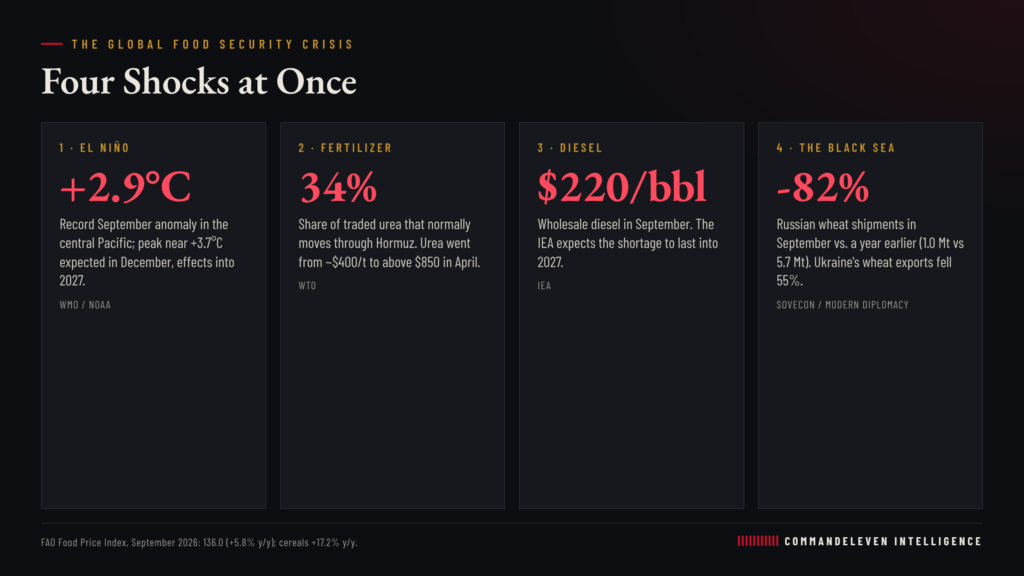
- A record El Niño. The central Pacific’s September temperature anomaly of 2.9°C is the highest ever measured, and forecasters expect a peak near 3.7°C in December, with effects lasting into 2027.
- A fertilizer shock from Hormuz. The strait normally carries about a third of the world’s seaborne fertilizer, including 34% of traded urea. Urea prices doubled within weeks of the February closure.
- A diesel shortage. The International Energy Agency now expects it to last into 2027. Wholesale diesel hit about $220 a barrel in September; diesel runs the tractors, irrigation pumps and trucks that move food.
- A closed Black Sea. Attacks on both sides’ ports have cut Russian and Ukrainian grain exports, which normally supply about 27% of the world’s wheat trade, to a fraction of normal.
The FAO Food Price Index rose to 136.0 in September, its highest since November 2022, with cereals up 17.2% in a year. That is the early signal. Most of the damage is still in the pipeline: crops planted with less fertilizer, harvests hit by El Niño, and lean seasons that peak between early and late 2027.
CommandEleven Intelligence’s United States series showed how these shocks reach American households. This series applies the same analysis to every other major region of the world, using one consistent track so the regions can be compared directly. The finding that runs through all of them: almost every government is reacting to the crisis, and very few have a plan for the next twelve months.
Key Judgments
KJ1: The 2026 food shock is a stacked crisis, not a single one. Each of the four drivers would be serious alone. Together they hit cost (fertilizer, diesel), supply (El Niño, the Black Sea) and logistics at the same time. [ASSESSED]
KJ2: The worst is still ahead. Fertilizer cut back this year shows up in next year’s yields, and FEWS NET places the peak of El Niño-driven hunger between February and September 2027 for most regions, and into early 2028 for Southern Africa. [CONFIRMED on forecasts; ASSESSED on timing]
KJ3: Exposure follows import dependence and conflict, not wealth alone. Rich Gulf states face empty shelves because their food comes through two contested chokepoints; poor exporters like Argentina face falling incomes rather than hunger. [ASSESSED]
KJ4: Africa carries the heaviest combined exposure. It is the only region exposed to all four drivers at a high level, and it holds the world’s worst crisis in Sudan. [ASSESSED]
KJ5: Aid will not close the gap. Funding for food assistance, emergency agriculture and nutrition fell an estimated 59% between 2022 and 2025, before this crisis began. [CONFIRMED]
The Global Scorecard
Each region is rated against the four drivers on a four-step scale: Low, Moderate, High and Severe. The ratings are CommandEleven Intelligence assessments, explained in each regional part. [ASSESSED]
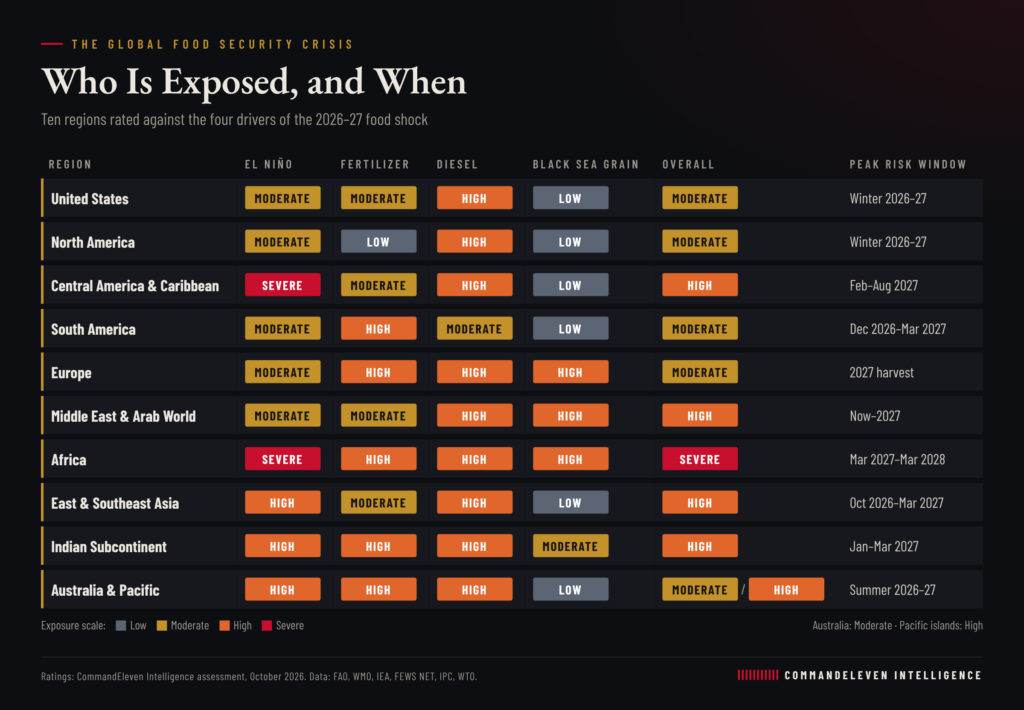
| Region | El Niño | Fertilizer | Diesel | Black Sea grain | Overall | Peak risk window |
|---|---|---|---|---|---|---|
| United States (baseline) | Moderate | Moderate | High | Low | Moderate | Winter 2026–27 |
| North America (Canada, Mexico) | Moderate | Low | High | Low | Moderate | Winter 2026–27 |
| Central America and Caribbean | Severe | Moderate | High | Low | High | Feb–Aug 2027 |
| South America | Moderate | High | Moderate | Low | Moderate | Dec 2026–Mar 2027 |
| Europe | Moderate | High | High | High | Moderate | 2027 harvest |
| Middle East and Arab World | Moderate | Moderate | High | High | High | Now through 2027 |
| Africa | Severe | High | High | High | Severe | Mar 2027–Mar 2028 |
| East and Southeast Asia | High | Moderate | High | Low | High | Oct 2026–Mar 2027 |
| Indian Subcontinent | High | High | High | Moderate | High | Jan–Mar 2027 |
| Australia and the Pacific | High | High | High | Low | Moderate (Australia); High (Pacific islands) | Summer 2026–27 |
The Four Drivers
1. El Niño. The World Meteorological Organization classifies this event as strong and intensifying. The September anomaly in the key Niño 3.4 region was a record 2.9°C, beating 2015 and 1877, and on October 5 the region’s sea temperature passed 30°C for the first time on record. The WMO expects drier-than-normal conditions over the Indian subcontinent, southern and eastern Australia, southern Central America and the Caribbean, northwestern South America and northern Europe, and wetter conditions in the Greater Horn of Africa, southern Europe and southeastern South America. A positive Indian Ocean Dipole is forecast on top, which can amplify drought and flood risk around the Indian Ocean. [CONFIRMED]
2. Fertilizer. According to WTO data, the Strait of Hormuz normally carries about a third of globally traded seaborne fertilizer: roughly 34% of urea, 23% of ammonia and nearly 20% of phosphate. The Gulf also supplies 40% to 45% of global sulfur exports, a key input for phosphate fertilizer. Urea went from about $400 a tonne before the war to above $850 in April, then eased to about $453 by June as shipping partly resumed and China reopened exports. But the damage was done in the planting seasons: farmers who could not afford or find fertilizer applied less, and that shows up in yields. [CONFIRMED]
3. Diesel. The IEA’s October report says the diesel shortage will last into 2027, with inventories not recovering until the second half of that year. Combined Middle East and Russian diesel exports are down more than 60% from a year ago. US pump prices passed $6 a gallon in September, and the EU average hit a record €2.23 a liter. Diesel runs irrigation pumps in South Asia, fishing fleets, tractors and the trucks that carry food to market. In many African markets, transport makes up 30% to 50% of the final price of food. [CONFIRMED]
4. The Black Sea. This driver was not in our original framing, but it can no longer be left out. Ukrainian strikes have taken an estimated 70% of Russia’s grain export capacity offline, including all three grain terminals at Novorossiysk, and Russian attacks have all but stopped ship traffic from Ukraine’s ports. Russian wheat shipments fell to about 1.0 million tonnes in September, against 5.7 million a year earlier; Ukraine’s wheat exports fell 55%. Meanwhile the US is harvesting its smallest wheat crop since 1972 after a Plains drought. [CONFIRMED]
Where the World Stands
- 266 million people in 47 countries faced high levels of acute food insecurity in 2025, according to the Global Report on Food Crises, before the 2026 shocks. 1.4 million were in catastrophe (IPC Phase 5), and famine was confirmed in both Gaza and parts of Sudan.
- The June FAO-WFP Hunger Hotspots report named six countries of highest concern: Sudan, South Sudan, Yemen, Gaza, Nigeria and Somalia. Afghanistan, the Democratic Republic of the Congo and Haiti were rated very high concern; Myanmar, Mali, Lebanon and Madagascar were also listed.
- Conflict was the main driver of hunger for 147 million people in 2025; extreme weather for 87.5 million. In 2026, both are rising at once.
How This Series Works
Every regional part follows the same five-step analysis track, so readers can compare one region directly with another:
- The Four Drivers: the region’s exposure to El Niño, fertilizer, diesel and the Black Sea.
- Import Dependence: how much of its food and farm inputs the region brings in, and through which routes.
- How Governments Are Responding: what has actually been done, as opposed to announced.
- Flashpoints: where food stress is most likely to turn into unrest, displacement or conflict.
- The 12-Month Outlook: what to expect through late 2027, and the indicators to watch.
Claims are marked CONFIRMED, ASSESSED or SPECULATIVE in line with CommandEleven Intelligence’s standard practice.
The Missing Plan
Across the regions, the pattern of response is strikingly similar: fuel tax cuts, price caps, export bans, emergency stock releases and appeals for aid. These are crisis tools. Very few governments have published a plan that connects fertilizer supply for the next planting season, fuel for the next harvest and food stocks for the next lean season. The Arab League’s call on October 5 for a regional early-warning system for food, water and climate security is one of the few attempts to plan ahead, and it is still a proposal. That gap, between reacting and planning, is the central finding of this series. [ASSESSED]
Sources
- FAO Food Price Index rises in September amid weather concerns and transport disruptions, FAO, October 2, 2026
- Strong El Niño expected to intensify, World Meteorological Organization
- Super El Niño set to peak in December, with impacts expected well into 2027, Down To Earth
- WTO data confirms Strait of Hormuz fertilizer trade disruption is easing as urea nears pre-war price, Fertilizer Daily, July 24, 2026
- Iran war: From fertilizer to food crisis?, IFPRI, July 2, 2026
- Diesel shortage to persist into 2027 as Iran war disrupts supply, IEA warns, The National, October 14, 2026
- How Do the Latest Black Sea Attacks Affect Global Food Security?, CSIS, September 11, 2026
- The Black Sea Has Quietly Closed, Modern Diplomacy, October 13, 2026
- USDA Projects Smallest US Wheat Harvest Since 1972 Due to Plains Drought, AgWeb, May 2026
- More than 266 million people face acute food insecurity, conflict main driver, Down To Earth (Global Report on Food Crises 2026)
- New FAO-WFP report warns worsening hunger puts 13 hotspots at significant risk, FAO, June 17, 2026
- 2026–2027 El Niño food security impacts, FEWS NET, October 6, 2026
The Global Food Security Series
Start with the United States baseline: Food Chain Reaction Revisited and The 12-Month Fuse.
- Global Food Security: North America – Part 1
- Global Food Security: Central America and the Caribbean – Part 2
- Global Food Security: South America – Part 3
- Global Food Security: Europe – Part 4
- Global Food Security: The Middle East and Arab World – Part 5
- Global Food Security: Africa – Part 6
- Global Food Security: East and Southeast Asia – Part 7
- Global Food Security: The Indian Subcontinent – Part 8
- Global Food Security: Australia and the Pacific – Part 9

