
Key Judgments
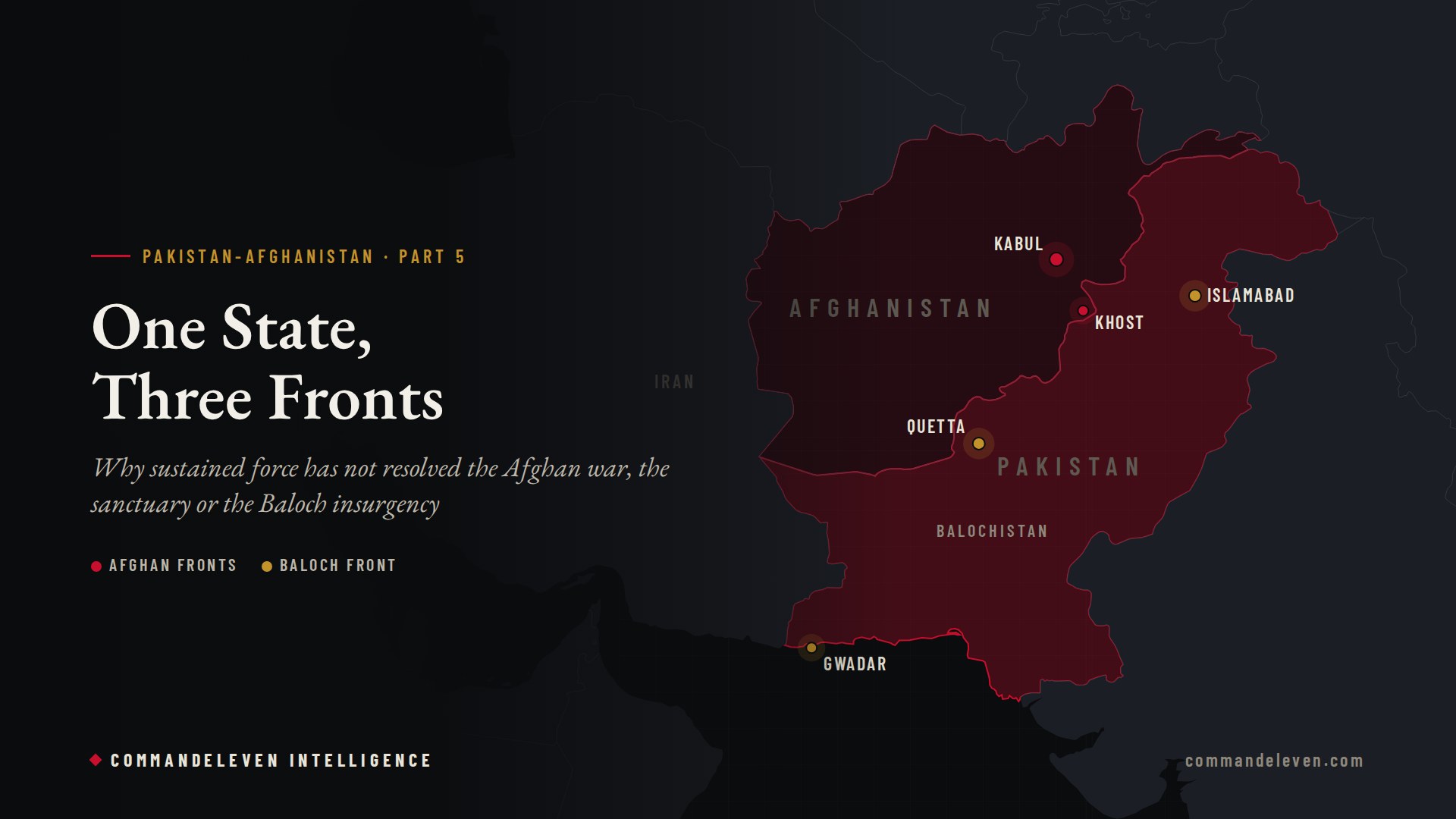
- [CONFIRMED] Across the four preceding parts of this series, Pakistan’s security establishment has spent 2026 managing three geographically and organizationally distinct pressure fronts simultaneously: a state-on-state border war with the Afghan Taliban (Part 1), a UN-documented TTP/AQIS jihadist sanctuary network embedded in the same eastern Afghan provinces (Parts 2-3), and a domestically rooted Baloch insurgency that has more than doubled in lethality within the same twelve-month window (Part 4).
- [CONFIRMED] These three fronts are not merely temporally coincidental. This series has documented direct organizational linkage between two of them (AQIS’s UN-documented ideological and training support to TTP, Part 3) and geographic overlap extending a third into the same Iran-adjacent borderlands CommandEleven Intelligence is treating in a dedicated standalone dossier (the Baloch-Fatemiyoun/Zainabiyoun question, excluded from this series per the editorial decision noted in Part 4).
- [ASSESSED] This convergence is best read as a test case for CommandEleven Intelligence’s own extended strategic argument, carried forward from its April 2026 GCTA — that the “Hard War” model of large-scale conventional kinetic operations has a declining ceiling of efficacy against decentralized, cross-border, and domestically rooted threats — rather than as three unrelated regional news stories. The GCTA’s own text develops this thesis around domestic, digital radicalization specifically; its application to this series’ regional state-on-state and sanctuary-denial case is CommandEleven Intelligence’s own extension, consistent with how the concept has already been carried forward in CommandEleven Intelligence’s Intelligence Hub baseline assessments. Pakistan’s substantial military resources and demonstrated willingness to use them (Part 1’s 73-plus strike locations) have not resolved any of the three fronts this series has documented, each of which remains active as of this writing.
- [ASSESSED] CommandEleven Intelligence’s outlook, consistent with the scenario framework this series’ Part 1 introduced (managed de-escalation, entrenched low-grade rivalry, or strategic backfire), is that entrenched multi-front rivalry — not resolution in any direction — remains the most probable near-term trajectory across all three fronts simultaneously, with resource competition between fronts itself becoming an independent variable shaping how any one of them develops.
- [DATA DEFICIT] This series deliberately excludes the Iran/Fatemiyoun-Zainabiyoun/BLA dimension flagged in Part 4, reserving it for dedicated standalone treatment given its distinct evidentiary weight and its implications extending well beyond the Pakistan-Afghanistan relationship this series examines. Readers should treat that exclusion as a scope decision, not as CommandEleven Intelligence’s assessment that the question is unimportant — the opposite is closer to true, which is precisely why it merits dedicated rather than folded-in treatment.
The Throughline This Series Has Traced
Read individually, each of this series’ four parts tells a complete story with its own evidentiary base: a border war with a clear trigger and timeline (Part 1), a UN-documented sanctuary network with specific named provinces and facilitation evidence (Part 2), an al-Qaeda regional leadership structure with its own independent UN sourcing (Part 3), and a domestic insurgency with decades-old roots now sharply intensifying (Part 4). Read together, these four parts describe something this series’ introduction anticipated but could not yet demonstrate: a single Pakistani security establishment, with finite military, intelligence, and diplomatic capacity, simultaneously confronting a conventional interstate conflict, a cross-border jihadist sanctuary problem with direct organizational linkages between its component groups, and a homegrown insurgency targeting the country’s most significant foreign economic partnership — all within the same twelve-month window, none of them resolved, and at least two of them (the Afghan sanctuary network and the Baloch insurgency) showing evidence of growing rather than shrinking in scale over the year this series covers.
This is not, CommandEleven Intelligence wants to be explicit, a claim that these three fronts are centrally coordinated against Pakistan by a single hostile actor or intelligence service. This series has found no evidence supporting that framing, and declines to speculate toward it. The throughline is structural rather than conspiratorial: a state with genuine, longstanding, independently-rooted security challenges on multiple fronts, experiencing most of them intensifying in the same period, placing unusual simultaneous strain on the same finite security apparatus.
What Pakistan’s Response Reveals About the Hard War Ceiling
CommandEleven Intelligence’s April 2026 Global Counter-Terrorism Assessment argued that large-scale conventional kinetic operations — the “Hard War” model that has defined most state counter-terrorism doctrine since 2001 — face a declining ceiling of efficacy against adversaries whose actual center of gravity is decentralized, cross-border, ideologically or tribally embedded, or rooted in grievances that military action does not address at their source. The GCTA’s own text develops this argument specifically around domestic, digital radicalization; CommandEleven Intelligence has since extended the same underlying logic to regional state-on-state and sanctuary-denial operations in its Intelligence Hub baseline assessments, and this series applies that extended framework. This series has, across its four parts, assembled what CommandEleven Intelligence assesses as the clearest single regional test of that extended thesis available in 2026.
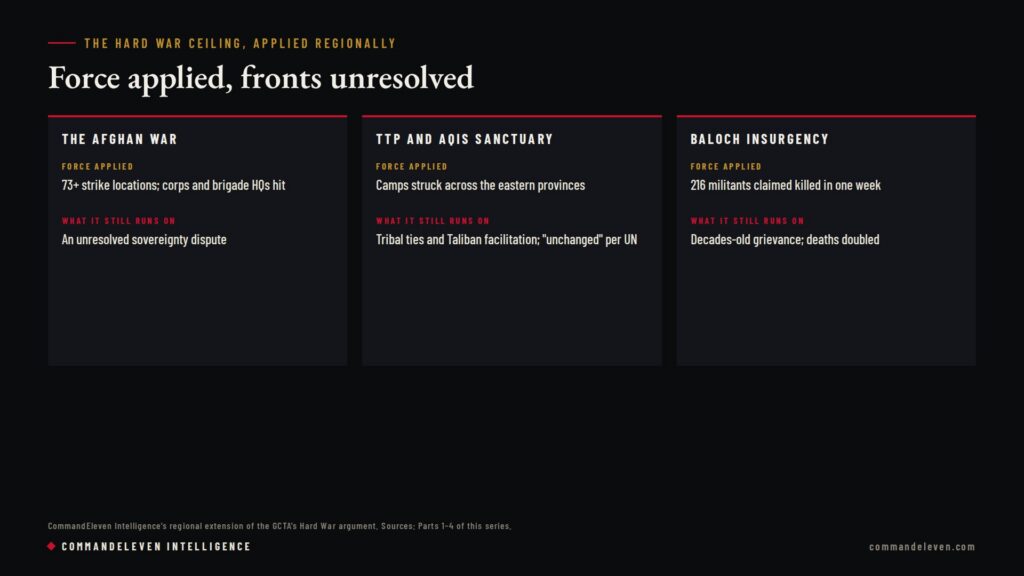
Pakistan’s response to each of its three fronts has been substantially, though not exclusively, kinetic: the air campaign documented in Part 1 struck over 73 distinct locations across nine-plus Afghan provinces, hitting Taliban corps and brigade headquarters directly; counter-insurgency operations against TTP’s sanctuary network, while less centrally documented in this series’ open-source review, have continued in parallel; and Pakistani security operations against Baloch insurgent groups during and after Operation Herof 2.0 killed a claimed 216 militants in a single week, per Part 4. By any conventional measure of military activity and claimed tactical effect, Pakistan has applied substantial, sustained force across all three fronts simultaneously.
[ASSESSED] And yet, as of this writing: the TTP sanctuary network Part 2 documented remains UN-assessed as “unchanged” in strength (and, per Part 2’s own caveat, CommandEleven Intelligence’s independent assessment suggests the true figure may run higher than that UN baseline); AQIS leadership remains, per Part 3, resident in Kabul with official Taliban documentation; and the Baloch insurgency Part 4 documented has grown in lethality rather than diminished over the same period Pakistan’s counter-operations have intensified. This is precisely the pattern CommandEleven Intelligence’s extended Hard War thesis predicts: substantial kinetic effort producing tactical results (named casualties, destroyed infrastructure, degraded specific facilities) without resolving the underlying structural conditions — organizational sympathy and tribal obligation in TTP’s case (Part 2), decentralized narrative-based cohesion in AQIS’s case (Part 3), and decades-old, resource- and rights-based grievance in the Baloch insurgency’s case (Part 4) — that regenerate the threat faster than kinetic pressure alone can suppress it.
The Resource-Competition Problem
This series’ most forward-looking judgment, not fully developed in any single prior part, is that the three fronts are not merely occurring simultaneously but are now in active resource competition with each other inside Pakistan’s own security establishment. A military and intelligence apparatus sized and postured for a single major contingency is, by definition, operating below its designed effectiveness threshold when confronting three simultaneously — air assets committed to the Afghan border campaign are not available for Baloch counter-insurgency operations in the same window; intelligence collection prioritized toward TTP/AQIS sanctuary monitoring competes for the same analytical and human-source capacity that Baloch insurgency monitoring requires; and diplomatic bandwidth spent on the collapsed Istanbul talks and subsequent Saudi-Qatari-Turkish mediation efforts (Part 1) is diplomatic bandwidth not simultaneously available for whatever international engagement the Baloch question or the broader CPEC-security relationship with China might otherwise receive.
[ASSESSED] CommandEleven Intelligence does not have access to Pakistan’s internal force-allocation decision-making and does not claim to know precisely how this competition is being managed or mismanaged inside the Pakistani security establishment. What this series does assess, based on the publicly observable pattern across all four parts, is that the simultaneity itself is a meaningful variable independent of any single front’s own merits — a security establishment that might manage any one of these three challenges to a reasonable resolution in isolation faces a qualitatively harder problem managing all three at once, and the twelve-month record this series has documented is consistent with that harder problem producing exactly the “entrenched rivalry on all fronts” outcome this chapter’s Key Judgments describe as the most probable near-term trajectory.
What This Series Does Not Claim
Consistent with CommandEleven Intelligence’s standing editorial discipline and this series’ own practice throughout, it is worth closing with what this series has not established:
- This series does not claim centralized coordination between Afghanistan’s Taliban government, TTP, AQIS, and Baloch insurgent groups against Pakistan as a single hostile strategy. The organizational linkage this series has documented (AQIS-TTP, Part 3) is real and UN-sourced; a four-way coordinated campaign against Pakistani state stability is not something this series’ sourcing supports, and CommandEleven Intelligence does not assert it.
- This series does not claim the Iran/Fatemiyoun-Zainabiyoun/BLA dimension flagged in Part 4, which carries its own distinct and significant evidentiary weight, as part of this series’ core argument. That question is reserved for dedicated standalone treatment, not because it is less important, but because folding it into this series’ four-front framework would understate its significance rather than appropriately capture it.
- This series does not predict a specific resolution timeline or outcome for any of the three fronts examined. The scenario framework drawn from Part 1 (managed de-escalation, entrenched rivalry, strategic backfire) remains the most defensible forward-looking structure available from current open-source evidence, and this series’ own assessment favors entrenched rivalry as the near-term base case without claiming certainty about it.
- This series does not take an institutional position on what policy response — Pakistani, American, Chinese, or multilateral — would best address any of the three fronts examined. Consistent with CommandEleven Intelligence’s standing practice, this series’ function is to establish the evidentiary record across all four parts; policy response is properly a matter for the relevant governments and the broader public debate this series aims to inform.
Closing Assessment and Forward Links
Twelve months into Pakistan’s 2026 crisis year, the region this series has examined remains under genuine, documented, multi-front pressure, with no single thread showing clear resolution and at least two (the Baloch insurgency and, per the UN’s own “unchanged” assessment, the TTP/AQIS sanctuary network) showing evidence of persistence or growth despite sustained Pakistani military effort. That is not, on its own, a prediction of state failure or imminent collapse — Pakistan retains, as Part 1 noted, substantial structural military and economic advantages over any single one of these threats in isolation. But it is a record that should inform how readers evaluate any single piece of regional news in isolation: a Pakistani airstrike in Kunar, a BLA attack claim in Khuzdar, or a new al-Qaeda propaganda release are each, individually, a data point in a single-front story. Read together, across the four parts this series has assembled, they are chapters in the same regional pressure test — one CommandEleven Intelligence’s own April 2026 GCTA anticipated in strategic-framework terms before most of 2026’s specific events had occurred.
This series connects forward to three pieces of CommandEleven Intelligence’s ongoing coverage: the forthcoming standalone dossier on Iran’s Fatemiyoun/Zainabiyoun deployment and its relationship to Baloch armed groups, which this series has deliberately excluded pending dedicated treatment; the GCTA Foresight Audit, Part 2, which scores the GCTA’s Indian Subcontinent forecasts against the record this series assembled, and reconciles the two where they differed: the war’s operation name and trigger, and the provinces hosting the TTP sanctuary; and CommandEleven Intelligence’s existing ISKP Convergence Series, whose TTP, BLA and Haqqani technical-handshake pieces (The TTP/ISKP Technical Handshake, The BLA/ISKP Technical Handshake and The Haqqani/ISKP Technical Handshake) this series has cross-linked throughout rather than duplicated, and which readers seeking the actor-to-actor technical relationships underlying this series’ broader regional argument should treat as essential companion reading.
Frequently Asked Questions
What fronts is Pakistan fighting on in 2026?
Three at once: the war with the Afghan Taliban, the TTP and al-Qaeda sanctuary network in eastern Afghanistan, and the Baloch insurgency at home.
Are the three fronts coordinated against Pakistan?
This series found no evidence of central coordination. AQIS supports the TTP, but the Baloch insurgency is separate. The link is structural: all three strain the same security apparatus at the same time.
What does the series conclude?
Substantial kinetic effort has produced tactical results without resolving any front. CommandEleven Intelligence’s base case is entrenched rivalry on all three through early 2027.
Sourcing Base
This closing synthesis draws on the full sourcing base established across Parts 1-4 of this series; no new primary sourcing is introduced beyond the structural cross-references above.
CommandEleven Intelligence Prior Work (Full Series Cross-Reference):
- CommandEleven Intelligence, 2026 Global Counter-Terrorism Assessment, April 2026 (Hard War ceiling-of-efficacy thesis, originally applied to domestic radicalization; its extension to this series’ regional case is CommandEleven Intelligence’s own, consistent with the firm’s Intelligence Hub baseline assessments)
- CommandEleven Intelligence, GCTA Foresight Audit, Part 1: Financing and the Stealth State and Part 2: The Indian Subcontinent
- CommandEleven Intelligence, ISKP Convergence Series (TTP, BLA and Haqqani technical-handshake pieces)
- CommandEleven Intelligence, Evolving Profile of TTP, Western Weapons Proliferation: TTP & BLA and Haqqani Network Technology Proliferation
- CommandEleven Intelligence, The Iran-al-Qaeda Nexus (leadership-location editorial standard applied throughout this series)
- CommandEleven Intelligence, Information Warfare & Radicalization in the AI Era (al-Qaeda’s narrative-bound decentralization, applied in Part 3)
- CommandEleven Intelligence, forthcoming standalone dossier on Iran’s Fatemiyoun/Zainabiyoun deployment and Baloch armed-group dynamics
Excluded from this synthesis: Any claim of centralized multi-actor coordination against Pakistani state stability; any specific resolution timeline for any of the three fronts examined; the Iran/Fatemiyoun-Zainabiyoun/BLA dimension, reserved for dedicated standalone treatment.
The Pakistan-Afghanistan Series
- Open War: The 2026 Pakistan-Afghanistan Escalation Timeline – Part 1
- The TTP Sanctuary Question: Mapping a Denied Safe Haven – Part 2
- Hamza bin Laden and Al-Qaeda’s Regional Re-Emergence – Part 3
- The Baloch Insurgency Uptick: A Second Front Under Pressure – Part 4
- Synthesis: A Region Under Simultaneous Pressure – Part 5 (you are here)

