
Key Judgments
- [CONFIRMED] Al-Qaeda’s As-Sahab media wing released a 52-minute video on September 10, 2026 — timed to the 25th anniversary of September 11 — titled “A Quarter Century of the 11 September Raids,” featuring Hamza bin Laden speaking twice despite a standing U.S. claim that he was killed in a 2019 strike; the video’s captions notably omitted the martyr honorifics conventionally applied to deceased jihadist figures, a deliberate ambiguity CommandEleven Intelligence reads as calculated rather than accidental.
- [CONFIRMED] UN Security Council Monitoring Team reporting, relayed via multiple outlets in 2026, documents that al-Qaeda in the Indian Subcontinent (AQIS) leadership — specifically emir Osama Mahmood and deputy Yahya Ghouri — are based in Kabul under Haqqani Network influence, and that AQIS leaders have been issued official Afghan identity documents (tazkiras) by the Taliban government, a direct and specific form of state facilitation distinct from the passive-tolerance framing the Taliban publicly maintains.
- [CONFIRMED] The same UN monitoring assessment found al-Qaeda’s overall “status and strength in Afghanistan remained unchanged” as of August 2026, and documented that AQIS provides ideological guidance, training, and support to Tehreek-e-Taliban Pakistan — a direct, UN-documented organizational link between the al-Qaeda regional network this chapter examines and the TTP sanctuary network this series’ Part 2 has already mapped in the same Afghan provinces.
- [ASSESSED] The Hamza bin Laden video’s actual content — dominated by de facto al-Qaeda leader Saif al-Adel’s strategic writings on 9/11’s purpose (not territorial conquest, but drawing the United States into prolonged overseas commitments and exacerbating internal political division) alongside Hamza’s own recruitment-oriented appeal — functions as a leadership-succession workaround: al-Qaeda has operated without a formally named successor since Ayman al-Zawahiri’s 2022 death, and the bin Laden name offers symbolic authority capable of binding an increasingly autonomous, decentralized affiliate network without requiring a formal oath of allegiance that could expose fracture lines.
- [DATA DEFICIT] Hamza bin Laden’s actual current status — alive and in a senior or symbolic role, possibly under Taliban or Haqqani protection inside Afghanistan, versus deceased with the video serving purely symbolic/archival purposes — remains unconfirmed in open-source reporting. CommandEleven Intelligence does not adopt either position as established fact and treats the ambiguity itself, as its Iran-al-Qaeda dossier did regarding Saif al-Adel’s own location, as a recurring and apparently deliberate feature of how al-Qaeda’s current leadership structure operates rather than a gap this dossier can responsibly close.
A Video Built to Be Ambiguous
Al-Qaeda’s September 10, 2026 release landed with calculated timing — one day ahead of the 25th anniversary of the September 11 attacks, ensuring maximum news-cycle visibility. The 52-minute production, “A Quarter Century of the 11 September Raids,” is not primarily a Hamza bin Laden vehicle in terms of actual content weight: the bulk of the video’s substantive argument is drawn from de facto al-Qaeda leader Saif al-Adel’s own strategic writings, reframing 9/11’s purpose in terms that notably do not claim military victory or territorial conquest as the operation’s goal. Instead, the video’s own framing — per Small Wars Journal’s detailed analysis — argues the attacks were designed to undermine U.S. global prestige and draw Washington into prolonged, exhausting overseas military commitments while deepening America’s own internal political divisions. Twenty-five years on, with the United States this year engaged in active hostilities against Iran (examined throughout CommandEleven Intelligence’s Iran War Doctrine series) and now watching two of its regional security partners, Pakistan and Afghanistan, fight an open war of their own, al-Qaeda’s own messaging is implicitly inviting the comparison between its stated 2001 strategic theory and 2026’s regional reality — whatever one concludes about the comparison’s actual validity.
Hamza bin Laden’s own on-camera role is narrower but pointed: an appeal urging followers to “join the blessed caravan” — a direct invocation of a seminal early jihadist recruitment text — paired with framing that casts Islam as facing “all-out war” requiring a jihadi response. [ASSESSED] CommandEleven Intelligence reads the video’s internal division of labor — Saif al-Adel supplying strategic legitimacy, Hamza supplying recruitment appeal and name-brand continuity — as itself the most analytically significant feature of the release, more significant than the unresolved question of Hamza’s literal survival. The video’s own captioning choice to withhold standard martyr honorifics is not an oversight in an organization with al-Qaeda’s documented media discipline (examined at length in the companion Information Warfare & Radicalization in the AI Era series, Part 1); it is a deliberate ambiguity, preserving recruitment and legitimacy value regardless of whether Hamza himself is alive to claim it.
The Succession Problem This Video Solves
Al-Qaeda has operated for over four years without formally naming a successor to Ayman al-Zawahiri following his July 2022 killing. That gap is not an oversight; per Small Wars Journal’s analysis, it reflects a structural problem specific to how al-Qaeda’s current organizational model actually functions — a decentralized, franchise-based network held together primarily by shared narrative and brand rather than centralized command. CommandEleven Intelligence’s own April 2026 GCTA documents this directly, describing post-2022 al-Qaeda Central as having become “a decentralized venture capital firm for insurgency” that provides funding, technical R&D, and ideological licensing to regional affiliates, and characterizing the resulting structure — the GCTA’s own term — as a “Stealth State” built, in the document’s words, to “survive the death of any single leader.” Naming a formal successor would require affiliate branches to render bay’ah (a formal oath of allegiance) to that individual specifically — a step that risks exposing exactly the fracture lines a decentralized network survives by avoiding. A new leader is also, immediately and permanently, a more findable and strikeable target than an ambiguous symbolic figure whose precise location and even survival status remain genuinely uncertain.
Hamza bin Laden’s reintroduction solves this problem without creating it. The bin Laden name carries inherited legitimacy no newly elevated leader could match, requires no formal oath that could fracture increasingly autonomous affiliates, and — per Small Wars Journal’s framing — gives geographically and operationally disconnected branches “access to a mythologized past” that binds them ideologically where no functioning command structure binds them operationally. The video’s third documented function, generational recruitment aimed at followers born after 2001 with no lived memory of the September 11 attacks themselves, extends the same logic forward: a new audience needs the founding narrative re-delivered, not a new command structure.
[ASSESSED] This chapter treats this as the clearest real-world case study yet of the mechanism this series’ companion Information Warfare & Radicalization series, Part 1 (Narratives & Strategic Influence), documented in the abstract: a decentralized network using narrative rather than command to produce coordinated effect across disconnected franchises. Readers of that series’ treatment of al-Qaeda’s narrative-bound decentralization should read this chapter as the concrete Afghanistan-Pakistan-specific instance of the pattern that series described structurally. Both use the GCTA’s own term for the structure: the “Stealth State.”
A note on why Hamza wasn’t in the GCTA. CommandEleven Intelligence’s April 2026 GCTA does not name Hamza bin Laden specifically, and that omission was deliberate rather than an oversight: at the time of drafting, CommandEleven Intelligence assessed too much uncertainty around Hamza’s actual role relative to Saif al-Adel’s to include him with any confidence in a document meant to name current leadership structures. The September 2026 video changes that calculus directly — Hamza has moved, in CommandEleven Intelligence’s assessment, “from a ghost to a person,” and this chapter accordingly treats him as a figure the ongoing GCTA Foresight Audit series will need to incorporate going forward, rather than retrofitting his reappearance as something the GCTA predicted. It did not predict it; it correctly declined to guess.
Where This Is Actually Happening: AQIS in Kabul
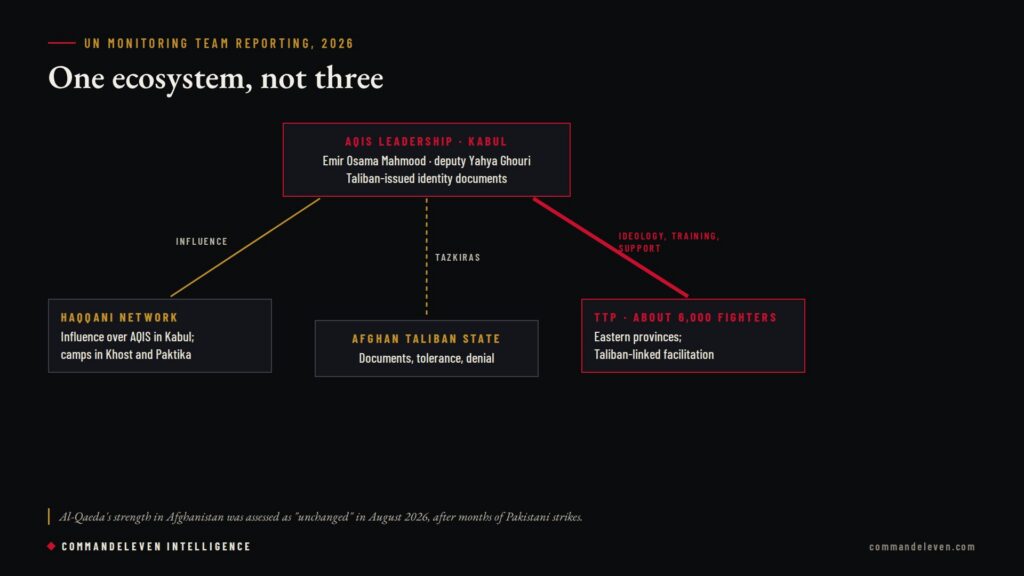
Whatever Hamza bin Laden’s precise personal status, the organizational reality the video draws attention to is independently documented and considerably less ambiguous. UN Security Council Monitoring Team reporting places al-Qaeda in the Indian Subcontinent’s leadership — emir Osama Mahmood and deputy Yahya Ghouri by name — based in Kabul itself, operating under Haqqani Network influence, with the group’s media operations conducted separately from Herat. Most consequentially, the same UN reporting documents that AQIS leaders have been issued official Afghan identity documents — tazkiras — by the Taliban government: not passive tolerance of a presence Kabul cannot fully police, but an affirmative administrative act of state facilitation, difficult to characterize as anything other than direct support regardless of how the Taliban’s own public statements frame the relationship.
[CONFIRMED] The UN’s August 2026 assessment found al-Qaeda’s overall “status and strength in Afghanistan remained unchanged” from prior reporting periods — notable given that assessment covers the same months as the acute phase of the Pakistan-Afghanistan war documented in this series’ Part 1, suggesting the war’s intense kinetic pressure on Taliban military infrastructure has not meaningfully degraded the separate, lower-visibility al-Qaeda sanctuary question this chapter examines. No UN Security Council member state, per the same reporting, endorsed the Taliban’s own public position that no terrorist groups operate inside Afghan territory.
[ASSESSED] Most significantly for this series’ structural argument, the same UN assessment documents that AQIS provides ideological guidance, training, and support directly to Tehreek-e-Taliban Pakistan — meaning the sanctuary network this series’ Part 2 mapped in Khost, Kunar, Nangarhar, Paktika, and Paktia and the al-Qaeda regional network this chapter examines are not merely co-located in the same provinces. They are organizationally linked, with AQIS functioning as an ideological and training resource feeding directly into the TTP insurgency that triggered Pakistan’s war in the first place. This is a materially different and more serious finding than parallel-but-separate sanctuary problems: it describes a single integrated jihadist ecosystem operating across Afghanistan’s eastern provinces, of which TTP and AQIS are two organizationally connected components rather than two coincidentally co-located ones.
A Caveat on Capability
Not every informed assessment reads AQIS’s current reach the same way. Expert commentary surveyed for this chapter is genuinely split: one analyst characterizes al-Qaeda as maintaining “a larger territorial presence across three continents than at any point since founding,” while a former senior Pakistani official argues the organization has, in a more skeptical framing, “lost its teeth and appeal.” [ASSESSED] CommandEleven Intelligence’s own reading sits between these positions: the organizational and sanctuary evidence in this chapter is independently documented and substantial, but documented presence, leadership sanctuary, and ideological support to TTP are not the same claim as restored operational capacity for large-scale external attacks, a distinction this series’ broader GCTA cross-reference (Section V) treats carefully rather than collapsing into a single threat-level judgment.
Saif al-Adel: The Pattern Repeats
Al-Qaeda’s actual strategic leadership almost certainly runs through Saif al-Adel rather than Hamza bin Laden, and al-Adel’s own location — reported as moving between Iran and Afghanistan — remains deliberately uncertain in available reporting. That is consistent with CommandEleven Intelligence’s prior editorial decision, documented in The Iran-al-Qaeda Nexus, to exclude current AQ leadership whereabouts from confident claims given how rapidly and contradictorily such reporting shifts.
[ASSESSED] The Hamza video reinforces rather than resolves that ambiguity, and CommandEleven Intelligence reads the pattern itself — genuine uncertainty maintained around every senior al-Qaeda figure’s precise location and status, Hamza included — as a deliberate operational security practice consistent with the decentralized network model this chapter has described throughout, not as a gap in open-source reporting that better sourcing would eventually close. This dossier accordingly makes no claim about Hamza bin Laden’s current location, and treats his reported possible presence “in a senior or symbolic position, possibly protected by Taliban or Haqqani networks in Afghanistan” — the furthest current reporting goes — as exactly that: a possibility consistent with the broader AQIS-Haqqani sanctuary pattern this chapter has independently documented, not a confirmed fact in its own right.
Series Continuity and the GCTA Throughline
This chapter completes a structural picture this series has now built province by province: Part 1 documented the war Pakistan launched partly over cross-border sanctuary; Part 2 documented the UN’s own independent findings on TTP’s specific sanctuary footprint in that same eastern Afghan geography; this chapter has now documented that the same geography hosts AQIS leadership under direct Taliban administrative facilitation (tazkira issuance), organizationally linked to TTP through documented ideological and training support. Three chapters, one integrated finding: the eastern Afghan sanctuary belt is not host to isolated, competing, or merely co-located threats. It is host to an interlocking jihadist ecosystem that Pakistan’s twelve months of kinetic pressure (Part 1) has not meaningfully degraded, per the UN’s own “unchanged” assessment.
This is also where this chapter connects most directly to CommandEleven Intelligence’s broader published work: the GCTA’s “Stealth State” decentralization framework this chapter’s succession-strategy analysis (Section II) draws on is the same underlying mechanism this series’ companion Information Warfare & Radicalization series built its entire four-part treatment around, and the AQ-Iran dossier’s own exclusion of current leadership-location claims (Section IV) reflects a standing CommandEleven Intelligence editorial judgment now independently reinforced by this chapter’s findings. Readers following this series should treat all three — this chapter, the Information Warfare series, and the AQ-Iran dossier — as a single evolving picture of how a deliberately decentralized, narrative-held network operates across multiple theaters CommandEleven Intelligence covers, rather than as separate stories that happen to share an organization’s name.
Part 4, next in this series, turns to a geographically distinct but temporally overlapping insurgent front: the Baloch insurgency’s own 2026 intensification, which this series’ Parts 1 through 3 have not yet addressed and which — unlike TTP and AQIS — operates from Pakistan’s own territory rather than Afghan sanctuary, raising a different and in some ways more urgent set of questions about Pakistani state capacity under simultaneous multi-front pressure.
Frequently Asked Questions
Is Hamza bin Laden alive?
Unconfirmed. He appears in al-Qaeda’s September 10, 2026 video despite a US claim that he was killed in 2019, and the video withholds the honorifics used for the dead. CommandEleven Intelligence takes no position either way.
Why did al-Qaeda bring back Hamza bin Laden?
CommandEleven Intelligence assesses it as a succession workaround: the bin Laden name binds a decentralized network without naming a new emir who would need oaths of allegiance and would become a target.
Is al-Qaeda’s leadership in Afghanistan?
UN Monitoring Team reporting places AQIS emir Osama Mahmood and deputy Yahya Ghouri in Kabul, with Taliban-issued identity documents, and found al-Qaeda’s strength in Afghanistan unchanged as of August 2026.
Sourcing Base (Confidence-Tiered, with Links)
CONFIRMED — Primary/Institutional & UN Monitoring:
- Small Wars Journal, “Why Al-Qaeda Is Bringing Hamza bin Laden Back“
- Militant Monitor (Substack), “Hamza bin Laden Resurfaces in Al-Qaeda’s 9/11 Anniversary Video“
- SATP, “Al-Qaeda releases new video of Hamza bin Laden ahead of 25th 9/11 anniversary“
- Amu TV, “UNSC says al Qaeda’s Indian Subcontinent leaders based in Kabul“
- The Media Line, “Al-Qa’ida’s Afghan Presence Persists 25 Years After 9/11“
ASSESSED — Credible Secondary/Academic Analysis:
- Combating Terrorism Center at West Point, “Al-Qa’ida in the Indian Subcontinent: An Appraisal of the Threat in the Wake of the Taliban Takeover of Afghanistan“
- GW Program on Extremism, “Al-Qaeda, the Taliban, and the Future of U.S. Counterterrorism in Afghanistan“
- HSToday, “Al-Qaeda Marks 25th Anniversary of 9/11 With Retrospective Video Glorifying Attacks“
- Kabul Now, “The Image of Hamza bin Laden“
CommandEleven Intelligence Prior Work (Cross-Reference):
- CommandEleven Intelligence, The Iran-al-Qaeda Nexus: From Sanctuary to the Houthi Bridge, September 4, 2026 (Saif al-Adel location-ambiguity editorial standard)
- CommandEleven Intelligence, Information Warfare & Radicalization in the AI Era, Part 1 (al-Qaeda’s narrative-bound decentralization mechanism)
- CommandEleven Intelligence, 2026 Global Counter-Terrorism Assessment, April 2026 (“Stealth State” and Distributed Strike Doctrine framework; the GCTA does not name Hamza bin Laden, a deliberate exclusion given insufficient certainty of his role relative to Saif al-Adel at the time of drafting)
- CommandEleven Intelligence, GCTA Foresight Audit, Part 1: Financing and the Stealth State
- CommandEleven Intelligence, Iran War Doctrine & Strategy series (US regional military commitment context)
Excluded from this dossier: Hamza bin Laden’s current survival status and location are not asserted as fact in either direction. Saif al-Adel’s precise current location is likewise excluded, consistent with CommandEleven Intelligence’s standing editorial practice established in the AQ-Iran dossier. Specific AQIS fighter-strength figures are excluded; no source reviewed for this chapter provided an independently verified current count.
The Pakistan-Afghanistan Series
- Open War: The 2026 Pakistan-Afghanistan Escalation Timeline – Part 1
- The TTP Sanctuary Question: Mapping a Denied Safe Haven – Part 2
- Hamza bin Laden and Al-Qaeda’s Regional Re-Emergence – Part 3 (you are here)
- The Baloch Insurgency Uptick: A Second Front Under Pressure – Part 4
- Synthesis: A Region Under Simultaneous Pressure – Part 5

