Update, November 12, 2026: New 2026 evidence adds to this chapter. ICCT and the Soufan Center note that companion chatbots can themselves become part of the radicalization process, which we hold as ASSESSED, and Europol’s recent reports show teenagers as a large share of EU terrorism arrests. The Key Judgments below stand. See Terrorist Use of AI and the Younger Recruit.
Key Judgments
- [CONFIRMED] State and non-state actors alike now treat the information environment as a contested operational domain in its own right — a framing formalized by NATO’s Allied Command Transformation in its Cognitive Warfare Exploratory Concept, and independently converged on by U.S., Russian, Iranian, and Chinese strategic-communications doctrine over the past several years.
- [CONFIRMED] Jihadist media organizations — al-Qaeda’s As-Sahab/Al-Hayat lineage and the Islamic State’s Al-Naba weekly newsletter and Amaq news agency — have operated as disciplined, brand-managed publishing operations for over a decade, with editorial cycles, house style, and audience segmentation more closely resembling a wire service than an underground pamphlet.
- [ASSESSED] The core mechanism connecting narrative exposure to mobilization is not persuasion by argument but identity fusion — a process, well documented in the academic radicalization literature, by which repeated narrative exposure collapses the distance between an individual’s personal identity and a group’s collective identity, after which action on the group’s behalf is experienced as self-expression rather than obedience.
- [ASSESSED] CommandEleven Intelligence’s April 2026 Global Counter-Terrorism Assessment (GCTA) anticipated this dynamic in its account of al-Qaeda’s “Stealth State”: a decentralized network, consolidated after 2022 under Saif al-Adel’s guidance, that licenses its brand and doctrine to regional franchises and is built, in the GCTA’s words, to “survive the death of any single leader.” What holds that network together is shared narrative rather than command-and-control. This dossier extends the framework from organizational structure into the narrative mechanics that make it function.
- [DATA DEFICIT] Open-source measurement of narrative effectiveness — which specific frames, delivered through which channels, produce measurable shifts toward mobilization versus passive sympathy — remains thin and is not independently quantifiable from public reporting. This series treats narrative mechanics as reasonably well established; it treats effect sizes as an open research question, and says so throughout.
The Information Environment as a Domain
For most of the post-9/11 counterterrorism era, propaganda was treated as a support function — the marketing arm of an organization whose real work was training camps, weapons, and attack planning. That framing is now out of date on both the state and non-state sides of the ledger.
NATO’s Allied Command Transformation has spent the past several years developing a formal Cognitive Warfare Exploratory Concept, treating the human mind itself — beliefs, perceptions, decision-making — as a domain that can be contested the way land, sea, air, space, and cyber already are. The concept’s premise is blunt: an adversary that can shape what a population believes to be true, without firing a shot, has achieved an operational effect that older frameworks would have required kinetic action to produce. Parallel doctrinal development on the state side — Russian, Iranian, and Chinese approaches to what regional analysts increasingly call “narrative warfare” — has converged on the same premise from a different direction, treating narrative dominance as a prerequisite for, not a byproduct of, operational success in grey-zone competition.
[ASSESSED] CommandEleven Intelligence reads this convergence as significant less because any one doctrine is novel — information operations are ancient — than because state militaries, terrorist media wings, and commercial platform-manipulation actors are now, for the first time, drawing on a shared and increasingly mechanized toolkit: the same generative AI systems, the same platform-amplification dynamics, and, in several documented cases, the same production values. Part 2 of this series examines that toolkit directly. This chapter establishes the narrative logic the toolkit is built to deliver.
Jihadist Media as Institution, Not Improvisation
It is worth stating plainly, because it is still underappreciated in general commentary: jihadist propaganda has not been amateur or improvised for well over a decade. Al-Qaeda’s As-Sahab Media Foundation and its later Al-Hayat Media Center offshoot, and the Islamic State’s Amaq News Agency and Al-Naba weekly newsletter, have functioned as disciplined publishing operations with editorial cadence, house style, translation pipelines into multiple languages, and deliberate audience segmentation — recruitment-facing content distinct from operational claims-of-responsibility distinct from doctrinal justification aimed at religious legitimacy questions.
Al-Naba’s publication history through 2025 illustrates the institutional discipline directly: the newsletter has run a sustained editorial campaign attacking Syria’s post-Assad transitional government under Ahmed al-Sharaa, using a consistent framing — that al-Sharaa’s accommodation with Western and regional governments constitutes apostasy from the movement’s founding principles — issue after issue, months apart, without deviation from the core narrative line. That is not the output of an organization producing propaganda opportunistically. It is a newsroom with an editorial position, maintained over time, the same way any state broadcaster maintains one.
[ASSESSED] The competitive dynamic between al-Qaeda’s and the Islamic State’s media strategies is itself analytically useful. Where the Islamic State’s brand — built for the caliphate-declaration era — favored high-production-value violence content designed for viral distribution and shock value, al-Qaeda’s output as the decentralized “Stealth State” the GCTA documents has trended toward longer-form doctrinal and strategic content aimed at a narrower, more durable audience of committed sympathizers and franchise leadership — a narrative strategy that matches the organizational strategy of franchise durability over spectacular centralized action.
The Mechanism: Identity Fusion, Not Persuasion
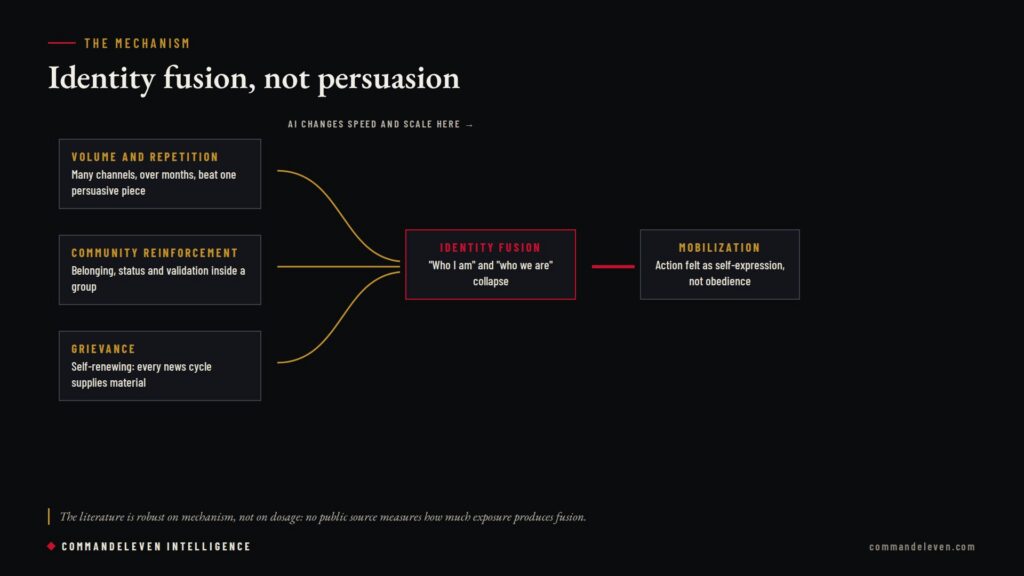
A recurring error in public commentary on radicalization is to model it as a persuasion problem — as though exposure to a convincing argument is what moves someone from sympathy to action. The academic literature on radicalization dynamics does not support that model. What the literature does support is a process closer to identity fusion: repeated, immersive exposure to a narrative — delivered through content, community, and social reinforcement rather than a single argument — that gradually collapses the psychological distance between “who I am” and “who this group is.” Once that fusion occurs, action taken on the group’s behalf stops registering, to the individual, as following orders. It registers as an act of self-expression.
This has three practical implications relevant to counter-messaging design, which this series’ Part 4 addresses directly:
- Volume and repetition matter more than argument quality. A narrative that is repeated across many low-production-value channels over months is, per the identity-fusion literature, more likely to produce fusion than a single high-production-value piece, however persuasive. This is one reason platform-scale amplification (Part 2, Part 3) is now treated as a threat-multiplier independent of content quality.
- Community reinforcement is the delivery mechanism, not a side effect. Narrative exposure that occurs inside a community — an encrypted channel, a forum, a peer network — that visibly rewards fusion (status, belonging, validation) fuses faster than the same narrative encountered in isolation. This is the through-line into Part 3’s treatment of digital recruitment ecosystems.
- Grievance narratives are more durable than ideological ones. Content framed around a specific, personally-resonant grievance — a war, a domestic policy, a personal humiliation — appears in the literature to produce more durable fusion than abstract ideological content, because grievance narratives are self-renewing: each new news cycle supplies fresh confirming material without the organization having to manufacture it.
[DATA DEFICIT] CommandEleven Intelligence flags, consistent with Key Judgment 5, that none of the above should be read as a quantified predictive model. The identity-fusion literature is robust on mechanism; it is not robust on dosage — how much exposure, over what period, produces fusion in what proportion of an exposed population. Any public claim implying a precise threshold should be treated with skepticism regardless of source.
AI as an Accelerant, Not a New Mechanism
The rise of generative AI tools over the past two years has altered the speed and scale at which narrative content can be produced and personalized, not the underlying psychological mechanism described above. Deepfake video and audio, AI-generated imagery, and large-language-model-assisted text production have all been documented in open-source reporting as tools already in use to accelerate radicalization pathways — lowering the production cost of high-volume, repetitive, community-reinforced content to near zero, and enabling a level of narrative personalization (content tailored to an individual’s specific grievances and vulnerabilities, inferred from their own online behavior) that was previously available only to well-resourced state influence operations.
[ASSESSED] CommandEleven Intelligence assesses this as the single most consequential shift in the information-warfare landscape since the GCTA’s April 2026 publication, and the reason this series exists as a standalone project rather than a subsection of prior coverage. Part 2 examines the specific tooling — platforms, generation methods, and the AI-enabled countertools now being deployed against them — in full.
Series Continuity and the GCTA Throughline
This series is CommandEleven Intelligence’s dedicated treatment of a dynamic the April 2026 GCTA raised but did not fully develop: that al-Qaeda’s “Stealth State” — a decentralized, franchise-based network held together by shared narrative rather than central command — depends on precisely the narrative-mechanics-at-scale problem this Part 1 chapter has outlined. A decentralized network cannot function on command-and-control; it has to function on a shared story compelling enough that geographically and operationally disconnected franchises act in a coordinated direction without being told to. Part 3 of this series returns to this point directly, extending the GCTA’s own treatment of the Stealth State into the algorithmic-amplification mechanics that let a single narrative reach and fuse audiences across every franchise simultaneously — the digital-era version of the old training-camp indoctrination pipeline, at a scale no training camp could match.
Frequently Asked Questions
How does extremist propaganda lead to violence?
Mostly through identity fusion rather than persuasion: repeated, community-reinforced exposure collapses the gap between a person’s identity and the group’s, so acting for the group feels like self-expression.
Is jihadist propaganda professionally produced?
Yes. Al-Qaeda’s As-Sahab and the Islamic State’s Amaq and Al-Naba have run as disciplined publishing operations for over a decade, with editorial lines, house style, translation and audience segmentation.
Has AI changed how radicalization works?
CommandEleven Intelligence assesses that AI has changed the speed, scale and personalization of narrative content, not the underlying psychological mechanism.
Sourcing Base (Confidence-Tiered, with Links)
CONFIRMED — Primary/Institutional Doctrine & CommandEleven Intelligence Prior Work:
- CommandEleven Intelligence, 2026 Global Counter-Terrorism Assessment, April 2026 (“Stealth State” and Strategic Pivot sections)
- NATO Allied Command Transformation, “Cognitive Warfare: Strengthening and Defending the Mind“
- NATO Allied Command Transformation, “Allied Command Transformation develops the Cognitive Warfare Concept to Combat Disinformation“
- NATO Allied Command Transformation, “Cognitive Warfare” activity page
- SpecialEurasia, “Al-Naba 495: Islamic State’s Propaganda Against al-Sharaa“
- SpecialEurasia, “Al-Naba Issue 525: the Islamic State Attacks al-Sharaa“
ASSESSED — Credible Secondary/Academic Reporting:
- Frontiers in Big Data, “Cognitive warfare: a conceptual analysis of the NATO ACT cognitive warfare exploratory concept“
- Small Wars Journal, “Narrative as a Weapon: Russian, Iranian, and Chinese Approaches to Cognitive Warfare“
- Small Wars Journal, “Sovereign Shield, Alliance Sword: Evolving NATO’s Strategic Communications Doctrine for Cognitive Warfare“
- Rise to Peace, “Al-Qaeda vs. the Islamic State: Evolving Media Strategies of Terrorist Organizations“
- Small Wars Journal (ASU), “ISIS’s Transition and the Interplay of Online and Face-to-Face Recruitment“
- Frontiers in Political Science, “The role of artificial intelligence in radicalisation, recruitment and terrorist propaganda“
- GNET, “From Confusion to Extremism: How Deepfakes Facilitate Radicalisation“
- Frontiers in Social Psychology, “Social media, AI, and the rise of extremism during intergroup conflict“
Excluded from this dossier: Specific claims of quantified narrative “conversion rates” or precise exposure thresholds circulating in some secondary commentary. The underlying identity-fusion literature supports mechanism, not a validated dosage model, and CommandEleven Intelligence declines to reproduce figures it cannot independently verify.
The Information Warfare Series
Information Warfare & Radicalization in the AI Era: Series Introduction
- Narratives and Strategic Influence: How Story Shapes Mobilization – Part 1 (you are here)
- The Tooling: Encrypted Platforms, Deepfakes and the AI Arms Race – Part 2
- Digital Recruitment Ecosystems and Algorithmic Amplification – Part 3
- Counter-Messaging: What Works, What Doesn’t and What Remains Unproven – Part 4