
Why This Series, Why Now
In February 2026, Pakistan and the Afghan Taliban moved from a deteriorating but still-managed security relationship into formally declared open war. Three weeks of sustained airstrikes followed — against Taliban corps headquarters, not just militant camps — then a ceasefire that broke down within a day, then a lower-tempo but unresolved rivalry that reheated sharply again this September. That war is the headline most audiences have seen. It is not the whole story.
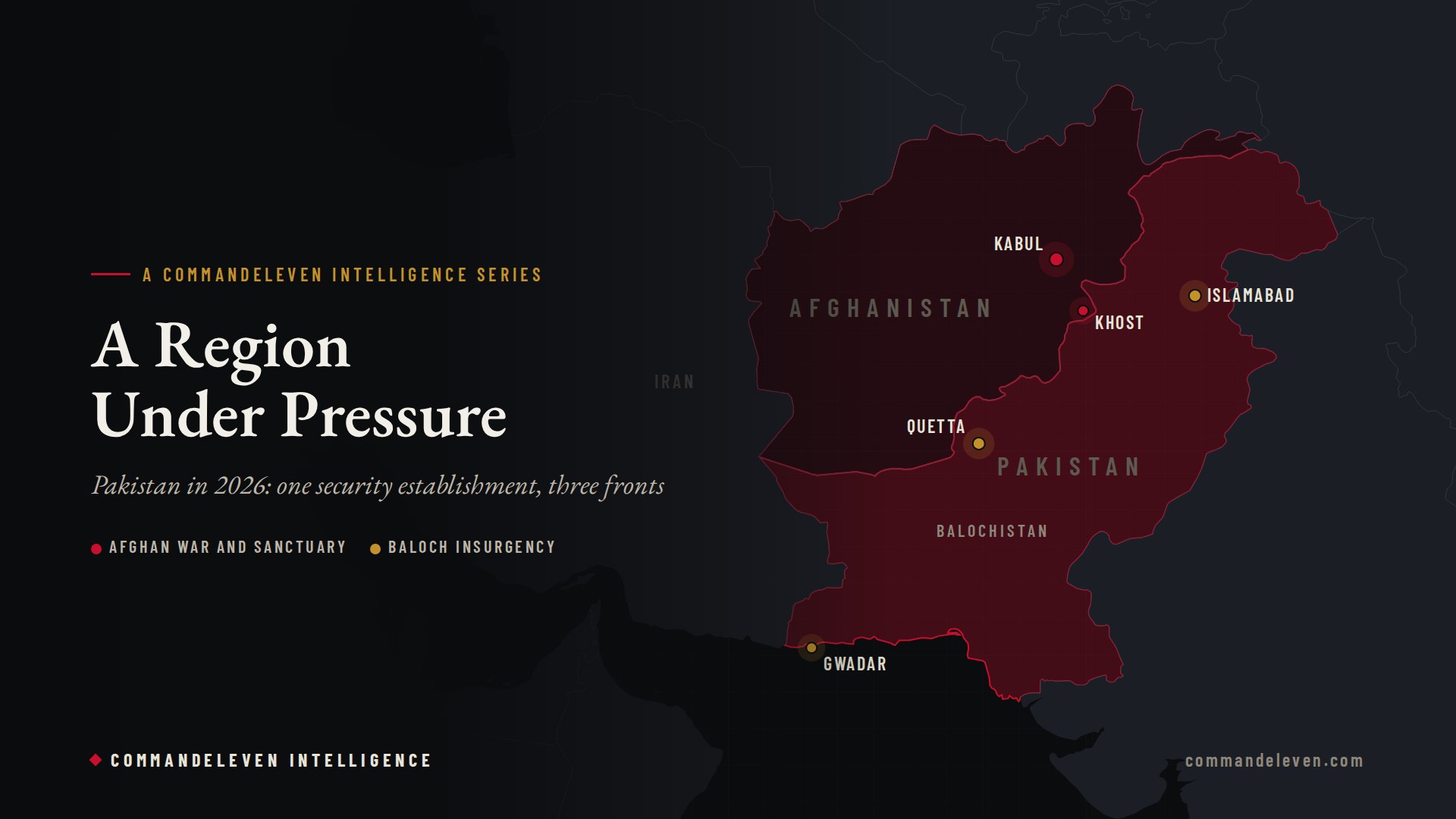
Running underneath and alongside that border war, CommandEleven Intelligence has spent this series tracing three further threads that rarely make the same news cycle as an airstrike: a UN Security Council-documented sanctuary network hosting roughly 6,000 Tehreek-e-Taliban Pakistan fighters across five eastern Afghan provinces, with Taliban-linked facilitation extending to financing and transfers; al-Qaeda’s own regional leadership — AQIS’s emir and deputy, by name — resident in Kabul with official Afghan identity documents issued by the Taliban government; and a Baloch insurgency, rooted in grievances decades older than any of 2026’s headlines, that has more than doubled in lethality over the same twelve months.
Each of these threads has its own trigger, its own timeline, and its own evidentiary base. This series’ core argument is that they are not, however, four unrelated regional stories that happen to share a map. They describe a single security establishment — Pakistan’s — managing three structurally distinct pressure fronts simultaneously, in the same window, with evidence that at least two of those fronts are intensifying rather than resolving despite sustained Pakistani military effort.
What This Series Covers
- Part 1 — Open War: The 2026 Escalation Timeline. The full, confidence-tiered account of how an October 2025 strike on a single TTP leader became Operation Ghazab lil-Haq, a sustained, multi-province air campaign — and why twelve months later neither side has achieved its core objective.
- Part 2 — The TTP Sanctuary Question. What UN monitoring actually documents about TTP’s Afghan footprint, the specific provinces involved, the weapons and facilitation networks, and why the Taliban’s unwillingness to act may be structural rather than merely diplomatic.
- Part 3 — Hamza bin Laden and Al-Qaeda’s Regional Re-Emergence. What a 25th-anniversary 9/11 video is actually built to do, and the more consequential, independently documented finding sitting underneath it: AQIS leadership resident in Kabul under official Taliban facilitation.
- Part 4 — The Baloch Insurgency Uptick. A second, geographically and organizationally distinct insurgent front — rooted in decades-old grievances over disappearances, resource distribution, and Chinese investment — that has sharply intensified in the same window as the border war, including a coordinated 13-district offensive and the formal rise of organized female combat units.
- Part 5 — Synthesis. What these four threads add up to when read together, what Pakistan’s substantially kinetic response across all three fronts reveals about the limits of conventional military pressure against decentralized and grievance-rooted threats, and what this series deliberately leaves for dedicated future treatment.
A Note on Method
Every claim in this series is confidence-tiered — CONFIRMED where independently verified (principally UN Security Council Monitoring Team reporting, which neither Pakistan nor the Taliban controls), ASSESSED where it reflects CommandEleven Intelligence’s own analytical judgment from credible secondary sourcing, and explicitly flagged as DATA DEFICIT where the open-source record does not yet support a confident claim. Each part carries its own full sourcing base with live links, including where this series’ findings cross-reference or deliberately leave out adjacent CommandEleven Intelligence coverage — most notably a forthcoming standalone dossier on Iran’s Fatemiyoun and Zainabiyoun brigades and their shifting relationship with Baloch armed groups, which carries enough independent weight to merit its own treatment rather than a folded-in mention here.
This series also serves as a live regional test of a central strategic argument CommandEleven Intelligence has carried forward from its own April 2026 Global Counter-Terrorism Assessment: that large-scale conventional military operations face a declining ceiling of efficacy against threats whose actual center of gravity is organizational, ideological, or rooted in grievance rather than territorial. The GCTA’s own text applied this argument specifically to domestic, digital radicalization; CommandEleven Intelligence has since extended the same underlying logic to regional kinetic counter-insurgency in its Intelligence Hub baseline assessments and GCTA updates, and this series applies that extended framework, part by part, against one of the most consequential and least internationally understood security crises of 2026.
How This Series Relates to the GCTA Foresight Audit
This series publishes alongside Part 2 of the GCTA Foresight Audit, which scores the Indian Subcontinent forecasts in CommandEleven Intelligence’s April 2026 Global Counter-Terrorism Assessment against the same events. Where the GCTA and this series’ open-source record differ, the audit says so and records which account held: the operation name and trigger of the February war, the provinces that host the TTP’s Afghan sanctuary, and the names of the 2025 train-hijacking operations. The two publish already reconciled.
Frequently Asked Questions
What is the Pakistan-Afghanistan series about?
A five-part CommandEleven Intelligence assessment of the pressure on Pakistan in 2026: the open war with the Afghan Taliban, the TTP’s sanctuary in Afghanistan, al-Qaeda’s regional leadership in Kabul and the Baloch insurgency.
When did Pakistan and Afghanistan go to war?
Pakistan launched Operation Ghazab lil-Haq on February 26–27, 2026, after Taliban forces attacked Pakistani border posts, and its defense minister declared “open war” on February 27.
How many TTP fighters are in Afghanistan?
About 6,000, according to UN Security Council Monitoring Team reporting from December 2025, concentrated in Afghanistan’s eastern provinces.
Is the Baloch insurgency connected to the Afghan war?
Not organizationally. It is a separate, domestically rooted insurgency, but it intensified in the same months and competes for the same Pakistani security resources.
The Pakistan-Afghanistan Series
- Open War: The 2026 Pakistan-Afghanistan Escalation Timeline – Part 1
- The TTP Sanctuary Question: Mapping a Denied Safe Haven – Part 2
- Hamza bin Laden and Al-Qaeda’s Regional Re-Emergence – Part 3
- The Baloch Insurgency Uptick: A Second Front Under Pressure – Part 4
- Synthesis: A Region Under Simultaneous Pressure – Part 5

