
Bottom Line Up Front (BLUF)
The GCTA’s Indian Subcontinent section, its longest regional assessment, got the big picture right and several specifics wrong. Its core forecast, that the TTP’s Afghan sanctuary would give it strategic depth that Pakistani military pressure could not remove, is confirmed: a year of open war has not closed it. Its account of the 2021 “structural upgrade” and of TTP-BLA convergence holds in direction but outruns the independent evidence in places. Three baseline facts need correcting: the provinces where the TTP is based, the trigger of the February 2026 war, and what the Cadet College Wana attack proved. One named Pakistani reform, “Project Sentinel,” cannot yet be verified at all. This part publishes alongside CommandEleven Intelligence’s Pakistan-Afghanistan series; the two have been reconciled against each other, and where they differed, this part records which account the evidence supports.
Key Judgments
- [CONFIRMED] The GCTA’s forecast that the TTP’s Afghan sanctuary gives it strategic depth against conventional retaliation is confirmed. After Operation Ghazab lil-Haq, the UN found al-Qaeda’s position in Afghanistan unchanged and continued to document TTP leadership, training and facilitation there.
- [ASSESSED] The GCTA’s “structural upgrade” forecast is partially confirmed. UN reporting documents TTP use of US-origin M4 and M24 rifles with optics and night vision, but the claim that TTP fighters operate from repurposed US and NATO bases is not independently documented.
- [ASSESSED] The GCTA’s forecast of TTP-BLA operational convergence is partially confirmed. The UN reports al-Qaeda trainers working with both groups and lists the BLA among groups operating from Afghan territory; the GCTA’s specific claim of TTP signals-intelligence support to the BLA during Operation Herof 2.0 is not independently documented.
- [CONFIRMED] Three GCTA baseline facts are revised: the TTP’s Afghan base is in the eastern provinces, not Ghazni, Helmand and Kandahar; the February 2026 war was triggered by Taliban attacks on Pakistani border posts, not by an ISKP bombing; and the Cadet College Wana attack was repelled with no cadets killed.
- [DATA DEFICIT] Pakistan’s “Project Sentinel” counter-terrorism modernization, as the GCTA describes it, could not be found in open sources.
What the GCTA Said
The GCTA frames the region’s deterioration as a structural consequence of the 2021 US withdrawal from Afghanistan rather than a series of local disputes. Three claims carry the thesis:
- The arsenal. The $7.1 billion in equipment abandoned by Afghan forces did not stay in Taliban armories. A “Proliferation Pipeline” through Khyber Pakhtunkhwa armed the TTP and BLA with M4 carbines, thermal optics and night-vision devices.
- The infrastructure. More than $11 billion in US- and NATO-built facilities were “seamlessly repurposed,” giving the TTP, which the GCTA put at roughly 6,000 fighters, “strategic depth” against retaliation that regional militancy had not had “since pre-9/11 Afghanistan.”
- The human capital. Afghan army personnel who defected to ISKP after the 2021 collapse brought Western-taught close-quarters, signals and counter-surveillance skills with them, a “Skill Up-Armoring” of the region’s militant groups.
The Forecasts
GCTA-IND-01: Did the 2021 Withdrawal Give Militants a “Structural Upgrade”?
Type: Forecast · Score: PARTIALLY CONFIRMED
What held. The weapons half. The UN Monitoring Team has documented TTP access to M4 carbines, M24 sniper rifles and M16A4 rifles fitted with optics and night-vision equipment, and research by the Combating Terrorism Center at West Point records cases of such weapons passed to the TTP by sympathetic Afghan Taliban commanders. The $7.1 billion figure for abandoned equipment is the US Defense Department’s own.
What is not documented. The infrastructure half. No independent source reviewed for this audit shows TTP fighters operating from specific former US or NATO bases. CommandEleven Intelligence’s own May 2026 audit, The Post-2021 TTP Border Ingress, made the same argument; the independent record has not yet caught up with it.
GCTA-IND-02: Would the Sanctuary Withstand Conventional Retaliation?
Type: Forecast · Score: CONFIRMED
Pakistan’s campaign, Operation Ghazab lil-Haq, struck Taliban corps and brigade headquarters, Bagram, Kandahar and sites as far north as Balkh from late February 2026. The UN’s August 2026 reporting nonetheless found al-Qaeda’s strength in Afghanistan “unchanged,” documented AQIS support to the TTP, and recorded information about individuals linked to Taliban networks facilitating transfers and financial assistance to TTP leadership. No UN member state endorsed the Taliban’s claim that no terrorist groups operate from Afghan territory. The sanctuary was degraded in places; it was not closed. The full record is in Parts 1 and 2 of the Pakistan-Afghanistan series.
GCTA-IND-03: Are the TTP and BLA Converging?
Type: Forecast · Score: PARTIALLY CONFIRMED
What held. The UN’s 38th Monitoring Team report records one member state’s account of al-Qaeda trainers working with both TTP and BLA elements, and the August 2026 Security Council session named the BLA alongside the TTP among groups operating from Afghan territory.
What is not independently documented. The GCTA’s specific claim that the TTP provided signals-intelligence support and Afghan safe havens to BLA commanders during Operation Herof 2.0 in January and February 2026. It is consistent with CommandEleven Intelligence’s earlier reporting, including two pieces in the ISKP Convergence Series, The BLA/ISKP Technical Handshake and The TTP/ISKP Technical Handshake, but no source outside CommandEleven Intelligence confirms it, and the audit does not score its own reporting as independent evidence.
The Baseline Facts
GCTA-IND-B1 and B2: How Many TTP Fighters, and Where?
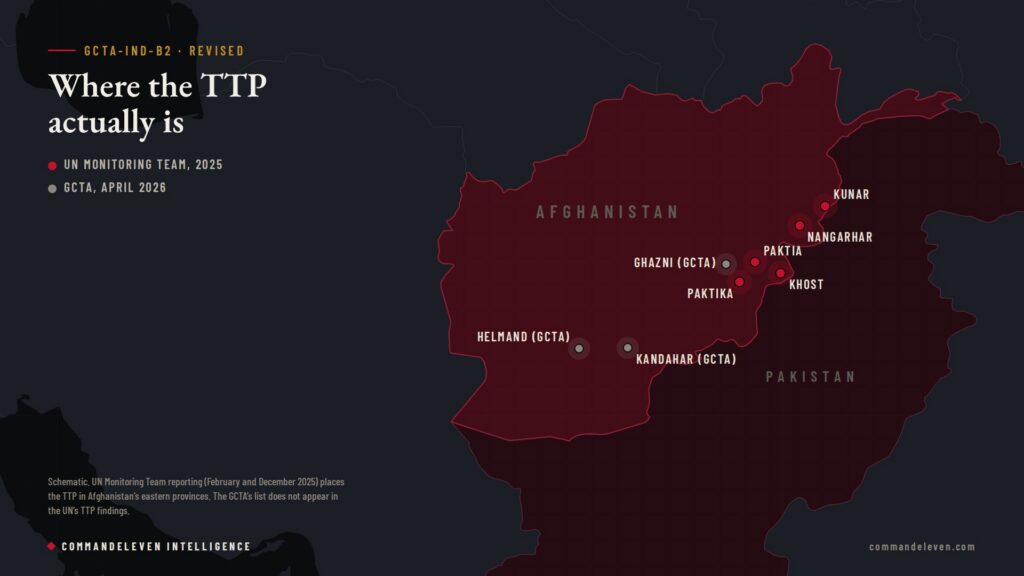
GCTA wording: The TTP maintains “a force of roughly 6,000 fighters utilizing these exact facilities across provinces like Ghazni, Helmand, and Kandahar,” citing UN monitoring reports from 2025.
Score: B1 (fighter count) VERIFIED · B2 (provinces) REVISED
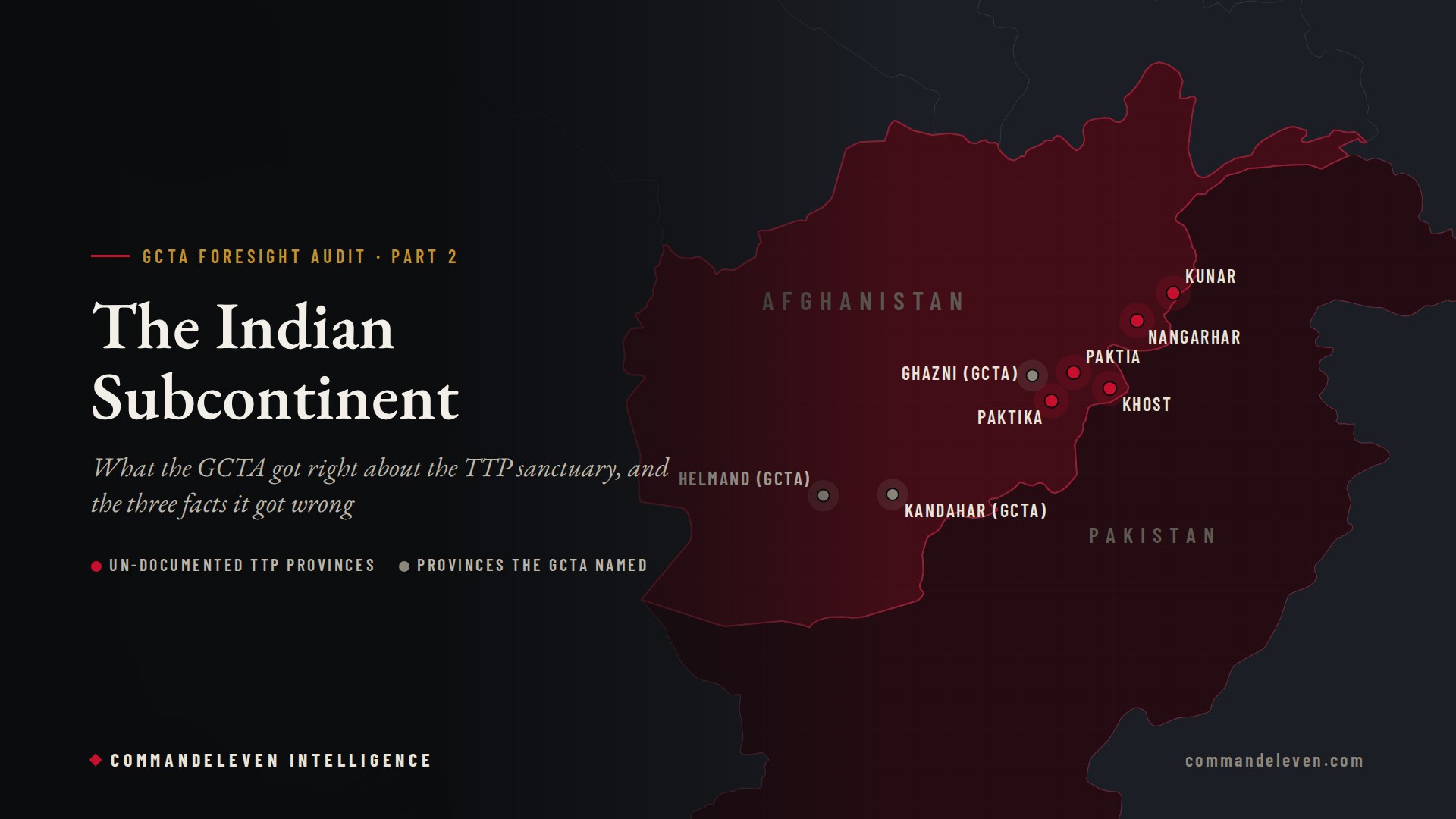
The number holds: UN Monitoring Team reporting through December 2025 puts the TTP in Afghanistan at about 6,000. The provinces do not. The UN’s February 2025 report, as summarized by Dawn and FDD’s Long War Journal, identified new TTP training centers in Kunar, Nangarhar, Khost and Paktika, and the December 2025 reporting places the force in Khost, Kunar, Nangarhar, Paktika and Paktia, all in Afghanistan’s east along the Pakistan-Afghanistan border. Ghazni, Helmand and Kandahar do not appear in the UN’s TTP findings. The GCTA’s list was wrong; the Pakistan-Afghanistan series uses the UN’s.
GCTA-IND-B3 and B4: What Started the February 2026 War?
GCTA wording: “On February 27, 2026, Pakistan officially declared open war with the Taliban following a devastating ISKP bombing in Islamabad. Under Operation Ghazab Lil Haq (Righteous Fury), the Pakistan Air Force… utilized F-16s and JF-17s to strike Taliban military installations in Kabul and Kandahar.”
Score: B3 (operation and date) VERIFIED · B4 (trigger) REVISED
The operation name, the date of the “open war” declaration and the strikes on Kabul and Kandahar are confirmed by Pakistani and international reporting; CommandEleven Intelligence’s own May 2026 audit already used the operation’s name. The trigger is not. Pakistan launched Operation Ghazab lil-Haq on February 26–27, after Taliban forces attacked Pakistani border posts, and following an air campaign that began on February 21. The chain started with Pakistan’s October 9, 2025 strike on TTP leader Noor Wali Mehsud in Kabul. The February 6 ISKP bombing of a Shiite mosque in Islamabad, which killed 32, added to the pressure in the weeks before; it was not the trigger. The GCTA compressed a five-month sequence into one event.
GCTA-IND-B5: What Did the Cadet College Wana Attack Prove?
GCTA wording: The November 2025 assault on Cadet College Wana in South Waziristan was proof of concept for the TTP’s special-forces capability.
Score: REVISED
The attack happened on November 10–11, 2025, and Pakistan attributed it to the Pakistani Taliban. It did not demonstrate what the GCTA said. Attackers breached the gate, but security forces contained them, about 650 students and staff were evacuated, and no cadets or staff were killed. It showed intent and a willingness to attack schools; it did not show a capability that defeated Pakistani security.
GCTA-IND-B6: The Jaffar Express Operation Names
GCTA wording: The BLA’s March 2025 hijacking of the Jaffar Express was “Operation Darra-e-Bolan,” met by Pakistan’s “Operation Green Bolan.”
Score: VERIFIED, with a minor revision
Pakistan’s counter-operation was Operation Green Bolan. The BLA’s own video material named its operation “Darra-e-Bolan 2.0.” Part 4 of the Pakistan-Afghanistan series now uses both names.
GCTA-IND-B7: The BLA’s Shadow Economy
GCTA wording: The BLA has moved from tribal contributions to a multi-million-dollar economy built on conflict minerals, Iranian diesel smuggling and kidnapping for ransom, with hawala networks concentrated in Oman, the UAE and Scandinavia.
Score: UNVERIFIED
The direction is plausible and consistent with the BLA’s growing scale and specialization documented in Part 4 of the series, but no independent source reviewed here documents the BLA’s revenue mix or the geography of its hawala networks. It is re-checked in December.
GCTA-IND-B8: Pakistan’s “Project Sentinel”
GCTA wording: A 12.07 billion rupee ($43 million) modernization of the Counter-Terrorism Department adding 638 field operators, paired with an “FMU-CTD Nexus” linking the Financial Monitoring Unit with the CTD, and a first-quarter 2026 crackdown on more than 30 charity-front entities.
Score: UNVERIFIED (DATA DEFICIT)
None of these specifics, the program name, the rupee figure, the 638 operators or the 30-entity seizure, could be found in open sources. It may exist under another name or in budget documents not reviewed here. It stays on the scorecard as unverified rather than being re-asserted on the GCTA’s authority.
GCTA-IND-B9: Did Afghan Army Defectors Upgrade ISKP?
GCTA wording: Afghan National Army personnel who defected to ISKP after 2021 brought Western-taught tradecraft with them, a “Skill Up-Armoring.”
Score: UNVERIFIED
Defections of former Afghan security personnel to ISKP were reported after the 2021 collapse, but this audit found no 2025–2026 evidence measuring their effect on ISKP’s capability. It is re-checked in December.
A Note on the Hard War Ceiling
The GCTA’s argument that the “Hard War” model, drone strikes and signals intelligence at scale, has reached its “ceiling of efficacy” was written about domestic, digital, lone-actor radicalization. The Pakistan-Afghanistan series applies the same logic to cross-border sanctuary and counter-insurgency. That is CommandEleven Intelligence’s own extension of the GCTA’s argument, made in its baseline assessments since April, and the series labels it that way. It is not scored here as a GCTA forecast about Pakistan.
Scorecard for This Part
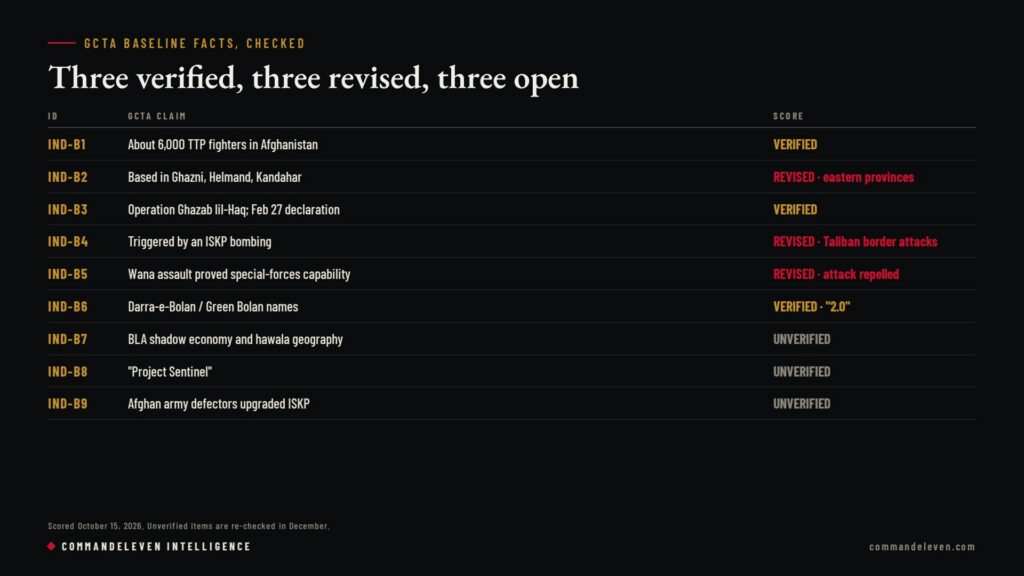
| ID | Item | Type | Score |
|---|---|---|---|
| GCTA-IND-01 | “Structural upgrade” from the 2021 withdrawal | Forecast | PARTIALLY CONFIRMED |
| GCTA-IND-02 | Sanctuary withstands conventional retaliation | Forecast | CONFIRMED |
| GCTA-IND-03 | TTP-BLA operational convergence | Forecast | PARTIALLY CONFIRMED |
| GCTA-IND-B1 | About 6,000 TTP fighters in Afghanistan | Baseline | VERIFIED |
| GCTA-IND-B2 | Based in Ghazni, Helmand and Kandahar | Baseline | REVISED (eastern provinces) |
| GCTA-IND-B3 | Operation Ghazab lil-Haq; February 27 declaration | Baseline | VERIFIED |
| GCTA-IND-B4 | Triggered by an ISKP bombing in Islamabad | Baseline | REVISED (Taliban border attacks) |
| GCTA-IND-B5 | Wana assault proved TTP special-forces capability | Baseline | REVISED (attack repelled) |
| GCTA-IND-B6 | Darra-e-Bolan and Green Bolan operation names | Baseline | VERIFIED (BLA name was “2.0”) |
| GCTA-IND-B7 | BLA shadow economy and hawala geography | Baseline | UNVERIFIED |
| GCTA-IND-B8 | “Project Sentinel” | Baseline | UNVERIFIED |
| GCTA-IND-B9 | Afghan army defectors upgraded ISKP | Baseline | UNVERIFIED |
Date scored: October 15, 2026 · Next review: December 2026.
What This Part Changes
- The record of the war uses the evidence, not the GCTA’s compression. The Pakistan-Afghanistan series names Operation Ghazab lil-Haq and dates its trigger to the Taliban’s February 26 border attacks.
- The TTP’s sanctuary is mapped to the UN’s provinces. Kunar, Nangarhar, Khost, Paktika and Paktia.
- Capability claims need a capability test. An attack that is repelled shows intent, not capability; future CommandEleven Intelligence assessments score attacks by outcome as well as ambition.
Frequently Asked Questions
How accurate was the GCTA on Pakistan and Afghanistan?
Of three forecasts, one is confirmed and two are partially confirmed. Three of its baseline facts are revised and three cannot yet be verified.
What was the GCTA right about?
That the TTP’s Afghan sanctuary would survive Pakistani military pressure. A year of open war, including Operation Ghazab lil-Haq, has degraded it in places but not closed it.
What did the GCTA get wrong?
The provinces where the TTP is based, the trigger of the February 2026 war, and the significance of the Cadet College Wana attack, which was repelled.
Where is the TTP based in Afghanistan?
In the eastern provinces of Khost, Kunar, Nangarhar, Paktika and Paktia, according to UN Monitoring Team reporting, not in Ghazni, Helmand and Kandahar as the GCTA stated.
Cross-Reference
This part publishes alongside the Pakistan-Afghanistan series. The method and running scorecard are in the GCTA Foresight Audit introduction; financing, including al-Qaeda’s training role with the TTP and BLA, is scored in Part 1.
Sourcing Base (Confidence-Tiered, with Links)
CONFIRMED, Primary/Official Record and Independent Verification:
- CommandEleven Intelligence, 2026 Global Counter-Terrorism Assessment, April 2026 (source document under audit: “Regional Assessment: The Indian Subcontinent”)
- UN Security Council, Thirty-eighth report of the Analytical Support and Sanctions Monitoring Team (S/2026/651), Aug. 10, 2026
- Dawn, “UN monitoring report,” February 2025 (editorial on the UN report naming new TTP training centers in Kunar, Nangarhar, Khost and Paktika)
- FDD’s Long War Journal, “Pakistani and Tajik Taliban open training camps in Afghanistan,” Feb. 13, 2025
- Asia Times, “Afghanistan’s TTP sanctuary is becoming harder to deny,” October 2026 (UN Monitoring Team, December 2025)
- Kabul Now, “UNSC Remains Concerned Over Presence and Capabilities of Terror Groups in Afghanistan,” August 2026
- intellinews, “Pakistan launches ‘Operation Ghazab lil-Haq’ after border clashes with Afghan Taliban,” February 2026
- Nukta, “Pakistan launches Operation Ghazab-lil-Haq against Afghanistan after hours of heavy border clashes,” February 2026
- The News, “Operation Ghazab lil Haq,” February 2026
- Wikipedia, “Cadet College Wana attack” (compiled from ISPR and press reporting)
- Arab News, “Pakistani forces repulse attack on cadet college in northwest,” November 2025
- Wikipedia, “2025 Jaffar Express hijacking” (Operation Green Bolan)
ASSESSED, Credible Secondary Reporting and Analysis:
- Combating Terrorism Center at West Point, “The Tehrik-i-Taliban Pakistan After the Taliban’s Afghanistan Takeover“
- The Tribune (India), “Baloch Liberation Army releases video of Jaffar Express hijack,” May 19, 2025 (BLA’s “Darra-e-Bolan 2.0” codename)
- War on the Rocks, “Open War at the Durand Line: Can Pakistan’s Escalation Compel a Taliban Recalculation?“
CommandEleven Intelligence Prior Work:
- Foresight Audit: The Post-2021 TTP Border Ingress, May 14, 2026
- ISKP Convergence Series, including The BLA/ISKP Technical Handshake and The TTP/ISKP Technical Handshake
- The Asymmetric Triad: Border Transnational Handshakes, June 2, 2026
- Pakistan-Afghanistan series, October 2026
Excluded from this part: CommandEleven Intelligence reporting is not scored as independent confirmation of GCTA claims. GCTA operational material that could not be independently verified is held on the internal scorecard pending verification rather than published.

