
Key Judgments
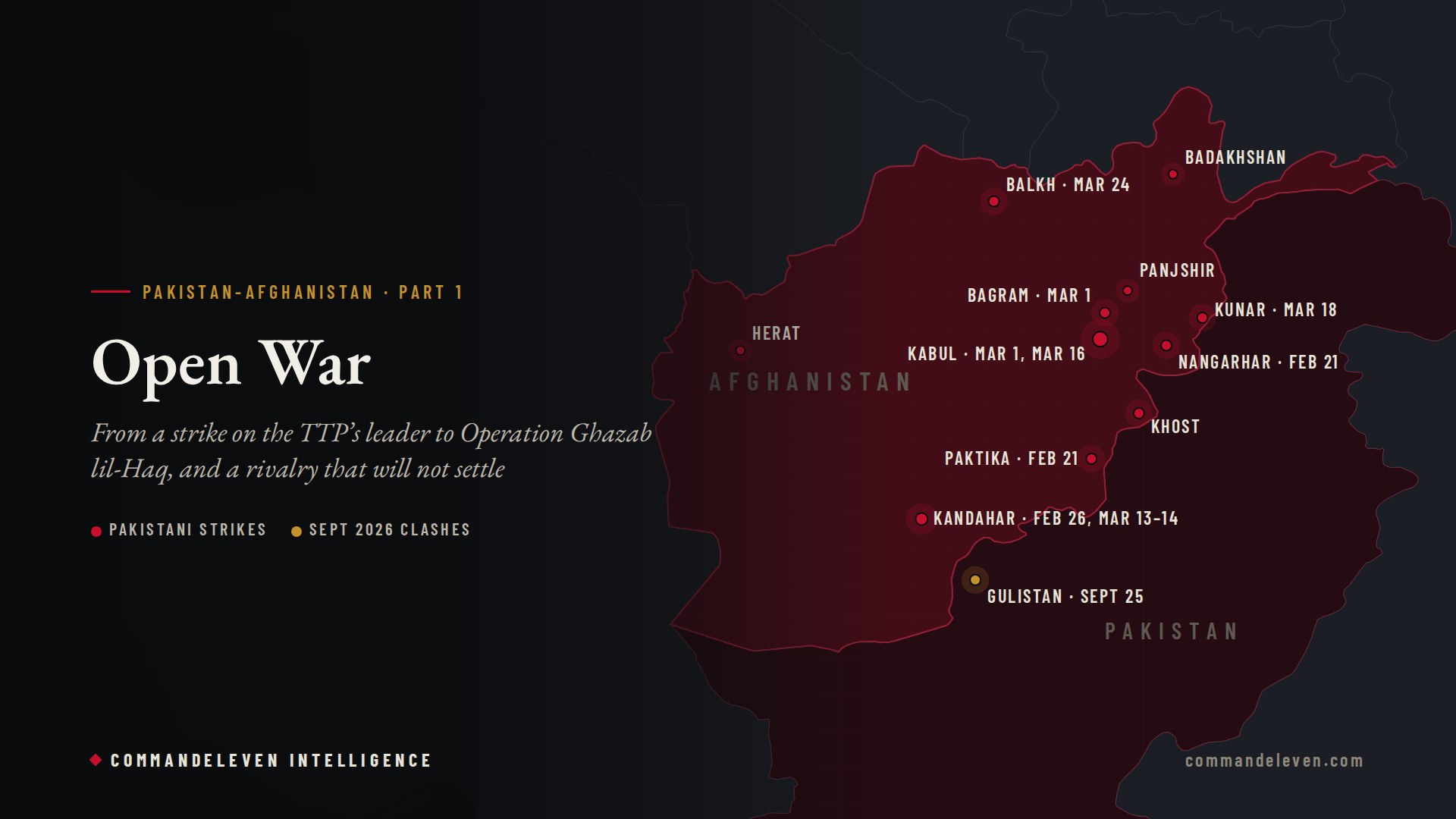
- [CONFIRMED] Pakistan and the Afghan Taliban moved from a deteriorating but still-managed security relationship to a formally declared “open war” posture between October 2025 and February 2026, culminating in a sustained Pakistani air campaign against Taliban state military assets — not merely non-state militant targets — beginning February 21, 2026.
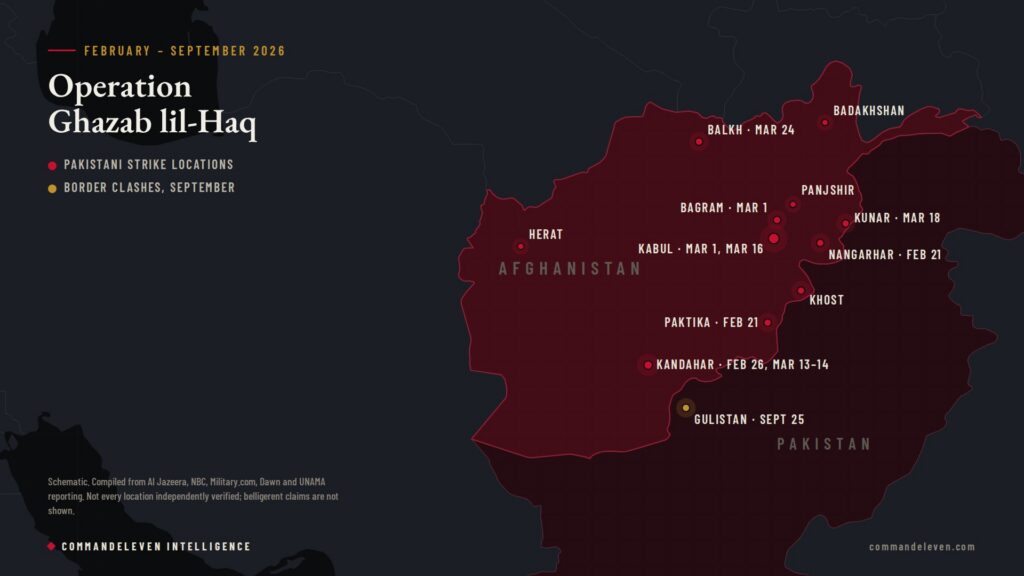
- [CONFIRMED] Pakistan named the campaign Operation Ghazab lil-Haq, launched on February 26–27, 2026, after Taliban forces attacked Pakistani border posts. Over the following three weeks (February 21–March 18, 2026), Pakistan conducted dozens of named airstrikes across at least nine Afghan provinces, targeting Taliban corps and brigade headquarters, ammunition depots, and command infrastructure, while Taliban forces conducted cross-border ground assaults and claimed to seize dozens of Pakistani border outposts; independent UN casualty verification (UNAMA) confirmed a minimum of 56 Afghan civilian deaths in the first ten days of the campaign alone, a figure both belligerents’ own claims vastly exceeded in opposite directions.
- [CONFIRMED] A Saudi-Qatari-Turkish-mediated “temporary pause” announced March 18, 2026 broke down within 24-48 hours, and fighting resumed at a lower but sustained tempo through the remainder of 2026, with a renewed major escalation on September 24, 2026 — Pakistani strikes on ten sites inside Afghanistan following accusations of Afghan drone incursions — demonstrating the conflict has settled into what War on the Rocks’ own structural analysis characterizes as the most probable near-term outcome: entrenched low-grade militarized rivalry rather than resolution in either direction.
- [ASSESSED] The proximate trigger — Pakistan’s October 9, 2025 airstrike targeting TTP leader Noor Wali Mehsud inside Kabul — and the underlying dispute it reflects (Pakistan’s accusation that the Taliban harbors and tolerates Tehreek-e-Taliban Pakistan on Afghan soil, which the Taliban denies while characterizing the resulting violence as Pakistan’s internal security failure) remains the conflict’s unresolved core after twelve months of fighting, diplomacy, and three rounds of collapsed Istanbul talks.
- [ASSESSED] This war is best read as the opening chapter of a broader regional pressure pattern rather than an isolated bilateral dispute: it has unfolded in parallel with an intensifying Baloch insurgency (Part 4 of this series), a documented al-Qaeda regional re-emergence signal (Part 3), and a contested TTP-sanctuary relationship with structural roots stretching back well before 2025 (Part 2) — four simultaneous pressure points converging on the same geography within the same twelve months.
From Alliance to Adversary: The Structural Backdrop
For most of the post-2021 period following the Taliban’s return to power in Kabul, Pakistan’s relationship with the new Afghan government was strained but functional — built on the premise, however fraying, that a Taliban-led Afghanistan would prove more willing than its predecessor to deny sanctuary to Tehreek-e-Taliban Pakistan, the Pakistani Taliban movement responsible for a sustained insurgency inside Pakistan’s own tribal districts. That premise did not hold. By 2024, Pakistani officials were citing over 1,700 TTP-attributed attacks for the year alone, and Islamabad’s patience with Kabul’s unwillingness or inability to act against TTP’s cross-border presence had visibly eroded.
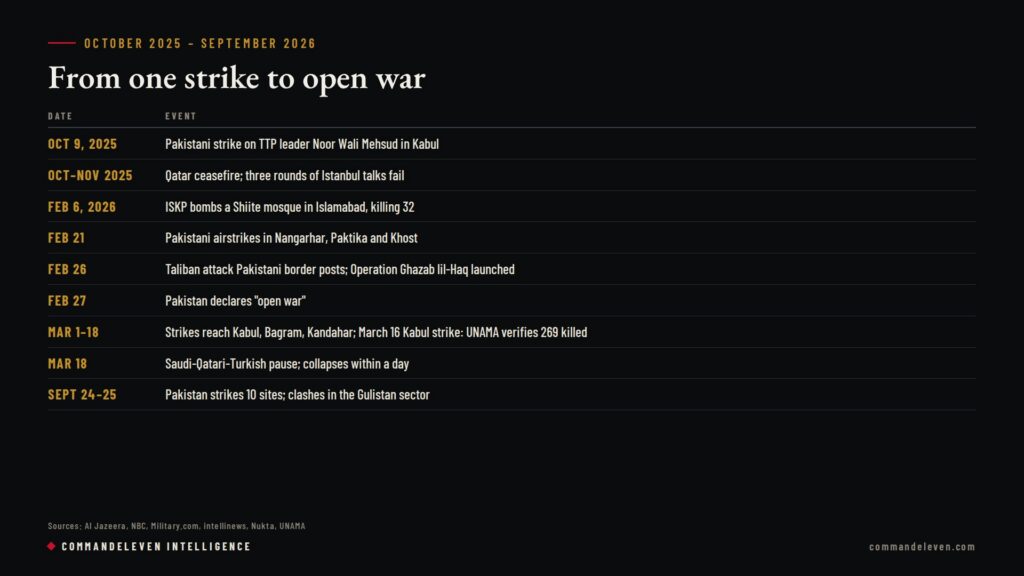
The breaking point, in retrospect, was narrower and more specific than the broader sanctuary dispute: Pakistan’s October 9, 2025 airstrike inside Kabul itself, targeting TTP leader Noor Wali Mehsud directly on what the Taliban regarded as sovereign Afghan soil rather than a contested border region. The Taliban’s retaliatory military response to that strike, not the underlying sanctuary dispute in the abstract, is what converted a chronic bilateral irritant into open hostilities. A Qatar-brokered ceasefire followed within weeks, and three subsequent rounds of Istanbul-hosted negotiations attempted to convert that ceasefire into a durable settlement. All three failed. By late October 2025, Pakistan’s own officials were already using the phrase “open war” as a conditional warning should talks collapse entirely — language that moved from threat to fact within four months.
[ASSESSED] CommandEleven Intelligence reads the eighteen-month arc from “chronic irritant” to “formally declared war” as evidence that the underlying dispute was never actually about Noor Wali Mehsud specifically, or any single strike. The TTP sanctuary question — examined in full in this series’ Part 2 — is a structural disagreement about sovereignty, capability, and intent that a decapitation strike merely exposed rather than created. This matters directly for how this war is likely to end, a question Section V returns to.
February–March 2026: The War Ignites
What began as a threat became a sustained air campaign on February 21, 2026, when Pakistan launched coordinated airstrikes across Nangarhar (Bihsud, Khogyani), Paktika (Barmal, Urgun), and Khost provinces, targeting what Pakistani military statements described as seven TTP/ISIS-K-linked camps. Pakistan claimed over 80 militants killed; UNAMA’s independent verification confirmed at least 13 civilian deaths, and Taliban reporting put the civilian toll at 18, including 11 children, in Bihsud alone — the first of what would become a recurring pattern throughout the campaign: Pakistani strike claims, Taliban casualty claims, and UNAMA’s independently verified (and consistently lower, but still substantial) civilian figures diverging sharply and never fully reconciling.
The trigger for full-scale escalation came five days later. On February 26, Taliban forces launched a coordinated retaliatory operation across six provinces — Nangarhar, Nuristan, Kunar, Khost, Paktia, and Paktika — claiming to kill 55 Pakistani soldiers and capture 19 border outposts. Pakistan’s response the same day, launched as Operation Ghazab lil-Haq (“righteous fury”), extended strikes to Kabul and Kandahar directly, for the first time hitting Taliban state military assets rather than only border-region militant infrastructure: Pakistani airstrikes destroyed what Islamabad described as two corps and three brigade headquarters, alongside 80-plus vehicles. Pakistan’s Defense Minister declared “open war” the following day, February 27 — the formal declaration catching up to a reality that had already arrived on the ground.
The Escalation Ladder, Day by Day
What followed over the next three weeks was among the most sustained state-on-state military campaigns either country had conducted against the other in decades:
- March 1 — Pakistani strikes reached Kabul’s Darulaman and Kārte Naw districts, Shash Darak, and Bagram Airfield itself, hitting what Pakistan described as the Afghan intelligence directorate’s facilities; satellite imagery independently confirmed hangar and warehouse destruction at Bagram.
- March 2-3 — Strikes extended to Panjshir, Badakhshan, and Herat — provinces far from the immediate border conflict zone — while Pakistan’s own cumulative casualty claims climbed past 460 Taliban fighters killed. UNAMA’s six-day rolling count (February 26-March 3) reached 42 confirmed Afghan civilian deaths and 104 injured.
- March 4-8 — The campaign’s bloodiest stretch by UNAMA’s count: 56 confirmed Afghan civilian deaths and 129 injured between February 26 and March 5 alone. A Pakistani refugee camp was shelled, killing 3 and displacing roughly 650 families — notable because it placed Afghan refugees inside Pakistan, rather than Afghan civilians inside Afghanistan, among the campaign’s casualties. Pakistan’s cumulative claimed Taliban death toll passed 580 by March 8.
- March 13-14 — The campaign’s highest-profile targeting shift: strikes on Kandahar’s Tarawo training center and the General Directorate of Intelligence facility, explicitly described by Pakistani sources as targeting Taliban supreme leader Haibatullah Akhundzada’s special forces directly — a strike against regime-protection infrastructure, not frontier militancy.
- March 16 — The campaign’s single most disputed incident: a Pakistani strike on a compound in Kabul that houses the Omid addiction treatment hospital. The UN Assistance Mission in Afghanistan (UNAMA) verified at least 269 people killed and 122 injured, and said the true toll was likely higher. Pakistan’s military said it struck ammunition depots, drone storage and technical installations, and Information Minister Attaullah Tarar said the hospital was several kilometers from the target site, attributing the damage to secondary explosions from stored ammunition. Amnesty International and Human Rights Watch have called for an independent investigation. [ASSESSED] The casualty figure is UNAMA’s, the most authoritative independent count available. The purpose of the site and the cause of the destruction remain disputed, and CommandEleven Intelligence does not adopt either side’s account of them.
- March 18 — Pakistan reported 63 missile strikes on Kunar’s Nari district alone in a single day, alongside dozens more across Manogai, Sarkani, Shultan, and Asadabad — the campaign’s highest single-day strike-count concentration in one province. The same day, Saudi Arabia, Qatar, and Turkey jointly announced a mediated “temporary pause” set to run March 19-24.
The Ceasefire That Didn’t Hold
The pause lasted less than a day in practice. March 19 reporting already documented violations — Taliban sources claimed 72 mortar attacks and 25 artillery shells on Kunar’s Nari district alone, with two additional Nuristan civilian deaths and a Pakistani civilian killed in Kurram district on the Pakistani side. By March 24, fighting had resumed in earnest, including a Pakistani strike on a Taliban corps installation in Balkh province — far north, nowhere near the traditional border conflict zone, and the campaign’s geographic high-water mark.
The war’s final documented chapter in this acute phase was less kinetic than cartographic: BBC Dari-verified satellite imagery, published March 27, showed Pakistani fence-construction extending 12-13.5 kilometers inside Afghan territory near Paktika’s Terwa district — roughly 32 square kilometers of claimed Afghan territory brought under de facto Pakistani control through unilateral border engineering rather than a negotiated settlement. Afghanistan’s government disputed the claim; independent satellite confirmation did not leave much room for the dispute to be about the imagery itself.
The Quiet That Wasn’t: April–September 2026
What followed the March fence-building episode was not peace but a reduction in strike tempo and headline visibility — consistent with the “entrenched low-grade militarized rivalry” trajectory War on the Rocks’ structural analysis identified as the most probable near-term scenario once the acute March escalation ladder topped out. Both sides had demonstrated capability and resolve; neither had achieved a result that changed the other’s calculus enough to justify sustained maximum-intensity operations, and both faced reasons to manage rather than resolve the conflict — Pakistan’s own multi-front security burden (the Baloch insurgency examined in Part 4, and ISIS-Khorasan’s continuing domestic attack tempo, including the February 6 Islamabad Shiite mosque bombing that killed 32, which added to the pressure on Islamabad in the weeks before Operation Ghazab lil-Haq) chief among them.
That lower-intensity period ended, at least temporarily, on September 24, 2026, when Pakistan struck ten sites inside Afghanistan following accusations that Kabul had conducted drone incursions the previous day. The following day, September 25, cross-border gunfire in the Gulistan border sector killed several Afghan Taliban fighters, with Pakistan characterizing the engagement as defensive — “foiling an attempted Afghan aggression.” In late September, fighting in the Gulistan sector was continuing, and mediation efforts by China, Turkey, Qatar, and Saudi Arabia — the same diplomatic bench that produced March’s failed pause — were reported to be under renewed strain.
[ASSESSED] CommandEleven Intelligence reads the September resumption not as a new conflict but as confirmation that the low-grade rivalry equilibrium the war settled into after March is inherently unstable rather than durable — capable of reheating to near-acute intensity on short notice whenever either side perceives a fresh provocation, without requiring a formal re-declaration of hostilities. The underlying dispute was never resolved; it was only temporarily deprioritized by both capitals’ other burdens.
Strategic Assessment: Why Neither Side Has Won
The military balance on paper heavily favors Pakistan: War on the Rocks’ structural analysis catalogs a 600,000-strong standing military, nuclear weapons, a permanent 2,600-kilometer border posture, and control of roughly 40% of Afghanistan’s customs revenue — all structural advantages the “graveyard of empires” narrative favored by some Taliban messaging tends to understate. Yet twelve months into the conflict, Pakistan has not achieved its stated core objective: a verifiable end to TTP’s cross-border sanctuary and operational freedom inside Afghanistan.
Three structural reasons help explain the stalemate, consistent with the bargaining-failure framework War on the Rocks applies to the conflict’s diplomatic collapse:
- Information asymmetry. Pakistan’s strike claims and Taliban’s counter-claims have diverged so consistently and so widely — Pakistan’s cumulative claimed Taliban fatalities exceeded 680 by mid-March against Taliban claims of over 300 Pakistani soldiers killed in the same window, with UNAMA’s independently verified civilian figures sitting far below either combatant’s framing — that neither side can credibly assess the other’s actual battlefield losses, undermining any negotiation that depends on a shared factual baseline.
- Commitment problems. Even if the Taliban leadership in Kabul wished to constrain TTP fully, doing so credibly and verifiably — in a way Pakistan would accept as sufficient — may exceed Kabul’s actual capability, given documented internal Taliban factional tension between Kandahar-based hardliners and more pragmatic Kabul-based elements. A commitment Kabul cannot enforce is not a commitment Islamabad can rely on, regardless of good faith.
- Sovereignty disputes. Pakistan’s October 2025 strike inside Kabul itself, and March 2026’s unilateral fence-construction inside claimed Afghan territory, both represent exactly the kind of unilateral cross-border action that converts a shared counter-terrorism problem into a sovereignty confrontation — making any Taliban concession on TTP look, domestically, like capitulation to territorial encroachment rather than reasonable counter-terrorism cooperation.
[ASSESSED] CommandEleven Intelligence’s own reading, consistent with the three scenarios War on the Rocks lays out (managed de-escalation, entrenched low-grade rivalry, or strategic backfire consolidating Taliban unity), is that the September 2026 resumption makes the middle scenario — entrenched rivalry — the base case through at least early 2027, with real but lower-probability risk of the third scenario materializing if Pakistan’s periodic strike campaigns continue producing rally-around-the-flag effects that strengthen rather than fracture Taliban internal cohesion. Nothing in the public record reviewed for this chapter supports confident prediction of the first scenario (managed de-escalation) materializing on any defined timeline.
Series Continuity and the GCTA Throughline
This conflict did not erupt in isolation, and this series treats it as the first of four interlocking regional pressure points rather than a standalone bilateral dispute. Part 2 examines the TTP sanctuary question this chapter has only sketched in structural terms — the specific sourcing on TTP’s safe-haven footprint inside Afghanistan, building on and cross-linking rather than repeating CommandEleven Intelligence’s existing ISKP Convergence Series, including The TTP/ISKP Technical Handshake and its dedicated Evolving Profile of TTP: Transnational Safe Havens & Border Operations piece. Part 3 examines the al-Qaeda regional re-emergence signal the Hamza bin Laden video represents, against the backdrop of exactly the kind of state-weakness and cross-border chaos this chapter has documented. Part 4 turns to the Baloch insurgency’s own 2026 intensification — a second, geographically distinct insurgent front that has escalated in close to the same window as this border war, raising the question of whether Pakistan’s security establishment is now managing three simultaneous fronts (Afghanistan border war, TTP, Baloch insurgency) with a force structure sized for fewer.
[ASSESSED] This war also stands as a live test of a framework CommandEleven Intelligence has carried forward from its own April 2026 Global Counter-Terrorism Assessment: that conventional, large-scale kinetic operations — the “Hard War” model — face a declining ceiling of efficacy against adversaries and sanctuary problems that are fundamentally decentralized, cross-border, and embedded in contested state capacity rather than concentrated in a targetable center of gravity. The GCTA’s own text develops this argument specifically around domestic, digital radicalization; the application here is CommandEleven Intelligence’s own extension of that logic to regional state-on-state and sanctuary-denial operations, consistent with how CommandEleven Intelligence has already carried the concept forward in its Intelligence Hub baseline assessments. Pakistan’s campaign, for all its scale (73-plus distinct airstrike locations by the campaign’s own account, hundreds of claimed enemy casualties, direct strikes against state military leadership infrastructure), has not resolved the TTP sanctuary dispute that triggered it. That outcome is consistent with, rather than a refutation of, CommandEleven Intelligence’s extended argument. The GCTA Foresight Audit, Part 2 scores the GCTA’s own account of this war against the record, including its trigger sequence: the GCTA compressed the chain into a single ISKP bombing, while the record shows the February 6 bombing as one pressure among several and the Taliban’s February 26 border attacks as the immediate trigger.
Frequently Asked Questions
What started the 2026 Pakistan-Afghanistan war?
The chain began with Pakistan’s October 9, 2025 strike on TTP leader Noor Wali Mehsud in Kabul. After airstrikes from February 21, 2026 and a Taliban attack on Pakistani border posts on February 26, Pakistan launched Operation Ghazab lil-Haq and declared “open war” on February 27.
What is Operation Ghazab lil-Haq?
Pakistan’s name for its 2026 air and ground campaign against the Afghan Taliban, launched February 26–27. It struck Taliban corps and brigade headquarters, Bagram, Kandahar and sites as far north as Balkh.
What happened at the Omid hospital in Kabul on March 16, 2026?
A Pakistani strike hit a Kabul compound housing an addiction treatment hospital. UNAMA verified at least 269 killed and 122 injured. Pakistan said it struck ammunition and drone storage and that the hospital was several kilometers from the target.
Is the Pakistan-Afghanistan war over?
No. A March 18 pause collapsed within a day, and Pakistan struck ten sites in Afghanistan on September 24, 2026. CommandEleven Intelligence’s base case is an entrenched, low-grade rivalry into 2027.
Sourcing Base (Confidence-Tiered, with Links)
CONFIRMED — Primary/Institutional & Independent Verification:
- Wikipedia, “2026 Pakistani airstrikes in Afghanistan” (compiled timeline, sourced to ISPR, Taliban MoD, UNAMA, and the outlets below)
- Wikipedia, “2025 Afghanistan–Pakistan conflict“
- Al Jazeera, “Pakistan says it conducted new strikes at Afghanistan’s military facilities“
- Al Jazeera, “New Afghan, Pakistani border clashes follow deadly strikes“
- Al Jazeera, “Pakistani forces kill Afghan Taliban fighters in border escalation“
- NBC News, “Pakistan says it struck 10 sites in Afghanistan after accusing Kabul of drone attacks“
- Military.com, “Pakistan Declares Open War on Afghan Taliban: Airstrikes Hammer Kabul and Kandahar“
- NBC News, “Pakistan declares ‘open war’ with Afghanistan as they trade deadly strikes“
- Dawn, “‘Calibrated’ air strikes target terrorist hideouts at two locations in Afghanistan“
ASSESSED — Credible Secondary/Analytical Reporting:
- War on the Rocks, “Open War at the Durand Line: Can Pakistan’s Escalation Compel a Taliban Recalculation?“
- The Diplomat, “How Former Allies Pakistan and the Taliban Came to ‘Open War’“
- Al Jazeera, “Pakistan minister warns of ‘open war’ with Afghanistan if peace talks fail“
- GlobalSecurity.org (RFE/RL relay), “Taliban Says Peace Talks With Pakistan Collapse But Cease-Fire Will Hold“
CommandEleven Intelligence Prior Work (Cross-Reference):
- CommandEleven Intelligence, ISKP Convergence Series, including The TTP/ISKP Technical Handshake and Evolving Profile of TTP: Transnational Safe Havens & Border Operations
- CommandEleven Intelligence, Foresight Audit: The Post-2021 TTP Border Ingress, May 14, 2026
- CommandEleven Intelligence, 2026 Global Counter-Terrorism Assessment, April 2026 (Hard War ceiling-of-efficacy thesis, originally applied to domestic radicalization; the regional application here is CommandEleven Intelligence’s own extension)
- CommandEleven Intelligence, GCTA Foresight Audit, Part 2: The Indian Subcontinent
Added for the March 16 strike and the operation name:
- UNAMA, “Statement on an airstrike on a medical facility in Kabul,” March 17, 2026
- Al-Monitor (Reuters), “Bombed Kabul site linked to storage of drones, ordnance, Pakistan military says,” March 18, 2026
- Wikipedia, “2026 Kabul hospital airstrike” (compiled record of UNAMA, Pakistani government, Amnesty and HRW statements)
- intellinews, “Pakistan launches ‘Operation Ghazab lil-Haq’ after border clashes with Afghan Taliban,” February 2026
- Nukta, “Pakistan launches Operation Ghazab-lil-Haq against Afghanistan after hours of heavy border clashes,” February 2026
Excluded from this dossier: Any finding on the purpose of the March 16 Kabul site or the cause of the destruction there; this dossier reports UNAMA’s verified casualty figure and both governments’ positions, and adopts neither government’s account. Cumulative belligerent casualty claims (Pakistani and Taliban) are reported throughout this chapter as claims, not verified figures, and should be read accordingly; only UNAMA’s civilian casualty figures carry independent-verification status in this dossier.
The Pakistan-Afghanistan Series
- Open War: The 2026 Pakistan-Afghanistan Escalation Timeline – Part 1 (you are here)
- The TTP Sanctuary Question: Mapping a Denied Safe Haven – Part 2
- Hamza bin Laden and Al-Qaeda’s Regional Re-Emergence – Part 3
- The Baloch Insurgency Uptick: A Second Front Under Pressure – Part 4
- Synthesis: A Region Under Simultaneous Pressure – Part 5

