
Key Judgments
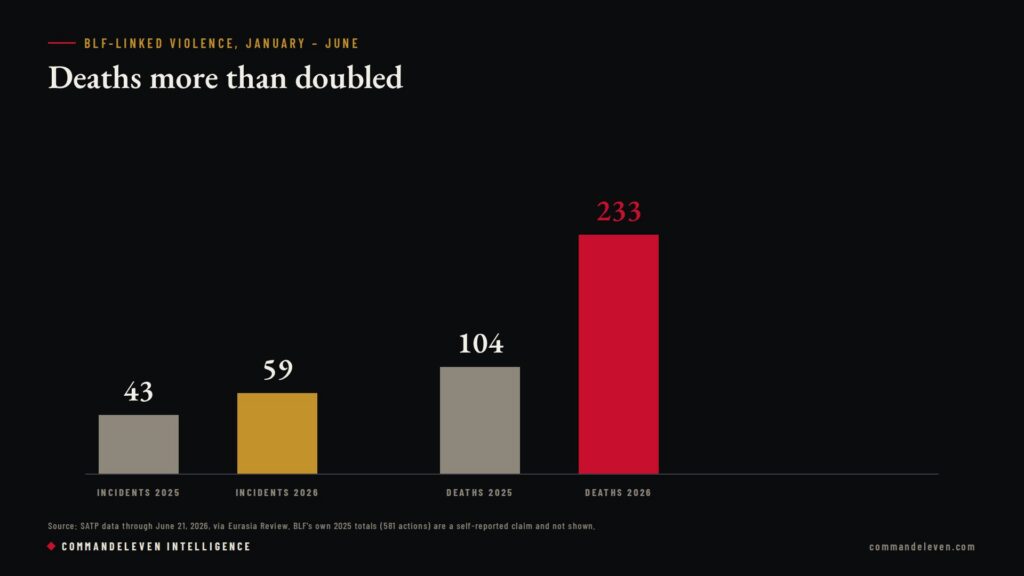
- [CONFIRMED] The Baloch insurgency has measurably intensified through 2026, running in close temporal parallel with — but geographically and organizationally distinct from — the Pakistan-Afghanistan border war documented in this series’ Part 1: Baloch Liberation Front-linked incidents alone rose from 43 incidents/104 fatalities in the first half of 2025 to 59 incidents/233 fatalities in the same window of 2026, more than doubling the death toll in a single year.
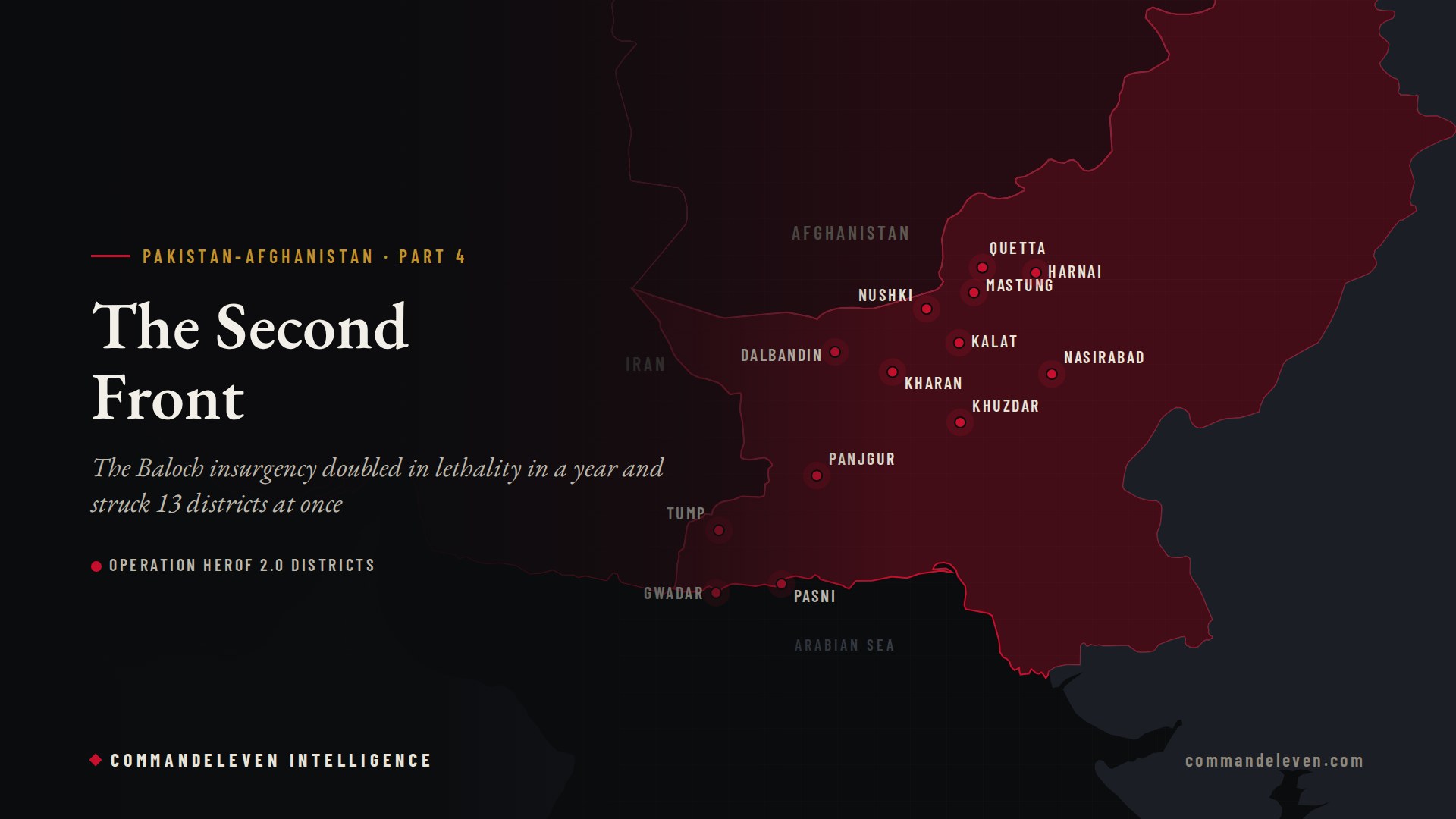
- [CONFIRMED] The January 30–February 5, 2026 coordinated offensive — BLA’s self-designated “Operation Herof 2.0,” conducted jointly with BLF — struck 13 Balochistan districts simultaneously (Quetta, Nushki, Gwadar, Mastung, Pasni, Kharan, Kalat, Panjgur, Harnai, Dalbandin, Tump, Khuzdar, and Nasirabad), killing 22 security personnel and 36 civilians per independently reported figures, with Pakistan claiming 216 militants killed and BLA itself eventually admitting to losing at least 92 fighters — a scale and coordination exceeding any single prior Baloch insurgent operation CommandEleven Intelligence has reviewed.
- [CONFIRMED] Both major factions have formed dedicated female combat units in 2026, extending a tactical pattern that began with the April 2022 Shari Baloch suicide bombing and has since produced multiple named female attackers (Sumaiya Qalandrani Baloch, June 2023; Mahal Baloch, August 2024); this is a documented organizational evolution, not an isolated incident, and CTC West Point’s research traces recruitment specifically to educated, activist-family backgrounds with histories of state-linked enforced disappearances.
- [ASSESSED] The insurgency’s primary strategic target — Chinese nationals and China-Pakistan Economic Corridor (CPEC) infrastructure — makes this front distinct in character from the TTP/AQIS sanctuary question examined in Parts 2-3: this is a domestic Pakistani insurgency with a specific great-power-adjacent economic target, not a cross-border sanctuary problem, and it draws on a five-phase historical grievance structure (enforced disappearances, resource distribution disputes, and CPEC opposition specifically, per CTC’s periodization) predating the current Pakistan-Afghanistan war by decades.
- [ASSESSED] CommandEleven Intelligence assesses that Pakistan’s security establishment is now managing three simultaneous, geographically distinct insurgent/conflict fronts — the Afghanistan border war (Part 1), the TTP/AQIS Afghan sanctuary network (Parts 2-3), and this chapter’s Baloch insurgency — within the same twelve-month window, a force-allocation burden this series’ Part 5 (Synthesis) will examine directly as the structural question this entire series has been building toward.
Five Phases of Grievance: Why This Insurgency Predates Everything Else in This Series
Unlike every other thread this series has examined, the Baloch insurgency’s roots have nothing to do with Afghanistan, the Taliban, or the border war documented in Part 1. CTC West Point’s periodization traces the movement through five distinct historical phases since Pakistan’s 1948 partition: initial tribal-politics-driven uprisings under the Khan of Kalat (1948-1955), a third phase introducing Marxist-Leninist ideological framing and new leadership structures from 1963 onward, and a fifth and current phase, emerging in the 2000s, driven by three specific and recurring grievances — enforced disappearances of Baloch activists and their relatives, disputes over natural-resource revenue distribution, and, increasingly, organized opposition to the China-Pakistan Economic Corridor as a symbol of resource extraction conducted without local consent or benefit.
[ASSESSED] This chapter treats that distinction — a grievance structure predating 2026’s regional crisis cluster by decades, now intensifying in close temporal proximity to it — as analytically important rather than coincidental. Section V returns to why a state managing a genuinely separate, long-standing domestic insurgency alongside the newer Afghanistan-border and TTP/AQIS-sanctuary pressures faces a qualitatively different strategic problem than any one crisis would present in isolation.
The Numbers: An Insurgency Doubling in Lethality
The clearest single data point establishing this chapter’s core claim comes from SATP’s own incident tracking, cited in Eurasia Review’s mid-2026 threat assessment: through June 21, 2026, SATP recorded 59 Balochistan Liberation Front-linked incidents resulting in 233 deaths, compared to 43 incidents and 104 fatalities across the same January-June window in 2025. That is not a marginal increase — it represents more than double the fatality count on a comparable incident-count base, indicating the insurgency’s lethality per operation has risen alongside its operational tempo.
BLF’s own 2025 annual accounting claims 581 total armed actions producing 929 casualties across the full year — figures that, as with all insurgent self-reporting reviewed throughout this series, CommandEleven Intelligence treats as the organization’s own claim rather than independently verified fact, while noting the broad direction (a substantial escalation) is independently corroborated by SATP’s separately sourced tracking above.
[CONFIRMED] CTC West Point’s own faction-level breakdown documents a similar trajectory for BLA’s most active faction: BLA-Jeeyand escalated from 50 claimed attacks in 2019 to 302 in 2024 — a six-fold increase over five years — while a second BLA faction, BLA-Azad (which split from the main organization in 2017), separately claimed 154 attacks in 2024, up sharply from prior years. The Baloch Raaji Aajohi Sangar (BRAS) coalition, which coordinates major cross-faction operations timed to symbolic dates, claimed 204 joint attacks across 2024 and a further 88 attacks during a single March 2025 commemorative period alone — evidence of growing inter-factional coordination capacity, not merely each faction independently escalating in parallel.
Operation Herof 2.0: The Clearest Evidence of Coordinated Capability
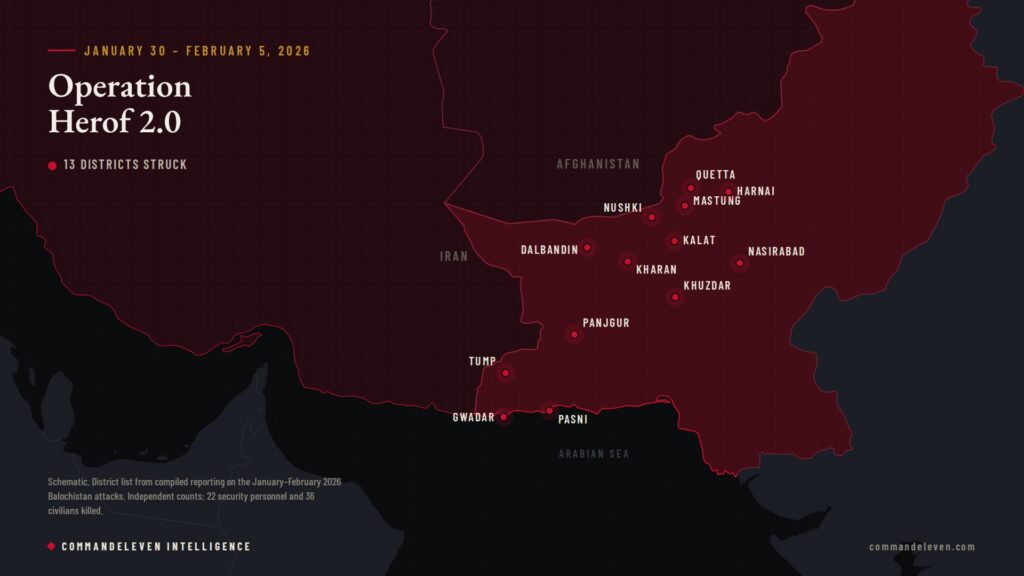
If any single event demonstrates the scale shift this chapter’s Key Judgments describe, it is the January 30–February 5, 2026 offensive BLA itself designated “Operation Herof 2.0” (“Black Storm”), conducted jointly with BLF across 13 Balochistan districts simultaneously: Quetta, Nushki, Gwadar, Mastung, Pasni, Kharan, Kalat, Panjgur, Harnai, Dalbandin, Tump, Khuzdar, and Nasirabad.
The target set within that single coordinated week illustrates the insurgency’s own operational maturity: police stations and training centers, paramilitary outposts, a high-security prison in Quetta itself, banks and markets, schools and hospitals, government administrative buildings, migrant-worker camps, and railway infrastructure — a target profile spanning security, economic, administrative, and labor-force disruption simultaneously rather than a narrow military-only campaign.
Casualty reporting again illustrates the recurring belligerent-claims divergence this series has documented throughout (Part 1’s treatment of Pakistani/Taliban casualty claims applies equally here): 22 security personnel and 36 civilians killed per independently reported figures; Pakistan’s government claiming 216 militants killed during counter-operations; BLA initially claiming only 18 of its own fighters lost before later admitting to at least 92 — a five-fold upward revision in the insurgent group’s own self-reported losses, notable both for what it suggests about the operation’s actual cost to BLA and for what it suggests about the reliability of any single-point-in-time insurgent casualty claim.
Tactical Evolution: Beyond Guerrilla Warfare
Both major factions have documented a shift from traditional rural guerrilla tactics toward what CTC’s research describes as combined “mountainous and urban guerrilla warfare” with temporary territorial occupation — most visibly illustrated by the March 2025 Jaffar Express hijacking (codenamed “Darra-e-Bolan 2.0” by the BLA; Pakistan’s 30-hour counter-operation was Operation Green Bolan), with roughly 450 passengers aboard and what CTC characterizes as the clearest prior demonstration of BLA’s growing operational sophistication before Operation Herof 2.0 surpassed it in scale.
BLA-Jeeyand in particular now fields specialized sub-units with distinct functions: the Majeed Brigade (dedicated suicide operations), STOS (tactical operations), the Fateh Squad (assault operations), and ZIRAB (intelligence gathering) — an organizational structure closer to a conventional light-infantry force with dedicated functional branches than a loosely organized insurgent militia. Eurasia Review’s separate assessment of BLF documents the same pattern of specialization within that organization: dedicated sniper teams, “fight-to-the-death” formations, and — as of November 2025 — BLF’s own first confirmed suicide bombing operation (at Nokundi, Chagai district), a tactic previously associated primarily with BLA.
The Female Combat Units
[CONFIRMED] Both organizations have moved from isolated female suicide attackers to formally structured female combat formations in 2026. The pattern traces back to April 2022, when Shari Baloch, a 30-year-old mother of two, conducted a suicide attack targeting Karachi’s Confucius Institute — explicitly a CPEC/China-linked target, consistent with the insurgency’s core grievance structure (Section I). Subsequent named attackers — Sumaiya Qalandrani Baloch (June 2023) and Mahal Baloch (August 2024) — established a recurring pattern rather than an isolated incident, and 2026 reporting documents both BLA and BLF formally organizing dedicated female combat divisions rather than continuing to rely on individual volunteer attackers.
CTC’s research traces recruitment for these units specifically to educated, activist-family backgrounds with documented histories of state-linked enforced disappearances within the recruit’s own family — a recruitment pathway distinct from, and arguably more resistant to standard counter-insurgency messaging than, poverty- or tribal-obligation-driven recruitment. [ASSESSED] CommandEleven Intelligence reads the organizations’ own apparent rationale, per the sourcing reviewed, as partly tactical (female attackers have historically faced less security scrutiny at checkpoints and sensitive sites) and partly propagandistic (per CTC’s own framing, these attacks “garner significant media attention, amplifying the psychological impact” in ways that directly serve recruitment messaging) — both motivations reinforcing rather than competing with each other.
The Cross-Border and CPEC Dimension
Two further threads connect this chapter to the series’ broader geography. First, the insurgency’s cross-border reach: BRAS-coordinated operations and individual faction activity extend into Iran’s own Sistan-va-Baluchestan province, part of what regional Baloch nationalist framing refers to as “Greater Balochistan” spanning the Pakistan-Iran frontier. An April 2025 incident saw the Baloch National Army (Beebarg) execute Pakistani laborers inside Iranian territory, and Pakistan and Iran conducted joint border airstrikes in November 2024 specifically targeting Jaish al-Adl positions — a separate Baloch-Iranian militant group whose own relationship to Iran’s Fatemiyoun/Zainabiyoun deployment question CommandEleven Intelligence is treating as a dedicated standalone dossier rather than folding into this series, consistent with the editorial decision to keep that Iran-specific thread separate given its distinct evidentiary weight.
Second, the insurgency’s consistent, explicit targeting of Chinese nationals and CPEC infrastructure specifically — not incidental to the broader campaign but its organizing economic grievance — carries direct bearing on Pakistan-China relations and on the broader regional great-power competition CommandEleven Intelligence’s grey-zone warfare series has examined in other theaters. BLA-Jeeyand’s 2023 ultimatum demanding Chinese withdrawal from CPEC projects within 90 days, while unmet, signals an insurgency whose strategic target selection is explicitly aimed at raising the political and security cost of Chinese regional investment, not merely Pakistani state authority.
Series Continuity and the GCTA Throughline
This chapter completes this series’ survey of the distinct pressure points converging on Pakistan and its immediate periphery in 2026: a state-on-state border war with Afghanistan (Part 1), a UN-documented TTP sanctuary network embedded in that same Afghan geography (Part 2), an al-Qaeda regional leadership and support network organizationally linked to that same TTP network (Part 3), and now a domestically rooted, decades-grievance-driven Baloch insurgency that has itself more than doubled in lethality within the same twelve-month window — operating from Pakistan’s own territory, extending across the Iranian border, and explicitly targeting the Chinese economic presence central to Pakistan’s own strategic partnerships.
[ASSESSED] CommandEleven Intelligence’s own standing assessment, flagged briefly in recent public commentary, is that the Baloch Liberation Army’s own posture toward Iranian-linked forces operating in the shared Pakistan-Iran Baloch borderlands may itself be shifting — a thread this series deliberately does not develop further here, reserved instead for the dedicated standalone dossier on Iran’s Fatemiyoun/Zainabiyoun deployment and its relationship to Baloch armed groups on both sides of that border, forthcoming separately from this series.
This chapter’s findings also extend this series’ running GCTA cross-reference: a security establishment managing three simultaneous, structurally distinct fronts — conventional interstate conflict, cross-border jihadist sanctuary, and a domestically rooted insurgency with its own great-power dimension — is close to the textbook case CommandEleven Intelligence’s extended “Hard War ceiling of efficacy” thesis was built to describe (the GCTA’s own text develops this argument around domestic radicalization; this series applies the same underlying logic regionally): no single military posture, however resourced, is well suited to all three problems simultaneously, and resource allocation to any one front necessarily constrains the other two. Part 5, this series’ closing synthesis, draws all four threads together directly and examines exactly that force-allocation question as its central argument.
Frequently Asked Questions
Is the Baloch insurgency getting worse?
Yes. SATP data show BLF-linked incidents rising from 43 incidents and 104 deaths in the first half of 2025 to 59 incidents and 233 deaths in the same period of 2026.
What was Operation Herof 2.0?
A coordinated BLA and BLF offensive from January 30 to February 5, 2026, that struck 13 Balochistan districts at once, killing 22 security personnel and 36 civilians by independent count.
Why do Baloch insurgents target China?
The insurgency treats the China-Pakistan Economic Corridor as resource extraction without local consent. Attacks on Chinese nationals and CPEC projects aim to raise the cost of Chinese investment, not only to challenge the Pakistani state.
Sourcing Base (Confidence-Tiered, with Links)
CONFIRMED — Institutional/Tracking Data:
- Combating Terrorism Center at West Point, “The Baloch Insurgency in Pakistan: Evolution, Tactics, and Regional Security Implications“
- Wikipedia, “January–February 2026 Balochistan attacks” (Operation Herof 2.0)
- Eurasia Review, “Pakistan: The Emerging Balochistan Liberation Front Threat – Analysis” (SATP incident data)
- Wikipedia, “Majeed Brigade“
- Wikipedia, “Fateh Squad“
- Wikipedia, “Balochistan Liberation Army“
ASSESSED — Credible Secondary Reporting:
- The Conversation, “Baloch insurgency: Suicide bombs and uptick in violence threaten Pakistan, regional security“
- Mapping Militants Project (Stanford), “Balochistan Liberation Army“
- The Hans India, “Women warriors emerge in Balochistan as BLA, BLF expand female units“
- Whalesbook, “Baloch Liberation Front Forms Female Combat Division“
- Wikipedia, “Mahal Baloch“
- Al Jazeera, “Who are the BLA – the group behind Pakistan’s deadly train hijack?“
CommandEleven Intelligence Prior Work (Cross-Reference):
- CommandEleven Intelligence, ISKP Convergence Series: The BLA/ISKP Technical Handshake
- CommandEleven Intelligence, Western Weapons Proliferation: TTP & BLA Telemetry Audit, May 25, 2026
- CommandEleven Intelligence, Haqqani Network Technology Proliferation: The Asymmetric Matrix, May 31, 2026
- CommandEleven Intelligence, 2026 Global Counter-Terrorism Assessment, April 2026 (Hard War ceiling-of-efficacy thesis, originally applied to domestic radicalization; the regional application here is CommandEleven Intelligence’s own extension)
- CommandEleven Intelligence, forthcoming standalone dossier on Iran’s Fatemiyoun/Zainabiyoun deployment and Baloch armed-group dynamics (not part of this series)
Added for the operation names:
- Wikipedia, “2025 Jaffar Express hijacking” (Operation Green Bolan; passenger and casualty figures)
- The Tribune (India), “Baloch Liberation Army releases video of Jaffar Express hijack,” May 19, 2025 (BLA’s own “Darra-e-Bolan 2.0” codename; insurgent self-designation)
Excluded from this dossier: BLF’s own self-reported 2025 annual casualty/action totals (581 actions, 929 casualties) are presented as the organization’s own claim, not independently verified. The specific operational relationship, if any, between BLA/BLF and Iran’s Fatemiyoun/Zainabiyoun brigades is explicitly excluded from this chapter and reserved for CommandEleven Intelligence’s dedicated standalone dossier on that question.
The Pakistan-Afghanistan Series
- Open War: The 2026 Pakistan-Afghanistan Escalation Timeline – Part 1
- The TTP Sanctuary Question: Mapping a Denied Safe Haven – Part 2
- Hamza bin Laden and Al-Qaeda’s Regional Re-Emergence – Part 3
- The Baloch Insurgency Uptick: A Second Front Under Pressure – Part 4 (you are here)
- Synthesis: A Region Under Simultaneous Pressure – Part 5

