Home » Intelligence Command Center
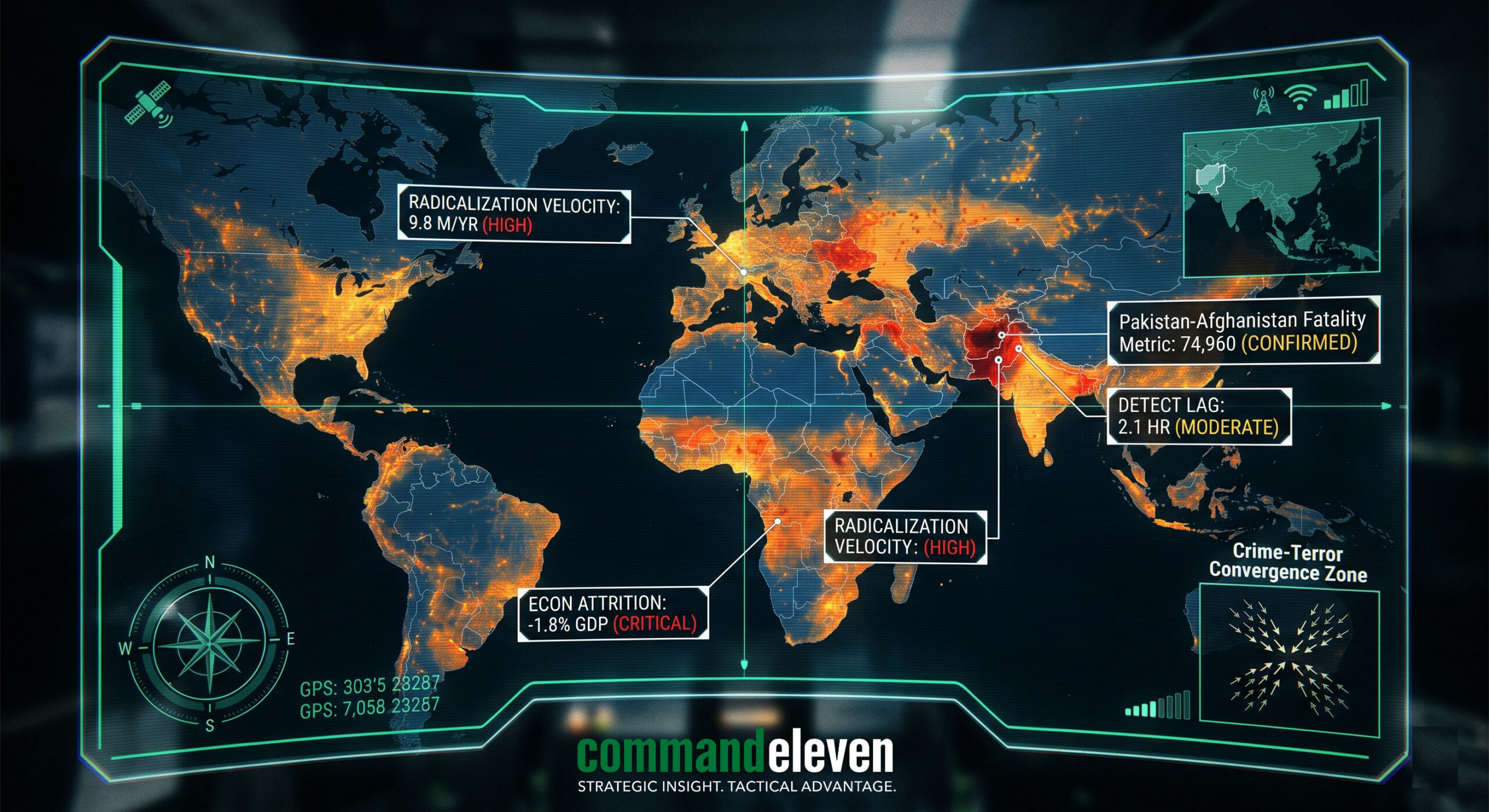
The CommandEleven Intelligence Command Center is the centralized nexus for all strategic, tactical, and spatial data streams. In an era of converged threats, the ability to pivot between regional geoeconomic assessments and localized kinetic mapping is essential for maintaining situational awareness.
This environment is designed to provide analysts, decision-makers, and field operators with a unified gateway to the CommandEleven Engine. Every module within this hub is synchronized with our 0400 GMT Daily Overwatch, ensuring that the tools you utilize are grounded in the most current “Ground Truth” available.

The primary theater for deep-dive geopolitical and geoeconomic intelligence. Access detailed briefings on specific Areas of Responsibility (AOR), from maritime interdiction protocols in the Indian Ocean to the weaponization of trade in the Middle East.
Our spatial intelligence layer. This interactive interface maps militant nodes, strike ranges, and logistical corridors in real-time. By overlaying HUMINT data onto geographic friction points, the Dashboard provides a multi-dimensional view of asymmetric threat projection.
A comprehensive database of the world’s most volatile non-state actors. This module profiles Tier 1 militant entities, their regional franchises, and their evolving cyber-kinetic capabilities.
The standardized dictionary of the CommandEleven Engine. To ensure total clarity in high-consequence environments, the Lexicon defines the technical terminology, Admiralty Code ratings, and tactical symbology used throughout our reporting.
This hub monitors the rapid deterioration of the security environment across West Africa’s “Sahel belt,” currently the global epicenter for militant Islamist activity. It tracks the collapse of international counter-terrorism support and the resulting vacuum being filled by Russian paramilitary forces and expanding insurgent groups like JNIM and IS-Sahel.
A focal point for the “contested geostrategic environment” where regional powers are increasingly forced to navigate the widening gap between US and Chinese interests. The hub analyzes traditional maritime flashpoints alongside non-traditional threats like industrial-scale cyber-scam operations and AI-enabled transnational crime.