Bottom Line Up Front (BLUF)
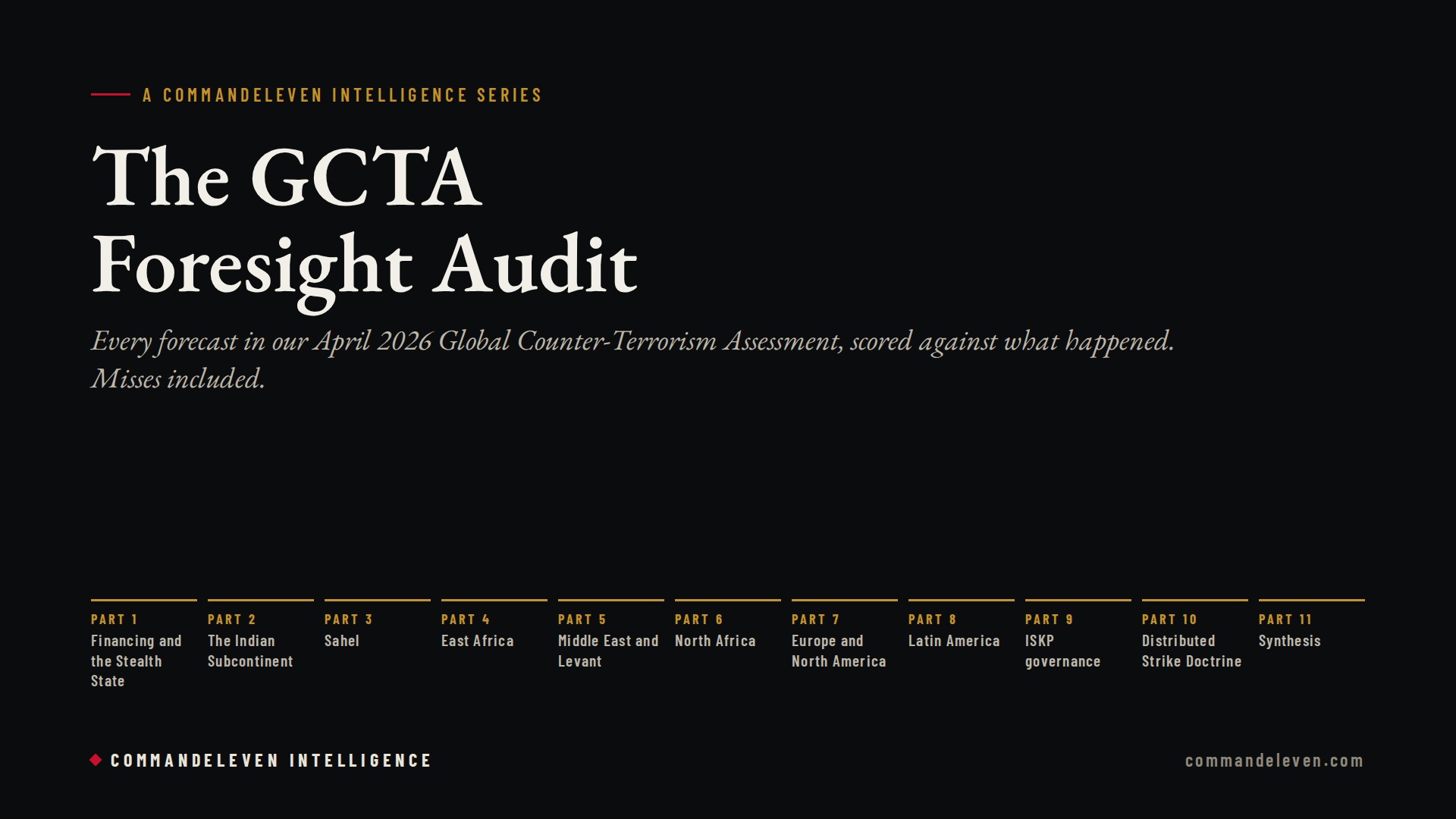
This series scores every specific forecast in CommandEleven Intelligence’s April 2026 Global Counter-Terrorism Assessment (GCTA) against what has actually happened, part by part, and publishes the misses alongside the hits. All eleven parts are now published: 41 forecasts in all, eight confirmed, eighteen partially confirmed, four not confirmed and eleven not yet resolved. Part 1, on terrorist financing, scores five forecasts: two confirmed, one partially confirmed, one not confirmed and one not yet resolved. Part 2, on the Indian Subcontinent, scores three forecasts (one confirmed, two partially confirmed) and corrects three of the GCTA’s baseline facts. Parts 3 to 5, on the Sahel, East Africa and the Middle East and Levant, score sixteen more forecasts and check the GCTA’s baseline figures separately. Part 6, on North Africa, Southeast Asia and the Sulu Sea, scores three more (one partially confirmed, two not yet resolved) and lists five Southeast Asian claims we could not verify. Parts 7 and 8, on Europe and North America and on Latin America, score six more and correct two baseline facts, including the Palm Springs case study. Parts 9 and 10, on ISKP and on cyber-kinetic convergence, score six more forecasts, all partially confirmed except one that stays open. Part 11 scores the last two, closes the series with the full scorecard and lists three policy claims in the GCTA that do not survive the public record. The running scorecard below grows with every part and is re-checked each quarter.
Why Publish an Audit of Our Own Work?
An assessment is only as credible as its track record, and a track record only counts if it can be checked. Most forecasting in this field is never revisited. This series does the opposite: it states what the GCTA said, in its own words where available, and holds each claim against primary institutional evidence published since April 2026.
Three commitments follow from that:
- Misses are published with the same prominence as hits. A scorecard showing only confirmations would be marketing, not methodology.
- Convergence is not influence. When an official body later reaches the same conclusion as the GCTA, this series records that as independent confirmation. It never claims the GCTA shaped that conclusion unless there is a documented citation.
- Corrections are made in the open. Where the GCTA got a fact wrong, the audit says what the record shows and carries the correction forward into later CommandEleven Intelligence work.
How Is Each Forecast Scored?
Every GCTA statement audited here is first sorted into one of three types, because only forecasts can be right or wrong about the future:
| Type | What it is | How it is handled |
|---|---|---|
| Forecast | A specific, checkable claim about how a threat will develop | Scored on the four-level scale below |
| Baseline claim | A statement of fact or estimate about the situation in April 2026 | Marked VERIFIED, REVISED or UNVERIFIED against later data; not counted in the forecast tally |
| Recommendation | A policy or operational proposal | Tracked for adoption; not scored as right or wrong |
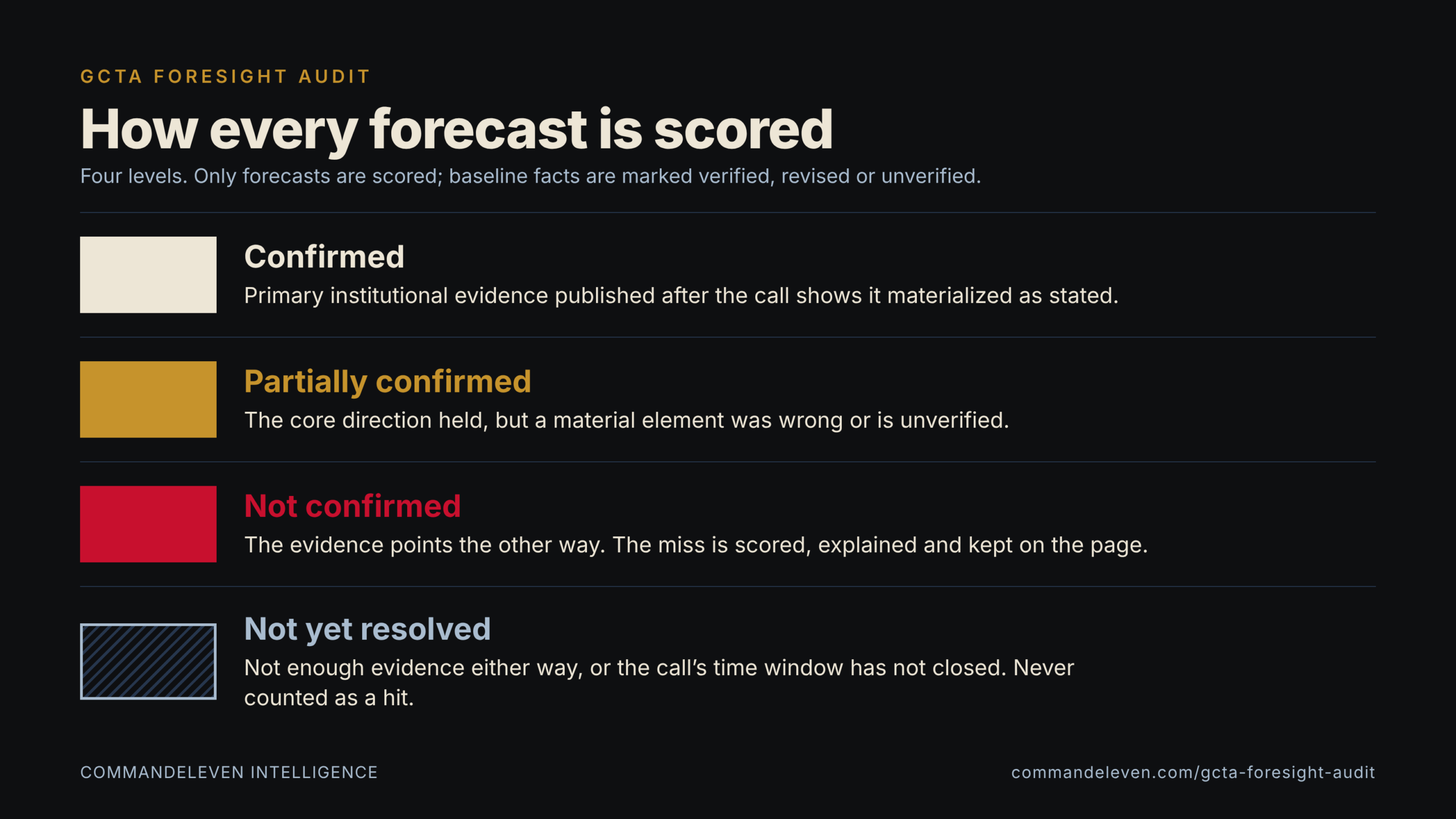
The four-level forecast scale:
| Score | Meaning |
|---|---|
| CONFIRMED | Primary institutional evidence published after April 2026 shows the forecast has materialized as stated |
| PARTIALLY CONFIRMED | The core direction held, but a material element was wrong or needs correcting |
| NOT YET RESOLVED | Insufficient evidence either way, or the forecast’s time window has not closed |
| NOT CONFIRMED | The evidence points the other way |
The original series plan used three levels. NOT CONFIRMED was added so that genuine misses are recorded as misses rather than parked indefinitely as “not yet resolved.”
What Counts as Evidence?
Evidence is weighted by source, in this order:
- Primary institutional records: UN Monitoring Team reports, FATF publications, government sanctions actions, court filings.
- Structured conflict and financial data: ACLED, blockchain analytics firms, established research centers.
- Credible secondary reporting and analysis.
A forecast is not scored CONFIRMED on secondary reporting alone. Every score cites the evidence it rests on, and every part carries its own confidence-tiered sourcing base.
How Is Each Entry Recorded?
Every audited item gets a scorecard entry in the same format, so parts can be compared and the running totals stay consistent:
| Field | Content |
|---|---|
| ID | Part code and number, e.g. GCTA-FIN-03 |
| GCTA wording | The original statement, quoted where available |
| Location | GCTA section |
| Type | Forecast, baseline claim or recommendation |
| Score | One of the four levels (or VERIFIED, REVISED or UNVERIFIED for baseline claims) |
| Evidence | The sources the score rests on, with dates |
| Date scored | When the score was assigned |
| Next review | When it will be re-checked |
Running Scorecard
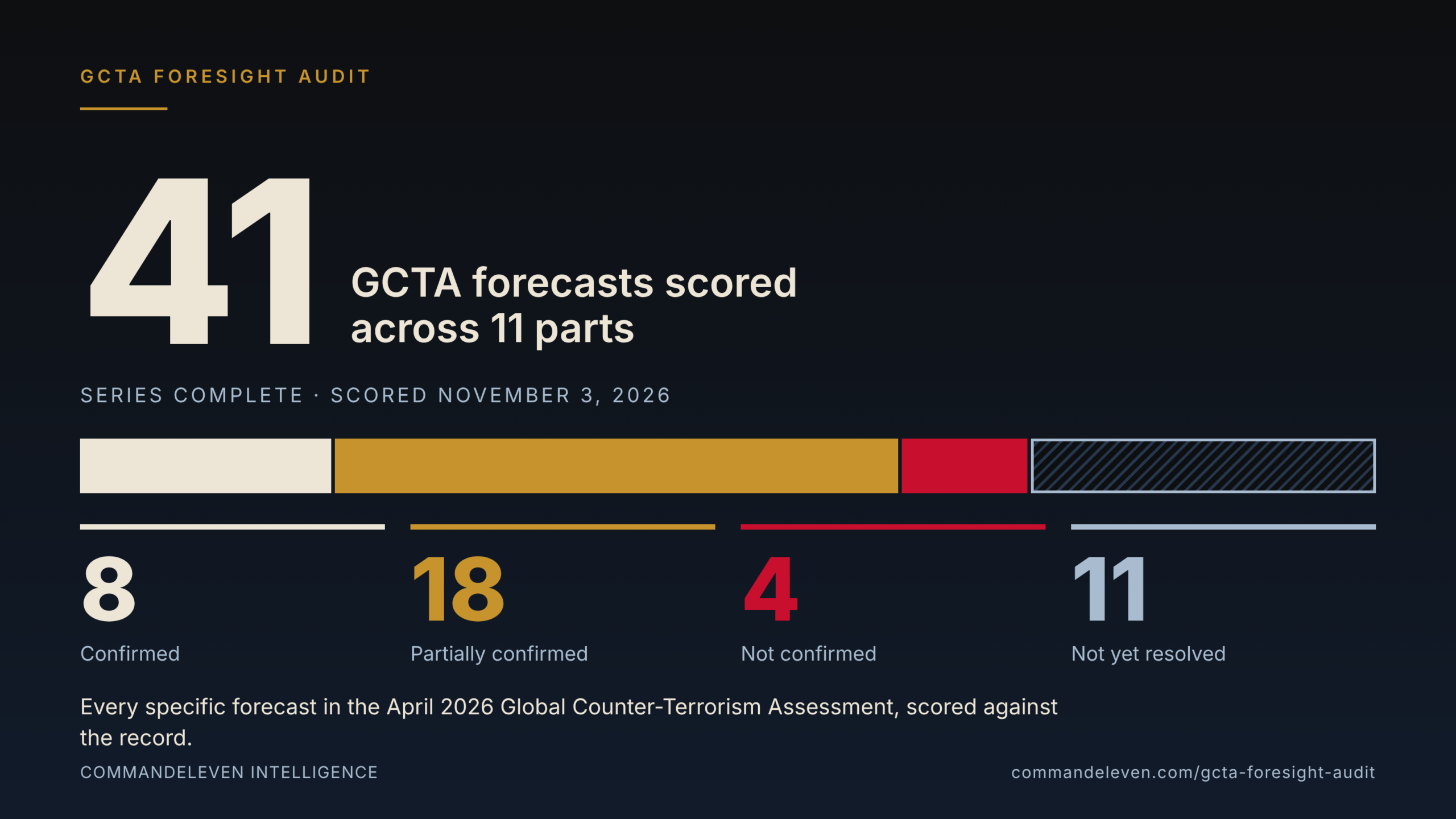
Updated with each part. Last updated: November 3, 2026 (Part 11, series complete).
Forecasts
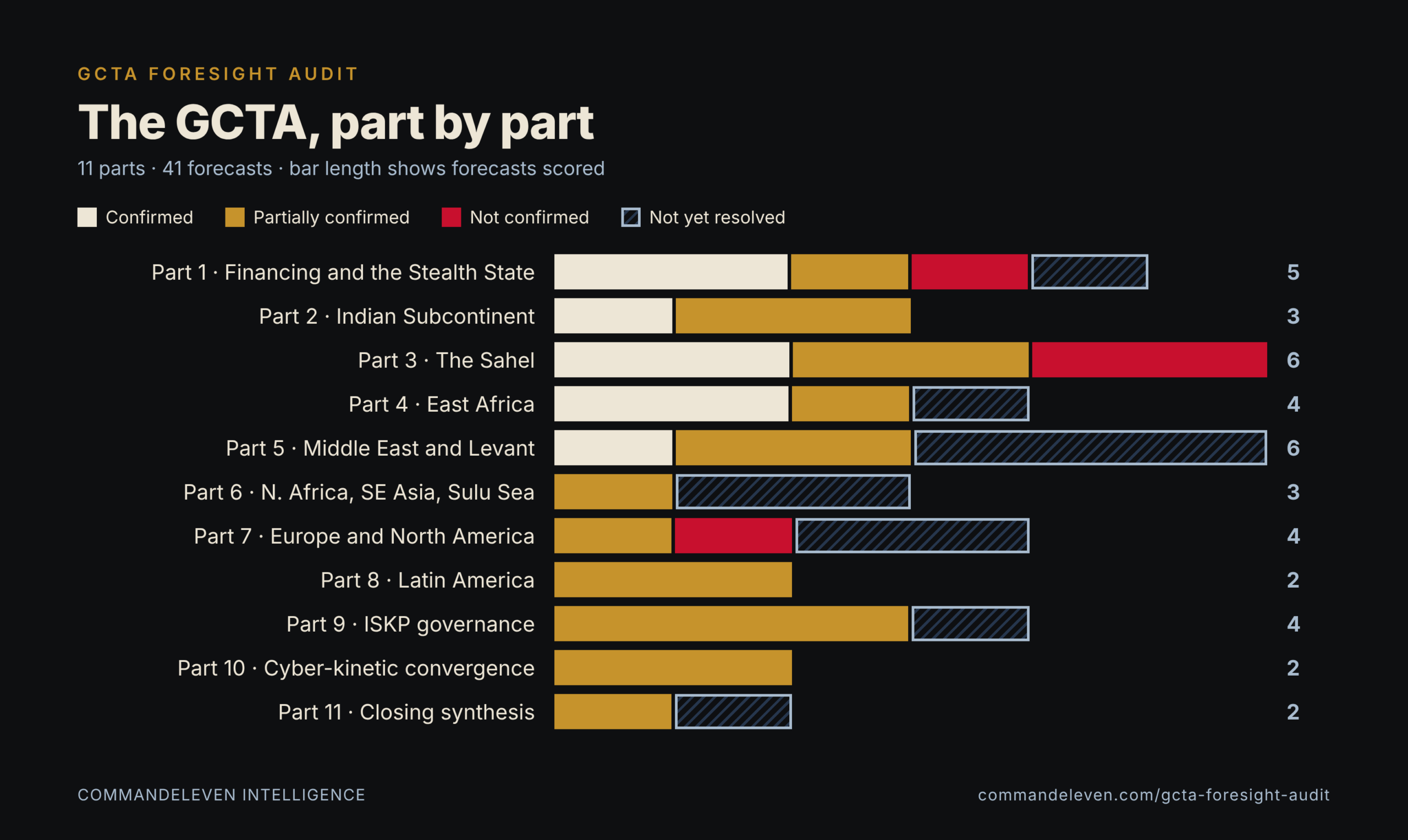
Each part publishes its individual forecasts, scores and evidence. This table shows the totals by part; open a part for the full scorecard.
| Part | Forecasts | Confirmed | Partially confirmed | Not confirmed | Not yet resolved |
|---|---|---|---|---|---|
| 1 · Financing and the Stealth State | 5 | 2 | 1 | 1 | 1 |
| 2 · The Indian Subcontinent | 3 | 1 | 2 | 0 | 0 |
| 3 · Sahel | 6 | 2 | 2 | 2 | 0 |
| 4 · East Africa | 4 | 2 | 1 | 0 | 1 |
| 5 · Middle East and Levant | 6 | 1 | 2 | 0 | 3 |
| 6 · North Africa, Southeast Asia and the Sulu Sea | 3 | 0 | 1 | 0 | 2 |
| 7 · Europe and North America | 4 | 0 | 1 | 1 | 2 |
| 8 · Latin America | 2 | 0 | 2 | 0 | 0 |
| 9 · ISKP governance | 4 | 0 | 3 | 0 | 1 |
| 10 · Cyber-Kinetic Convergence | 2 | 0 | 2 | 0 | 0 |
| 11 · Closing Synthesis | 2 | 0 | 1 | 0 | 1 |
| Total | 41 | 8 | 18 | 4 | 11 |
Totals to date: 41 forecasts scored · 8 confirmed · 18 partially confirmed · 4 not confirmed · 11 not yet resolved.
Baseline claims
Baseline claims for Parts 1 and 2 are listed below. Later parts list their own baseline checks at the end of each part.
| ID | Claim | Part | Score |
|---|---|---|---|
| GCTA-FIN-B1 | Al-Shabaab revenue of about $150 million a year | 1 | VERIFIED |
| GCTA-IND-B1 | About 6,000 TTP fighters in Afghanistan | 2 | VERIFIED |
| GCTA-IND-B2 | Those fighters are based in Ghazni, Helmand and Kandahar | 2 | REVISED: the UN places them in the eastern provinces |
| GCTA-IND-B3 | Operation Ghazab lil-Haq and the February 27 “open war” declaration | 2 | VERIFIED |
| GCTA-IND-B4 | The war followed “a devastating ISKP bombing in Islamabad” | 2 | REVISED: the Taliban’s February 26 border attacks were the trigger |
| GCTA-IND-B5 | The Cadet College Wana assault proved TTP special-forces capability | 2 | REVISED: the attack was repelled with no cadets killed |
| GCTA-IND-B6 | The Jaffar Express operation names | 2 | VERIFIED, with a minor revision |
| GCTA-IND-B7 | BLA’s shadow economy and Gulf and Scandinavian hawala network | 2 | UNVERIFIED |
| GCTA-IND-B8 | Pakistan’s “Project Sentinel” CTD modernization | 2 | UNVERIFIED |
| GCTA-IND-B9 | Afghan army defectors upgraded ISKP’s tradecraft | 2 | UNVERIFIED |
Recommendations tracked: GCTA-FIN-R1, the al-Karrar Financial Accord: not adopted.
Series Roadmap
| Part | Subject | Status |
|---|---|---|
| 1 | Financing and the Stealth State | Published |
| 2 | The Indian Subcontinent (TTP, BLA, the Pakistan-Afghanistan war) | Published, alongside the Pakistan-Afghanistan series |
| 3 | Sahel | Published |
| 4 | East Africa | Published |
| 5 | Middle East and Levant | Published |
| 6 | North Africa, Southeast Asia and the Sulu Sea | Published |
| 7 | Europe and North America | Published |
| 8 | Latin America | Published |
| 9 | ISKP governance | Published |
| 10 | Cyber-Kinetic Convergence and the Distributed Strike Doctrine | Published |
| 11 | Synthesis: what the GCTA got right, wrong and early | Published |
The Archive Track
Alongside the GCTA parts, the audit extends to CommandEleven Intelligence assessments published outside the GCTA. Archive entries use the same scorecard format, carry the original publication date and link to the original post. They are counted separately from the GCTA totals so the two records stay distinct.
| ID | Original claim | Published | Score |
|---|---|---|---|
| ARC-01 | Mali’s state would collapse within a 45-day window after the April offensive, with Bamako already seized | Sahel Collapse series, April 30 – May 2, 2026 | NOT CONFIRMED. Bamako held; see the on-the-record correction |
| ARC-02 | JNIM would choose a siege of Bamako over an assault, and Kidal would fall to the FLA | Sahel Collapse series, April 30 – May 1, 2026 | CONFIRMED |
Earlier standalone audits are part of this record: Fighting 2026 Terrorism Using The 2000 Playbook (September 18, 2026) and The Post-2021 TTP Border Ingress (May 14, 2026).
How Often Is the Scorecard Reviewed?
Quarterly. Every NOT YET RESOLVED and UNVERIFIED item is re-checked each quarter, and any score can move in either direction as new evidence appears. Every change is dated and noted in the relevant part, and earlier scores are never silently overwritten. The next full review is in December 2026.
Frequently Asked Questions
What is the GCTA Foresight Audit?
A running, public audit of the specific forecasts in CommandEleven Intelligence’s April 2026 Global Counter-Terrorism Assessment, scored against evidence published since. It records misses as well as hits.
How are forecasts scored?
On four levels: CONFIRMED, PARTIALLY CONFIRMED, NOT YET RESOLVED and NOT CONFIRMED. Scores rest on primary institutional evidence where it exists, such as UN Monitoring Team reports and FATF publications.
How accurate has the GCTA been so far?
Of 41 forecasts scored across eleven parts, eight are confirmed, eighteen partially confirmed, four not confirmed and eleven not yet resolved. Baseline facts that did not hold up are corrected in the part where they appear.
Does a confirmed forecast mean officials relied on the GCTA?
No. The audit records independent confirmation only. It never claims the GCTA influenced a later official finding unless there is a documented citation.
What happens when a forecast is wrong?
It is scored NOT CONFIRMED, explained, and kept on the public scorecard. Where a miss reveals a flaw in the underlying analysis, the part says what should be corrected.
Sourcing Base
- CommandEleven Intelligence, 2026 Global Counter-Terrorism Assessment, April 2026 (source document under audit)
- CommandEleven Intelligence, Fighting 2026 Terrorism Using The 2000 Playbook: A Foresight Audit, September 18, 2026 (first GCTA foresight audit; convergent-validation standard)
- CommandEleven Intelligence, The Siege That Held: Mali Six Months After the April Offensive, October 15, 2026 (archive-track correction)
Part-level sources are listed in each part.