Bottom Line Up Front (BLUF)
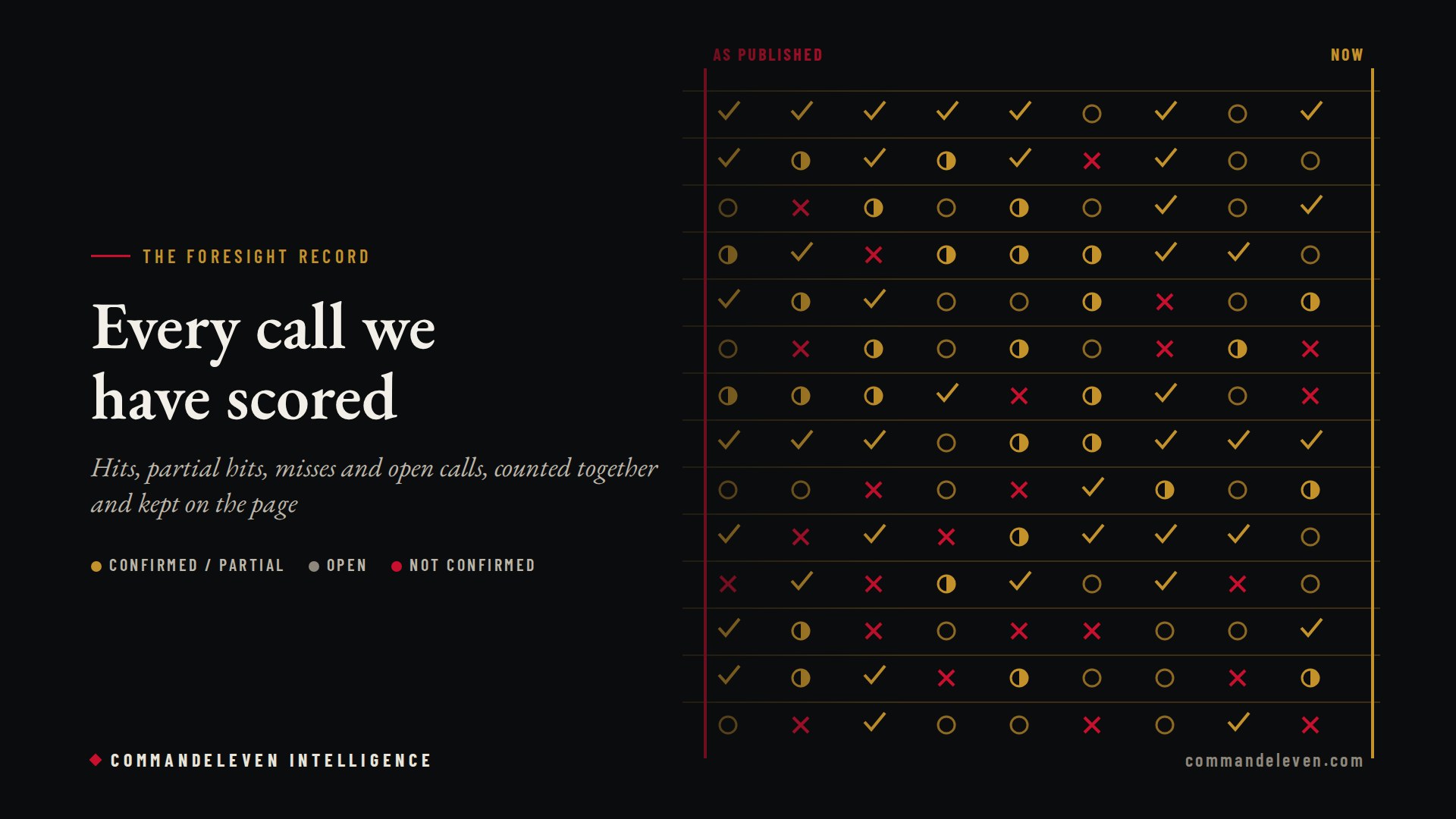
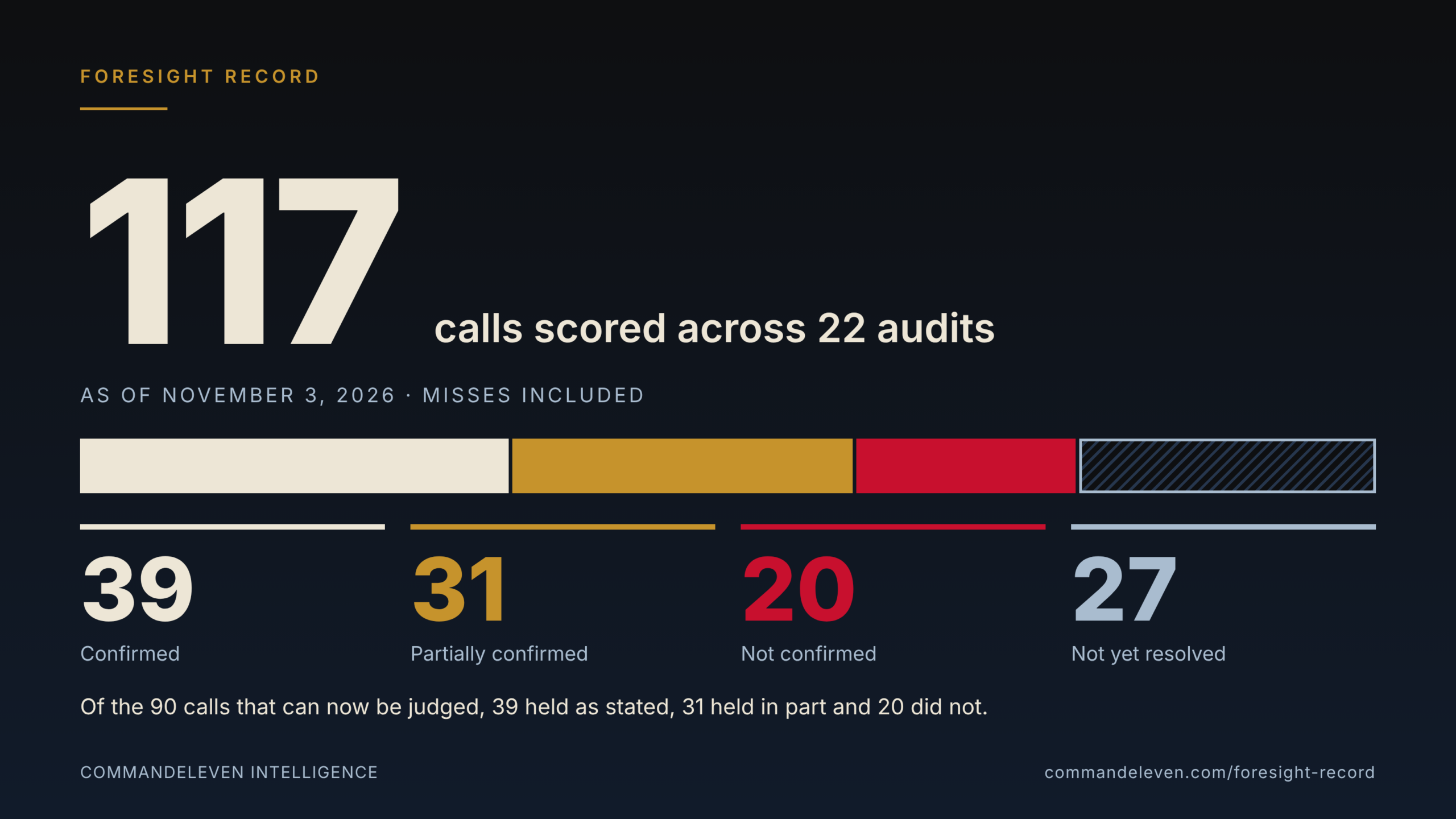
This page keeps CommandEleven Intelligence’s public scorecard: every call we have formally scored against the record, in one place, with the misses alongside the hits. One hundred and twenty-four calls have been scored across twenty-five audits so far. Forty-three are confirmed, thirty-one partially confirmed, twenty-three not confirmed and twenty-seven not yet resolved. A further set of calls is registered with due dates and will be scored when those dates arrive. The record counts CommandEleven Intelligence’s own calls only; work published by external contributors is not scored. It is updated whenever a new audit publishes and reviewed in full each quarter. We publish it because analysis is only worth what it gets right before the fact, and that claim means nothing unless the misses are on the page too.
How the Record Works
Every audit on this page uses the same rules, set out in full in the GCTA Foresight Audit introduction.
- The original call is quoted and dated. An audit scores what we actually published, on the date we published it, and links to the original post.
- Only our own calls count. The record scores the judgments of CommandEleven Intelligence: the Intelligence Desk, our analysts and our Executive Director. Articles by external contributors reflect their authors’ views and are not CommandEleven projections, so they are not scored, whether they proved right or wrong.
- Scores rest on evidence published after the call. Primary institutional evidence (UN Monitoring Team reports, FATF publications, government records) carries the most weight. Nothing is scored CONFIRMED on a single secondary report.
- Convergence is not influence. When an official body reaches the same conclusion, we record independent confirmation. We never claim it relied on our work without a documented citation.
- Misses stay on the record. A call that did not hold is scored, explained and kept on this page. Where a miss exposes a flaw in the analysis, the audit says what changes.
- Pending calls are left alone. A call that has not resolved is listed as open. It is not counted as a hit, and it is not promoted as a likely one.
| Score | Meaning |
|---|---|
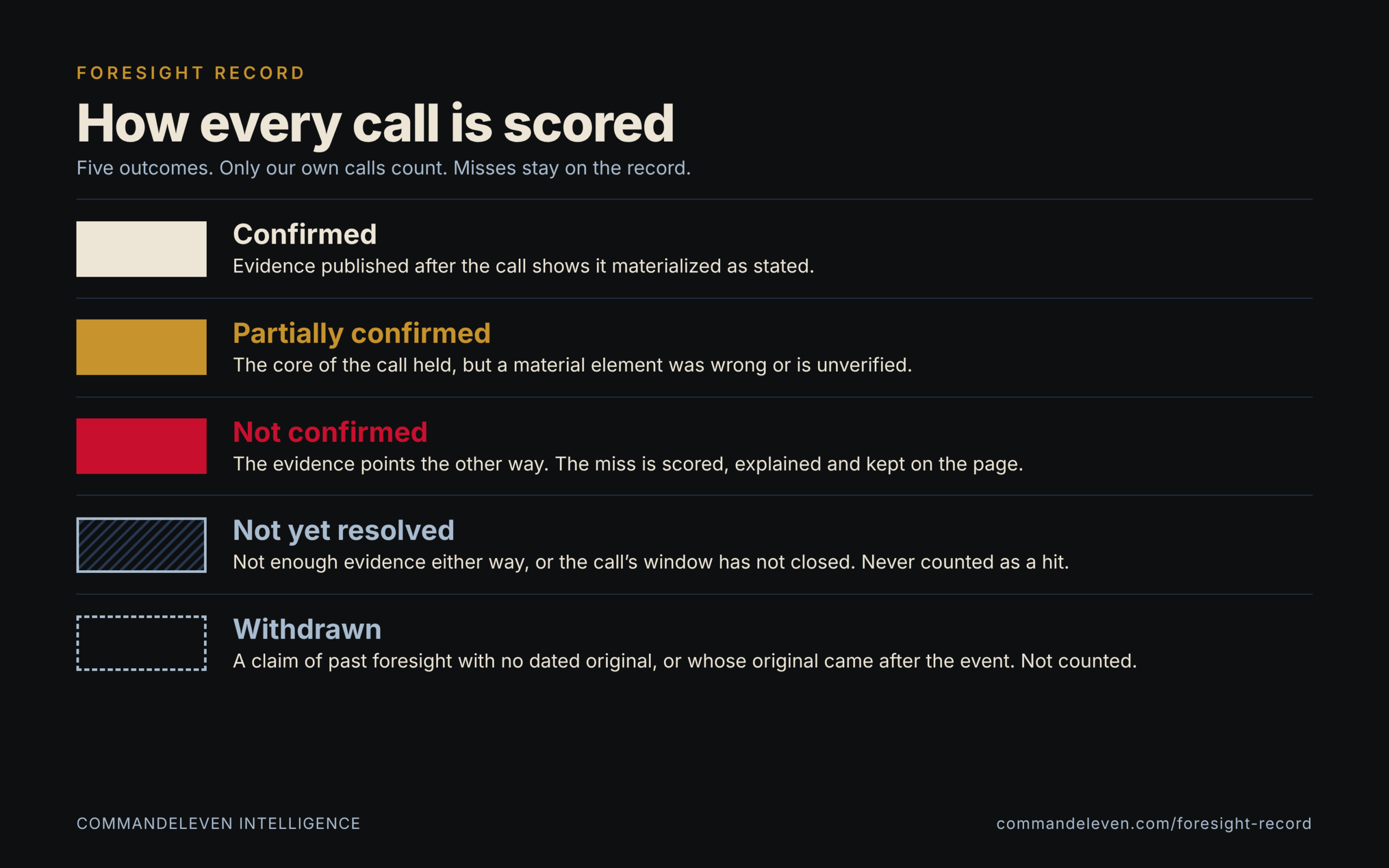
| CONFIRMED | Evidence published after the call shows it has materialized as stated |
| PARTIALLY CONFIRMED | The core of the call held, but a material element was wrong or is unverified |
| NOT YET RESOLVED | Not enough evidence either way, or the call’s time window has not closed |
| NOT CONFIRMED | The evidence points the other way |
| WITHDRAWN | A claim of past foresight that has no dated original, or whose original came after the event or reported past events. Not counted. |
The China-Iran audit used “Not borne out” for its one miss; it is counted here as NOT CONFIRMED. Baseline facts (statements about the situation at the time, rather than calls about what would happen) are marked VERIFIED, REVISED or UNVERIFIED and are kept out of the forecast totals.
The Running Totals
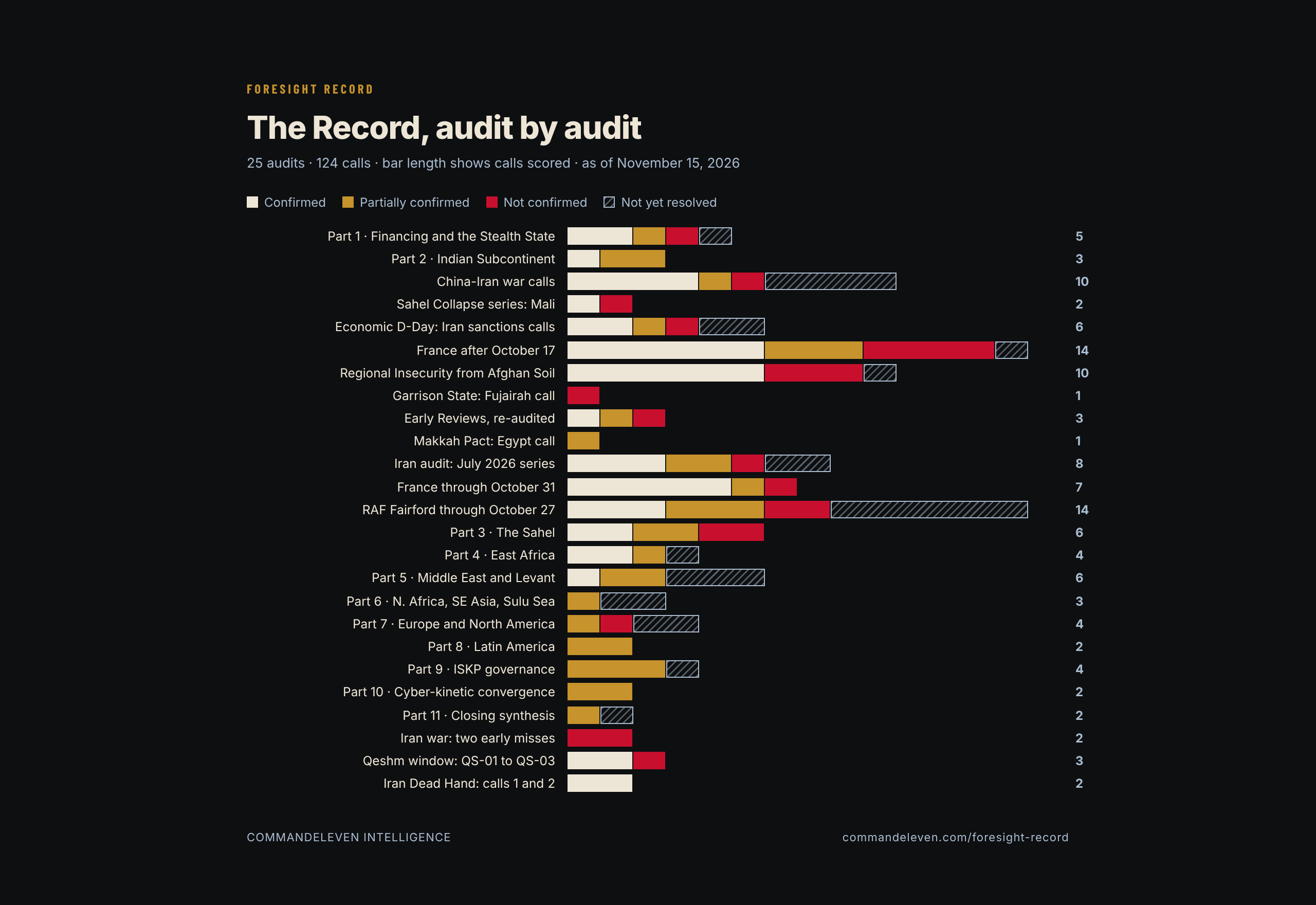
Of the 97 calls that can now be judged, 43 held as stated, 31 held in part and 23 did not.
Notes, November 15. QS-03 is scored not confirmed: Iran did not fire at a Gulf host state within 72 hours of the November 6 Qeshm strikes. Iran later claimed attacks on a US radar in Bahrain on November 13 and 15, citing a strike on a Sirik telecom tower that the US has not acknowledged; those fall outside the call’s window. Dead Hand calls 1 and 2 are scored confirmed: no joint US-Israeli strike on Iran occurred by November 3 (the November 2 Qeshm strikes were US-only), and as of November 15 there is no independent confirmation of the Mosaic Defense activation order or target lists.
The Audits
Qeshm and the Post-Midterm Window: QS-01, QS-02 and QS-03
Scores three calls from our Qeshm and Post-Midterm Window dossier on November 15, 2026. Two are confirmed and one is not.
- QS-01, confirmed: no new US-Iran agreement has been reached. The Trump administration itself says there is none, and the versions floated by Qatar and Pakistan have not been accepted by either side.
- QS-02, confirmed: the United States struck Iranian air defenses on Qeshm. President Trump confirmed the strikes on November 6, as Al Jazeera reported on November 7.
- QS-03, not confirmed: Iran did not fire at a Gulf host state within 72 hours of the November 6 strikes. Iran’s later claims, on November 13 and 15, cite a different trigger: a strike on a communication tower in Sirik that the United States has not acknowledged. CENTCOM said it shot down two Iranian drones launched toward Bahrain, with no injuries or damage, and called the claim that a radar was hit false.
Iran’s Dead Hand: Calls 1 and 2
Scores the first two calls from our Iran’s “Dead Hand” dossier on November 15, 2026. Both are confirmed.
- Call 1, confirmed: no joint US-Israeli strike on Iran occurred by November 3. The November 2 Qeshm strikes were US-only.
- Call 2, confirmed: as of November 15 there is no independent confirmation of the Mosaic Defense activation order or its target lists.
- Call 3 remains open through December 31: if strikes resume, whether Iranian retaliation comes from more than one provincial command within 72 hours, including a US-linked economic or political site in the region.
GCTA Foresight Audit, Part 1: Financing and the Stealth State
Scores five terrorist-financing forecasts from the April 2026 Global Counter-Terrorism Assessment (GCTA) against UN and FATF evidence.
- Confirmed: affiliates fund themselves through local economies rather than donors; hawala-crypto bridges are a core channel, as FATF’s September 3 report found.
- Partially confirmed: al-Qaeda as a “venture capital firm” for its franchises. UN reporting shows money flowing up from the affiliates as well as down.
- Not confirmed: we flagged Monero exit ramps; stablecoins dominate illicit volume.
- Open: the “Captagon-Gold” nexus, re-checked in December.
- Baseline: al-Shabaab’s $150 million annual revenue, verified.
GCTA Foresight Audit, Part 2: The Indian Subcontinent
Scores three forecasts on the TTP, the BLA and the Pakistan-Afghanistan war, and checks nine baseline facts.
- Confirmed: the TTP’s Afghan sanctuary would survive conventional retaliation. A year of open war has not closed it.
- Partially confirmed: the 2021 “structural upgrade” (the weapons are documented; the bases are not) and TTP-BLA convergence (direction documented; specific claims not).
- Baseline: three facts verified, three revised (the TTP’s provinces, the trigger of the February war, the Wana attack) and three unverified, including Pakistan’s “Project Sentinel.”
Our China-Iran War Calls, Scored Honestly
Scores ten calls from three 2026 pieces on China’s role in the Iran war.
- Confirmed: Chinese firms as Iran’s dual-use procurement hub; Chinese satellite data reaching Iranian targeting; Beijing as “stable” mediator while shielding Iran; the move from quiet evasion to open defiance of US sanctions.
- Partially confirmed: continued propellant-precursor shipments to scale Iran’s missile production.
- Not confirmed: a Chinese “rare-earth veto” over the US bombing campaign.
- Open: the CM-302 anti-ship missile, Iran’s move from GPS to BeiDou, YLC-8B coastal radars and the long-range production calls.
The Sahel Collapse Series: Mali, on the Record
In the first days after JNIM’s April 25 offensive, the Sahel Collapse series reported Bamako as already seized and projected the state’s collapse within 45 days. Neither happened.
- Not confirmed (ARC-01): the 45-day collapse, with Bamako already seized. The junta has held the capital throughout. The related claims about the central bank’s Bamako branch are withdrawn.
- Confirmed (ARC-02): JNIM chose a siege of Bamako over an assault, and Kidal fell to the Azawad Liberation Front.
Read the correction and update
Economic D-Day, Eight Weeks On
Scores six calls from our August 21 dossier, Iran Sanctions 2026: Trump’s Toolkit vs. China’s Defiance, against the first eight weeks of Washington’s “Economic D-Day” campaign.
- Confirmed: the naval blockade, not new Treasury designations, would do most of the damage; China, Russia and India would keep a floor under Iran’s economy, so sanctions would not force capitulation.
- Partially confirmed: Gulf states would stay de-escalatory rather than sanction Iran. The UAE then blocked Bank Melli’s branches and said it would cut financial ties.
- Not confirmed: the next escalation would be wider interdiction under blockade authority. Washington instead opened new fronts against Iranian aviation and overland trade.
- Open: the designation of a major Chinese state bank; growing unrest inside Iran.
France After October 17
Scores seven calls made by Syed Khalid Muhammad on Survival Dispatch before the October 17 mobilization, and gives an interim read of the seven indicators in our October 14 dossier, France and Belgium Before October 17.
- Confirmed: October 17 was “a real date”; the next wave would turn to arson and attacks on businesses; an escalation ladder, with each round “two, three steps above” the last.
- Partially confirmed: action across several cities and countries (yes, but not Germany); treating the violence as domestic terrorism (Macron’s language moved that way, but no terrorism laws or emergency powers).
- Not confirmed: an IED or vehicle bomb and a mass-casualty event. No explosive attack occurred.
- Open: the collapse of the French government.
- Indicators (scored November 2, counted in the totals): three met (turnout, attacks on police, Belgian escalation), one partly met (calls for the government’s fall: the target was the president, not the Lecornu government) and three not met (arson after October 17, emergency powers or dissolution of a group, foreign money). They count as three confirmed, one partially confirmed and three not confirmed.
Regional Insecurity from Afghan Soil, Three Years On
The first audit on the archive track. Scores ten calls from our November 2023 briefing paper, Regional Insecurity: Assessing Cross-Border Terror Risks, three years on.
- Confirmed: the Taliban would not act against the TTP; Pakistan would answer with airstrikes on TTP camps; the dispute would become a regional crisis; Afghanistan would become a terrorist haven again; ISKP’s Afghan bases would be used against neighboring states; ISKP would stay on the Afghan battlefield.
- Not confirmed: ISKP attacks inside Afghanistan would increase; Tajik-Taliban relations would sour significantly; Central Asia would turn to Russia for security.
- Open: Afghanistan on the path to civil war, re-checked in December.
The Garrison State, Part 3: The Fujairah Call
In April and May 2026, the original Garrison State dossiers and related CommandEleven Intelligence pieces described a specific, scheduled IRGC cyber-sabotage campaign against the UAE’s Habshan-Fujairah pipeline, the main route for Gulf crude that bypasses the Strait of Hormuz. The rewritten series scored that call on October 20.
- Not confirmed: no independent reporting of any such campaign, intrusion or physical incident at Fujairah has emerged. The strategic interest behind the call was real: Iran pursued the same goal, maximizing its leverage over Gulf energy, by closing Hormuz itself rather than by attacking the bypass. The campaign as described did not happen, and the original material describing it has been corrected.
Our Early Reviews, Re-Audited
Goes back to the dated originals behind three May 2026 reviews that claimed earlier calls had come true: the Fujairah tanker attacks of 2019, the post-2021 TTP border ingress and the five-entry “Predictive Audit Ledger.”
- Confirmed: on Fault Lines on April 20, 2021, Syed Khalid Muhammad said the Taliban would launch heavy attacks and would not compromise after the US missed its May 1 deadline.
- Partially confirmed: in the same broadcast, that the Islamic State and the TTP in Afghanistan would become the main danger.
- Not confirmed: a 65 percent forecast of a coordinated cyber-kinetic “Flash-Dark” strike on the US Eastern Interconnection by late in the third quarter of 2026.
- Withdrawn (not counted): the 2019 Fujairah call (no dated original), NADRAGate (reporting, not a forecast) and the cyber-kinetic entry (published after the event).
- Contributor work (not counted): three ledger entries came from external contributors and are set aside under the rule above.
The Makkah Pact, Part 6: The Egypt Call
Part 5 forecast that Egypt’s parliament would authorize air defense and logistics support for Saudi Arabia, limited to Saudi territory, with no combat role in Yemen. Parliament voted on October 26.
- Partially confirmed: the vote passed, the support is defensive, air defense is named and no combat role in Yemen is planned. But the mandate itself is broad (“necessary measures”): the limits come from President Sisi and officials, not the text, and logistics support has not been specified.
Iran Foresight Audit: The July 2026 Doctrinal Series
Scores 20 claims from our July 2026 six-part series on how Iran fights against the evidence through October 30. Only the eight forward claims count in the totals. The other 12 described the situation as it already stood, so they test accuracy, not foresight.
- Confirmed: the IRGC would escalate and sustain the attrition tempo (tanker attacks around Hormuz peaked in the week of September 28 to October 5); the shadow supply chain would be degraded but not collapse under interdiction; the proxy network would keep operating despite disruption (the Houthi strikes on Saudi airports in October).
- Partially confirmed: AI-generated media would be deployed at the moment of a kinetic crisis (it was, but the reports of pre-staged deepfakes and “catastrophic” command-and-control effects are unproven); strike volume would surge in the first 12 to 24 hours (Iran’s largest post-ceasefire attack came the day after the September 1 US strikes, but no source gives an hourly profile).
- Not confirmed: blinding adversary radars would remove back-channels and force a “blind response.” More than a dozen radar and missile-defense systems were hit, yet Qatari mediation continued.
- Open: influence shifting to unaffiliated influencers; the “collateral trigger” for high-intensity retaliation, re-scored after the November 3 window.
- Accuracy claims (not counted): 12 claims scored for accuracy only: one confirmed, six partially confirmed, one not confirmed and four not yet resolved. The largest error was the gray-zone framing of Iran’s posture, scored not confirmed.
France Through October 31: Scoring Acte II and Acte III
Scores the five calls in our Acte II brief of October 20 and the two dated calls in our Acte III brief of October 26, all due November 2. The seven October 14 indicators, closed in the same audit, are counted under France After October 17 above.
- Confirmed: October 24 turnout below October 17 (about 410,000 against 550,000); no state of emergency or dissolution of a group before October 31; counter-terrorism prosecutors did not take over the Limoges case; no authority identified the website registrants or traced foreign funding; Acte III turnout below Acte II (about 320,000 against 410,000).
- Partially confirmed: Germany on October 31. Violence occurred in all four named cities, but a count of demonstrations in at least 15 of the 21 announced cities is not yet verified. It moves to confirmed if that count is verified.
- Not confirmed: public buildings or businesses set on fire in at least two major cities on October 24. None was reported.
- How the questions were scored: Acte II calls 3, 4 and 5 were published as questions. All three are scored by one rule, and call 4 was the least committal of the five.
GCTA Foresight Audit, Part 8: Latin America
Scores two judgments from the April 2026 GCTA on cartel terror tactics and fiber-optic drones.
- Partially confirmed: cartel and dissident car bombings (Colombia, with FARC dissidents blamed); fiber-optic drones (first Mexican seizure October 4, no attack documented).
GCTA Foresight Audit, Part 9: ISKP, the Islamic State’s Engine Room
Scores four judgments from the April 2026 GCTA on ISKP as a center of excellence, remote direction, tactical overload and the security vacuum.
- Partially confirmed: ISKP as a center of excellence, remote direction of plots, and the security vacuum. Open: tactical overload in Western cities.
GCTA Foresight Audit, Part 10: Cyber-Kinetic Convergence
Scores two judgments from the April 2026 GCTA on anti-drone guns in militant hands and attacks on field controllers.
- Partially confirmed: militants acquiring anti-drone guns (one captured jamming gun filmed, no arms race shown); strikes on field controllers (confirmed in substance, but by an Iranian-affiliated group, not the actors we named).
GCTA Foresight Audit, Part 11: Closing Synthesis and the Series Scorecard
Scores two judgments from the executive summary and closes the series: 41 forecasts, 8 confirmed, 18 partly confirmed, 4 not confirmed and 11 open.
- Partially confirmed: the shift from spectaculars to persistent localism. Open: the automated AI recruitment funnel.
GCTA Foresight Audit, Part 7: Europe and North America
Scores four judgments from the April 2026 GCTA on the World Cup and July 4 threat, a cyber-kinetic strike on US infrastructure, Hezbollah and Tren de Aragua infiltration, and lone-actor attacks.
- Partially confirmed: the lone-actor pattern (vehicles and knives, but official attack counts fell).
- Not confirmed: coordinated multi-city strikes during the World Cup and July 4.
- Open: the strike on US data centers and the grid, and Hezbollah and Tren de Aragua infiltration.
GCTA Foresight Audit, Part 6: North Africa, Southeast Asia and the Sulu Sea
Scores three judgments from the April 2026 GCTA on the shift of Southeast Asian terrorism to the cities, maritime drone use by Abu Sayyaf and Maute remnants, and the tempo of IS-Sinai and IS-Libya.
- Partially confirmed: the shift to the cities (online youth radicalization and arrests are documented, but no urban attack and no ISKP link).
- Open: maritime drone use in the Sulu Sea, and the low-tempo call on IS-Sinai and IS-Libya.
GCTA Foresight Audit, Part 5: The Middle East and Levant
Scores six judgments from the April 2026 GCTA on Syria, the Houthis, Captagon and state use of criminal proxies.
- Confirmed: Captagon production fragmenting into mobile labs, with drone and balloon crossings.
- Partially confirmed: the Houthi shipping call (a pause, then a resumption against Saudi-linked ships); state use of criminal proxies (mechanism documented, Iran link untested).
- Open: the ISIS detainee handover, Division 84 splintering, and ISIS infiltration of the Defense Ministry.
GCTA Foresight Audit, Part 4: East Africa
Scores four judgments from the April 2026 GCTA on al-Shabaab, AUSSOM and Kenya.
- Confirmed: AUSSOM funding gaps creating vacuums; probing attacks on Kenya’s frontier.
- Partially confirmed: the 30 percent territorial claim and the encirclement of Mogadishu (right in direction, no independent figure).
- Open: Ethiopian sleeper cells in the Bale Mountains.
GCTA Foresight Audit, Part 3: The Sahel
Scores six judgments from the April 2026 GCTA on JNIM, Bamako, the coastal states and Africa Corps.
- Confirmed: the Bamako siege and the junta’s turn to urban survival; the push toward Benin and Togo.
- Partially confirmed: Africa Corps in fortified hubs; state violence as JNIM’s recruiter.
- Not confirmed: no direct assault on Bamako (the April 25 attacks reached Bamako and Kati); shadow courts and a fifth column in Côte d’Ivoire.
RAF Fairford Through October 27: Scoring Our Judgments
Scores eight judgments from the September 28 and October 1 Fairford dossiers against the October 27 charges, and holds six more open.
- Confirmed: bail meant no proven attack capability; Epic Fury bases are live targets; not yet a foiled bomb plot.
- Partially confirmed: Iran as the leading line (official attribution and charges, no verdict); the Rear-Area Hypothesis; the self-reporting call (the call happened, our reading of it did not hold).
- Not confirmed: the protest reading as most underweighted; the on-air forecast of further attacks in London and Manchester.
- Open: prior intelligence, which 999 call triggered the arrests, the branding link, the MacDill coincidence, and two on-air calls. Re-scored after the November 20 Old Bailey hearing.
Pakistan’s Iran Border Pause (interim read, not yet counted)
Gives a day-10 read of the Pakistan-Iran calls in Makkah Pact Part 1, after Pakistan suspended trade at Taftan and Gabd-Rimdan. These calls enter the totals when Part 1’s 30- and 90-day windows close.
Update, November 15: the Gabd crossing reopened around October 26 after a suspension of about a week, though traders have reported lingering restrictions. Reported US pressure on Pakistan to join Task Force Iron Gate is a new variable. This remains an interim read and is not counted.
- Holding: closing the transit corridors would cost Pakistan almost as much as Iran (LPG, rice exporters and Quetta traders were hit within 48 hours); Iran would respond indirectly and deniably, not with direct state action.
- Not borne out so far: sharper Iranian rhetoric toward Islamabad. Tehran called the suspension “technical issues.”
- Open: a BLA or TTP spike timed to coalition milestones; attacks on the corridors or CPEC sites; an Iranian power cut to Makran.
Other Analysts’ Calls (not counted)
We also score widely read predictions made by others, using the same rules. These audits are kept separate and never change our totals. The Pre-War Iran Debate, Scored checks 18 calls from six pieces published before the February 28 strikes: 11 confirmed, 2 partially confirmed, 4 not confirmed and 1 open until after November 3.
Iran War: Two Early Misses
Two calls on the US–Iran war were scored on November 11, before their windows closed, because the events they depended on had already happened. Both are misses, and both were ours.
| Call | What we said | What the record shows | Score |
|---|---|---|---|
| Iran War Status Brief, October 14 | No US strikes on Iran before November 3, by Trump’s own pledge. | US forces struck Qeshm Island on November 2, the day before the pledge expired; US officials called them defensive strikes. On November 6 Trump confirmed further strikes on Qeshm air defenses (Al Jazeera, November 7). We covered the strike in our Qeshm assessment. | NOT CONFIRMED |
| Iran War Update: Task Force Iron Gate, November 10 | No US-acknowledged strikes inside Iran by December 15. | The call was published four days after Trump publicly confirmed the November 6 strikes on Qeshm, and its wording did not carve them out. It was already contradicted when it went up. | NOT CONFIRMED |
What we got wrong. On the first call we treated a presidential pledge as a forecast of behavior. It was a statement of intent, and the strike came while it was still in force. On the second we drafted a forward call without checking it against what had already been said on the record. We have scored both as misses now instead of waiting for the windows to close, because waiting would only have hidden the error.
On the Record: Survival Dispatch, November 11, 2026
Calls and assessments Khalid Muhammad makes on air are logged here with the date and time of the broadcast, so they can be checked later. Survival Dispatch News aired on Wednesday, November 11, 2026, at 7 p.m. Eastern Standard Time.
| Statement on air | Tier | Status |
|---|---|---|
| On Task Force Iron Gate: “until this coordination with those countries that are bordering countries with Iran, we don’t know how these things are going to be kept out.” | Call, open | Scored with Call 1 on Iran War Update: Task Force Iron Gate: no specific Iron Gate crossing, partner government or enforcement measure publicly named by December 10, 2026. The full quote and the figures cited are on that page. |
| “The sleeper cells are active… They’ve got their target list. They’ve got their green lights.” | ASSESSED | This is CommandEleven Intelligence’s assessment of how Iranian cells are built: embedded in the United States for years, working from a standing target list that is updated as needed, and acting when preset conditions are met, not on an activation call from the IRGC. It is not an official finding. The question put to the panel concerned public evidence of activation, and no public evidence or official declaration of activation exists. Not scored, because it carries no date and no public test yet. He has set out this model on earlier Survival Dispatch episodes, including EP716, America on High Alert: Iran’s Sleeper Cells Active!; EP718, War Without Borders: Sleeper Networks Will Target Civilians; EP719, Homeland Sleeper Cell Danger: Iran Conflict Will EXPLODE!; EP720, Homeland Threat Escalates As Sleeper Networks Activate; EP722, The Next Homeland Terror Wave Starts NOW!; EP724, Iran War EXPLODES: Sleeper Networks AWAKEN!. |
| Two air bridges are carrying weapons into Iran, one from Beijing and one from Moscow. | ASSESSED | CommandEleven Intelligence’s own assessment, with no public source to cite. How it compares with the Reuters import records is set out on Iran War Update: Task Force Iron Gate. |
Audit Calendar
Every audit in production and every registered call, with the date it will be published or scored. Nothing is counted until it is scored. If a date moves, the change is noted here.
Date changes, October 26: The France scoring moves from October 31 to November 2, so the October 31 protests can be included. The remaining GCTA audit parts move back one week. Update, November 2: the France scoring is complete and counted on this page. The Germany city count for October 31 is pending. Update, November 2, later: all three remaining GCTA audit parts, Parts 3 to 5, 6 to 8 and 9 to 11, now publish in the week of November 2. Update, November 3: Parts 9 to 11 are published and counted on this page.
Calls Coming Due
| Entry | Calls | Due | Where it was set |
|---|---|---|---|
| Acte III: The European Spread | 2 open calls: another terrorism-related arrest in another country by November 20; the November 20 youth strike in at least four of six named countries. The Germany call is scored partially confirmed and moves to confirmed if a count of at least 15 demonstrating cities is verified | November 21, 2026 | Acte III: The European Spread |
| Iran war | 5 open dated entries. A sixth, whether the US pledge of no strikes on Iran before November 3 would hold, was scored a miss on November 11 (see Iran War: Two Early Misses) | October 20 to November 21, 2026 | Iran War Status Brief: October 2026 |
| Iran Foresight Audit | 2 open forward calls: influence shifting to unaffiliated influencers (IRN-IW-03) and the “collateral trigger” for high-intensity Iranian retaliation (IRN-SB-03) | November 13, 2026 re-check; IRN-SB-03 re-scored after the November 3 window | Iran Foresight Audit |
| Iran’s “Dead Hand” | 1 call remains: if strikes resume by December 31, Iranian retaliation from more than one provincial command within 72 hours, including a US-linked economic or political site in the region | November 3 to December 31, 2026 | Iran’s ‘Dead Hand’ Is a Chain of Command, Not a Machine |
| GCTA Part 9, ISKP | 1 open call: tactical overload in Western cities (IK-03) | December 31, 2026 year-end review | GCTA Foresight Audit, Part 9 |
| GCTA Part 11, Closing Synthesis | 1 open call: the automated AI recruitment funnel (SY-02) | December 31, 2026 year-end review | GCTA Foresight Audit, Part 11 |
| The Makkah Pact | Part 1’s 30-day indicators | Around November 8, 2026 | The First Test, Tested |
| The Makkah Pact, Part 3 | Part 3’s outlook on Riyadh’s air power and its gap on the ground | First check around November 8, 2026, then at each Makkah update (moved up from April) | Strong in the Air, Weak on the Ground |
| Pakistan-Iran border (interim) | Whether the suspended crossings and border trade reopen | November 15, 2026 (interim read; full scoring January 31, 2027) | Pakistan’s Iran Border Pause |
| RAF Fairford audit: open calls | 6 open calls (prior intelligence, which 999 call triggered the arrests, the branding link, the MacDill coincidence, and two on-air calls), re-scored after the Old Bailey hearing | November 20, 2026 | RAF Fairford Through October 27: Scoring Our Judgments Against the Charges |
| The Makkah Pact, Part 6 | 2 calls: no Saudi-Houthi ceasefire or agreement announced by both sides; Egyptian air defense forces publicly confirmed as deployed in Saudi Arabia | November 30, 2026 | The Pact Goes to Tehran |
| FAA ground stop, Microsoft 365 and Workday outages | 4 calls: Microsoft publishes a post-incident report that attributes the November 12 outage to an internal change or fault, not an external attack (by November 30, 2026); Workday publishes a root-cause statement that does not attribute its outage to external intrusion (by December 15); no US official attributes the FAA ground stop to a cyberattack or foreign actor; at least one further FAA facility outage triggers a ground stop at a major US airport (both by December 31) | November 30 to December 31, 2026 | FAA Ground Stop, Microsoft 365 and Workday Outages: What’s Documented and What Isn’t |
| Pakistan and the Taliban after Kandahar | 3 calls: no handover of senior TTP leaders by the Taliban is publicly announced or confirmed by either government (by November 30, 2026); neither Torkham nor Chaman-Spin Boldak reopens for regular commercial trade (by November 30, 2026); Pakistan and the Taliban do not announce a jointly agreed border monitoring or verification mechanism (by December 31, 2026) | November 30 and December 31, 2026 | Pakistan and the Taliban After Kandahar |
| France: Germany city count (October 31) | 1 pending verification: Germany’s October 31 count of demonstrating cities. A verified count of at least 15 moves the Germany call from partly confirmed to confirmed | Week of December 1, 2026 | France Through October 31: Scoring Acte II and Acte III |
| Iran War Update: Task Force Iron Gate | 4 open calls: no specific Iron Gate crossing, partner government or enforcement measure is publicly named by CENTCOM or the Department of Defense (by December 10); and by December 31, no ceasefire or settlement framework confirmed by both governments, no independently corroborated Iranian launch or test beyond 2,000 km, and no credible public evidence of an S-400 delivery. A fifth call, no US-acknowledged strikes inside Iran by December 15, was scored a miss on November 11 (see Iran War: Two Early Misses) | December 10 to December 31, 2026 | Iran War Update: What Is Confirmed, What Is Reported, and What Is Hype |
| Governor’s Rule in Khyber Pakhtunkhwa | 8 indicators at the end of the two-month window | Around December 11, 2026 | Governor’s Rule in Khyber Pakhtunkhwa |
| Sudan’s proxy war | 7 indicators, including the arms embargo and Saudi Arabia’s place in the Quad | December 11, 2026 (Security Council sanctions renewal) | Sudan’s Proxy War |
| The Gulf split | 7 indicators, including a leaders’ meeting and UAE attendance at the GCC summit | December 2026 (GCC annual summit) | The Gulf Split |
| GCTA open items | The “Captagon-Gold” nexus and the unverified baseline facts | December 2026 review | GCTA Foresight Audit |
| Regional insecurity from Afghan soil | RI-10: Afghanistan on the path to civil war | December 2026 review | Regional Insecurity audit |
| Iran Foresight Audit (December review) | Quarterly re-score of every unresolved and partly confirmed call from the July 2026 doctrinal series | December 2026 review | Iran Foresight Audit: July 2026 Doctrinal Series |
| CENTCOM’s 25,000 Systems: Bases Still Exposed | 4 calls: no published intercept or effectiveness data for the CENTCOM systems; no DoD disclosure of total Iranian-damage repair cost; BAE APKWS framework not an announced funded multiyear contract (all by December 31); no formal congressional authorization of the Autonomous Warfare Command by March 31, 2027 | December 31, 2026 to March 31, 2027 | CENTCOM’s 25,000 Systems: Bases Still Exposed |
| The Sulfur Shortage, Explained | 3 calls: Gulf sulfur loadings will not return to the 2025 monthly average of about 1.17 million tonnes (December 31); QatarEnergy’s monthly sulfur contract price will not fall below $600 a tonne FOB (December 31); China will not have fully lifted its sulfuric acid export suspension, which will be extended or replaced by a licensing or quota regime (January 15, 2027) | December 31, 2026 to January 15, 2027 | The Sulfur Shortage, Explained |
| Tactical Diffusion: How Militant Drone Warfare Spreads – Part I | 3 calls: no government, UN or court source will publicly document direct operational transfer of drone know-how between a jihadist group and a Mexican cartel (December 31); no cartel armed-drone attack on U.S. soil will be officially confirmed (March 31, 2027); the Pakistani military and Khyber Pakhtunkhwa Police will not publish a reconciled count of 2025 TTP and IMP drone attacks (December 31) | December 31, 2026 to March 31, 2027 | Tactical Diffusion: How Militant Drone Warfare Spreads – Part I |
| Year-end review | Every counted call broken down as right, partly right and wrong, with open calls left out of the rate | Late December 2026 | This page |
| Do drugs still finance the Taliban? (2026 opium rebound) | 4 calls: no further release of a convicted drug offender from US custody in a Taliban prisoner exchange is announced (by December 31, 2026); no UN Monitoring Team report states a figure for Taliban state revenue from narcotics (by June 30, 2027); UNODC’s next survey estimates cultivation above the 2026 point estimate of 43,300 hectares; in that survey Badakhshan is again the largest province, with more than half of the national total | December 31, 2026; June 30, 2027; autumn 2027 (next UNODC survey) | Do Drugs Still Finance the Taliban? The 2026 Opium Rebound |
| GCTA Foresight Audit, Parts 3 to 5: open calls | 4 open calls: Ethiopian sleeper cells (EA-04), ISIS detainees (ME-02), Division 84 (ME-03), ISIS in the Defense Ministry (ME-04) | December 31, 2026 year-end review | Part 4 and Part 5 |
| GCTA Foresight Audit, Parts 6 and 7: open calls | 4 open calls: maritime drones in the Sulu Sea (SE-02), IS-Sinai and IS-Libya tempo (NF-01), strike on US data centers and the grid (NA-02), Hezbollah and Tren de Aragua infiltration (NA-03) | December 31, 2026 year-end review | Part 6, Part 7 |
| The Taliban losing control of Afghanistan | 4 calls: no anti-Taliban group holds a district center for 24 hours or longer, confirmed by the Taliban or at least two independent outlets; the next UN Secretary-General report on Afghanistan records more anti-Taliban armed-group attacks than the 88 claimed in the report covering May to July; Sirajuddin Haqqani is still the Taliban’s interior minister; the NRF, AFF and AUF have not jointly announced a unified command (all by December 31, 2026) | December 31, 2026 | The Taliban Losing Control of Afghanistan: Where the Evidence Shows It and Where It Does Not |
| The Taliban and Europe’s Fear of Migrants | 4 calls: Germany carries out at least two more charter deportation flights to Kabul after the October 28 flight; no European state formally accepts a Taliban-appointed ambassador or opens an official Taliban mission displaying the group’s name or flag; no European government or the Commission publicly announces an agreement with the Taliban that includes reintegration funding for returnees (all by December 31, 2026); the European Commission or a member state hosts a second Taliban delegation in Europe for talks on returns or consular access (by March 31, 2027) | December 31, 2026 and March 31, 2027 | The Taliban and Europe’s Fear of Migrants |
| The Afghan Fracture, Part 2 | 3 calls: Russia does not formally suspend or withdraw its recognition of the Taliban government; no state other than Russia formally recognizes the Taliban government (both by December 31, 2026); India does not formally announce recognition of the Taliban government (by March 31, 2027) | December 31, 2026 and March 31, 2027 | The Afghan Fracture: Russia, India, and the Taliban’s New Balancing Act – Part 2 |
| The Strike Clock | 2 calls: if US or Israeli strikes on Iran resume before December 31, a Gulf undersea cable reported damaged or a Gulf data center reported struck within seven days; by December 31, a major cloud provider announces capacity outside the Gulf, or a shift of Gulf traffic to overland routes, citing regional security | December 31, 2026 | The Strike Clock |
| The Makkah Pact, Part 5: UK, Syria, Türkiye | 3 calls: no British offensive strikes on Houthi targets; no official Syrian combat deployment inside Yemen; Turkish ratification of the Makkah Joint Defence Agreement | December 31, 2026 | The Coalition Forms |
| The Makkah Pact, Part 6: Tehran format | A second four-way meeting of Saudi Arabia, Pakistan, Türkiye and Iran at minister or chief-of-staff level | December 31, 2026 | The Pact Goes to Tehran |
| China-Iran open calls | 4 calls | Next quarterly review | China-Iran audit |
| The Makkah Pact | Part 1’s 90-day indicators | Around January 7, 2027 | The Makkah Pact series |
| Houthi missile production | 5 indicators, including any launch attributed to a locally assembled Kheibar Shekan and a designation of the Chinese supplier | January 31, 2027 | The Houthi Arsenal Goes Local |
| The Makkah Pact: Diamond vs. Hexagon | 5 indicators on Netanyahu’s doctrine, both blocs and Pakistan’s answer | January 31, 2027 | Diamond vs. Hexagon – Part 4 |
| Economic D-Day | 5 indicators, including Türkiye or Pakistan restricting Iran’s land routes and Brent above $120 or below $90 | January 31, 2027 | Economic D-Day, Eight Weeks On |
| CFB Wainwright | 5 indicators: cause, outside involvement, accountability, policy and the Latvia deployment | January 31, 2027 | CFB Wainwright |
| Pakistan-Iran border | 6 indicators, including whether trade at Taftan and Gabd-Rimdan resumes before November 15 | January 31, 2027 | Pakistan’s Iran Border Pause |
| Cosmos 2612 and ICEYE-X36 | 5 indicators, including the satellite’s status, a repeat approach and a Western response | January 31, 2027 | Cosmos 2612 and ICEYE-X36 |
| Russia’s Sahel playbook (leaked SVR files) | 2 calls: a Western government or the EU announces sanctions or a formal attribution naming Africa Politology, “the Company” or the SVR’s role in African influence operations; none of Mali, Burkina Faso or Niger announces an end to Russian military cooperation or orders Russian forces out | January 31, 2027 | Russia’s Sahel Playbook: The Leaked Files on the SVR and Wagner’s Influence Arm |
| Balochistan’s hybrid insurgency | 2 calls: the BLA, BLF or BRAS claims a coordinated attack across five or more Balochistan districts within 48 hours, reported by at least two independent outlets (by February 28, 2027); the US does not designate the BLF or any other Baloch group as an FTO or SDGT (by January 31, 2027) | January 31 and February 28, 2027 | Balochistan’s Hybrid Insurgency: Sanctuary, Attribution and the Fight Over the Narrative |
| Venezuela’s passports | 7 indicators, including El Aissami’s transfer to US custody and any document review | March 31, 2027 | Venezuela’s Passport Pipeline |
| Afghanistan aid | 3 calls: none of WFP, UNICEF or UNHCR publishes program-level, machine-readable Afghanistan spending data; the next UN monitoring team report again records Taliban financial or logistical support to the TTP; no donor government restores direct bilateral aid to the Taliban government | March 31, 2027 | Who Gets the Aid Money? |
| Hezbollah finance in the Americas | 3 calls: by March 31, 2027, the US Treasury or State Department designates, charges or names in a reward offer at least one Tri-Border Area person or company for Hezbollah financing, and Canada’s Financial Crimes Agency has not yet laid its first criminal charges; by June 30, 2027, Brazil does not designate Hezbollah as a terrorist organization | March 31 and June 30, 2027 | From Montréal to the Triple Frontier |
| The Afghan Fracture, Part 1 | 2 calls: Russia does not host or formally mediate direct talks between Pakistan and the Taliban (by March 31, 2027); the ninth Moscow Format round, if held, again ends without a joint statement signed by both Pakistan and the Taliban (by June 30, 2027) | March 31 and June 30, 2027 | The Afghan Fracture: The Moscow Format Collapse and the Pakistan-Taliban War – Part 1 |
| Karak to Deraa (Jordan church attack) | 3 calls: Jordanian prosecutors formally charge the three Karak suspects under terrorism laws; Jordan or Syria announces at least one further arrest outside the suspects’ family (both by December 31, 2026); the Islamic State does not claim the attack through its official media (by January 31, 2027) | December 31, 2026 and January 31, 2027 | Karak to Deraa: An IS-Inspired Church Massacre and Jordan’s Strikes in Syria |
| A Region Under Pressure, Part 6 (Pakistan-Taliban border) | 3 calls: Pakistan and the Afghan Taliban announce no formal ceasefire or joint border mechanism (by November 30, 2026); fighting is reported at a fourth crossing area beyond Kurram–Paktia, Angoor Adda and Torkham; Pakistan acknowledges, or credible outlets report, a Pakistani air or drone strike inside Paktika or Khost (both by December 31, 2026) | November 30 and December 31, 2026 | The Front Moves South: Angoor Adda, Torkham and the October Border War – Part 6 |
| The Rear-Area War, Part 4 (RAF Fairford) | 3 calls: at least one more person charged in the RAF Fairford investigation (by March 31, 2027); UK authorities do not publicly identify the handler “Ali” by his real name or sanction him; neither defendant’s case reaches a verdict (both by June 30, 2027) | March 31 and June 30, 2027 | RAF Fairford Charges: The Handler, the Money and the Iran Case |
| Hezbollah After Nasrallah, Part 1 | 3 calls: no new Hezbollah military chief publicly named; Naim Qassem remains secretary-general (both by March 31, 2027); at least one more senior Hezbollah military commander killed in an Israeli strike (by June 30, 2027) | March 31 and June 30, 2027 | Who Runs Hezbollah Now |
| Hezbollah After Nasrallah, Part 2 | 3 calls: Syria announces at least two more seizures bound for Hezbollah; Lebanon announces at least one more seizure of weapons, explosives or cash linked to Hezbollah; Hezbollah does not resume sustained fire on Israel (three or more consecutive days) | March 31, 2027 | Rearming North of the Litani |
| Hezbollah After Nasrallah, Part 3 | 3 calls: Congress enacts a law tying Lebanese army aid to Hezbollah’s disarmament (by December 31, 2026); the army does not start disarmament operations in Beirut’s southern suburbs; Israel does not withdraw beyond the pilot zones and agreed additions (both by March 31, 2027) | December 31, 2026 and March 31, 2027 | The Disarmament Test |
| Hezbollah After Nasrallah, Part 4 | 3 calls: Lebanon’s cabinet does not revoke Al-Qard al-Hassan’s registration; no Al-Qard al-Hassan or Jood official charged in a Lebanese court; Treasury designates at least one more Hezbollah-linked exchanger, courier or front company | March 31, 2027 | Following the Money |
| Hezbollah After Nasrallah, Part 5 | 3 calls: at least one more government outside Lebanon, Israel and Syria announces arrests in a Hezbollah-linked plot or cell; US prosecutors charge at least one more person with material support to Hezbollah (both by March 31, 2027); the EU does not designate Hezbollah as a whole (by June 30, 2027) | March 31 and June 30, 2027 | Hezbollah Abroad |
| Hezbollah After Nasrallah, Part 6 | 3 calls: Al-Manar still broadcasting; Lebanon announces at least one more arrest of a person accused of spying for Israel against Hezbollah (both by March 31, 2027); Israel strikes Al-Manar or Al-Nour again or kills another Al-Manar staff member (by June 30, 2027) | March 31 and June 30, 2027 | The Information Front |
| Hezbollah After Nasrallah, Part 7 | 3 calls: the Security Council does not extend UNIFIL beyond December 31, 2026; Hezbollah does not publicly agree to hand its weapons to the state (by March 31, 2027); the army does not announce phase two of its disarmament plan (by June 30, 2027) | December 31, 2026 to June 30, 2027 | What Comes Next |
| The Muslim Brotherhood in Europe | 7 indicators, including an EU listing and France’s entryism bills | June 30, 2027 | The Muslim Brotherhood in Europe |
| The Money: How Terrorist and Criminal Finance Share the Same Rails – Part II | 3 calls: the U.S. Treasury will announce at least one further sanctions action naming exchange houses, money service businesses or hawala operators serving the Islamic State or Hezbollah (February 28, 2027); the Treasury will add further stablecoin addresses to the sanctions entry of at least one terrorist group (March 31, 2027); no government, UN or court document will tie a Southeast Asian scam-compound operator to a designated terrorist group (June 30, 2027) | February 28 to June 30, 2027 | The Money: How Terrorist and Criminal Finance Share the Same Rails – Part II |
| The Corridors: Where Terrorist and Criminal Supply Routes Overlap, and Where They Do Not – Part III | 3 calls: another Iranian-attributed, Houthi-bound weapons seizure will be reported (March 31, 2027); no government or UN source will name a Baloch militant group receiving southern-route heroin revenue (June 30, 2027); a UN report will again describe Houthi cooperation with al-Shabaab (July 31, 2027) | March 31 to July 31, 2027 | The Corridors: Where Terrorist and Criminal Supply Routes Overlap, and Where They Do Not – Part III |
| The Transcontinental Crime: Where Criminal Networks Link Up, and Where the Record Stops – Part IV | 3 calls: no government, UN or court document will describe precursor shipments from Myanmar, Laos or Cambodia to Mexican ports (March 31, 2027); the State Department will add at least one more criminal group to the Foreign Terrorist Organization list beyond the 21 reported in September 2026 (June 30, 2027); the Daniel Kinahan case will not have reached a verdict (June 30, 2027) | March 31 to June 30, 2027 | The Transcontinental Crime: Where Criminal Networks Link Up, and Where the Record Stops – Part IV |
| Terrorist Use of AI and the Younger Recruit | 3 open calls: Europol’s 2027 report counts at least 100 suspects aged 18 or younger (July 31, 2027); at least one more publicly documented attack or arrest in the US, UK or EU where official records cite chatbot use by a suspect under 18 (March 31, 2027); the Senate does not pass S. 4762 or H.R. 1736 (June 30, 2027) | March 31 to July 31, 2027 | Terrorist Use of AI and the Younger Recruit |
| Hormuz shipping and the UKMTO weekly counts | 3 open calls: weekly UKMTO transits stay at least 50% below pre-conflict through December 15; the UKMTO threat level stays severe through December 31; no IRGC-claimed mine strike is independently confirmed by November 30 | November 30 to December 31, 2026 | Hormuz Shipping Is Still 65% Below Pre-War: What the Weekly Counts Measure and What They Miss |
| Turkey–Qatar defense pact | 3 open calls: the full text or an official detailed summary of the agreement is published; a joint Türkiye–Qatar exercise or deployment is announced under it; no other Gulf state signs a comparable bilateral defense agreement with Türkiye, all by December 31 | December 31, 2026 | Turkey and Qatar Sign a Mutual Defense Pact: What Is Public, What Is Not, and Where It Sits Among the Gulf’s Defense Webs |
Interim reads. The Makkah Pact Part 2 gave an early read of Part 1’s 30-day indicators four days after publication, and the October Iran War Status Brief logged two of them as confirmed. On October 19, Pakistan’s Iran Border Pause gave a day-10 read of the Pakistan-Iran calls, and the France audit gave an interim read of the October 14 indicators. Interim reads are shown in those posts; the calls enter the totals only when the full window is scored.
Earlier Reviews
Before this method was set, CommandEleven Intelligence published several reviews of its own earlier calls. They recorded calls that held, but they did not quote the dated original in full or record misses alongside, and some presented contributors’ work as our own. They stay online, each with a correction note, but only the calls re-scored against their dated originals count.
- Foresight Audit: The Fujairah Maritime Interdiction (2019), May 14, 2026. Re-audited October 26: withdrawn, no dated original.
- Foresight Audit: The Post-2021 TTP Border Ingress, May 14, 2026. Re-audited October 26: two calls from April 2021 scored, one confirmed and one partially confirmed.
- From Commentary to Capability, May 20, 2026 (five-entry ledger). Re-audited October 26: two entries withdrawn, three contributor entries not counted, and one new call found and scored not confirmed.
- Fighting 2026 Terrorism Using The 2000 Playbook, September 18, 2026. Its central call, the hawala-crypto bridge, is now scored as GCTA-FIN-03 in Part 1 of the GCTA audit.
Coming to the Record
- The rest of the GCTA. The Sahel, East Africa, the Middle East and Levant, North Africa, Europe and North America, Latin America, ISKP governance, and Cyber-Kinetic Convergence, then a closing synthesis. Three parts a week from November 2, finishing the week of November 16. The full roadmap is in the GCTA Foresight Audit introduction.
- The archive track. Earlier CommandEleven Intelligence reports scored against what followed. The November 2023 report on regional insecurity from Afghan soil and the May 2026 reviews are now scored and counted above; more follow.
How Often Is the Record Reviewed?
The totals change whenever a new audit publishes. Every open call is re-checked each quarter, and the next full review is in December 2026. Scores can move in either direction. Every change is dated in the audit it belongs to, and earlier scores are never silently overwritten.
Frequently Asked Questions
What is the CommandEleven Intelligence Foresight Record?
A public scorecard of the calls CommandEleven Intelligence has formally audited against later evidence, with hits, partial hits, misses and open calls counted together.
How accurate has CommandEleven Intelligence been?
Of 56 calls scored so far, 23 are confirmed, 11 partially confirmed, 11 not confirmed and 11 not yet resolved.
Are contributor articles counted?
No. Contributors write under their own names and reflect their own views. The record scores CommandEleven Intelligence’s judgments only, so contributor projections are left out whether they proved right or wrong.
Why publish the misses?
Because a forecasting record that shows only hits cannot be checked. Every miss on this page is explained in the audit it comes from, along with what it changed in our analysis.
Are open calls counted as hits?
No. A call counts only once it is scored. Open calls are listed with their due dates and are not promoted as likely wins.
Does a confirmed call mean officials relied on CommandEleven Intelligence?
No. The record shows independent confirmation only. It never claims influence without a documented citation.