
Bottom Line Up Front (BLUF)
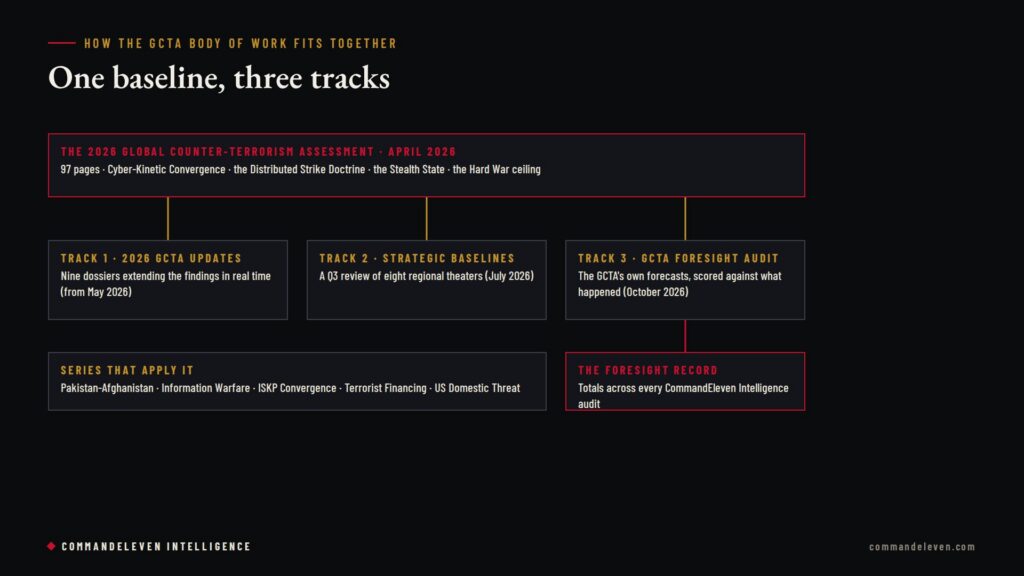
CommandEleven Intelligence’s 2026 Global Counter-Terrorism Assessment (GCTA), published in April 2026, is the 97-page baseline our counter-terrorism work builds on. Since then it has grown three tracks: the 2026 GCTA Updates, nine dossiers that extend its findings in real time; the Strategic Baseline Assessments, a Q3 review of eight regional theaters; and the GCTA Foresight Audit, which scores the GCTA’s own forecasts against what happened, misses included. This page brings all of it together, with the frameworks that connect it and the series that apply them. The assessment itself is a free download.
Download the 2026 Global Counter-Terrorism Assessment
What the GCTA Argues
The GCTA’s executive summary starts from a paradox: global terrorism deaths fell to a post-2007 low, while Western nations saw fatalities surge, 93% of fatal Western attacks were carried out by lone actors, and Pakistan became the most-impacted country in the world for the first time. Its frameworks explain how both can be true at once.
- Cyber-Kinetic Convergence. The GCTA’s keystone: digital operations are used to enable and amplify physical attacks, so defenses built for one domain miss threats that cross between them.
- The Distributed Strike Doctrine. The GCTA’s umbrella framework for how today’s jihadist networks organize, finance and attack without depending on a single center.
- The Stealth State. The GCTA’s name for al-Qaeda’s current model: a decentralized, self-sustaining structure built, in the GCTA’s words, to “survive the death of any single leader.” It funds itself through local economies rather than donors and licenses its brand to regional franchises.
- Hub-and-Spoke. The GCTA’s model for how the Islamic State’s core relates to its regional provinces, ISKP among them.
- The Hard War ceiling. The GCTA argues that “the Hard War model of counter-terrorism has reached its ceiling of efficacy” against digital, lone-actor radicalization at home, and calls for a shift to community-based de-radicalization. CommandEleven Intelligence has since extended the same logic to regional sanctuary and counter-insurgency, most fully in the Pakistan-Afghanistan series; that extension is labeled as ours wherever it appears.
Track 1: The 2026 GCTA Updates
Nine dossiers that extend the GCTA’s findings as events develop, introduced by the Strategic Preface: The 2026 Operational Realignment. The preface’s argument: as Western intelligence has turned toward state rivals, non-state actors are exploiting the gaps through diaspora support networks, decentralized finance and remotely directed attacks.
- TTP Command Structure: Analyzing the JuA Re-Integration Matrix
- Transnational Funding Pipelines: Tracking TTP Diaspora Networks
- Domestic Counter-Terrorism Profiling: Assessing Western Intelligence Gaps
- Hezbollah Logistics Pipeline: The HTS Transnational Symbiosis
- The Authoritarian Surveillance Model: Analyzing Damascus’ Safe City
- Haqqani Network Technology Proliferation: The Asymmetric Matrix
- ISIS External Operations: The Expansion of the ISKP Nexus
- Virtual Radicalization Process: Early Detection Indicators
- Asymmetric ISR Typologies: Target Vulnerability Modeling
Track 2: The Strategic Baseline Assessments
A Q3 2026 review of eight theaters, introduced by the Global Strategic Baseline Assessment. It identifies three macro-trends: logistics (energy grids, shipping routes and underground transit) as the main target set; cheap autonomous systems narrowing the gap between armed groups and conventional forces; and criminal and insurgent networks moving from disruption to running parallel governance.
Track 3: The GCTA Foresight Audit
A running public audit that scores every specific forecast in the GCTA against evidence published since, part by part. After two parts, eight forecasts are scored: three confirmed, three partially confirmed, one not confirmed and one not yet resolved. Three of the GCTA’s baseline facts have been corrected on the record.
- The GCTA Foresight Audit: Scoring Our 2026 Forecasts Against What Happened (method, running scorecard and roadmap)
- Part 1: Financing and the Stealth State
- Part 2: The Indian Subcontinent
- Fighting 2026 Terrorism Using The 2000 Playbook, the September 2026 review that first recorded the hawala-crypto confirmation
The GCTA audit is part of the wider CommandEleven Intelligence Foresight Record, which keeps the totals across all our audits.
Series That Apply the GCTA
- A Region Under Pressure: The Pakistan-Afghanistan Series: the 2026 war, the TTP sanctuary, al-Qaeda’s regional re-emergence and the Baloch insurgency, read against the Hard War ceiling.
- Information Warfare & Radicalization in the AI Era: how a narrative-held network like the Stealth State recruits, and what counter-messaging can do about it.
- The ISKP Convergence Series: ISKP’s technical handshakes with the BLA, the TTP and the Haqqani Network.
- Terrorist Financing: Hawala, Crypto, and the Coordination Gap: the financing channel the GCTA flagged, after FATF’s September report.
- The US Domestic Threat Landscape: the lone-actor and online radicalization threat behind the GCTA’s Western figures.
Frequently Asked Questions
What is the 2026 Global Counter-Terrorism Assessment?
CommandEleven Intelligence’s 97-page assessment of the global terrorism threat, published in April 2026. It covers threat actors, safe-haven logistics and regional theaters, and sets out the frameworks our later work builds on.
Where can I download the GCTA?
It is a free download from the 2026 Global Counter-Terrorism Assessment page.
What is Cyber-Kinetic Convergence?
The GCTA’s central framework: digital operations used to enable and amplify physical attacks, which defenses built for a single domain tend to miss.
What is the Stealth State?
The GCTA’s name for al-Qaeda’s current model: a decentralized, self-financing network built to survive the loss of any single leader.
How accurate has the GCTA been?
The GCTA Foresight Audit has scored eight of its forecasts so far: three confirmed, three partially confirmed, one not confirmed and one not yet resolved. The audit continues region by region.

