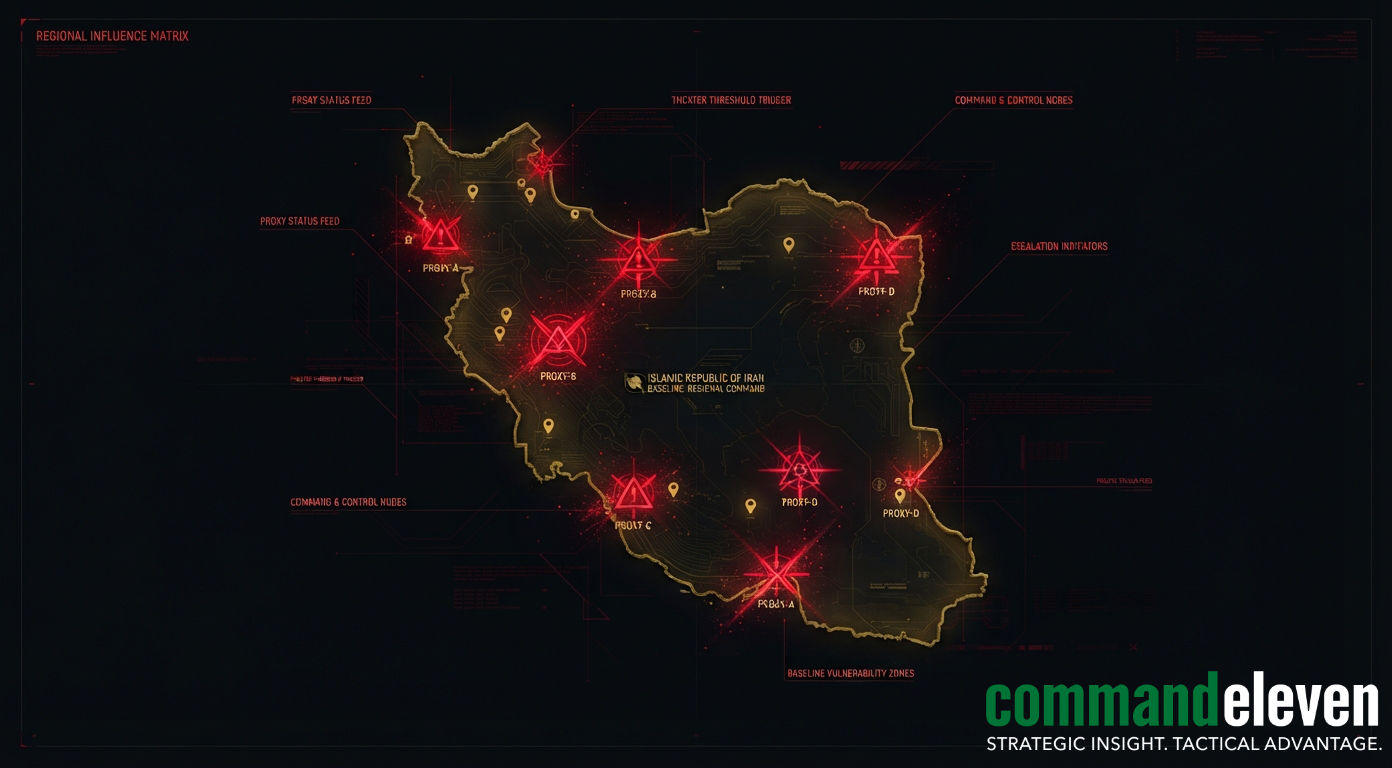
As of July 2026, the Islamic Republic of Iran is operating under a posture of “Defensive Asymmetric Power Projection.” The theater is defined by Iran’s ability to maintain a layered, redundant network of regional proxies while simultaneously insulating the domestic core from kinetic escalation. The strategic priority remains the institutionalization of the “Axis of Resistance” into a cohesive, interoperable force that can exert influence across the Levant, the Gulf, and the Caucasus without inviting direct state-on-state confrontation.
Overall Threat Indicators

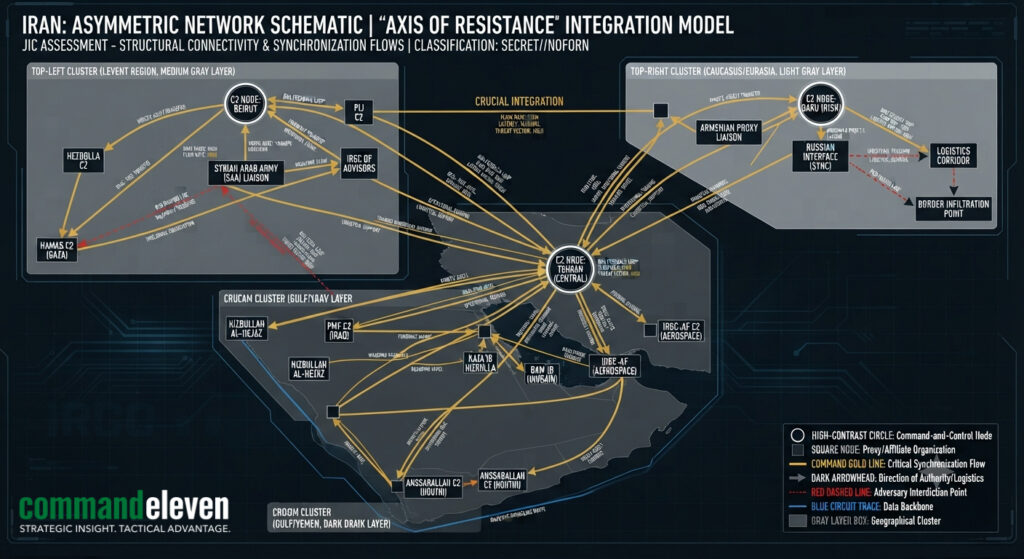
- Proxy Network Synchronization: Iran has achieved unprecedented levels of command-and-control (C2) integration with regional proxies, facilitating real-time coordination during multi-vector kinetic events.
- A2/AD Strategic Depth: The refinement of regional integrated air and missile defense (IAMD) systems, coupled with persistent drone saturation, has established a formidable defensive bubble that deters conventional adversarial incursions.
- Strategic Patience vs. Tactical Aggression: Tehran continues to utilize “managed escalation” cycles—allowing regional proxies to execute high-impact strikes while maintaining diplomatic-deniability channels.
Operational Topology: The Attrition Architecture
Iran’s “Attrition Architecture” relies on the following structural pillars:
- Subterranean Logistical Backbone: A sophisticated, multi-layered infrastructure of hardened caches and transport corridors that ensures the continuous flow of specialized munitions and technical hardware to proxies.
- Swarm-Based Deterrence: The deployment of autonomous, low-cost UAV and USV swarms is intended to overwhelm adversary IAMD grids and disrupt maritime shipping lanes in the Gulf.
- Cyber-Kinetic Synergy: The integration of offensive cyber capabilities—targeting regional energy and financial infrastructure—serves as the non-kinetic lever to enforce “red lines” during periods of heightened tension.
Technical Integration and Asymmetric Warfare
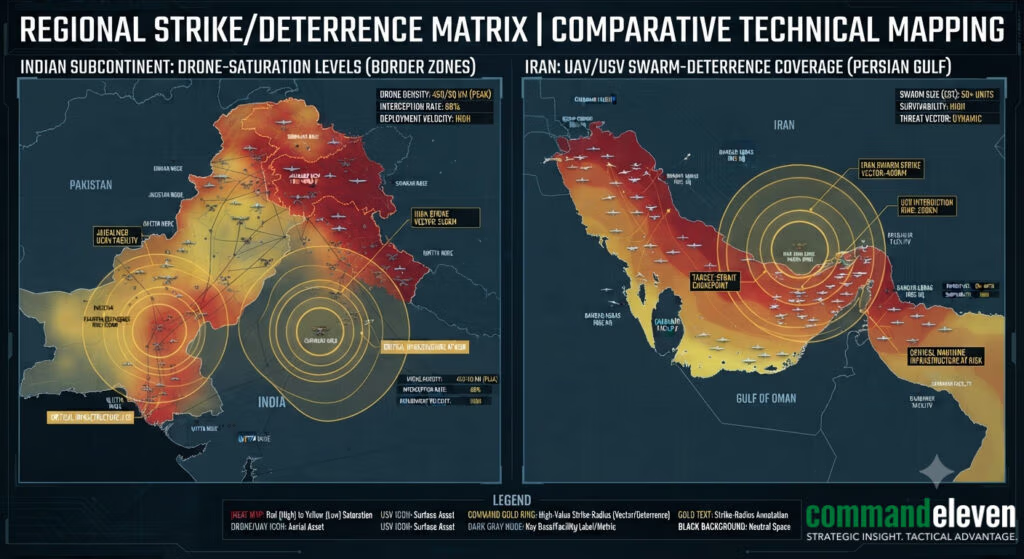
- Autonomous Munitions: Massive scaling in the production and deployment of loitering munitions, reducing the sensor-to-shooter loop to critical seconds.
- RF Spectrum Dominance: Iran’s tactical EW suites are increasingly sophisticated, capable of persistent disruption of RF spectrums, effectively blinding adversarial ISR and communication nodes.
Strategic Implications for Regional Stability
Iran’s regional strategy remains the central driver of instability. The ability to manipulate the Levant, Gulf, and Caucasus theaters through proxies ensures that Tehran remains a critical, albeit unpredictable, hegemon. The continued maturation of its autonomous and missile capabilities poses a persistent, growing threat to regional energy security and maritime stability.
Forecasting and Baseline Indicators
- Proxy C2 Density: Tracking the frequency of synchronized multi-proxy strikes across regional theaters.
- Autonomous Strike Capability: Monitoring the technical evolution and deployment volume of loitering munitions.
- Maritime Harassment Thresholds: Assessing the frequency and persistence of UAV/USV interference in Gulf maritime transit corridors.