Enhanced Interrogation is part of the CommandEleven Intelligence Special Report – The Warnings Reassessed
Terrorism and Crisis Desk · December 1, 2026
Bottom Line Up Front
Khalid Sheikh Mohammed (KSM) pitched the planes plot to Usama bin Laden, helped run it, and later told a Guantánamo status tribunal he was responsible for it “from A to Z.” He then spent years across a table from American interrogators, and the record shows he handled them the way he handled his operations: with patience, selective disclosure and a sense of what his questioners already knew. CIA cables from 2003 call part of his reporting “deliberate withholding.” An interagency assessment, “Precious Truths, Surrounded by a Bodyguard of Lies,” concluded he was withholding or lying about plots against the United States. The CIA’s own response concedes that one tip of his, about two men, was fabricated. Yet he also gave material that analysts used. The sources agree on the stalling. They disagree on what ended it, how much of what followed can be trusted, and whether the delay cost anything. One finding of this part is a warning in its own right: by the CIA’s own 2003 cable, the Karachi plots were stopped by Pakistani police work, and KSM spoke of them only after the arrests.
The Record at a Glance
| Behavior | Reported by | Outside record | Our grade |
|---|---|---|---|
| Pitched the planes plan to bin Laden at Tora Bora, 1996 | KSM, in interrogation reports | 9/11 Commission Report, pp. 148 to 149 | His account CONFIRMED as reported; independent confirmation limited |
| “Soon you will know,” in answer to a question about U.S. operations | Mitchell; Rodriguez | Neither is a transcript | REPORTED; the two accounts differ on who heard it |
| Gave dead or decades-old plots while appearing to cooperate | Mitchell; Soufan | Both describe the pattern; they disagree on its meaning | ASSESSED |
| Heathrow and Canary Wharf account on March 12, 2003, later retracted | Senate | CIA cables cited by the Senate | DISPUTED as to whether it was deception or a retraction under pressure |
| Karachi plots admitted only after seeing photos of captured associates | CIA cable, quoted by the Senate | Pakistani arrests, April 2003 | CONFIRMED in the cable; consequence ASSESSED |
| “Withholding or lying” about plots against the United States | Interagency Intelligence Committee on Terrorism, April 3, 2003 | Described in the Senate report; we have not seen the document | REPORTED; we hold only the Senate’s description |
| Fabricated derogatory information on two men | CIA response | The CIA says the men were released | CONFIRMED by the CIA itself |
| Waterboarding did not break him | Mitchell; Rodriguez; CIA response | Senate counts at least 183 times, in 15 sessions | The failure of the technique is agreed; the number and the effect of the rest are DISPUTED |
Key Judgments
- CONFIRMED as his account. KSM was the architect of the planes operation but not the head of al Qaeda (al-Qa’ida). According to the 9/11 Commission, relying on his own interrogation reports, he arranged a meeting with bin Laden at Tora Bora in mid-1996, briefed bin Laden and Mohammed Atef on the 1993 Trade Center bombing and the Manila air plot, and proposed training pilots to crash planes into buildings in the United States (9/11 Commission Report, pp. 148 to 149). He knew the plan needed money and logistics that only al Qaeda could supply (p. 149). He then moved to Kandahar, supervised the 9/11 planning and eventually led al Qaeda’s media committee (p. 150). The Commission warns that it could not test these detainee reports and had no control over how the questions were asked (p. 146).
- DISPUTED. Whether KSM swore allegiance to bin Laden. The Commission says KSM declined bin Laden’s request to join in 1996 and later “refused to swear a formal oath of allegiance,” keeping “a last vestige” of autonomy (pp. 149 to 150). In his 2007 tribunal statement, the first item on his list says he swore bay’ah to bin Laden (CSRT transcript, ISN 10024, Enclosure 3, p. 17). We do not know which is accurate. The difference matters because it is the same man giving two accounts of his own place in the organization, a few years apart and under very different conditions.
- ASSESSED. KSM’s stated grievance is U.S. policy toward Israel and the Arabian Peninsula. The Commission says “by his own account” his animus stemmed from his “violent disagreement with U.S. foreign policy favoring Israel,” not from his years as a student in the United States (p. 147). In his tribunal statement he cites bin Laden’s own complaint about the U.S. military presence in the Arabian Peninsula and U.S. aid to Israel, and compares bin Laden to George Washington (CSRT transcript, pp. 22 to 23). Bruce Riedel, a former CIA analyst, draws the same line from KSM’s testimony and bin Laden’s messages (The Search for al-Qaeda, supplied PDF p. 15). This is a statement of motive, not proof of it, and we label it as his.
- CONFIRMED. The CIA’s own contemporaneous documents record that KSM withheld information. The Senate quotes a CIA cable from ALEC Station (see the legend at the bottom) that called his late admissions about Karachi “a clear illustration of continued and deliberate withholding of threat information” (Executive Summary, pp. 245 to 246). The Senate also describes an April 3, 2003 assessment by the Interagency Intelligence Committee on Terrorism, titled “Precious Truths, Surrounded by a Bodyguard of Lies,” which concluded he was withholding or lying about plots and operatives targeting the United States (p. 93). The Senate is a hostile source for the program, but the cables it quotes are the CIA’s.
- ASSESSED. KSM’s stalling was a method, not an accident. Mitchell says KSM shifted from protecting information to trying to “provide just enough truthful information to avoid” the techniques “but still protect his most important secrets” (Enhanced Interrogation, supplied PDF p. 148). He describes a tactic he calls “hiding in the truth,” telling a version of the truth that is uninformative and not responsive to the question (p. 148). He also says detainees were taught to answer exactly what they were asked and not volunteer more (p. 203). Soufan, a critic of the program, describes the same behavior as “classic counterinterrogation techniques,” saying KSM gave interrogators a West Coast plot that was already over (The Black Banners, supplied PDF p. 753). The two men disagree about the program. They agree about the behavior.
- DISPUTED. What ended the resistance, and what the rest was worth. Mitchell says the waterboard “wasn’t effective on KSM,” because KSM swallowed water, let it run out through his nose and counted seconds on his fingers (supplied PDF p. 141). Rodriguez, who led the CIA’s Counterterrorism Center during the program, writes that waterboarding did not immediately produce results and that more sleep deprivation eventually brought KSM to a compliant stage (Hard Measures, supplied PDF p. 112). The CIA’s response calls KSM “adept at resisting the technique” (supplied PDF p. 79). On those points there is no dispute. The Senate majority says he was waterboarded at least 183 times and that his reporting “includes significant fabricated information” (Executive Summary, p. 85); we did not find the 183 figure in the CIA’s response. The Senate also says the CIA continued after the techniques ended to assess that he was withholding and fabricating (p. 93).
- ASSESSED. The cost of the stalling cannot be measured from the open record, except in one case. The ALEC cable said KSM’s omission about Karachi “may well have cost American lives” had Pakistani authorities not followed “unrelated criminal leads” (Senate, p. 246). That was the CIA’s judgment at the time, and on that account the plots were stopped by local police work, with KSM’s contribution coming after the arrests. The CIA later represented that the plotting was uncovered in the interrogations of Khallad bin Attash and Ammar al-Baluchi “and later confirmed by KSM” (Senate, p. 245, quoting the CIA). The two statements are not the same, and the gap bears directly on Part 7.
How He Got to the Table
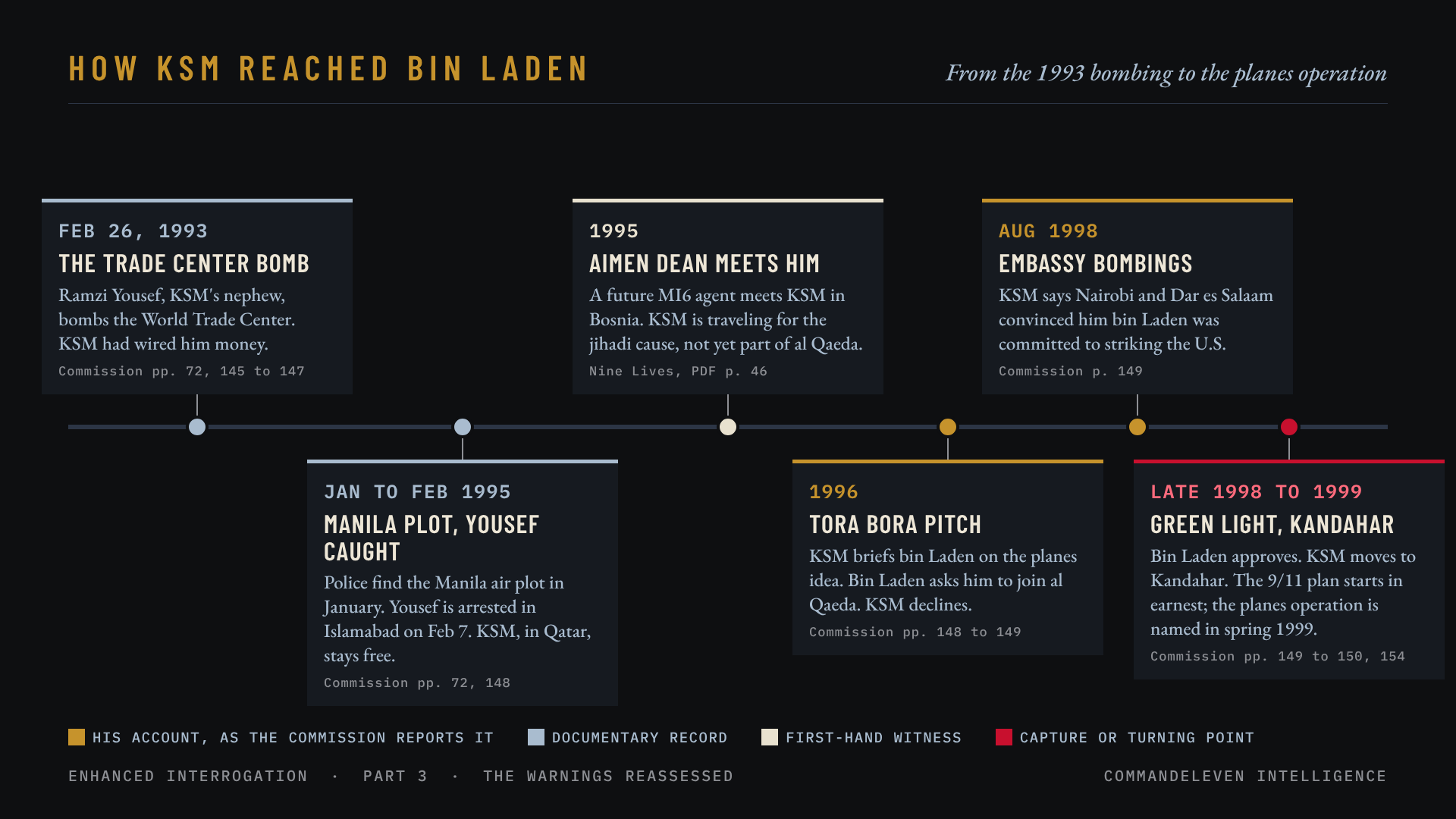
The man who called himself “the Brain” (Enhanced Interrogation, supplied PDF p. 13) was not a product of bin Laden’s organization. The Commission says KSM grew up in Kuwait in a family from the Baluchistan region, claims to have joined the Muslim Brotherhood at 16, and became enamored of violent jihad at youth camps (p. 145). He was the uncle of Ramzi Yousef, the planner of the 1993 World Trade Center bombing, and wired Yousef a small sum before it (pp. 72, 147). The Commission says Yousef’s notoriety inspired KSM to plan attacks on the United States, and that the 1994 Manila air plot was the first time KSM took part in planning an operation (p. 147).
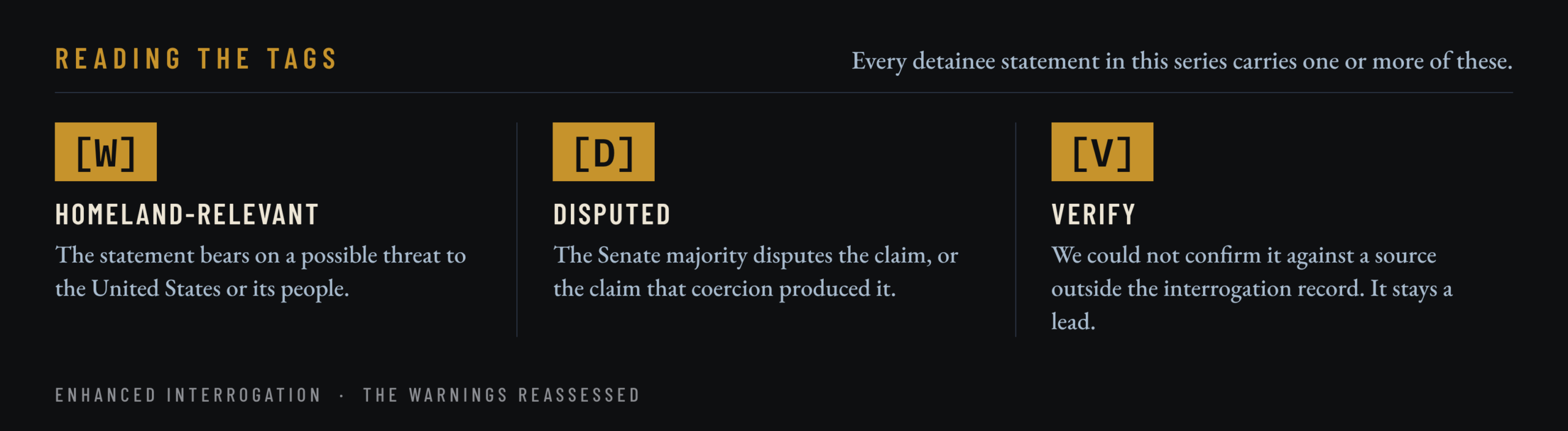
Aimen Dean, a former MI6 agent inside al Qaeda, met KSM in Bosnia in 1995, when KSM was traveling from a base in Qatar on behalf of the jihadi cause. He notes that the Commission’s account of KSM’s Bosnia activity is incomplete (Nine Lives, supplied PDF p. 46) [V]. It is one witness and not a document, but it is a first-hand account from before KSM joined al Qaeda.
The Commission says that in 1996 KSM, with Atef’s help, arranged a meeting with bin Laden at Tora Bora. KSM told his interrogators that bin Laden likely agreed to meet because of Yousef’s reputation (p. 148). By KSM’s account, bin Laden listened “without much comment,” asked him to join al Qaeda formally and move to Afghanistan, and KSM declined, preferring to stay independent (p. 149). The Commission says bin Laden gave the green light for the operation sometime in late 1998 or early 1999, apparently at Atef’s urging, after which KSM accepted the invitation to Kandahar and planning “began in earnest” (pp. 149 to 150). KSM says he formally joined al Qaeda in late 1998 or 1999, and that bin Laden summoned him to Kandahar in March or April 1999 to say al Qaeda would support the proposal, at which point it was called the “planes operation” (p. 154). Riedel dates the start of the plot to meetings at bin Laden’s Kandahar headquarters in 1999 (supplied PDF p. 15). Riedel’s account and the Commission’s appear to describe different stages, the pitch and the commitment, and we treat them as compatible unless a primary document shows otherwise.
KSM also says he pushed the Southeast Asian group Jemaah Islamiyah toward U.S. economic targets (Commission, p. 151) [V].
In His Own Words
On March 10, 2007, a Combatant Status Review Tribunal at Guantánamo heard a statement that KSM had his personal representative read. It is a government document, declassified, and our primary source for how he describes himself.
In it he says he was a member of the al Qaeda council, media operations director for al-Sahab, operational director for bin Laden for the 9/11 operation under the military commander Abu Hafs al-Masri, and military operational commander for all foreign operations (CSRT transcript, Enclosure 3, pp. 17 to 18). He says he was “responsible for the 9/11 Operation, from A to Z” and he lists the Bojinka plot, the Second Wave plans against four U.S. skyscrapers, the Bali nightclub bombing and the Pearl killing among about thirty items (pp. 18 to 20).
Three cautions apply.
First, it is a self-report. The list includes items outside our reach, and we have not tested each one. Where an item can be checked against another record, such as Bojinka (Commission, p. 147), it is consistent. For others we hold only his word.
Second, he says some of his earlier statements to interrogators were false. Asked whether he made statements because of his treatment between 2003 and 2006, he said that some of what he told interrogators was made-up “stories,” and that under torture he sometimes agreed he knew people he did not know (CSRT transcript, pp. 14 to 15). The same document has him affirming his list “without duress” (p. 17). We cannot reconcile those. A statement made after years in custody may be an honest self-account or a performance, and the record does not let us tell which.
Third, it is his account of his motive. He frames his actions as war, says the language of war is killing, and says Muslims who see bin Laden as a hero see him as fighting for independence (pp. 22 to 23). That is a claim about how he wants to be understood. It tells us what he said, not whether it is accurate.
Stalling and the Half-Truth
The line. Mitchell writes that when he asked KSM who and where his people in the United States were, KSM looked up “defiantly,” half smiled and said, “Soon you will know,” adding that “the Brain always has something to think about” and that he had nothing for Mitchell (Enhanced Interrogation, supplied PDF p. 14) [W] [V]. Rodriguez gives a version of the same line to a CIA officer in the cell, in answer to a question about planned operations (Hard Measures, supplied PDF pp. 111 to 112) [W] [V]. The two accounts differ on where and to whom it was said. Neither is a transcript, and neither author claims to quote a recording. We use the line as the title because two accounts report it, not because it is verified.
The pattern. Mitchell says KSM’s early output was “detail about a dead person or a decades-old terror plot” (supplied PDF p. 147) [V]. Soufan makes the same point with a specific plot: KSM told interrogators about a West Coast plot that had already been derailed, which led them to think he was cooperating, and he did not tell them about cells he must have known of in Madrid, London and Jakarta (The Black Banners, supplied PDF pp. 753 to 754) [W] [D]. The CIA’s response says CIA officers distrusted KSM’s reporting on Jafar al-Tayyar because he had put al-Tayyar “into practically every story,” each time with a different role, and read the inconsistency as a sign that KSM was protecting him (CIA Response, supplied PDF p. 116) [W] [D].
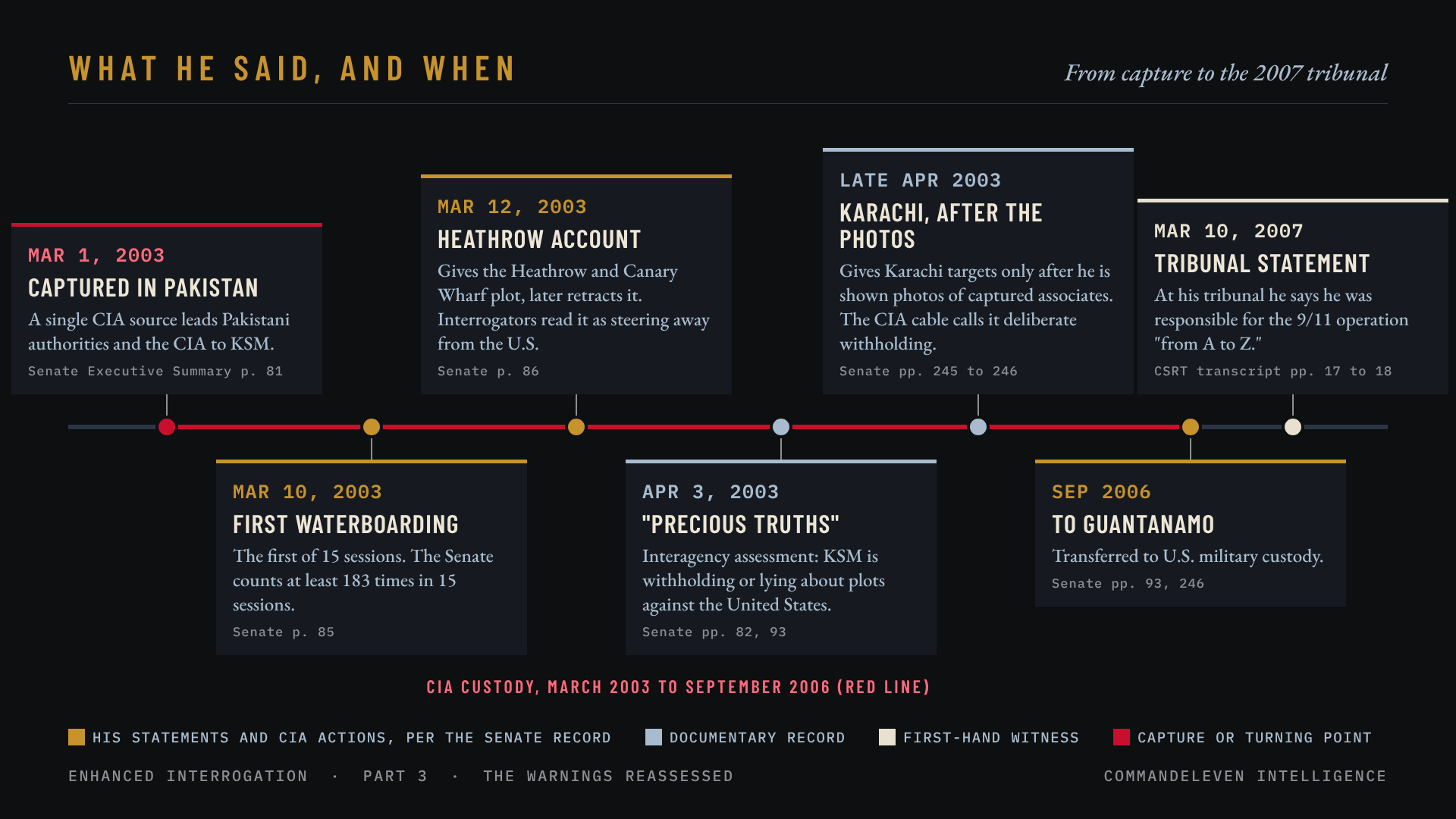
The first sessions. On March 12, 2003, KSM gave information on the Heathrow and Canary Wharf plot and on directing prospective pilots to study at flight schools. The Senate says he later retracted all of it and that there are no CIA records showing the retractions were assessed to be false (Executive Summary, p. 86). It adds that interrogators at the time read the Heathrow account as an effort to avoid discussing plotting inside the United States, which contributed to two waterboarding sessions that day (p. 86) [W] [D]. The CIA says detainee reporting did play a role in disrupting the Heathrow plot (CIA Response, case 7, p. 18).
Karachi. The CIA cable the Senate quotes is the clearest documented example. In late April 2003, more than a month after the CIA stopped using the techniques on him, interrogators confronted KSM with capture photographs of his nephew Ammar al-Baluchi and of Khallad bin Attash, and only then did he provide information on potential targets in Karachi (Executive Summary, pp. 245 to 246). The ALEC Station wrote that it was “disappointed” and considered the omission “a serious concern” (p. 246) [W]. It said he “deliberately withheld” the information until confronted with evidence that the CIA already knew, or soon would (p. 246). The cable is the CIA’s own contemporaneous judgment, not a later critic’s.
The fabrications. The CIA’s response says that when KSM “provided actionable information” that two individuals posed “continuing, serious threats,” the CIA detained them, and that KSM then admitted he had fabricated the derogatory information, after which they were released (CIA Response, supplied PDF p. 77) [D]. The CIA uses this to argue the program has a working “safety valve.” It is also a documented case of a high-value detainee naming innocent people.
The “Precious Truths” assessment. On April 3, 2003, the Interagency Intelligence Committee on Terrorism concluded that KSM was withholding or lying about plots and operatives targeting the United States and that it found contradictions between his reporting on chemical, biological, radiological and nuclear weapons and other sources (Executive Summary, p. 93) [W] [D]. We know it from the Senate’s description and a footnote. We have not seen the document and do not know how it has been characterized elsewhere.
Mitchell’s reading. Mitchell says that after the techniques KSM began to answer the question as asked, then add, “But that’s not the question I would ask,” and rephrase it to supply a fuller answer (supplied PDF p. 203). He says it was a sin to volunteer information the enemy had not asked for (p. 204) [V]. That is the justification Mitchell attributes to the detainees, and it is plausible as a cultural explanation, but it is his reading. The pattern it describes, silence until asked precisely, is also consistent with a detainee protecting information as long as he can.
What Ended It, and What the Record Disputes
All parties agree the waterboard did not break KSM. Mitchell, Rodriguez and the CIA’s response say so in their own terms. The disagreement is about what followed.
Mitchell says cooperation began roughly 72 hours into the techniques, with sleep deprivation and walling doing more than the waterboard (supplied PDF pp. 141 to 149) [V]. The Senate says KSM was waterboarded at least 183 times and that the reporting he produced included significant fabricated information (p. 85) [D]. Soufan, a former FBI agent, argues that KSM’s reporting on dead plots, while he held back live ones, shows the techniques did not produce reliable intelligence (supplied PDF pp. 753 to 754). Mitchell reads the same behavior as resistance the techniques were designed to overcome (supplied PDF pp. 147 to 148). Each side points to the same behavior as evidence for its case. The record cannot separate “he stopped resisting” from “he learned what to say.”
A second dispute concerns the first identification of KSM as the planner. The CIA says Abu Zubaydah’s account was the first “authoritative, detailed” statement singling KSM out as the “mastermind,” and that earlier reports were speculative emails and vague references (CIA Response, Tab 9, supplied PDF p. 103) [D]. The CIA also concedes one of its briefing documents wrongly said the information came after the techniques were applied (p. 103). The Senate disagrees and the CIA says it cites five earlier references. We have not read the Senate’s own section on this point and will not decide it here.
The third dispute, whether KSM’s lies about a courier named Abu Ahmed al-Kuwaiti were a clue or a distraction, belongs to Part 6.
What We Do Not Know
- Whether KSM’s tribunal statement is accurate item by item. We hold the government’s declassified transcript and no independent test of most of the list.
- Which of his accounts of his place in al Qaeda is true, the one in the Commission’s interrogation reports or the one in the 2007 tribunal.
- What the “Precious Truths” assessment actually says. We have the Senate’s summary of it.
- How much of what he withheld was ever recovered. The open record gives us Karachi and almost nothing else.
- What the military commission has ruled about the admissibility of his statements. The defense motion to suppress (AE 630BBBBBB) is in our files; we have not confirmed a ruling.
What to Watch
- KSM’s military commission proceedings, where his statements to the CIA will be tested for admissibility.
- Any new release of the “Precious Truths” assessment or the Karachi cables, which would let readers judge the quotes in this piece against the originals.
Calls We Will Score
- No verdict will be entered against KSM in any U.S. proceeding, by December 31, 2027.
- The full text of the April 3, 2003 “Precious Truths, Surrounded by a Bodyguard of Lies” assessment will not be publicly released, by December 31, 2027.
What This Assessment Does and Does Not Establish
It establishes that KSM pitched the planes plot and ran much of it, that CIA cables record him withholding information in 2003, that the CIA concedes at least one fabricated tip, and that every source, including the program’s defenders, says the waterboard did not break him.
It does not establish whether the techniques made him more truthful or more compliant, whether his self-account in 2007 is accurate, or how much he withheld that was never found. Those questions return in Parts 6 and 7.
Frequently Asked Questions
Was KSM the leader of al Qaeda?
No. According to the 9/11 Commission he was the architect and manager of the planes operation, working under bin Laden. His own 2007 statement claims several senior titles; we treat those as claims.
Did KSM lie to his interrogators?
The CIA’s own cables say he withheld information about Karachi, and the CIA concedes he fabricated a tip about two men. The record also shows he gave information analysts used. “Lied” is too broad. “Managed what he said” fits better.
Did the waterboard make him talk?
The sources that agree on little else agree it did not break him. The dispute is about what did, and whether the information that followed was reliable.
Is his 2007 confession reliable?
It is his account. He says some of his earlier statements were invented under torture, and he also affirms the list “without duress.” Treat it as what he wants on the record, not as verified fact.
Why does the Karachi case matter more than the rest?
Because the CIA wrote down at the time that the information was late, that it mattered, and that local police work, not KSM, had stopped the plot.
Related Reading
- Enhanced Interrogation: What the Captured Said, and What Became of the Warnings
- Enhanced Interrogation, Part 1: Who Was in the Room, and What We Can Trust
- Enhanced Interrogation, Part 2: Plots Named in Custody
- The Warnings Reassessed
Sources
- National Commission on Terrorist Attacks Upon the United States, The 9/11 Commission Report (2004), pp. 72, 145 to 151, 154. Page numbers are the printed page numbers.
- Senate Select Committee on Intelligence, Committee Study of the CIA’s Detention and Interrogation Program: Executive Summary (December 3, 2014 revisions; page numbers follow the 499-page release PDF), pp. 81 to 82, 85 to 86, 93, 245 to 246.
- Central Intelligence Agency, CIA Comments on the Senate Select Committee on Intelligence Report (June 27, 2013; copy hosted by the Federation of American Scientists), including Tab 9 and the case-study responses (supplied PDF pp. 77, 79, 103, 116).
- U.S. Department of Defense, Verbatim Transcript of Combatant Status Review Tribunal Hearing for ISN 10024, March 10, 2007, Enclosure 3, pp. 14 to 15, 17 to 20, 22 to 23.
- U.S. Military Commissions, United States v. Khalid Shaikh Mohammad et al., AE 630BBBBBB (defense motion to suppress).
- James E. Mitchell with Bill Harlow, Enhanced Interrogation (2016); Jose A. Rodriguez Jr., Hard Measures (2012); Ali H. Soufan, The Black Banners (2011); Aimen Dean with Paul Cruickshank and Tim Lister, Nine Lives (2018); Bruce Riedel, The Search for al-Qaeda (2008); Lawrence Wright, The Looming Tower (2006).
- The two timeline graphics are built from the pages cited in this dossier. The Aimen Dean item rests on his memoir alone; the other dated items rest on the Commission, the Senate study or the tribunal transcript.
Legend: ALEC Station
ALEC Station was the CIA’s unit for tracking Usama bin Laden and al Qaeda. The Counterterrorism Center (CTC) set it up in 1996 (Soufan, The Black Banners). It was called a “virtual” station because it sat in an office building near Langley and not in a foreign capital (Wright, The Looming Tower). By the time of the interrogation program, former CIA officers describe it as the CTC unit responsible for targeting al Qaeda (Mitchell, Enhanced Interrogation), and the Senate study quotes its cables about the interrogations of Abu Zubaydah and KSM. When this dossier says “the ALEC Station wrote,” it means those cables, not the CIA’s final assessment of the program.