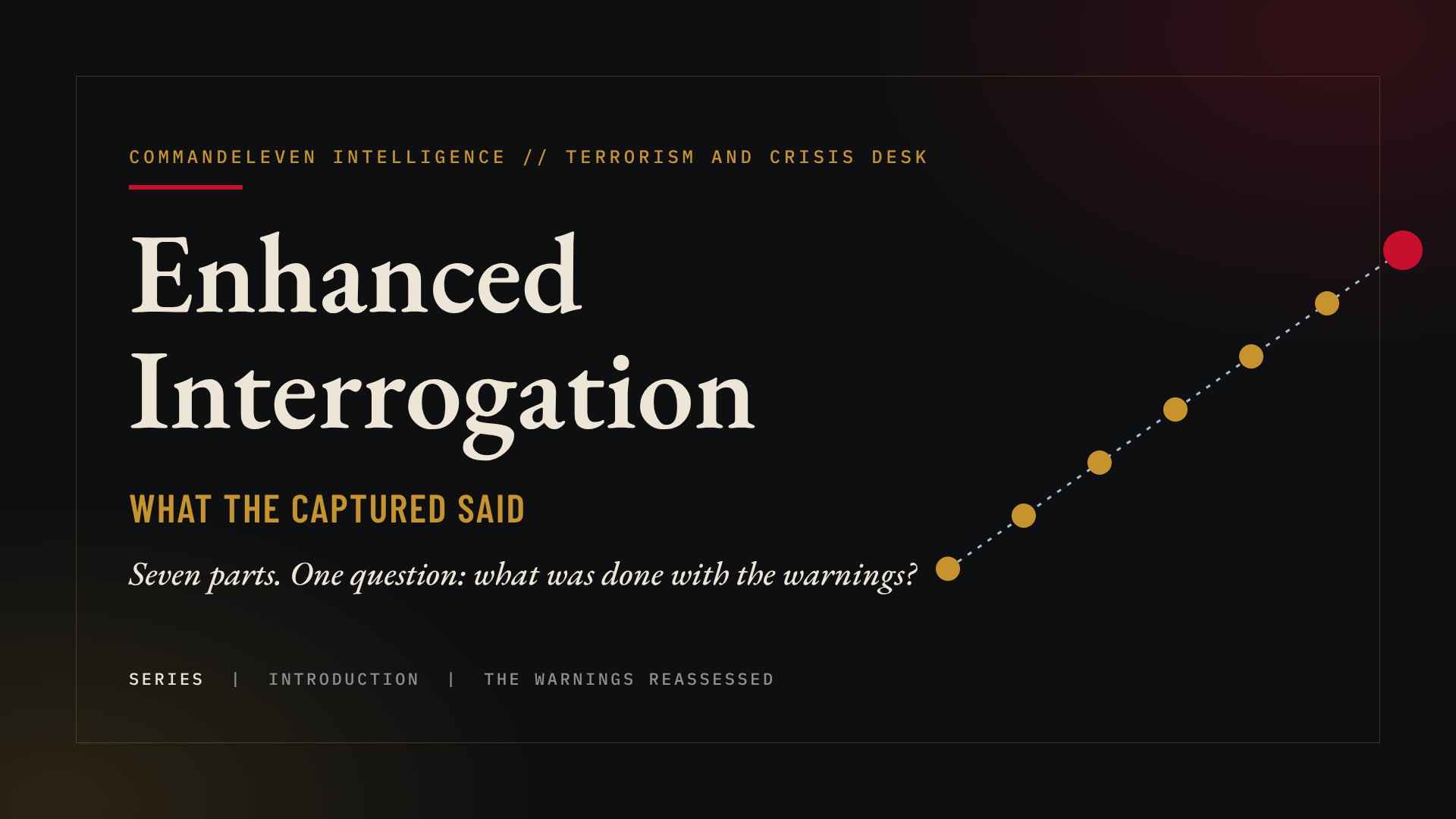
Enhanced Interrogation is part of the CommandEleven Intelligence Special Report – The Warnings Reassessed
Terrorism and Crisis Desk · November 27, 2026
Bottom Line Up Front
After September 11, the United States held the men who planned it and questioned them for years. They talked about plots, about how they thought, and about how they meant to win. This seven-part series reads what they reportedly said, checks each statement against evidence from outside the interrogation room, and asks the question that matters for homeland security: when the warnings came, what was done with them?
The series is not a verdict on whether coercive interrogation was right or wrong, and it does not take the side of the program’s designers or of its critics. It follows the intelligence.
Why This Series, and Why Now
Two decades on, the debate about the CIA’s program is still argued from fixed positions. The people who ran it say it saved lives. The Senate committee that investigated it says its central claims were wrong. The CIA’s own response concedes errors and calls the key counterfactual “unknowable.” What gets lost in that argument is what the detainees actually said about threats to the United States, how much of it held up, and whether anyone acted on it.
How We Read It
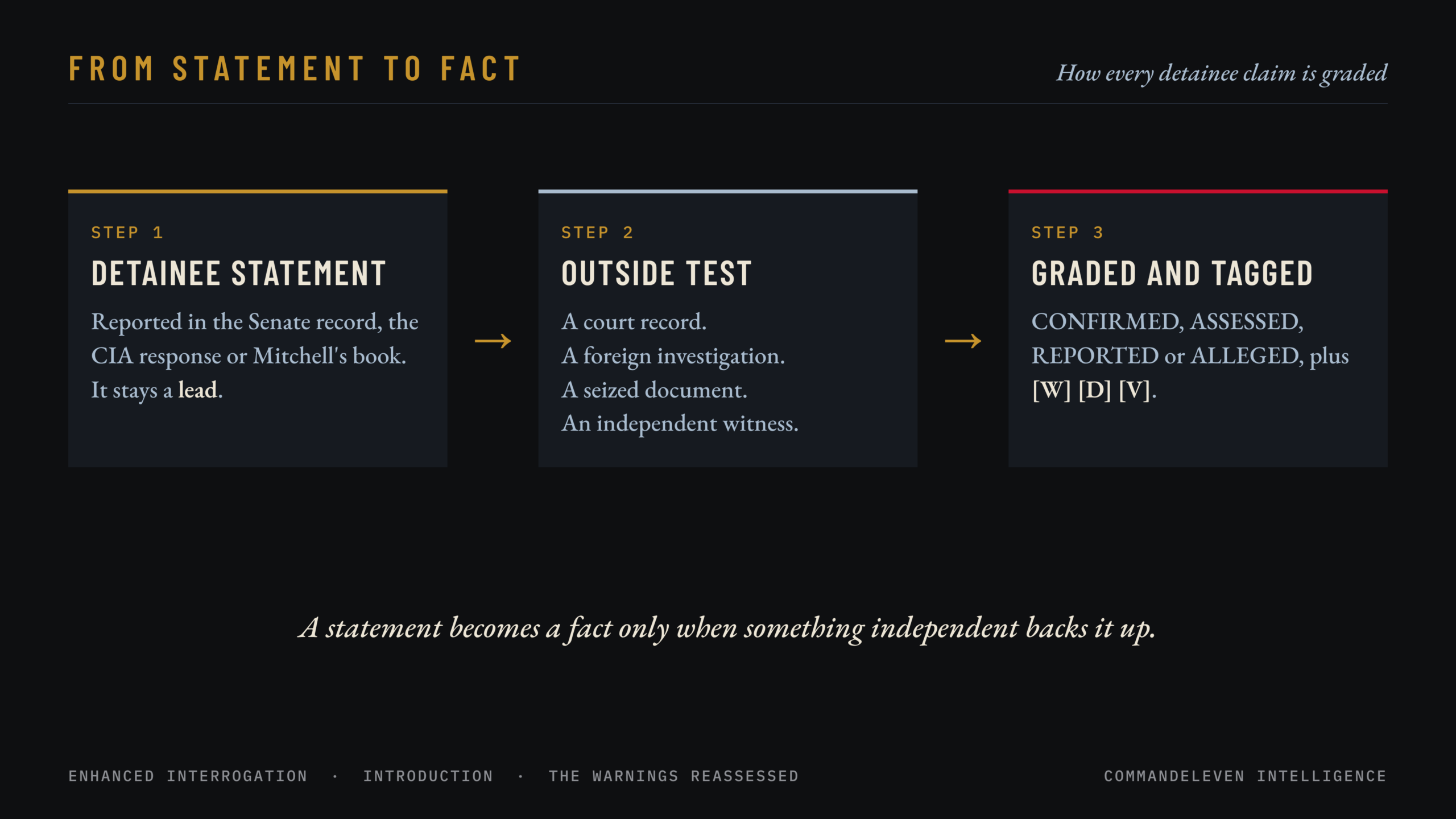
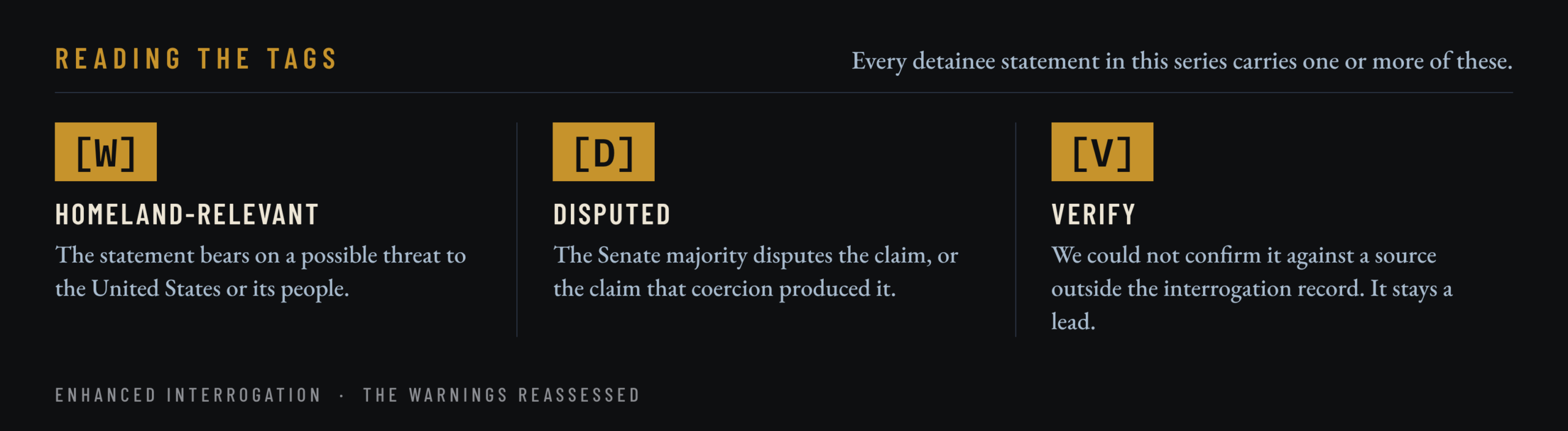
Our main text is the account by James Mitchell, who helped design the techniques, written with Bill Harlow. It is a one-man recollection by a paid insider, so we treat it as a set of claims. Every claim is tested against the Senate majority report, the Senate minority views, the CIA’s 2013 response, the 9/11 Commission, court records and the other first-hand accounts of the period. Each statement carries a tag: [W] bears on a homeland threat, [D] is disputed by the Senate majority, [V] could not be verified outside the interrogation record. Where a detainee describes his own doctrine, we report what he said about his movement, not about Muslims in general.
Where This Goes Next
In our assessment, the intelligence from these interrogations was never turned into a counter to the al Qaeda (al-Qa’ida) playbook, or into preparation for threats to the U.S. homeland. As part of The Warnings Reassessed, we take the plots, ideologies, doctrines and objectives the detainees described and run them through our own tradecraft, to show how each has appeared in the Western world and, specifically, in the United States. Part 7 tests that judgment against the record.
The Seven Parts
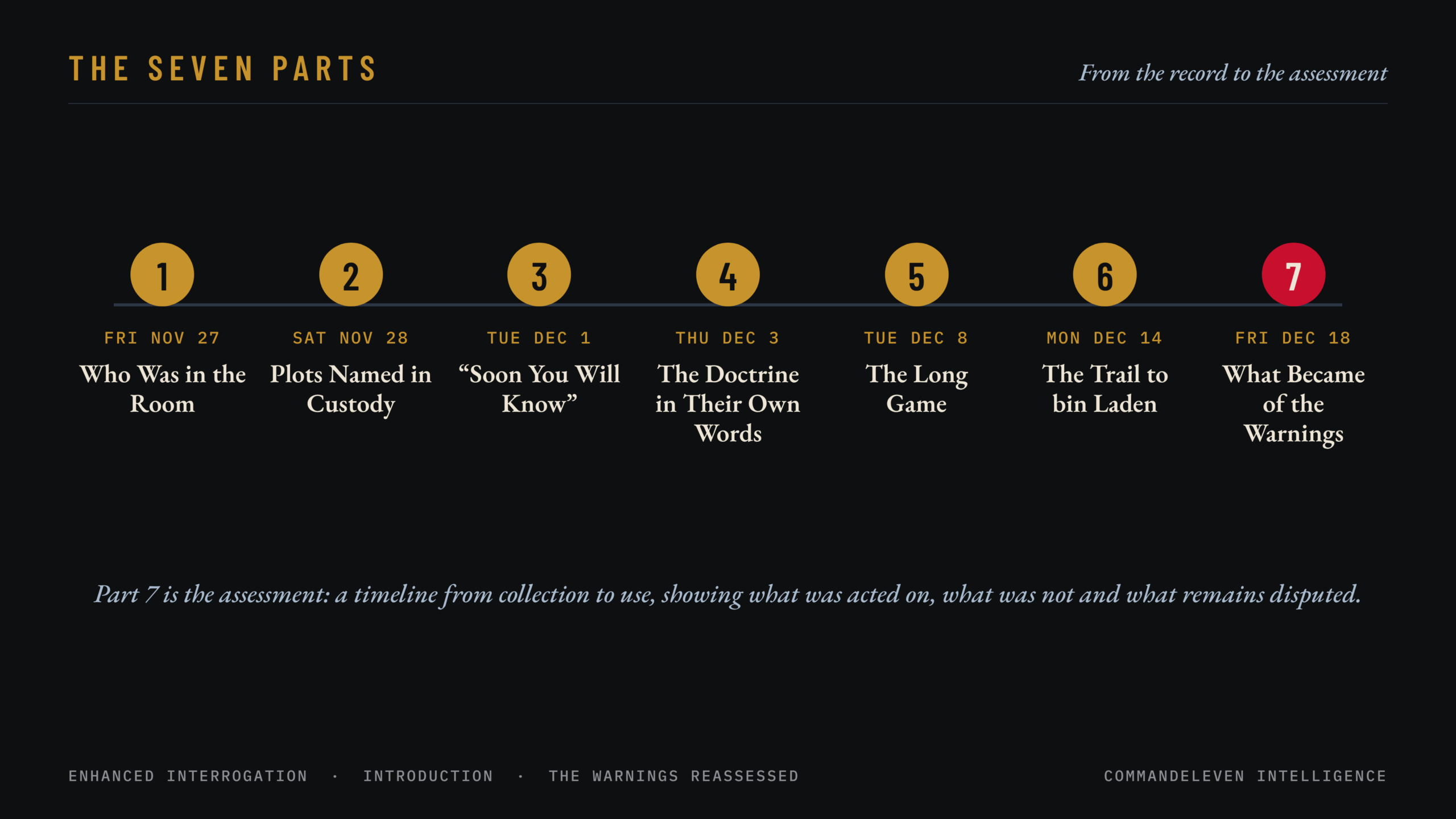
| Part | Title | Date |
|---|---|---|
| 1 | Who Was in the Room, and What We Can Trust | Fri, Nov 27 |
| 2 | Plots Named in Custody | Sat, Nov 28 |
| 3 | “Soon You Will Know” | Tue, Dec 1 |
| 4 | The Doctrine in Their Own Words | Thu, Dec 3 |
| 5 | The Long Game | Tue, Dec 8 |
| 6 | The Trail to bin Laden | Mon, Dec 14 |
| 7 | What Became of the Warnings | Fri, Dec 18 |
Part 7 is the assessment: a timeline from collection to use, showing what was acted on, what was not and what remains disputed. The series sits alongside our work on the Muslim Brotherhood and AI in warfare, and it feeds the closing capstone, which runs the whole record through the CommandEleven Intelligence assessment model.
What This Series Does Not Do
It does not reproduce the book, it does not publish operational detail, and it does not treat any single source, including ours, as final.