CommandEleven Intelligence Desk // Terrorism and Crisis Desk, status as of November 26, 2026
Bottom Line Up Front
Black Friday is November 27, Cyber Monday is November 30, and the crowded season runs through New Year’s Eve. No public source we reviewed identifies a specific, credible plot against a U.S. shopping venue this season. Officials are warning in general terms: U.S. embassies in Europe say lone actors could strike markets, malls and transit hubs “with little or no warning,” and U.S. aviation authorities have briefed airlines on al-Qaeda messaging. An 18-year-old was charged in October over an alleged plot against the Mall of America, which shows the target set is real even though no 2026 holiday plot has been made public.
We assess that the harm most likely to reach an ordinary shopper this season is fraud and theft, not terrorism. That is a judgment from the data below, not a reason to stop paying attention to crowds. This guide covers both: what officials have said, what the numbers show, how to recognize behavior that deserves a report, and what to do about each.
Key Judgments
- CONFIRMED. U.S. embassies in London, Berlin, Madrid, Rome and Brussels issued holiday security alerts between November 16 and 18 naming Christmas markets, shopping centers, transit hubs and crowded events as possible targets for lone actors. The alerts name no specific plot.
- CONFIRMED. The FBI, DHS and TSA sent the aviation industry an informational report on November 19 about al-Qaeda messaging encouraging attacks on commercial aviation, according to CNN. A law enforcement source told CNN there is no known specific, credible plot. The report itself has not been published, and DHS’s National Terrorism Advisory System showed no current advisories on November 26.
- CONFIRMED. Federal prosecutors in Minnesota charged an 18-year-old on October 7 with receiving a firearm to commit a federal crime of terrorism, alleging he planned a mass shooting at the Mall of America. The FBI had been in contact with him since December 2024 and supplied the weapon in a sting, rendered inert. The charge is an allegation.
- CONFIRMED. Federal, CISA and UK counter-terrorism guidance all point to behavior as the thing to watch. UK police state that hostile individuals cannot be identified by looks, age, ethnicity, gender or clothing. Clothing appears in official guidance only as a context cue, such as bulky clothing that does not fit the weather, and never on its own.
- ASSESSED. Fraud is the most probable harm to a typical shopper. The FBI’s 2025 Internet Crime Report received 1,008,597 complaints and $20.877 billion in total reported losses. It logged 56,478 non-payment and non-delivery complaints with $503.4 million in losses, 18,774 credit card and check fraud complaints with $282.7 million, and 191,561 phishing and spoofing complaints. These are voluntary complaints for the full year, not holiday-season counts.
- REPORTED. Darktrace, a security vendor, says Black Friday-themed phishing emails per day in November 1 to 21 ran about 13 times the October daily average in its customer data. This is a vendor claim from its own detection models.
- CONFIRMED. “Ghost tapping” means two different things. The Better Business Bureau uses it for tap-to-pay overcharges, where a vendor or fake charity collector shows a small amount and processes a larger one. Group-IB uses “Ghost Tap” for NFC relay fraud, where a victim is tricked into installing a malicious app. Neither source documents card theft by scanning through clothing or bags.
- REPORTED. A September 2026 Security.org survey estimates 47.7 million Americans had a package stolen in the past year, worth about $7.7 billion. The figures are extrapolated from a three-month rate and are a survey estimate, not a police count.
- REPORTED. The National Retail Federation’s 2026 study found shoplifting incidents fell 12.4% in 2025, while retailers reported rising phone scams, loyalty fraud and gift card fraud. Retail crime is shifting toward fraud and away from the shelf.
The Season’s Threat Ladder
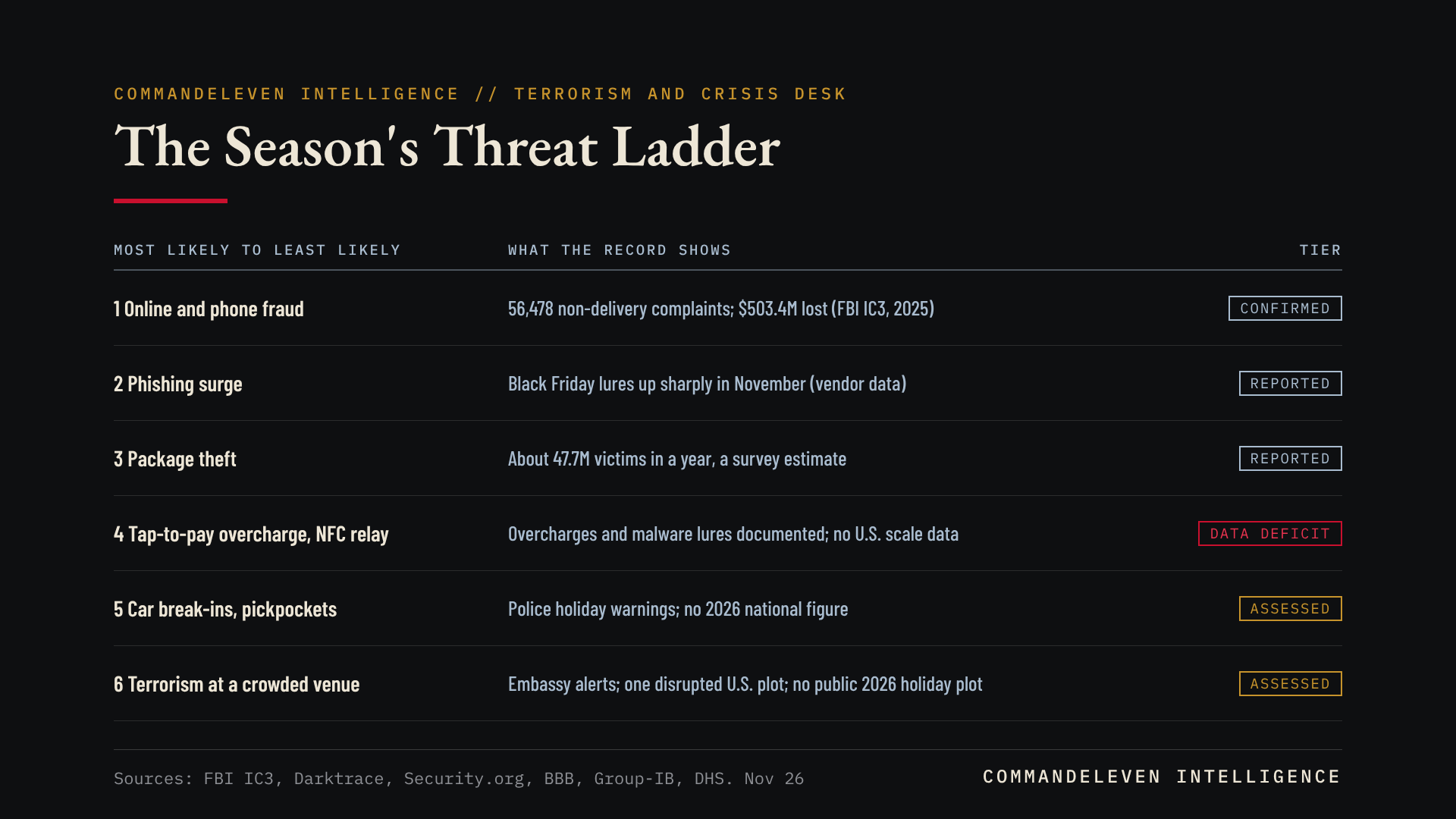
The table ranks what a shopper is most likely to meet, using the evidence in this guide. It is our assessment of likelihood for an ordinary person, not a ranking of consequence. A terrorist attack is the least likely and the most severe.
| Threat | What the record shows | Tier |
|---|---|---|
| Online and phone fraud | 56,478 non-delivery and non-payment complaints, $503.4 million in losses (FBI IC3, 2025) | CONFIRMED |
| Phishing surge | Black Friday lures up sharply in November (Darktrace) | REPORTED |
| Package theft | About 47.7 million victims in the past year, extrapolated (Security.org) | REPORTED |
| Tap-to-pay overcharging and NFC relay | BBB alert on overcharges; Group-IB on relay malware; no U.S. scale data | REPORTED, DATA DEFICIT on scale |
| Vehicle break-ins and pickpocketing in crowds | Standard police holiday warnings; no 2026 national figure found | ASSESSED |
| Terrorism at a crowded venue | Embassy alerts, one disrupted plot (Mall of America); no specific 2026 holiday plot made public | ASSESSED, low likelihood and high severity |
What Officials Are Saying
Europe: embassy alerts on markets and malls
The U.S. Embassy in London issued a holiday security alert on November 16, and the embassies in Berlin and Madrid did the same that day, with Brussels following on November 17 and Rome on November 18. The alerts say terrorist attacks are a risk in the run-up to Christmas and that lone actors could target tourist sites, markets, transport hubs and shopping centers. They advise travelers to keep a low profile, stay away from demonstrations, follow police instructions and enroll in the State Department’s STEP program. ITV reports the UK threat level stands at severe, meaning an attack is highly likely, and that the London alert also mentions hoax bomb threats against UK airports in November and heightened alert at U.S. bases in Britain tied to an Iranian threat. Brussels’ Winter Wonders celebrations run November 27 to January 3.
Christmas markets have been a target before. Polish authorities announced the disruption of an Islamic State-inspired Christmas market plot in December 2025, per Euronews. The 2026 alerts do not cite a new specific plot.
Aviation: the November 19 report
According to CNN, which obtained a copy, the FBI, DHS and TSA sent an informational report to airlines, air cargo carriers and airports on November 19. It describes al-Qaeda messaging praising the September flydubai FZ1073 attempt and encouraging similar attacks, and it lists four indicators for aviation staff: attempts to evade screening, unusual questions about flight operations or security from people with no business need, insistence on handling specific luggage or cargo personally, and unexplained losses of airline radios, badges or uniforms. A law enforcement source said there is no known specific, credible threat. TSA has announced no new passenger screening rules. Our full assessment is in Al Qaeda Aviation Threat: What the FBI-DHS-TSA Warning Means for US Air Travel.
DHS’s National Terrorism Advisory System page showed “No Current Advisories” when we checked it on November 26. That means no formal NTAS bulletin is in force, and the November 19 aviation report was an industry notice, not an NTAS product. Check the page again before you travel, because that status can change in a day.
The U.S. mall case: Mall of America, October 2026
The Justice Department says the FBI arrested an 18-year-old from Richfield, Minnesota on October 6 after he took possession of a rifle, magazines and ammunition in an undercover sale. The complaint alleges he pledged allegiance to the Islamic State, identified the Mall of America as a target and picked October 24 as the date. The FBI rendered the weapon inert before the sale. The case is useful to readers for what it shows rather than what it predicts: investigators found the plan early, through contact that began in December 2024, and the disruption happened before any public risk. A complaint is an allegation, and the defendant is presumed innocent.
For readers who want the wider pattern, our AI Attack Planning: What the GAO Test Proved assessment covers why crowded venues are the soft-target category officials worry about most, and The HAYI Network covers the Iran-linked attack wave in Europe.
Fraud, Phishing and Tap-to-Pay (NFC)
Online fraud and phishing
The FBI’s 2025 Internet Crime Report counted 56,478 non-payment and non-delivery complaints with losses of $503.4 million, down from $785.4 million on 49,572 complaints in 2024. Credit card and check fraud rose to 18,774 complaints and $282.7 million, up from $199.9 million. Phishing and spoofing drew 191,561 complaints and $215.8 million in losses, about three times the $70.0 million of 2024. IC3 counts complaints that victims chose to file across the whole year, so these are not holiday-season figures and they understate total harm. Americans 60 and older filed 201,266 complaints and reported $7.7 billion in losses, the most of any age group, which is a reason to share this guide with older relatives.
Darktrace reports that Black Friday-themed phishing emails per day in the first three weeks of November ran roughly 13 times the October average, with Christmas-themed lures up 117%. The lures it lists are fake order confirmations, payment notices, refunds and delivery updates, and emails impersonating major retailers, payment services and streaming brands. Treat the 1,200% figure as a vendor claim: it comes from the company’s own models and customer data, and it gives no raw counts.
A Treasury advisory on seasonal scams lists online sales fraud, gift card fraud, charity scams, phishing and spoofing, and AI-enabled impersonation of loved ones by voice or video among this season’s main types. Our earlier pieces on voice-clone impersonation and protecting your devices cover the same techniques.
NFC and “ghost tapping”: two separate problems
NFC is the short-range radio link behind tap-to-pay cards and phone wallets. Two different problems share the name “ghost tapping,” and readers should keep them apart.
- The overcharge (REPORTED, BBB, November 3, 2026). A dishonest vendor or a fake charity collector quotes a small amount, then processes a larger one on a tap-to-pay terminal without showing the total. The BBB’s examples are about overcharges the customer approves by tapping. They do not establish secret scanning through clothing or bags, and the BBB notes that an RFID-blocking sleeve will not stop an inflated charge you approve yourself.
- NFC relay fraud (ALLEGED by a security vendor, DATA DEFICIT on U.S. scale). Group-IB, which disclosed the activity in January 2026, describes a Chinese-language fraud-as-a-service operation selling Android malware that lets criminals present stolen card data at a payment terminal as if the card were there. The malware runs on the fraudster’s phone. Victims are reportedly lured by text or phone calls into installing a malicious app and tapping their physical card against their own phone, and card data can also come from phishing or underground markets. Group-IB reports at least $355,000 in fraudulent transactions through one point-of-sale vendor between November 2024 and August 2025, says the true total across affiliates is substantially higher, and counts more than 54 malware variants and more than 21,000 subscribers in the sales channel. These are one vendor’s figures. We found no public U.S. loss total for this method, and Group-IB states no confidence level for its attribution.
What the sources do not show is as important as what they show: none of them documents card theft by passively scanning through pockets or purses. If a post tells you to buy a shielded wallet to stop “invisible tap theft,” the evidence we reviewed does not support it. The documented risks are the vendor who inflates the amount and the stranger who gets you to install an app.
Theft: Packages, Vehicles, Stores and Crowds
Packages. Security.org’s September 2026 survey of 3,494 U.S. adults found about 30% have had a package stolen at some point, up from 24% in its 2025 survey, and estimates 47.7 million victims over the past year, worth about $7.7 billion, with an average loss of $161 on the most recent theft. The report says its annual totals multiply a three-month rate by four, so read them as an estimate. The delivery season produces the most packages on porches, which is why police warn about it each year.
Vehicles. Police in Prince George’s County, Maryland told WTOP that visible purchases make a car a target, and advised parking in well-lit areas, keeping bags out of sight, and storing items in the trunk or under a cover between trips. We found no 2026 national figure for holiday vehicle break-ins, so this is local police advice and not a trend line.
Stores. The NRF and the Loss Prevention Research Council surveyed 66 retail companies between February and April 2026. Shoplifting incidents fell 12.4% in 2025 and merchandise theft fell 8.1%, while retailers reported increases in phone scams (69% of retailers), loyalty fraud (51%) and gift card theft or fraud (42%). The study also found 63% of retailers report fewer than half of store theft incidents to police, so official counts understate the problem. The NRF survey covers retailers’ own experience and not shoppers’.
Crowds. Pickpocketing and phone snatching are the old companions of dense holiday crowds. Neither the embassy alerts nor the U.S. sources we reviewed give 2026 numbers, so we treat this as an ASSESSED seasonal pattern and not a measured trend.
How to Spot Suspicious Behavior
The official guidance we reviewed says the same thing in different words: judge behavior, not appearance. UK counter-terrorism police state that hostile individuals cannot be identified by their looks, age, ethnicity, gender or clothing, and the FBI’s bystander research stresses concerning behavior, including what people say. This guide follows that rule. Religion, ethnicity, accent and dress are never a reason to report someone. Our Soft Targets America episode The Next Terrorist Won’t Look Like A Terrorist makes the same point.
Behavior that officials say is worth reporting
- Surveillance. Photographing or filming entrances, exits, cameras, guards or staff in a way that is not ordinary personal photography, or showing prolonged, covert interest in them (DHS, CISA, UK police).
- Unusual questions. Asking staff about security, shift patterns or how the venue operates, beyond ordinary curiosity (DHS, CISA).
- Lingering without a reason. Staying in one spot with no apparent purpose, especially near entrances, exits or staff-only doors (CISA, UK police).
- Testing or entering restricted areas. Trying doors, slipping into staff-only areas, or posing as staff (DHS).
- Leaving an item behind. Putting down a bag or package and walking away (CISA).
- Concealing identity. Hiding the face or wearing what looks like a disguise (UK police). In late November, scarves, hoods and masks are ordinary, so this counts only when it does not fit the setting and comes with other behavior on this list.
- Vehicles. A vehicle parked where it should not be, left abandoned, or seen repeatedly on the same route (UK police).
- Threats and “leakage.” Saying or writing that someone intends violence, in person or online. The FBI found that verbal statements are as significant as written ones, and that bystanders often tell friends or do nothing. Silence can be read by the person as permission to act.
- Repeat presence. The same person seen again and again, or observed in unusual places, so that it no longer looks like chance (NPSA).
Clothing and items: what the guidance says, and its limits
CISA’s holiday shopping guidance for venues lists “bulky clothing that does not fit the weather” that could hide a weapon or device, and items that seem out of place for the setting. The UK’s NPSA lists bulky or non-typical clothing, items hidden from view, bags or cases that are out of place, signs of tampering, unusual odors and, plainly, a visible weapon or knife. It also says that preparation, such as someone appearing to ready something in a place where that is out of the ordinary, deserves attention.
Three limits matter more than the list:
- Season. In most of the United States, heavy coats are normal at the end of November. A bulky coat tells you nothing. Clothing only counts when it does not match the setting, such as a heavy coat in a hot, crowded store, and only together with behavior.
- Combination. The NPSA says its indicators are not exhaustive, must be weighed together and considered in context. No single cue is evidence.
- Reliability. UK police say clothing cannot identify a hostile individual. Treat clothing as a prompt to watch behavior, not as a reason to report on its own.
If you see a visible weapon, leave the area and call 911. Do not confront the person.
Unattended bags: the HOT test
UK police use a three-question check for an item nobody claims. Hidden: was it placed out of view? Obviously suspicious: does it show wires, batteries, tape or other signs of a device, or did it appear after suspicious behavior? Typical: is it the kind of item you would expect in this place? Most unattended items are lost property. For anything that looks wrong, the public advice is not to touch it, to tell staff or security, and, where there may be a risk to life, to move at least 100 meters away and take cover behind solid structures, away from glass, and wait for police. These are UK distances and procedures. Follow the instructions of U.S. police and venue security first.
Theft crews and pickpockets: no reliable look
A former NYPD robbery detective told Fox News last year that organized retail theft crews blend in with ordinary shoppers, and that Black Friday crowds help them do it. We found no authoritative source that lists clothing or physical tells for thieves. If a post claims there is a “type” of pickpocket, treat it with skepticism. What police do recommend is protective behavior: shop in groups, carry little cash, keep your purse closed, lock gifts in the trunk before you leave the parking spot, and call 911 if you think someone is following you after a large purchase.
How to report
- In a venue, tell security or a staff member first. In an emergency, call 911.
- Describe what you saw, not who you think someone is: what they did, where, when, how many people, and any vehicle. Keep your own safety first and do not follow or confront anyone.
- For non-urgent tips, use your local police non-emergency line or the FBI’s tip line at 1-800-CALL-FBI or tips.fbi.gov. DHS’s “If You See Something, Say Something” campaign lists the indicators above.
- A single sign is not proof of anything. Report patterns and combinations, and let trained people decide.
Our aviation assessment carries an 18-item warning-signs reference card for airports, building staff and first responders, and our Survival Dispatch episode Terror Attack Warning Signs Everybody Must Know, EP569 covers more of the same ground.
Awareness Checklist
Everything below is defensive and comes from the official guidance and police advice cited in this guide, plus ordinary good practice. None of it requires you to change your plans.
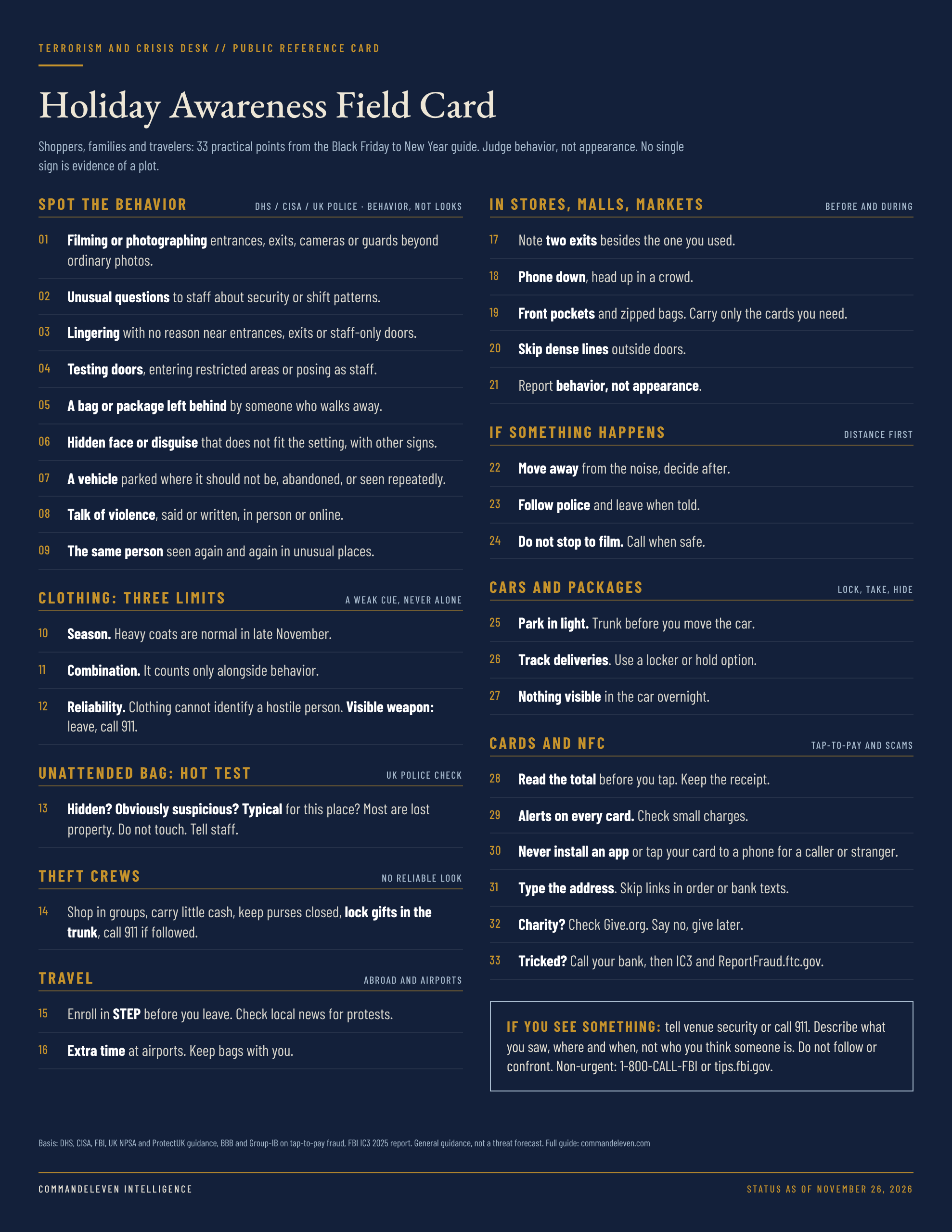
In stores, malls and markets
- When you walk in, note two ways out besides the door you used. It takes ten seconds.
- Keep your phone in your hand less. The embassy advice is explicit about not getting absorbed in your phone in a crowd.
- Carry only the cards you need, keep wallets and phones in front pockets or zipped bags, and avoid carrying more bags than you can manage.
- Do not wait in dense lines outside doors if you can avoid it. Early-opening sales concentrate people in the places that are hardest to leave.
- If something looks wrong, report behavior and not appearance (see the section above). Tell security or call 911.
If something happens
- Move away from the noise first and decide after. Distance matters more than a perfect plan.
- Follow police and emergency responders, and leave when told to leave.
- Do not stop to film. Call emergency services when you are safe, and tell family where you are.
Parking lots, vehicles and packages
- Park in light, lock the car, and put purchases in the trunk before you move the car, not after.
- Track deliveries, pick up promptly, or use a locker, a neighbor or a hold-at-location option.
- Do not leave packages visible in a vehicle overnight.
Online and tap-to-pay
- Read the total on the terminal before you tap, and ask to see the screen. Keep the receipt.
- Turn on transaction alerts for every card and check small charges, not only large ones.
- Never install an app because a text, call or email told you to, and never tap your card against your phone at someone else’s request. A bank does not ask for that.
- If a message is about an order, a delivery or your bank, open the retailer’s app or type the address yourself. Do not use the link in the message.
- Verify charities at Give.org and businesses at BBB.org. You can say no on the spot and give later.
- If you are overcharged or tricked, call your bank on the number on the back of the card, then report it to the FBI’s IC3 and ReportFraud.ftc.gov.
Travel
- Enroll in the State Department’s STEP program before you leave the U.S.
- Check local news the morning you visit a city center, because demonstrations and strikes are also on the embassy lists.
- Leave extra time at airports, and keep your bags with you.
What We Do Not Know
- The text of the November 19 aviation report is not public, so we cannot say how it words the threat.
- Whether any specific U.S. retail venue or holiday event is under threat. No public source says so.
- How widespread NFC relay fraud is in the United States. DATA DEFICIT.
- Real theft totals. The package-theft figure is a survey extrapolation and retailers report most store theft to no one.
- How much of the IC3 fraud total falls in the holiday weeks. The report gives annual counts only. DATA DEFICIT.
- How reliable any behavioral indicator is on its own. The guidance says to weigh them together, and none of it publishes a false-alarm rate. DATA DEFICIT.
What To Watch
- Any change to DHS’s NTAS page, or a new joint FBI-DHS bulletin on retail or holiday venues.
- Arrests or charges in Europe or North America tied to Christmas markets or crowded holiday events.
- Iran-linked activity in Europe, which the London alert raises, and the UK threat level.
- FBI, FTC or Treasury warnings on tap-to-pay, gift card and delivery-text scams.
- New Year’s Eve gatherings, the last big crowd date of the season.
Calls We Will Score
- By January 3, 2027: no attack killing four or more people at a U.S. shopping center, market or holiday event will be charged by federal prosecutors as terrorism or officially attributed to a terrorist group. (ASSESSED)
- By January 3, 2027: at least one arrest or charge tied to a plot against a Christmas market or holiday crowd venue will be publicly announced in Europe or North America. (ASSESSED)
- By January 31, 2027: an FBI, FTC, DOJ or CFPB statement will publicly address NFC relay or “ghost tap” fraud affecting U.S. consumers. (ASSESSED)
What This Assessment Does and Does Not Establish
It establishes what U.S. embassies, federal agencies and prosecutors have said publicly, what the cited surveys and reports measured, and where those sources disagree or run out. It does not establish that any attack is planned against a U.S. shopping venue this season. It does not prove that NFC relay fraud is common in the United States. The behavioral indicators are drawn from government and police guidance, are meant to prompt a report and not a conclusion, and do not make anyone a suspect. This guide does not give safety advice for individual circumstances and does not replace instructions from local police or emergency services. Several figures are vendor or survey estimates and are labeled as such.
Frequently Asked Questions
Is it safe to go shopping on Black Friday?
Officials have named no specific threat to U.S. stores this season. Fraud and theft are the likelier problems, and the checklist above covers them. Crowds call for ordinary awareness, not avoidance.
How do I spot a suspicious person in a crowd?
Watch what people do, not what they look like. Official guidance points to unusual filming of entrances or security, prolonged interest in staff or security, lingering without reason, trying to enter staff-only areas, leaving a bag behind, and statements about violence. One sign alone is not proof.
Does clothing matter?
Only as context. CISA and the UK’s NPSA mention bulky clothing that does not fit the setting, but UK police say clothing cannot identify a hostile person, and heavy coats are normal in November. Clothing is a reason to look at behavior, not a reason to report someone.
What is the biggest holiday shopping scam risk?
Non-delivery and non-payment fraud, phishing that imitates retailers and delivery services, and gift card scams. Check the seller, open the retailer’s own app, and do not pay with gift cards or transfers.
Can someone steal my card by tapping it through my pocket?
None of the sources we reviewed documents that. The documented problems are overcharges you approve by tapping and malware that tricks you into helping the fraud. Read the amount before you tap and never install an app on a stranger’s instruction.
What should I do if a charity collector asks me to tap?
Ask to see the amount on the screen, check the organization at Give.org, and consider giving later through its official site. Declining on the spot is fine.
Should I change my holiday travel to Europe?
That is your decision. The U.S. embassies advise vigilance at holiday festivals, a low profile, avoiding demonstrations and enrolling in STEP. Their alerts name no specific plot.
Related CommandEleven Intelligence Reading
- Al Qaeda Aviation Threat: What the FBI-DHS-TSA Warning Means for US Air Travel
- The Next Terrorist Won’t Look Like A Terrorist (Soft Targets America)
- Terror Attack Warning Signs Everybody Must Know, EP569 (Survival Dispatch)
- ISIS Changed Its Strategy – Now Your Local Mall Is a Target (Soft Targets America)
- AI Attack Planning: What the GAO Test Proved
- The HAYI Network: How Seven Men Allegedly Ran Iran’s Attack Wave in Europe
- Cyberattacks, November 1 to 17, 2026: What Happened, What Is Rumor, and How to Protect Yourself
- Deepfake CEO Fraud: What the Alleged $129 Million Case Shows About Voice-Clone Impersonation
- The Warnings Reassessed
Sources
- FBI Internet Crime Complaint Center (IC3): 2025 Internet Crime Report
- U.S. Department of Homeland Security: National Terrorism Advisory System (checked November 26, 2026)
- U.S. Attorney’s Office, District of Minnesota: man arrested and charged over alleged plot at the Mall of America (October 7, 2026)
- CNN: Security officials warn the US aviation industry of recent calls for attack by Al Qaeda (November 20, 2026)
- 10TV via Yahoo News: FBI, TSA warn of potential aviation threats (November 23, 2026)
- ITV News: US citizens in UK warned by embassy to keep a low profile (November 16, 2026)
- Fox News: American embassies in Europe issue security alert for holiday travelers (November 18, 2026)
- Yahoo Travel: Holiday market security alert, U.S. Embassy Brussels (November 20, 2026)
- U.S. Department of Homeland Security: If You See Something, Say Something, Recognize the Signs
- CISA: Protecting Patrons During Holiday Shopping
- FBI: Bystander quick reference guide, Pre-Attack Behaviors research
- ProtectUK (UK counter-terrorism policing): Hostile reconnaissance
- ProtectUK: Unattended and suspicious items (HOT protocol)
- UK National Protective Security Authority: Recognising terrorist threats, threat recognition guide
- Darktrace: more than 1,200% rise in Black Friday phishing (vendor release, November 24, 2026)
- U.S. Department of the Treasury, OCCIP: 2026 Seasonal Scam Advisory
- Better Business Bureau: Consumer alert on ghost tapping (November 3, 2026)
- Group-IB: TX-NFC (Ghost Tap), NFC relay fraud threat profile (January 2026)
- National Retail Federation: Impact of Theft and Violence 2026 (July 30, 2026)
- Security.org: 2026 Package Theft Report and Statistics
- WTOP: Police warn about leaving gifts in cars (December 2025)
- Atlanta Journal-Constitution: Metro Atlanta police agencies offer holiday safety tips (November 29, 2024)
- Fox News: Black Friday theft threat, former detective (November 28, 2025)
- Euronews: Polish authorities foil Islamic State-inspired Christmas market attack plot (December 16, 2025)