CommandEleven Intelligence Desk // Europe and State Threats Desk, status as of November 16, 2026. Everything attributed to prosecutors, governments or anonymous officials is an allegation or an assessment, not a court finding. The defendants are presumed innocent. Read the confidence tiers.
Bottom Line Up Front
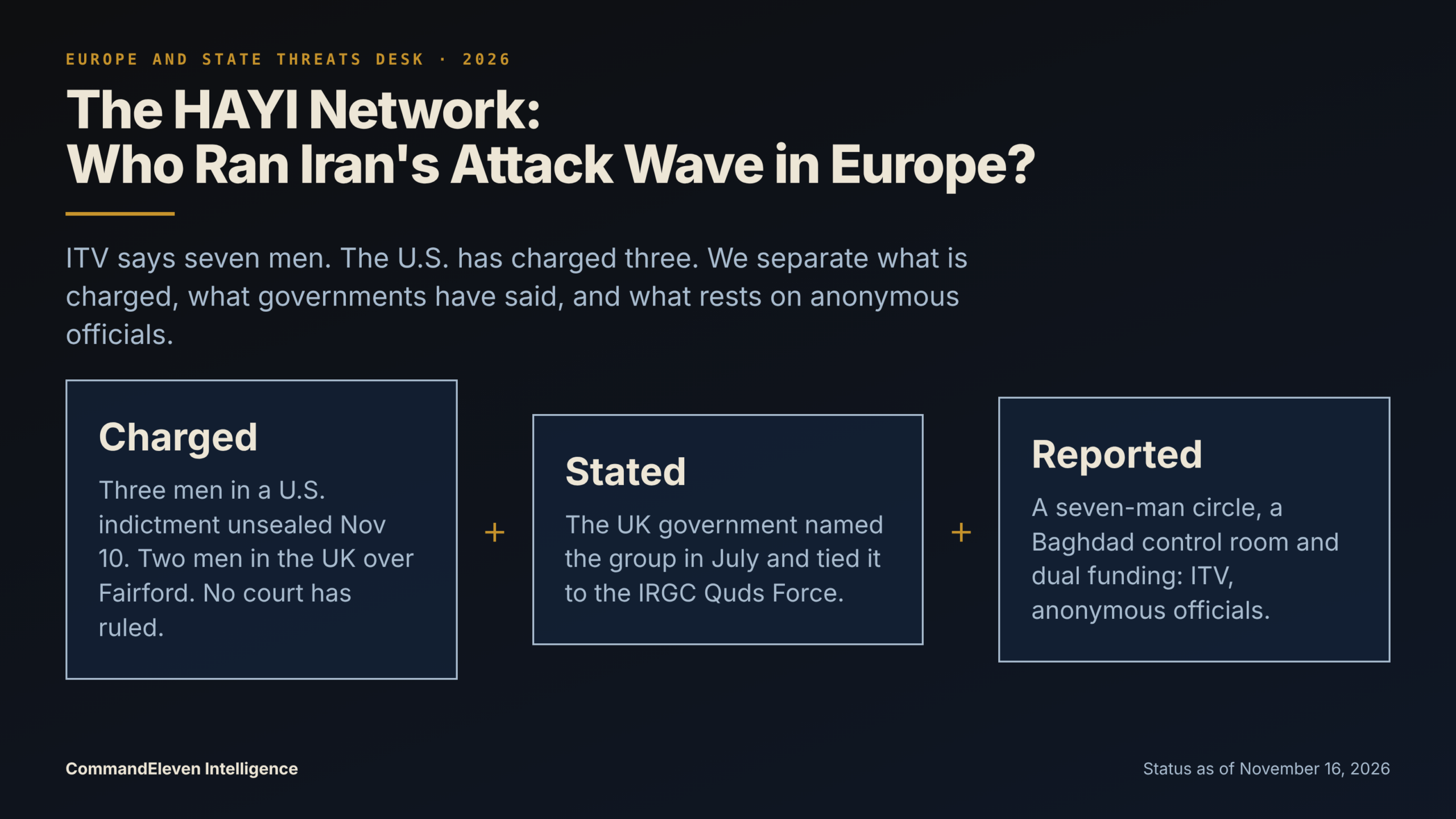
ITV News reported on November 11 that the wave of arson and bombing attacks on Jewish and Israeli targets in Europe in spring 2026 can be traced to a circle of seven men, directed from a control room in Baghdad and paid for by two Iranian agencies. The attacks were claimed under the name Harakat Ashab al-Yamin al-Islamia (HAYI). The UK government calls the same group the Islamic Movement of the Companions of the Right (IMCR) and has said that members of the Islamic Revolutionary Guard Corps (IRGC) Quds Force sat behind it. A day earlier, the U.S. Department of Justice had charged three of the men. What is documented is the charging, the government statements and the pattern of paid local recruits. What rests on anonymous officials is the size of the network, the control room, the dual funding and the identities of the two brothers ITV names for the first time. No court has tested any of it.
Key Judgments
- CONFIRMED: IMCR and HAYI are one group. The UK Foreign Office, in its July 13, 2026 announcement, calls the group the Islamic Movement of the Companions of the Right and says it is “otherwise known as HAYI.” The ICCT’s September 2026 review of European security-service reporting uses HAYI and translates the name as the Islamic Movement of the People of the Right. The ICCT counts 18 attacks claimed by the group in Europe in spring 2026, noting that involvement in some is hard to prove. The UK government says the group claimed seven attacks at UK locations.
- ALLEGED (government attribution, untested in court): Iran directed the group. On July 13, the UK Security Minister said that members of the IRGC Quds Force “sat behind” it. The U.S. indictment, unsealed November 10, charges three men with acting in support of the IRGC and Kataib Hezbollah. Iran denies involvement.
- ASSESSED (single source, anonymous officials): The network was a circle of seven men run from Baghdad. ITV names five men: Mohammad Baqer Saad Dawood al-Saadi, whom it describes as the network’s center, the brothers Mustafa and Rassoul Alkyaui, and, in connection with the U.S. indictment, Mohsen Mohajeri and Mohammad Ali al-Hassani. ITV does not say that Mohajeri and al-Hassani are among the seven, and it does not identify all seven. The control room is ITV’s reporting from “multiple security officials,” with no document cited beyond the public indictment.
- ASSESSED (ITV only): The Quds Force and Iran’s Ministry of Intelligence both funded the network, and each reportedly did not know the other was involved. Investigators read this as poor coordination inside the Iranian state. No official source we found confirms the dual funding.
- ASSESSED (two independent sources agree): The network relied on paid local criminals, often without their knowing who ordered the attacks, and on a front brand to claim them. ITV reports this. The ICCT describes the same model as a state using “deniable and single use” operators. That agreement is why we hold this at ASSESSED rather than SPECULATIVE.
- ASSESSED: European countries have treated the attacks differently. The ICCT reports that Dutch and French authorities filed terrorism-related charges, while British authorities mainly pursued standard criminal charges such as arson and criminal damage, even though counter-terrorism police investigated the London cases. The ICCT counts at least 28 arrests in the UK, ten in the Netherlands, seven in Belgium and four in France.
- DATA DEFICIT: Two different men are reported to have been arrested in Turkey, and the sources do not date or source one of them. Al-Saadi was arrested in Turkey in May and extradited to the U.S., per the ICCT, citing The Guardian. ITV reports that Mustafa Alkyaui was arrested in Turkey and remains in detention, with no official source and no date. These are separate people, so the accounts do not contradict each other, but the second arrest is unverified.
- DATA DEFICIT: Whether the “Ali” named as the handler in the UK Fairford charges is the al-Hassani the U.S. names as director. No source says so, and we do not say so either.
Two Names, One Group
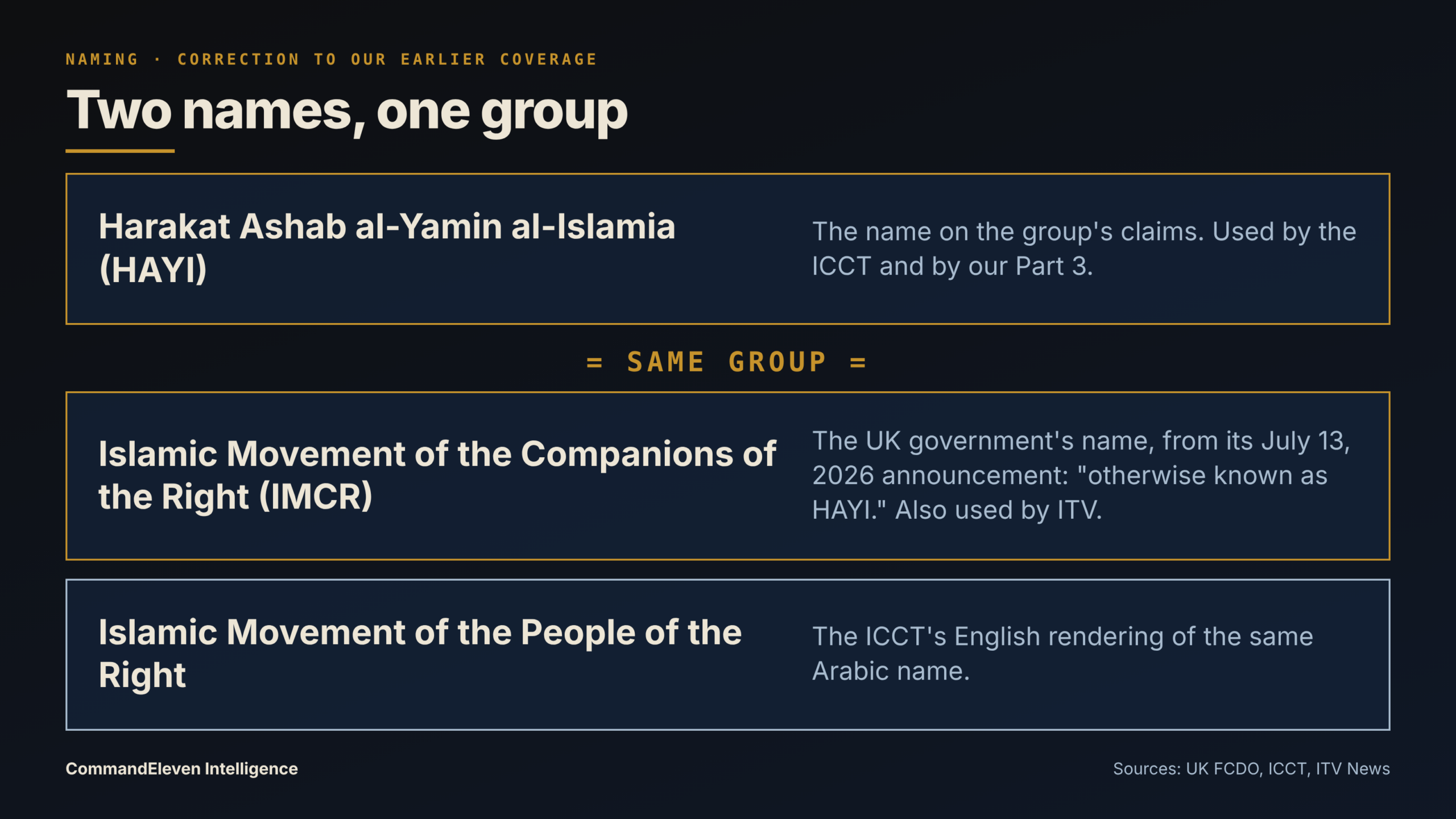
Readers of our earlier Fairford coverage will have seen the group called HAYI. UK government material and some press reporting call it IMCR. They are the same group. The two names come from different English renderings of the same Arabic name.
| Rendering | Who uses it |
|---|---|
| Harakat Ashab al-Yamin al-Islamia (HAYI) | The group’s own claims as reported, the ICCT, and our Part 3 and November 11 update |
| Islamic Movement of the Companions of the Right (IMCR) | The UK government and ITV |
| Islamic Movement of the People of the Right | The ICCT’s English gloss of HAYI |
There is one point of detail we should correct. Our November 11 update described HAYI as the front name we flagged in Part 3 on October 1, and listed any UK charge naming HAYI as something to watch. The UK government had in fact named the group, as IMCR, and described its Quds Force links on July 13, before our October 1 piece. Our October 1 reading of the brand as a front was our own assessment. The UK government’s July statement was the first official attribution. The AP described the July 13 UK action against IMCR and the IRGC as a ban. The Foreign Office page describes it as an asset-freezing designation under the Iran Sanctions Regulations. Both can be accurate, and we treat the legal mechanism as unresolved. We use “HAYI” below, and name IMCR where the UK government is the source.
What ITV Reports, and How It Is Sourced
The ITV investigation, by Global Security Editor Rohit Kachroo, says the network “can be unmasked as a group of just seven men.” Almost all of its important claims are attributed to anonymous “Western officials,” “security officials” or “investigators,” and many use hedged verbs such as “believe,” “think” and “suspect.” The only document it cites is the public U.S. indictment. That does not make the reporting wrong. It does mean that we cannot tier most of it above ASSESSED.
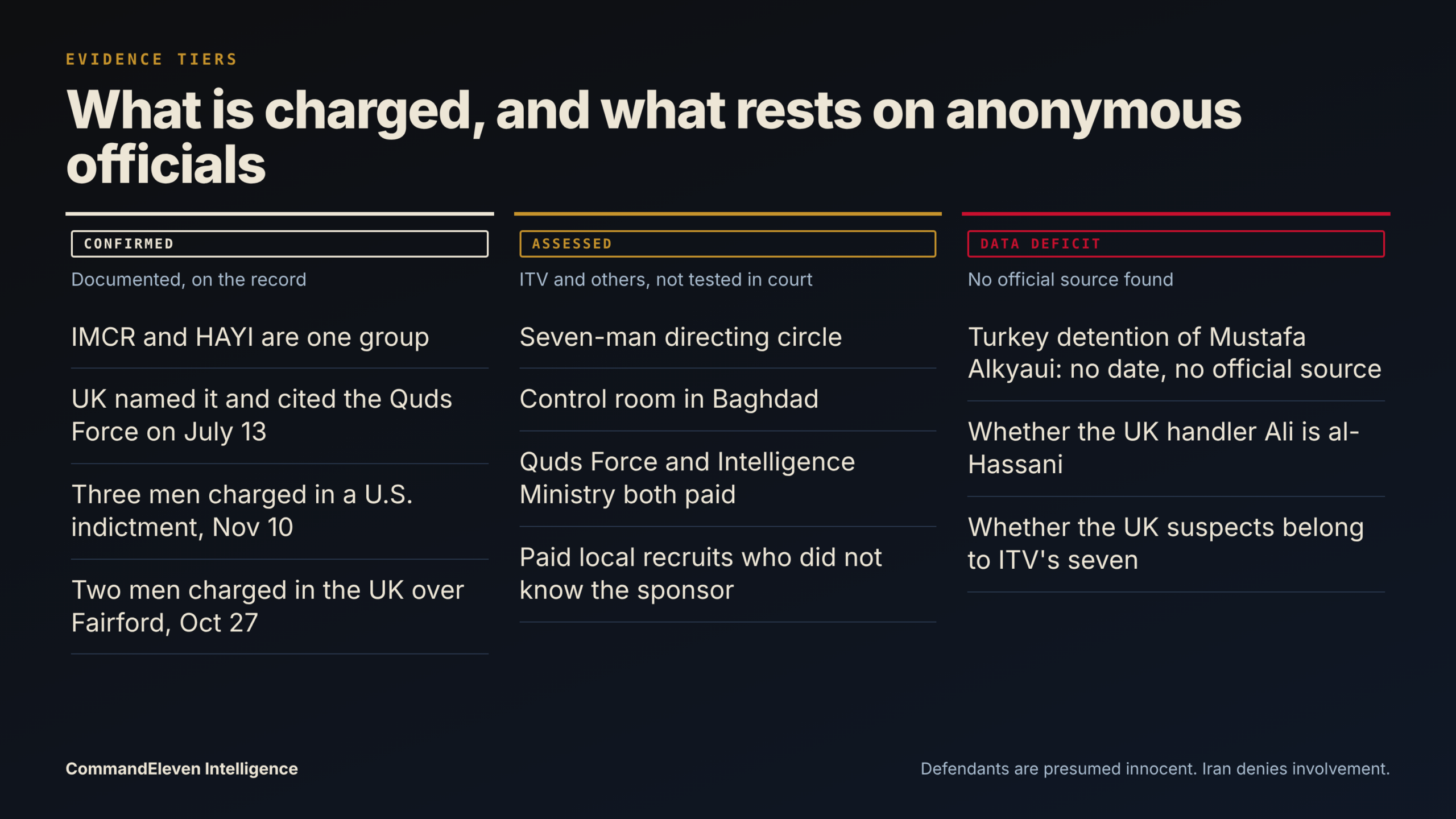
According to ITV, the circle worked this way:
- Direction: Members are believed to have chosen targets and devised tactics from a control room in Baghdad, on tasking from Tehran to retaliate against Israel and the United States.
- Delivery: Local criminals in Europe were paid for each attack, and in many cases did not know who had ordered it. The two Alkyaui brothers are described as having suspected links to organized crime in the Netherlands, and their contacts there are said to have been crucial. The aim, ITV reports, was to create fear more than to kill.
- Target choice: The Liège synagogue explosion in March was reportedly chosen because local criminals willing to carry it out could be found, not because of the synagogue’s significance.
- The brand: The attacks were claimed under the IMCR name. ITV says the group’s sophistication was partly an illusion created with AI, which imitated the style of established terrorist groups and made a small network look larger.
- Fairford: Officials believe the same network targeted RAF Fairford, and that senior IRGC figures probably approved the target. ITV labels that a belief.
It is worth keeping two “sevens” apart. ITV’s seven men are the alleged directing circle. Separately, seven men were arrested in the UK over the Fairford incident, per ITV’s October 20 report. Two were charged on October 27 and the rest were reported bailed. They are not the same seven, and nothing we found says the UK suspects belong to the circle.
What Is Charged, and Where
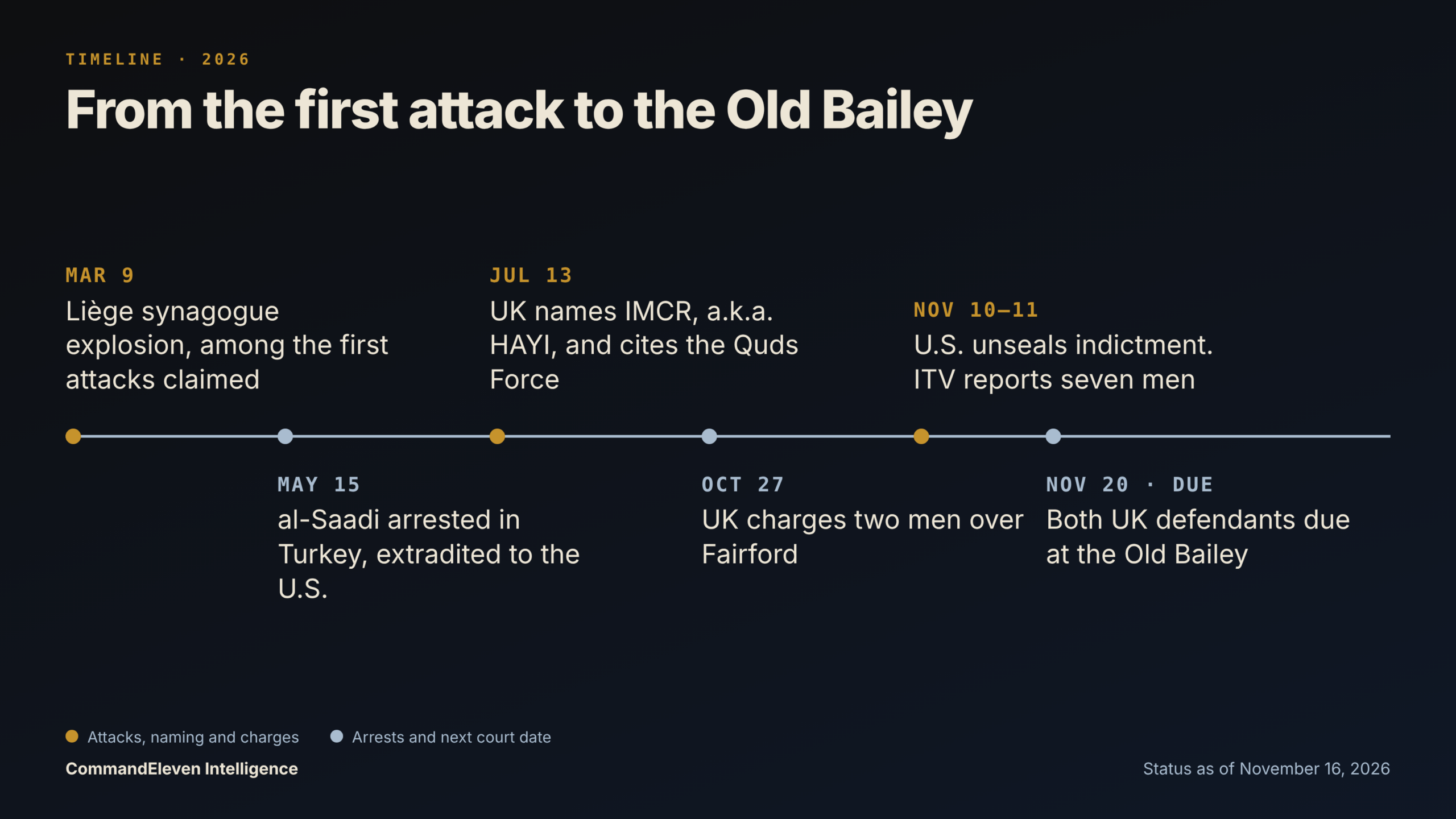
United States. The Justice Department unsealed an eight-count indictment on November 10 against Mohsen Mohajeri, Mohammad Ali al-Hassani and Mohammad Baqer Saad Dawood al-Saadi, whom it calls Iran-backed operatives acting in support of the IRGC and Kataib Hezbollah. Prosecutors allege that al-Hassani directed and paid associates in the UK to prepare the Fairford plot, and that al-Saadi relayed coded messages from jail in New York. In May, the U.S. had charged al-Saadi with directing attacks on U.S., Israeli and Jewish targets. He pleaded not guilty in June and has been held without bail. All of this is allegation.
United Kingdom. On October 27, UK prosecutors charged two men under the National Security Act in the Fairford case: Mohmed Abdulkarim, a British-Iranian dual national, with conduct likely to materially assist a foreign intelligence service, and Nouman Essghir with entering a prohibited place for a purpose prejudicial to the UK. Counter Terrorism Policing has said it believes the state concerned is Iran and that the incident was “directed by the Iranian state.” Both men are due next at the Old Bailey on November 20, according to ITV News.
Netherlands, France and Belgium. According to the ICCT, Dutch and French authorities have treated the incidents as terrorism-related offenses. Dutch prosecutors said in March that four teenagers were suspected of terrorism offenses over the Rotterdam synagogue attack, per DutchNews. These are European charging decisions, and they sit alongside the American and British ones.
Where the Accounts Differ
| Question | One account | Another account | Our reading |
|---|---|---|---|
| Is the group IMCR or HAYI? | UK government: IMCR | ICCT, our earlier pieces: HAYI | One group |
| Who sat behind it? | UK government (July): Quds Force | ITV (November): Quds Force and Iran’s Ministry of Intelligence | The second agency is ITV only |
| Who was arrested in Turkey? | ICCT: al-Saadi, in May, extradited to the U.S. | ITV: Mustafa Alkyaui, detained, no date | Two men, one unverified |
| How many men? | ITV: seven in the directing circle | ITV (Oct 20): seven arrested in the UK over Fairford | Different groups of seven |
| Terrorism or criminal law? | Dutch and French authorities: terrorism charges | UK: mostly standard criminal charges for the arson cases, National Security Act for Fairford | Different legal paths, same wave |
What Defenders Can Do About It
The measures follow from the pattern, and stay at the policy level.
- Treat paid local recruits as the exposure. If an attack wave is delivered by criminals who do not know the sponsor, defenders are better placed watching for the local criminal market, the money that pays it and the brand that claims it than hunting for a command structure.
- Align charging decisions across borders. One wave has been charged as terrorism in some countries and as ordinary crime in another. Shared case files and a common description of the group would help investigators connect incidents.
- Plan for front brands. A claimed name can be invented, and AI makes a small network look large. Treat claims as evidence of an operator’s intent, and verify the size independently before moving resources.
- Protect soft targets that criminals can reach cheaply. Synagogues, charities’ vehicles and community buildings were chosen in part because they were reachable. Local policing and community security funding address that gap directly.
- Share the finance trail. Payments to local intermediaries are where the sponsor becomes visible. Financial intelligence units across the countries involved should compare notes.
What To Watch
- November 20: the Old Bailey hearing in the UK Fairford case, and whether any charge or filing names the group or the handler.
- Any U.S. arraignment, extradition request or superseding indictment, and any further filing that names the Alkyaui brothers.
- Official confirmation or denial of the Turkey detention ITV reports.
- Any official source that confirms or contradicts the Ministry of Intelligence co-funding claim.
- New attacks claimed under the HAYI or IMCR name, or the appearance of a successor brand.
- The Old Bailey trial, due in 2027, of the suspect in the April 29 Golders Green stabbing. The group claimed it within an hour, although investigators called the claim likely opportunistic.
Calls We Will Score
- By December 31, 2026: A Turkish, Dutch, British or U.S. official source will publicly confirm that Mustafa Alkyaui is in custody in Turkey. If no official source does, we will score the ITV report as unconfirmed.
- By March 31, 2027: At least one further arrest or charge in the UK, the Netherlands, Belgium, France or the United States will be tied by officials to the HAYI or IMCR attacks.
- By June 30, 2027: A court in any country will convict, or accept a guilty plea from, at least one person over an attack claimed by HAYI or IMCR.
What This Assessment Does and Doesn’t Establish
It establishes that HAYI and IMCR are one group; that the UK government attributed the group to the IRGC Quds Force in July; that the U.S. has charged three men in connection with it; and that ITV’s account of a seven-man circle is built on anonymous officials.
It does not establish that the circle is exactly seven men, that a control room exists in Baghdad, that the Ministry of Intelligence funded the group, or that the Alkyaui brothers had the role ITV describes. It does not establish that the Fairford plot was directed by the same circle. It does not rely on any information from our own field sources, and it describes no attack methods.
Frequently Asked Questions
What is HAYI?
Harakat Ashab al-Yamin al-Islamia is the name under which a series of arson and bombing attacks on Jewish, Israeli and U.S. targets in Europe were claimed in spring 2026. The UK government calls the same group the Islamic Movement of the Companions of the Right (IMCR). The ICCT counts 18 attacks claimed under the name in Europe.
Are IMCR and HAYI the same group?
Yes. The UK Foreign Office says IMCR is “otherwise known as HAYI.” The names are different English renderings of one Arabic name.
Who is behind HAYI?
The UK government said in July that members of the IRGC Quds Force sat behind it. The U.S. indictment alleges the accused acted in support of the IRGC and Kataib Hezbollah. ITV reports, from anonymous officials, that a seven-man circle ran it with funding from the Quds Force and Iran’s Ministry of Intelligence. Iran denies involvement. No court has ruled.
Is the seven-man network the same as the seven men arrested over RAF Fairford?
No. ITV’s seven are the alleged directing circle. The seven arrested in the UK were arrested over the Fairford incident, and nothing we found links the two groups.
Has anyone been convicted?
Not in the cases we reviewed. The U.S. defendants have been charged, the UK defendants have been charged and have not been tried, and European suspects have been charged or are suspected in the Netherlands and France.
Related CommandEleven Intelligence Reading
- RAF Fairford: U.S. Charges Three Iran-Backed Men and Names the HAYI Network (the November 11 update this dossier builds on)
- The Gig Economy of Terror: From Hatzola to Fairford – Part 3
- RAF Fairford Charges: The Handler, the Money and the Iran Case – Part 4
- RAF Fairford Terror Plot: Dossier on the Averted Attack – Part 1
- MacDill Breach and the RAF Fairford Plot: Two Bases, One War – Part 2
- RAF Fairford Through October 27: Scoring Our Judgments Against the Charges
- Unit 4000 and Unit 600: How Iran Is Rebuilding Its External Plotting Apparatus
Sources
- Seven men behind alleged Iranian terror network ‘unmasked’ (ITV News, November 11, 2026)
- Two men re-arrested on suspicion of assisting Iran over RAF Fairford incident (ITV News, October 20, 2026)
- RAF Fairford ‘plot co-ordinated by handler working on behalf of Iran’ (ITV News, October 27, 2026)
- UK sanctions Iran-linked criminal group that publicly claimed responsibility for recent attacks on Jewish locations (Foreign, Commonwealth and Development Office, July 13, 2026)
- UK says Iran-backed group behind arson and vandalism attacks on Jewish community (Associated Press via PBS NewsHour, July 13, 2026)
- US charges 3 men over alleged Iranian-backed plot at UK Fairford airbase (Al Jazeera, November 11, 2026)
- UK prosecutors charge two after RAF Fairford incident (Al Jazeera, October 27, 2026)
- In Their Eyes: How European Security Services Look at Terrorism and Counter-Terrorism, 2026 Edition (ICCT, September 18, 2026)
- Arrest of Iraqi terror suspect with alleged links to Iran’s Quds Force is astonishing but not surprising (The Guardian, May 16, 2026)
- Four suspects in synagogue bombing accused of terrorism offences (DutchNews, March 2026)