CommandEleven Intelligence Desk // Domestic Threat and Europe Desk, status as of November 16, 2026. This dossier works from published research, official data and news reporting. It contains no operational detail on recruitment or attack methods. Read the confidence tiers.
Bottom Line Up Front
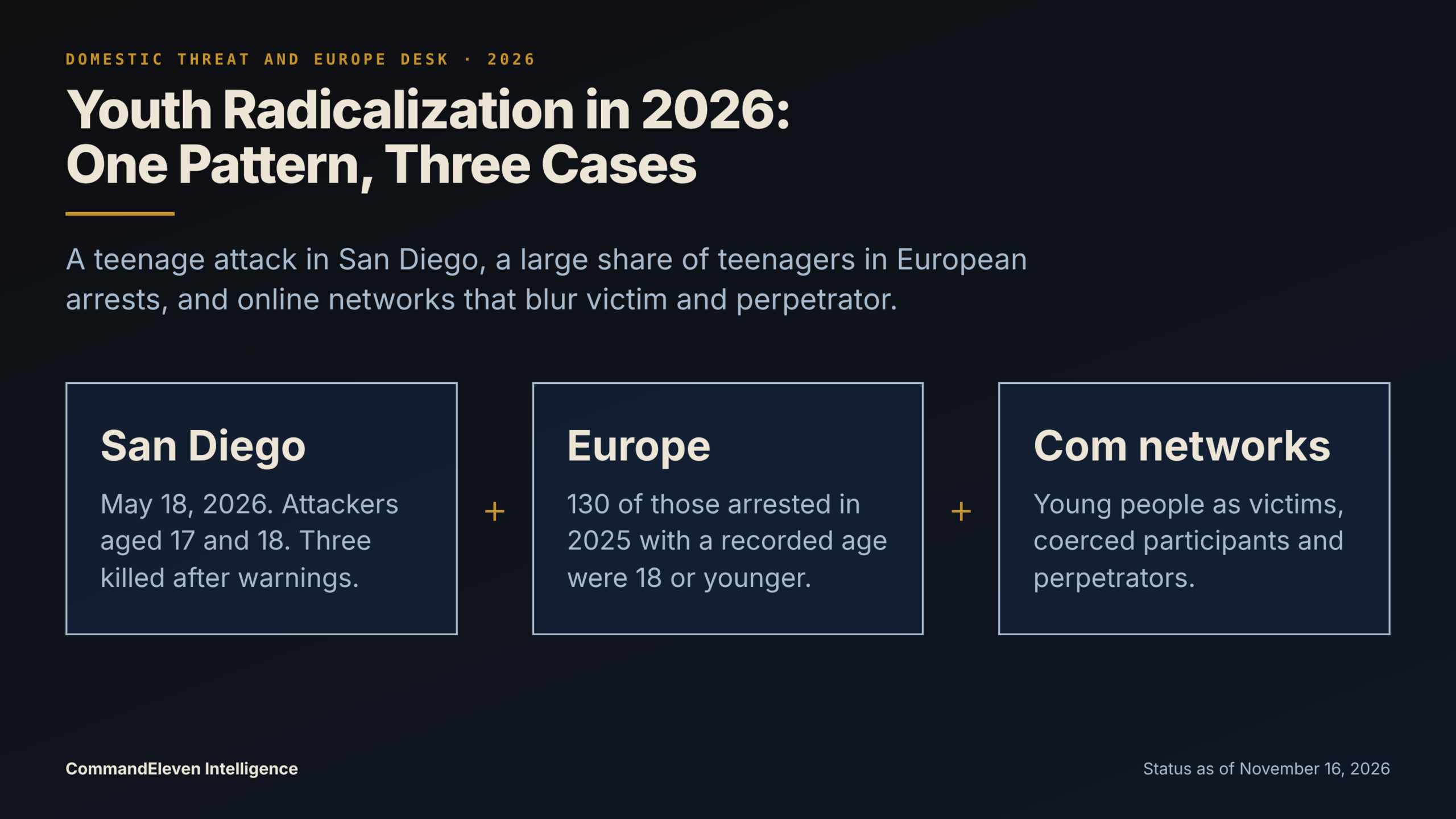
Four separate sources published in 2026 point to the same conclusion from different directions. Teenagers are now a large share of terrorism arrests in Europe. A US attack in May was carried out by a 17-year-old and an 18-year-old. Islamic State-linked material is being written in the style of youth culture. And researchers who study the Com networks describe a mix of sexual exploitation, cruelty and extremism in which young people are victims, coerced participants and perpetrators at once. The common thread is not one ideology. It is a young age, an online community that rewards extreme behavior, and warning signs that were seen but not acted on in time.
What is CONFIRMED is the arrest data and the facts of the San Diego attack. What is ASSESSED is that these cases form one pattern rather than separate problems. What is a DATA DEFICIT is how many young people are involved, because age recording is incomplete, age bands differ between sources, and the largest single statistic we found is a secondary citation. We also set out the cautions that the Com researchers themselves attach to their work, because the evidence is thinner than the headlines suggest.
Key Judgments
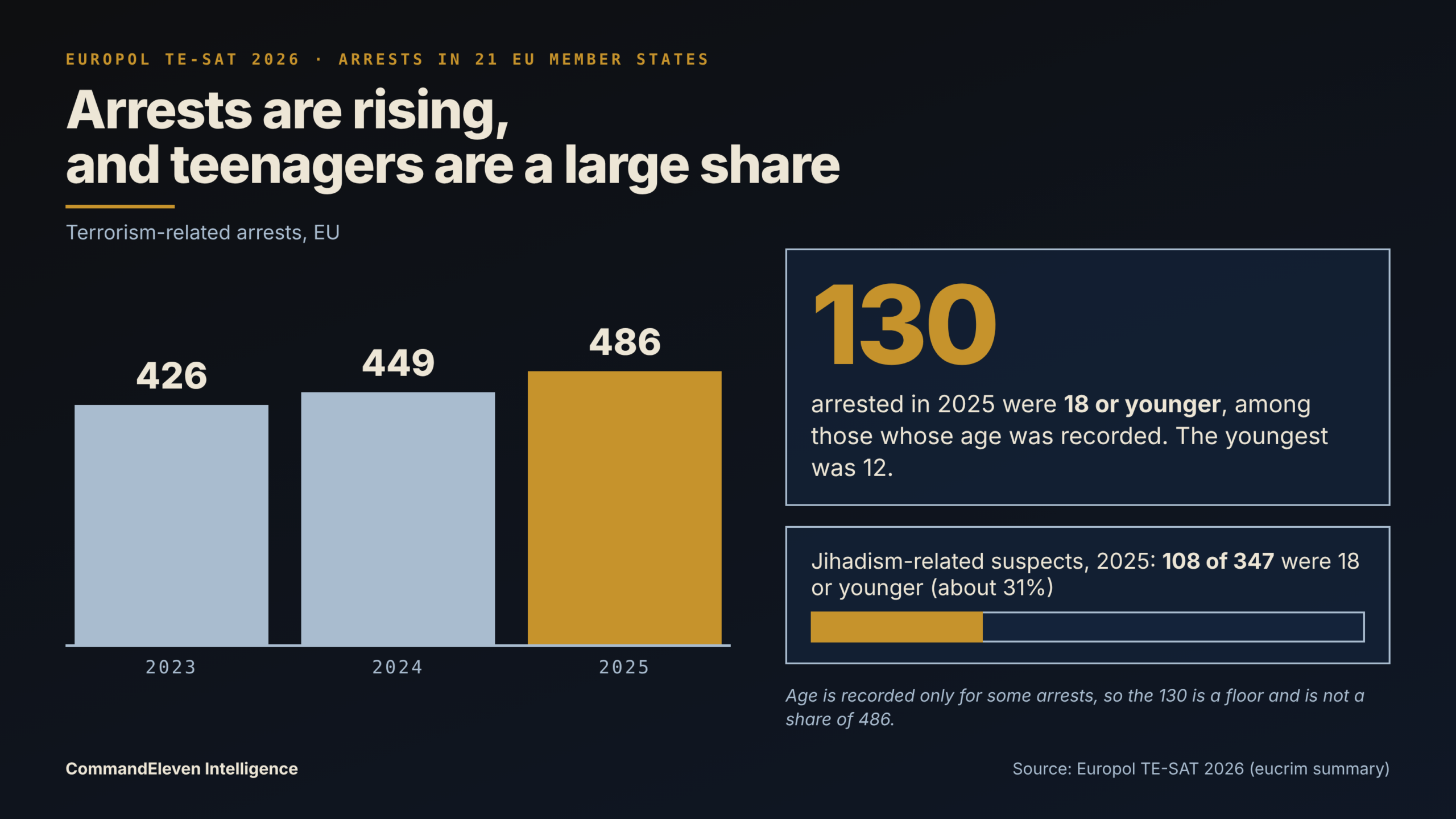
- CONFIRMED: Minors are a substantial share of terrorism arrests in the EU. Europol’s TE-SAT 2026 reports 486 arrests for terrorism-related offenses across 21 member states in 2025, up from 449 in 2024 and 426 in 2023. Of the arrested persons whose age was recorded, 130 were 18 or younger, the youngest 12. In jihadism-related cases, 108 of 347 suspects (about 31%) were 18 or younger.
- CONFIRMED: On May 18, 2026, a 17-year-old and an 18-year-old attacked the Islamic Center of San Diego and killed three people, including a security guard whom police credited with saving lives. Both attackers died by suicide shortly afterward. Police were already searching for them after a parent reported a missing, suicidal son and missing weapons, about two hours before the attack. FBI statements said the two met online and left writings expressing hatred.
- ASSESSED: The attackers’ motive was ideological, mainly neo-Nazi accelerationism, mixed with other fixations. ISD’s post-attack analysis puts the case nearer the ideological end of a spectrum that also includes more nihilistic violence. Early police statements spoke of “generalized hate rhetoric.” The sources do not fully agree on how much weight each element carries.
- ASSESSED: The same developmental and online dynamics appear across jihadist, far-right and nihilistic cases. That is the finding of the ICCT’s September 2026 analysis of the San Diego case, Europol’s TE-SAT 2026, and the ICCT’s review of European security-service reporting. The method of violence differs by context. Easy access to firearms is the distinctive accelerant in the US, while European plots more often involve arson, knives, target lists or explosives.
- ASSESSED: Some online networks combine sexual exploitation, cruelty and extremism, and young people move between the roles of victim, coerced participant and perpetrator. This is the central argument of the Taylor, Quayle and Horgan research note of March 2026. The authors say the extent of these networks is not known and warn against overestimating them.
- ASSESSED: Warning signs were present before San Diego. ICCT reports that law enforcement had been warned about one attacker more than a year earlier, that a protective order described a child “idolizing Nazis and mass shooters,” and that a gun violence restraining order and an involuntary psychiatric hold followed. The finding that the response stayed with immediate symptoms rather than the wider ecosystem is ICCT’s interpretation.
- DATA DEFICIT: No source gives a harmonized count of minors involved in terrorism across countries. TE-SAT counts people aged 18 or younger. The EU counter-terrorism coordinator cited 133 of 449 arrests (almost a third) aged 12 to 20 for 2024. Those are different age bands, and neither covers every arrest. The claim that children account for 42% of terror-related investigations in Europe and North America, a threefold rise since 2021, comes from a UN figure quoted in an ICCT short read, and we have not seen the underlying UN dataset. We treat it as unverified.
- SPECULATIVE: AI tools may lower the barrier for teenagers to produce extremist content, as security-service reporting suggests. No source shows that this changes how often teenagers turn to violence.
The San Diego Case: What Is Documented
The Islamic Center of San Diego, the city’s largest mosque, which also housed a school, was attacked on May 18, 2026. Three men were killed. A security guard, identified by a family friend as a decade-long employee, was among them. Police said his actions saved lives. Responding officers reached the scene within four minutes of the first calls, and the attackers were later found dead in a vehicle a few blocks away.
Several facts matter more than the headline. A parent had reported that a son was suicidal and had run away, with weapons missing from the home, and police were searching for the pair when the attack began. Investigators later seized more than 30 firearms from homes linked to the two, according to Anadolu’s report. The FBI said the pair met online and left writings expressing broad hatred. The ICCT analysis reports that parts of the attack were live-streamed and that a manifesto invoked the 2019 Christchurch attacker. We treat the live-stream detail as ASSESSED, because the other sources we read do not mention it.
ISD adds an analytical layer. Its post-attack review reports that both attackers named Christchurch as inspiration and referred to the Great Replacement conspiracy theory, but also listed non-ideological mass killers among their inspirations, engaged with fandom communities built around mass killers, and in one case with incel spaces. ISD notes that two people mobilizing together departs from the usual lone-actor model. Several of ISD’s details come from its own online investigation and are not independently corroborated, so we mark them ASSESSED and do not rely on them beyond the pattern they describe.
The ICCT authors, Adrian Shtuni and Colin Clarke, draw the policy point. Authorities had recognized the risk. The response did not become sustained prevention.
The European Numbers
Europol’s TE-SAT 2026, published July 13, 2026, covers calendar year 2025. The arrest count rose for a second year, from 426 in 2023 to 449 in 2024 and 486 in 2025. Youth is a measurable share of that. Of those with a recorded age, 130 were 18 or younger. Jihadism-related cases drove the number: 108 of the 347 jihadism-related suspects were 18 or younger. The report records 45 attacks in total: 22 completed, 3 failed and 20 foiled. It does not break these down by perpetrator age. It flags more fragmented forms of terrorism, in which ideological boundaries blur, and names younger perpetrators and more random targeting as concerns for future risk.
The ICCT review of European security-service reporting, “In Their Eyes,” adds the national picture. More than three quarters of the reporting countries named youth radicalization as a concern in 2025, a more common mention than lone attackers or self-radicalization. Seven countries linked it mainly to jihadist terrorism, and three linked it to right-wing extremism. The review reports that young people radicalized early tend to have shallower ideological knowledge and are pushed toward more serious offenses over time because they fear losing standing in the group. It also reports that recruiters sometimes join gaming platforms to reach minors as young as 14, and that young people increasingly produce extremist content themselves, helped by new AI tools.
The operations it describes show the range:
- Germany, May 2025: arrests of suspected members of a right-wing terrorist cell, all aged 14 to 18, accused of planning attacks.
- Greece, May 2025: 25 arrests, including twelve minors, tied to a far-right youth group accused of violent acts and hate crimes.
- Italy, July 2025: searches against radicalized male minors, with about fifteen aged 13 to 17 arrested.
- France, July 2025: two minors, 15 and 17, arrested over alleged plots against Paris landmarks after pledging allegiance to Islamic State online.
- Netherlands, February 2026: fifteen arrests over an account spreading Islamic State propaganda with Dutch subtitles. Four of the suspects were minors, as young as 16.
Europol also coordinated a referral action day on May 27, 2025, in which 16 countries took part in removing more than 2,000 links to jihadist and right-wing violent extremist propaganda aimed at minors.
The EU counter-terrorism coordinator, Bartjan Wegter, told Euronews in March 2026 that cases now involve children as young as 12 and that young people can radicalize within weeks. He also described “salad bar” ideology, in which networks combine elements of different belief systems, and a trend of nihilistic violence that often mixes racism and misogyny but does not fit the legal definition of terrorism neatly.
One Message, Many Messengers: The Islamic State Material
Saif Tahir and Amira Jadoon argue, in an ICCT short read of April 28, 2026, that Islamic State has moved from territory to a “virtual caliphate” built partly from youth online culture: trending aesthetics, remixed audio and meme formats. They report that much of the youth-facing material is produced by loosely affiliated or inspired users rather than by official media, and that some of it mixes jihadist and far-right imagery, a blend they call “Alt-Jihad.” They describe an “acceleration gap,” in which governments respond more slowly than these groups adapt.
The authors add cautions that belong in any use of their work. The youth-facing material is one layer of a wider Islamic State ecosystem, and doctrinal and regional messaging, including ISKP content aimed at Afghan and Pakistani audiences, remains separate. Usage figures are snapshots. We therefore use this source for the pattern, not for counts.
The Com Networks: What Is Known and What Is Not
Max Taylor, Ethel Quayle and John Horgan published a research note in Perspectives on Terrorism in March 2026. It draws on the UK National Crime Agency’s assessment of Com networks, which are loose, decentralized online communities in which participants, mostly young men, compete for status through increasingly extreme content and acts. The note describes a “hybridisation of harms,” in which sexual exploitation, cybercrime, cruelty and extremist ideas sit in one space. It reports that the NCA considers engagement with this content almost certain to be causing some individuals, especially young males, to develop a dangerous propensity for extreme violence, including targeted violence against schools and places of worship.
The note’s most important finding for prevention is about roles. Adolescents in these networks may be victims, coerced participants or active facilitators of harm, and the roles often change. The authors argue that this calls for trauma-informed, gender-aware and developmentally sensitive responses, with clinicians, law enforcement and researchers working together, rather than a purely security-led one.
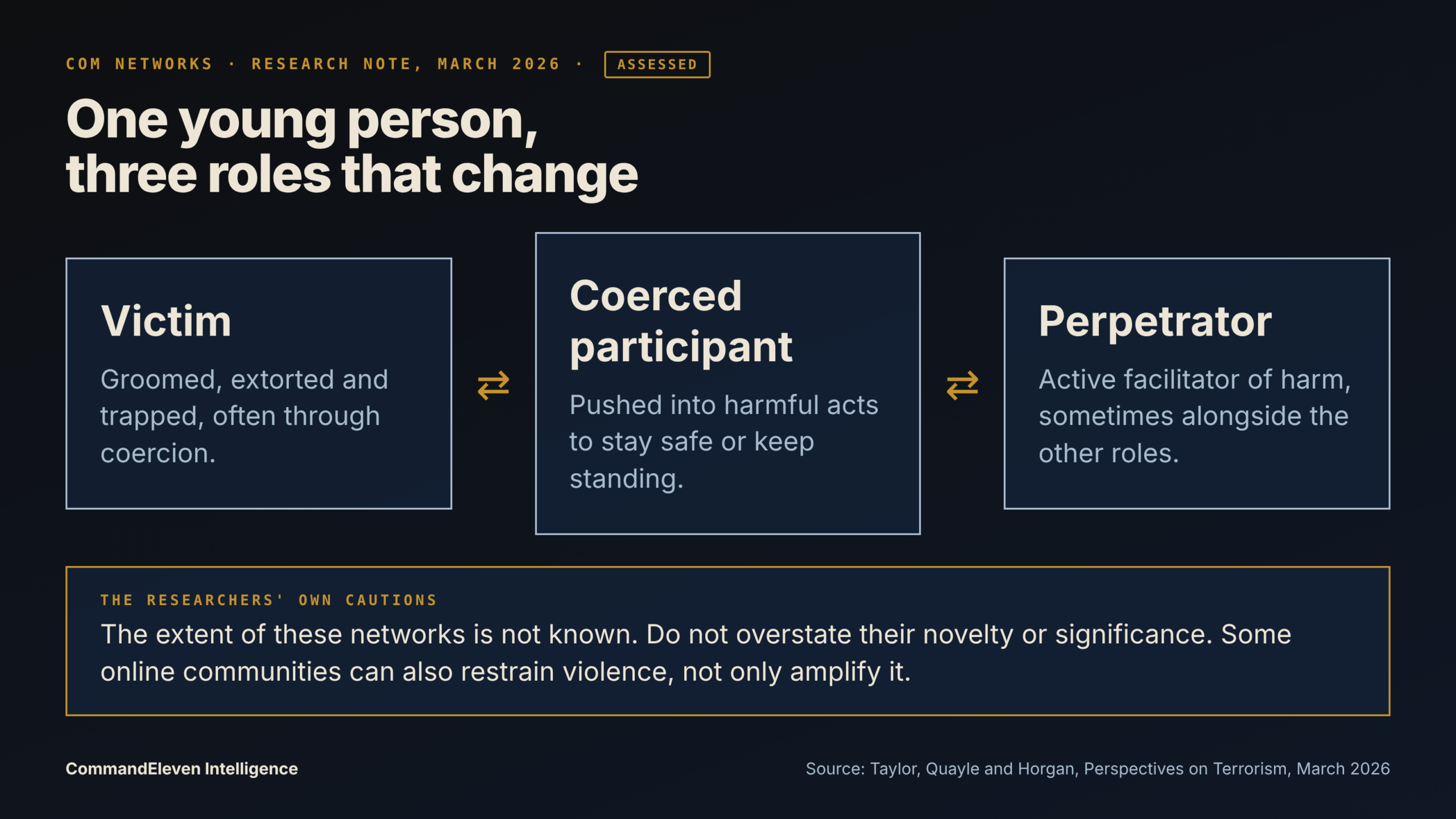
The note also carries limits that we repeat here. The extent of these networks needs more investigation. The authors say it is important not to overestimate their novelty or significance, given the absence of reliable data on how many people are involved. They also cite research showing that online extremist communities can create their own internal restraints that moderate violence, as well as amplify it. That evidence cuts against any simple story of online spaces as pure accelerants. This is why we tag the Com findings ASSESSED, not CONFIRMED.
Where the Sources Agree and Where They Do Not
They agree that the age of those drawn into violent extremist spaces is falling, that online communities supply belonging and status, and that early warning signs are common. They agree that prevention needs more than law enforcement.
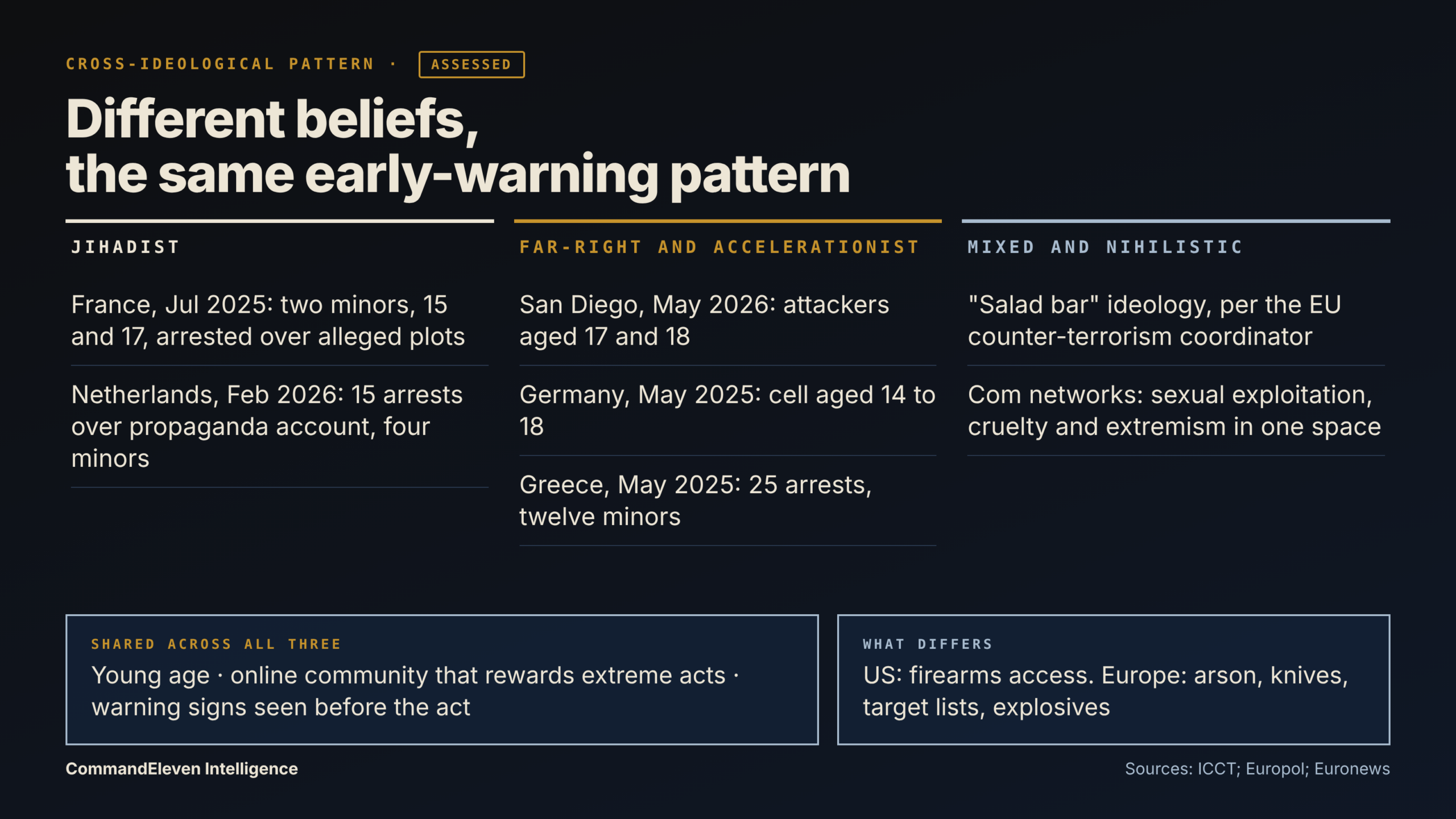
They differ on at least four points. They differ on definitions: Europol counts people aged 18 or younger, the EU coordinator cited ages 12 to 20, and ICCT’s review uses national reports with different rules. They differ on how ideological the violence is: ISD sees San Diego as largely ideological, while early police statements and the nihilistic-violence research stress a looser mix. They differ on novelty: Com researchers warn against overstating it. They differ on evidence of effect: the UK Prevent figures cited by ICCT show a record number of referrals, with ages 11 to 15 the largest group where age was known and extreme far-right concerns 20% of referrals, but referrals are concerns raised, not confirmed radicalization.
What Defenders Can Do About It
The measures follow from the evidence and stay at the policy level.
- Bring in youth professionals earlier. ICCT recommends involving social workers, youth workers, educators and mental-health practitioners before a case becomes primarily criminal, and sustained mental-health care rather than short crisis holds.
- Connect the people who see the signs. Information sharing among families, schools, clinicians, law enforcement and platforms is the weak point the San Diego record exposes.
- Reduce access to weapons for high-risk minors. In the US, checking associates and relatives to limit weapons access is a distinct prevention step, because firearms turn warning signs into mass-casualty risk.
- Disrupt networks, not only content. Both ICCT analyses favor network-level disruption over episodic takedowns.
- Keep prevention method ideology-neutral and analysis threat-specific. The same early-warning approach works across jihadist, far-right and nihilistic cases, while the analysis of each must stay specific.
- Count the problem consistently. A shared definition of age bands and recording rules would let analysts test the claims in this dossier. For now that is a DATA DEFICIT.
What To Watch
- Europol’s TE-SAT 2027 (expected mid-2027): the number and share of arrested persons aged 18 or younger, and whether age recording improves.
- UK Prevent statistics for the year ending September 2026: whether under-16s remain the largest group where age is known.
- Further public arrests or charges of minors over plots against places of worship in Europe and North America.
- Whether US authorities change how protective orders, weapons restraint and mental-health follow-up are used when a minor shows warning signs.
- Further research on the extent of Com networks and any evidence on whether online communities restrain or accelerate violence.
- Publication of the UN data behind the 42% figure.
Calls We Will Score
- By March 31, 2027: At least three separate public arrests or charges of minors (under 18) will be reported in Europe or North America over alleged plots against places of worship, schools or other public targets, in cases publicly tied to extremist or accelerationist beliefs.
- By March 31, 2027: UK Home Office Prevent statistics for the year ending September 2026 will again show 11-to-15-year-olds as the largest age group among referrals where age is known.
- By July 31, 2027: Europol’s TE-SAT 2027 will report at least 130 arrested persons aged 18 or younger for 2026. If it reports fewer, or changes how it counts age, we will say that the comparison cannot be made.
What This Assessment Does and Doesn’t Establish
It establishes that minors are a substantial and, in Europe, a documented share of terrorism arrests; that San Diego was an attack by two teenagers after warning signs; and that several independent research teams describe similar online and developmental dynamics across ideologies.
It does not establish how many young people are involved across countries, because definitions and age recording differ. It does not establish that online communities cause violence, since the Com researchers themselves say the evidence on extent is thin and that such communities can also restrain behavior. It does not establish that AI tools have raised the rate of youth violence. It does not rely on any information from our own field sources, and it does not describe recruitment or attack methods.
Frequently Asked Questions
What happened in San Diego on May 18, 2026?
Two teenagers, aged 17 and 18, attacked the Islamic Center of San Diego and killed three people, including a security guard. Both attackers died by suicide shortly afterward. Police had been searching for them after a parent’s report about two hours earlier. The FBI said they met online and left writings expressing hatred.
How many young people are arrested for terrorism in Europe?
Europol’s TE-SAT 2026 reports that 130 of those arrested in 2025 whose age was recorded were 18 or younger, out of 486 arrests overall. The youngest was 12. The figure covers only arrests with recorded ages, so it is a floor for what is known, not a full count.
Is this a jihadist problem or a far-right problem?
Both. Europol links most of the youth arrests to jihadism, while the San Diego attack and several European cases involve far-right and accelerationist beliefs. The ICCT analysis finds the same online and developmental dynamics in each.
What are Com networks?
Decentralized online communities, mostly of young men, in which sexual exploitation, cruelty, cybercrime and extremist ideas overlap and members compete for status. Researchers say young people may be victims, coerced participants and perpetrators at once, and that the extent of these networks is not yet known.
Does online radicalization always lead to violence?
No. The Com researchers cite work showing that online extremist communities can also provide governance and release that reduces real-world mobilization. Most people who engage with extreme content never act.
Related CommandEleven Intelligence Reading
- Terrorist Use of AI and the Younger Recruit (the November 12 update this dossier extends)
- The US Domestic Threat Landscape (series hub)
- Information Warfare and Radicalization in the AI Era: A CommandEleven Intelligence Series
- Digital Recruitment Ecosystems and Algorithmic Amplification – Part 3
Sources
- San Diego Warning: The West Needs a New Prevention Strategy for the Rise of Radicalised Minors (ICCT, Shtuni and Clarke, September 4, 2026)
- Engineering the Virtual Caliphate: Islamic State’s Exploitation of Gen-Z Culture (ICCT, Tahir and Jadoon, April 28, 2026)
- San Diego mosque shooting highlights new generation of neo-Nazi accelerationism (Institute for Strategic Dialogue)
- Police were searching for teens behind San Diego mosque shooting before the bloodshed began (Associated Press via WTOP, May 19, 2026)
- Police seize over 30 guns from homes linked to San Diego mosque shooters (Anadolu Agency)
- Europol TE-SAT 2026 (eucrim summary)
- EU Terrorism Situation and Trend Report 2026 (Europol, July 13, 2026)
- Children as young as 12 are getting radicalised in Europe, EU counter-terrorism chief tells Euronews (March 23, 2026)
- In Their Eyes: How European Security Services Look at Terrorism, 2026 Edition (ICCT, September 2026)
- Radicalisation in Coercive Online Communities: A Research Note (Taylor, Quayle and Horgan, Perspectives on Terrorism, Vol. XX, Issue 1, March 2026)