Key Judgments
- [CONFIRMED] Recommendation and ranking algorithms across mainstream and gaming-adjacent platforms optimize for engagement, and a substantial and growing body of peer-reviewed and policy research documents that engagement-optimized ranking systematically favors extreme, polarizing, and emotionally activating content over moderate content — an amplification dynamic that operates independent of any platform’s content policy on extremism specifically.
- [CONFIRMED] Gaming and gaming-adjacent platforms — Roblox, Discord, and Minecraft chief among them, per GNET, Frontiers, and mainstream investigative reporting through 2026 — have become a documented recruitment and grooming environment for both jihadist and nihilistic violent extremist networks targeting minors specifically, exploiting the same platforms’ youth-dominant user base and weak identity verification.
- [CONFIRMED] The 764 network and its “Com” ecosystem affiliates — already covered in CommandEleven Intelligence’s Domestic Threat Landscape series — represent the most fully documented case of an algorithmically-amplified, gaming-platform-based recruitment pipeline operating end-to-end: from initial contact through coerced escalation to self-harm and violence content, entirely online and substantially targeting minors.
- [ASSESSED] This chapter extends the GCTA’s “Stealth State” framework directly: a franchise network held together by shared narrative, as the GCTA describes for al-Qaeda’s post-2022 structure, requires exactly the kind of algorithmically-amplified, low-friction recruitment pipeline documented here to recruit and sort new franchise-level participants without centralized vetting or in-person contact.
- [DATA DEFICIT] Platform-level data on recommendation-algorithm contribution to specific extremist recruitment outcomes is almost never released publicly with methodology attached; most of what is publicly known comes from independent researcher reconstruction, leaked internal documents, or post-hoc case investigation rather than platform transparency reporting. This chapter’s claims about algorithmic mechanism are well supported; claims about the precise share of recruitment outcomes attributable to algorithmic amplification specifically, versus other factors, are not.
The Mechanism: Engagement Optimization as an Amplification Engine
Every major recommendation system in commercial use today is trained, directly or indirectly, to maximize a proxy for engagement — watch time, click-through, session length, return visits. A growing research literature, including peer-reviewed work on recommender-system amplification of extremist content and empirical studies on engagement-and-personalization-driven ranking, converges on a consistent finding: content that provokes strong emotional reactions — anger, fear, tribal identification, moral outrage — reliably outperforms moderate content on every one of those engagement proxies, and ranking systems that optimize for the proxies therefore amplify the emotionally extreme content whether or not that was any platform’s intent.
[ASSESSED] This is the structural link back to Part 1’s identity-fusion mechanism: a process that depends on volume and repetition does not require an extremist organization to defeat a platform’s content policy. It only requires that policy-compliant but emotionally activating adjacent content — grievance narratives, us-versus-them framing, content that stops just short of an explicit policy violation — perform well enough on engagement metrics that the platform’s own ranking system does the repetition work for the organization, for free, at a scale no propaganda unit could achieve through direct distribution alone. Congressional Research Service’s own review of platform algorithms for congressional consideration reaches a compatible structural conclusion: the amplification effect is a property of the optimization target, not a bug specific to any one platform’s implementation.
Gaming Platforms as the New Recruitment Floor
The most significant recruitment-ecosystem development of the past eighteen months, and the reason this chapter treats gaming platforms as a distinct threat vector rather than a subcategory of “social media,” is the documented migration of both jihadist and nihilistic-extremist recruitment activity into Roblox, Discord, and Minecraft specifically.
GNET’s September 2026 research on jihadist identifiers embedded in Roblox games documents extremist actors building custom in-game content — symbols, environments, narrative scenarios — designed to introduce jihadist identity markers to a young player base inside what appears to be ordinary gameplay. Parallel reporting on gaming-platform recruitment more broadly documents the same dynamic on the nihilistic-extremist side: a 2026 investigative account (via security-industry reporting drawing on New York Times sourcing) traces terrorist grooming activity across Roblox and piracy-adjacent platforms targeting children, exploiting exactly the properties that make these platforms attractive to their intended youth audience — weak or absent identity verification, direct messaging with minimal moderation, and a peer-social structure that normalizes extended one-on-one contact between an adult recruiter and a minor without raising the flags that would trigger scrutiny on a platform built for adult audiences.
[CONFIRMED] CommandEleven Intelligence’s own Domestic Threat Landscape series has already documented the fullest single case of this pipeline in operation: the 764 network and its wider “Com” ecosystem, the subject of a 2026 designation analyzed by GNET, which the Combating Terrorism Center at West Point and the Anti-Defamation League both document as operating an end-to-end online coercion pipeline — initial gaming-platform or Discord contact, escalating psychological manipulation, coerced production of self-harm content, and in documented cases escalation toward real-world violence — conducted entirely through remote digital contact with minors, without the network’s adult organizers ever needing physical proximity to a target.
This case is examined in full in this series’ companion coverage in the Domestic Threat Landscape series, Part 1 (Right-Wing Accelerationism and 764), which should be read as this chapter’s applied case study on the recruitment-pipeline mechanism described here.
From Individual Contact to Networked Sorting
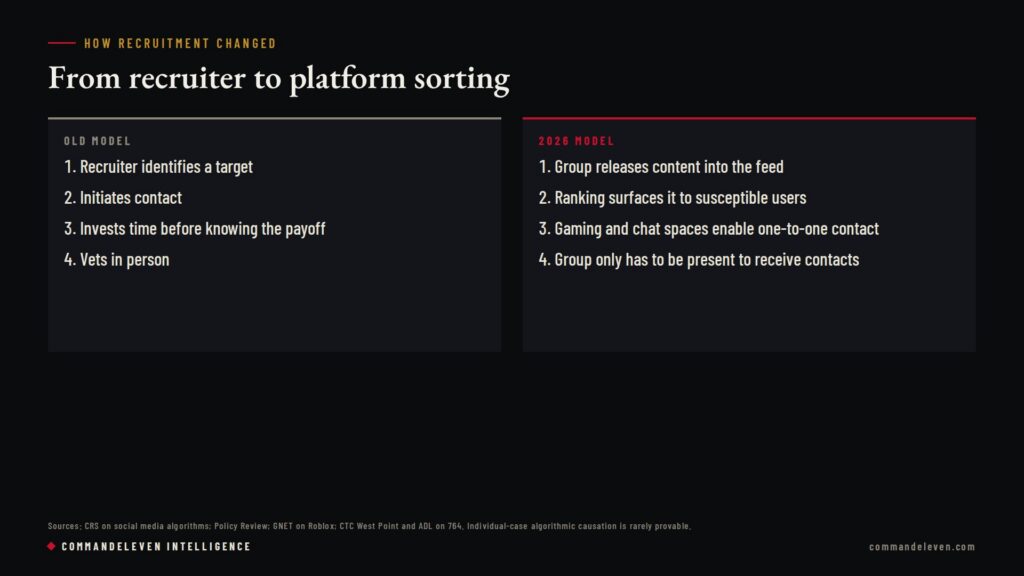
What algorithmic amplification and gaming-platform recruitment share, and what distinguishes this era’s recruitment ecosystem from the pre-social-media model, is a shift from an organization actively seeking out and vetting individual recruits to an organization building content and environments that let the platform’s own systems — recommendation algorithms, in-game social structures, engagement-optimized ranking — do the initial sorting work. A recruiter under the older model had to identify a susceptible individual, initiate contact, and invest time before knowing whether the investment would pay off. Under the current model, the platform’s own engagement optimization surfaces susceptible individuals to extremist content (and vice versa) as a byproduct of ordinary platform operation, and the organization only needs to be present to receive whichever contacts the system generates.
[ASSESSED] This is precisely the mechanism the GCTA’s “Stealth State” framework requires to function at scale. A decentralized, franchise-based network cannot rely on centralized recruitment and vetting — by definition, no single node has visibility into or control over recruitment happening in every other node. What it can rely on is a shared narrative and content strategy (Parts 1 and 2 of this series) released into an information environment whose own algorithmic structure performs the initial audience-sorting function for free. Read this way, algorithmic amplification is not an incidental modern inconvenience layered on top of the Stealth State — it is close to a structural precondition for the model working at the scale and speed the GCTA documents.
What This Chapter Does Not Claim
Consistent with this series’ Key Judgment 5 and CommandEleven Intelligence’s standing editorial standards, this chapter does not claim:
- That any specific platform’s recommendation algorithm has been shown, with methodology, to have caused a specific documented radicalization case. The mechanism is well supported in the aggregate research literature; individual-case algorithmic causation is very rarely provable from outside a platform’s own data.
- That gaming-platform recruitment activity is representative of the median user experience on Roblox, Discord, or Minecraft. It is a documented, serious, and apparently growing minority phenomenon within platforms serving hundreds of millions of users, not evidence that these platforms are majority-extremist environments.
- A quantified estimate of how many minors have been successfully recruited or coerced via this pipeline. No source reviewed for this chapter provides a reliable aggregate figure, and CommandEleven Intelligence declines to estimate one.
Series Continuity
This chapter completes the mechanism-and-infrastructure arc of this series: Part 1 established why narrative exposure produces mobilization; Part 2 documented the AI-accelerated toolkit now producing that narrative content at unprecedented volume and speed; this chapter has shown how algorithmic amplification and gaming-platform ecosystems deliver that content to susceptible audiences with minimal organizational effort, and why that delivery mechanism is close to structurally necessary for the GCTA’s Stealth State to function at the scale documented since April 2026. Part 4, the series’ closing chapter, turns from diagnosis to response: what counter-messaging strategies the practitioner and policy literature actually supports, and — as important — what popular counter-messaging approaches the evidence does not support.
Frequently Asked Questions
Do social media algorithms amplify extremist content?
Research consistently finds that engagement-optimized ranking favors emotionally activating and polarizing content, which amplifies extremist-adjacent material whatever a platform’s policy.
Are terrorists recruiting children on gaming platforms?
Documented cases show jihadist and nihilistic extremist networks using Roblox, Discord and Minecraft to reach minors. It is a serious minority phenomenon, not typical use of those platforms.
What is the 764 network?
A nihilistic violent extremist network that coerces minors online into self-harm and violence content, documented by the Combating Terrorism Center at West Point and the ADL.
Sourcing Base (Confidence-Tiered, with Links)
CONFIRMED — Institutional, Legal & CommandEleven Intelligence Prior Work:
- CommandEleven Intelligence, The US Domestic Threat Landscape (Part 1: Right-Wing Accelerationism and “764”)
- U.S. Department of Justice, Office of Public Affairs, “Member of Nihilistic Violent Extremist Group ‘764’ Pleads Guilty to Child Exploitation Offenses“
- Combating Terrorism Center at West Point, “Remotely Coerced Violence: 764, The Com Network, and the Hybridization of Threats“
- Anti-Defamation League, “764” backgrounder
- GNET, “The Designation of 764 Network: Why Does it Matter?“
- Congressional Research Service, “Social Media Algorithms: Content Recommendation, Moderation, and Congressional Considerations“
ASSESSED — Credible Secondary/Academic Reporting:
- GNET, “Playful Extremism: Unmasking Jihadist Identifiers in Roblox Games Among Minors“
- GNET, “Beyond the Ban Hammer: Building Resilience Against Youth Exploitation in Gaming Spaces“
- GNET, “The Nordic Front of ‘764’: Trends, Drivers, and Countering Youth Exploitation and Radicalisation“
- Security Boulevard, “Roblox Games, Piracy Platforms Fertile Ground for Terrorist Grooming“
- PMC, “‘Play as a Nazi prison guard’: childhood and adolescent exposure to online extremist materials in online gaming environments“
- Policy Review, “Recommender systems and the amplification of extremist content“
- ORF, “From clicks to chaos: How social media algorithms amplify extremism“
- arXiv, “Rewarding Engagement and Personalization in Popularity-Based Rankings Amplifies Extremism and Polarization“
Excluded from this dossier: Any quantified estimate of total minors recruited or coerced via gaming-platform pipelines, and any claim of proven algorithmic causation in a specific named individual radicalization case. Neither is supportable from the sourcing reviewed for this chapter.
The Information Warfare Series
Information Warfare & Radicalization in the AI Era: Series Introduction
- Narratives and Strategic Influence: How Story Shapes Mobilization – Part 1
- The Tooling: Encrypted Platforms, Deepfakes and the AI Arms Race – Part 2
- Digital Recruitment Ecosystems and Algorithmic Amplification – Part 3 (you are here)
- Counter-Messaging: What Works, What Doesn’t and What Remains Unproven – Part 4