
Key Judgments
- [CONFIRMED] Terrorist and extremist organizations have moved from experimental to operational use of generative AI tools for propaganda production, per documented case tracking by Tech Against Terrorism, the International Centre for Counter-Terrorism, and multiple open-source investigations through 2025-2026.
- [CONFIRMED] Telegram remains the single most significant encrypted/semi-encrypted platform for extremist and terrorist content distribution, notwithstanding a documented increase in takedown volume following the platform’s 2024-2026 policy shifts under legal and regulatory pressure; researchers consistently describe the crackdown as changing how threat actors operate on the platform more than whether they remain on it.
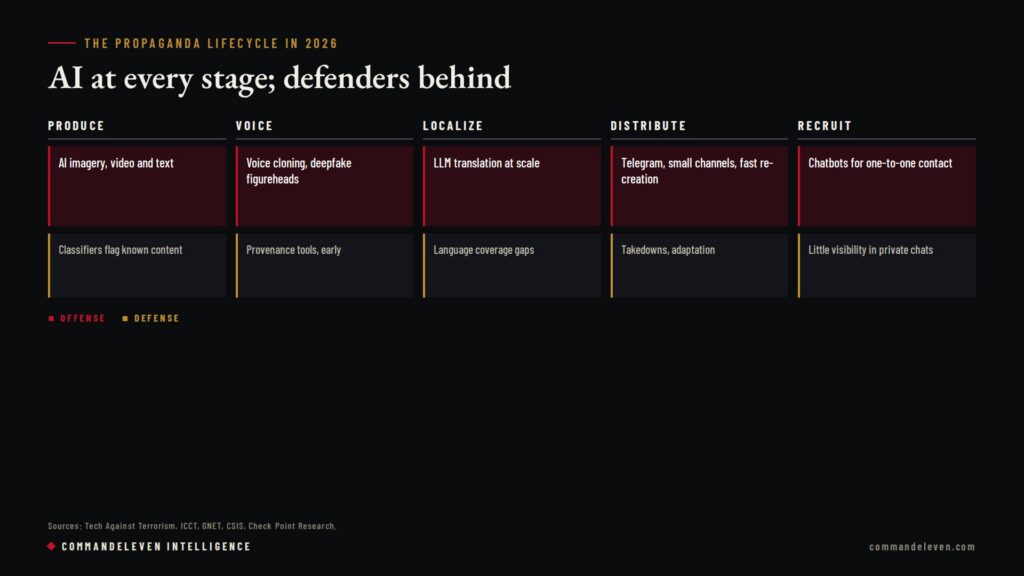
- [ASSESSED] The propaganda production toolkit now spans the full content lifecycle — AI-generated or AI-enhanced imagery and video, voice cloning and deepfake audio for figurehead messaging, and large-language-model-assisted translation and localization — collapsing what used to be a resource-intensive, specialist-dependent production process into something a small cell or even a lone actor can execute.
- [ASSESSED] Counter-terrorism practitioners are deploying AI-enabled detection and moderation tools in response, but the academic and practitioner literature reviewed for this chapter is notably cautious about claiming these tools have closed the gap — false-positive/false-negative tradeoffs, adversarial evasion, and platform-fragmentation all remain live, unresolved problems.
- [DATA DEFICIT] Attribution of specific AI-generated propaganda pieces to specific tools, and the operational scale (volume, reach, conversion) achieved by AI-accelerated production versus legacy production methods, is not independently verifiable from open-source reporting at this time. This chapter documents the toolkit and its use; it does not claim a validated before/after effectiveness comparison.
From Camera Crew to Prompt: The Production-Cost Collapse
The single most consequential change in extremist media production over the past two years is not a new narrative — it is a new cost structure. Producing the kind of high-production-value content that once required a dedicated media unit, editing software expertise, and days of work can now be approximated by a single operator with access to commercial generative AI tools and a prompt.
Tech Against Terrorism’s briefing on early terrorist experimentation with generative AI services documents this shift directly: extremist actors testing commercial text, image, and voice generation tools not as a novelty but as a deliberate substitute for in-house production capability that smaller or more geographically dispersed cells never had. The International Centre for Counter-Terrorism’s parallel research on generative AI exploitation by terrorist groups reaches a compatible conclusion — that the barrier to entry for producing polished, brand-consistent propaganda has fallen faster than platforms’ and governments’ capacity to adapt detection and takedown processes to match.
[ASSESSED] This is the direct mechanical link back to Part 1’s identity-fusion argument: if narrative fusion depends on volume and repetition across many channels, then a production-cost collapse that lets one operator generate what used to require a team is, independent of any single piece’s persuasive quality, a threat-multiplier. Scale itself became easier to buy.
Deepfakes: From Confusion to Instrumentalization
Deepfake video and voice-cloning technology has moved through a documented progression in extremist use: first as a source of ambient confusion — content designed to muddy the information environment and make any claim, true or false, harder to verify — and increasingly as a purpose-built instrumentalization tool, used to place words in the mouths of real or synthetic figureheads, or to fabricate “evidence” supporting a grievance narrative.
GNET’s research on deepfakes and radicalization traces this progression carefully, noting that the psychological effect of deepfake exposure on a radicalization trajectory does not require the viewer to be fully deceived — ambient uncertainty about what is real is itself corrosive to trust in legitimate information sources, and that erosion is, on its own, useful to an actor whose narrative benefits from audience distrust of mainstream and governmental counter-narratives. Africa Defense Forum’s reporting on chatbot and deepfake adoption documents specific instances of extremist actors using AI chatbots to conduct scaled, personalized recruitment conversations — automating what used to require a human recruiter’s one-on-one time investment per target.
[DATA DEFICIT] CommandEleven Intelligence has not independently verified specific claims of deepfake content directly attributed by name to a specific current terrorist operation as of this writing; the sourcing above documents the technique and its adoption pattern, not a confirmed, named current campaign. Readers should treat this chapter as documenting a capability that is confirmed to be in use across the extremist ecosystem broadly, not evidence tied to one specific group’s current operation.
The Platform Layer: Telegram and the Whack-a-Mole Problem
No single platform matters more to this ecosystem than Telegram, and the platform’s own trajectory over the past two years illustrates the limits of a takedown-centric response. Following sustained legal and regulatory pressure — including a widely reported executive detention episode and subsequent policy commitments — Telegram has documented a record volume of channel takedowns targeting criminal and extremist content. Checkpoint Research and multiple independent trackers characterize the practical effect as behavioral adaptation rather than displacement: threat actors have not left the platform in significant numbers, but have adjusted operational security — smaller channel sizes, faster channel-recreation cycles after takedown, migration of the most sensitive content to private groups and one-to-one chats that moderation systems cannot reach at all.
[ASSESSED] This pattern — enforcement pressure producing adaptation rather than elimination — is consistent with the broader grey-zone and asymmetric-actor behavior CommandEleven Intelligence has documented elsewhere in its published work: a resourced but technically inferior actor facing pressure from a stronger one does not stop operating, it changes shape. Applied here, the practical implication for platforms, governments, and researchers alike is that channel-count and takedown-volume metrics are a poor proxy for actual threat reduction, and public claims of platform “wins” against extremist content should be read with that caveat.
The Counter-Tooling: What AI Offers Defenders
The same generative and analytical AI capability set is now being tested by defenders. AI-enabled content moderation tools — automated classifiers trained to flag extremist imagery, text, and coded language at a scale no human moderation team could match — are in active deployment across major platforms, and dedicated counter-terrorism-focused AI research, including UN Counter-Terrorism Centre and UNICRI’s joint work on AI applications against online extremism, has expanded substantially since 2024.
[ASSESSED] The practitioner and academic literature reviewed for this chapter is consistently more cautious than platform marketing material about how far this has closed the gap. GNET’s own assessment of AI-led moderation tooling in a Canadian case study frames automated detection as a necessary but insufficient layer — effective against high-volume, low-sophistication content, and considerably less effective against adversarially adapted content specifically designed to evade classifier training (coded language, meme-based dogwhistles, content fragmented across platforms to avoid triggering any single detection threshold). CSIS’s broader assessment of AI and the future of terrorism frames this as a durable structural asymmetry rather than a temporary technology gap: offense-side AI use requires no coordination and can iterate faster than defense-side detection systems, which must be retrained, validated, and deployed at platform scale before they close against any given evasion technique — by which point the technique has often already shifted again.
[DATA DEFICIT] No open-source metric reviewed for this chapter permits a confident, quantified statement of current detection effectiveness (true-positive rate against operational extremist content specifically, as opposed to test-set performance). CommandEleven Intelligence treats claims of near-complete AI-driven detection success, wherever they originate, as unverified until platforms or independent auditors publish methodology alongside results.
Series Continuity
This chapter is the toolkit half of the mechanism Part 1 described: narrative fusion requires volume, repetition, and community reinforcement, and the production-cost collapse and platform-adaptation dynamics documented here are what currently supply all three at a scale unavailable to extremist organizations even five years ago. Part 3 extends this into the recruitment-ecosystem and algorithmic-amplification question directly — not just how content is produced and where it lives, but how platform recommendation systems move it toward the audiences most likely to fuse with it, a question this series’ Part 3 treats as a direct expansion of the GCTA’s own “Stealth State” framework.
Frequently Asked Questions
Are terrorist groups using generative AI?
Yes. Tech Against Terrorism and the ICCT document extremist groups moving from experiments to operational use of AI for imagery, video, voice and translation.
Did Telegram’s crackdown remove extremists from the platform?
No. Takedowns rose sharply, but researchers find threat actors adapted with smaller channels, faster re-creation and private groups rather than leaving.
Can AI moderation tools stop extremist content?
Only partly. They work against high-volume, low-sophistication content and much less well against content built to evade them, and no published metric shows real-world effectiveness.
Sourcing Base (Confidence-Tiered, with Links)
CONFIRMED — Institutional & Practitioner Reporting:
- Tech Against Terrorism, “Early terrorist experimentation with generative artificial intelligence services“
- International Centre for Counter-Terrorism (ICCT), “Exploitation of Generative AI by Terrorist Groups“
- UN Counter-Terrorism Centre / UNICRI, “Countering Terrorism Online with Artificial Intelligence“
- Atlantic Council, “Countering terrorist propaganda in the age of AI“
ASSESSED — Credible Secondary/Academic Reporting:
- CSIS, “Artificial Intelligence and the Future of Terrorism“
- GNET, “From Confusion to Extremism: How Deepfakes Facilitate Radicalisation“
- GNET, “AI-led Content Moderation Tools: Are They The Answer To Combatting Online Extremism in Canada?“
- Africa Defense Forum, “From Deepfakes to Chatbots, Terrorists Embrace AI to Spread Propaganda“
- The Media Line, “Terrorists Exploit AI for Propaganda and Operations, Exposing Critical Gaps in Tech Safeguards“
- ORF, “Jihadi Use of Artificial Intelligence: A Growing Threat in the Digital Age“
- Check Point Research, “Telegram’s Crackdown in 2026 and Why Cyber Criminals Are Still Winning“
- The Hacker News, “Telegram’s Crackdown Changed How Threat Actors Act, But Not Where They Act“
- CyberNews, “Telegram executes record number of takedowns, but cyber crooks still stand tall“
Excluded from this dossier: Specific named-operation attributions of deepfake propaganda pieces to specific current terrorist campaigns, and any quantified AI-detection “success rate” figures not accompanied by published methodology. Neither is independently verifiable from the open-source record reviewed for this chapter.
The Information Warfare Series
Information Warfare & Radicalization in the AI Era: Series Introduction
- Narratives and Strategic Influence: How Story Shapes Mobilization – Part 1
- The Tooling: Encrypted Platforms, Deepfakes and the AI Arms Race – Part 2 (you are here)
- Digital Recruitment Ecosystems and Algorithmic Amplification – Part 3
- Counter-Messaging: What Works, What Doesn’t and What Remains Unproven – Part 4