Key Judgments
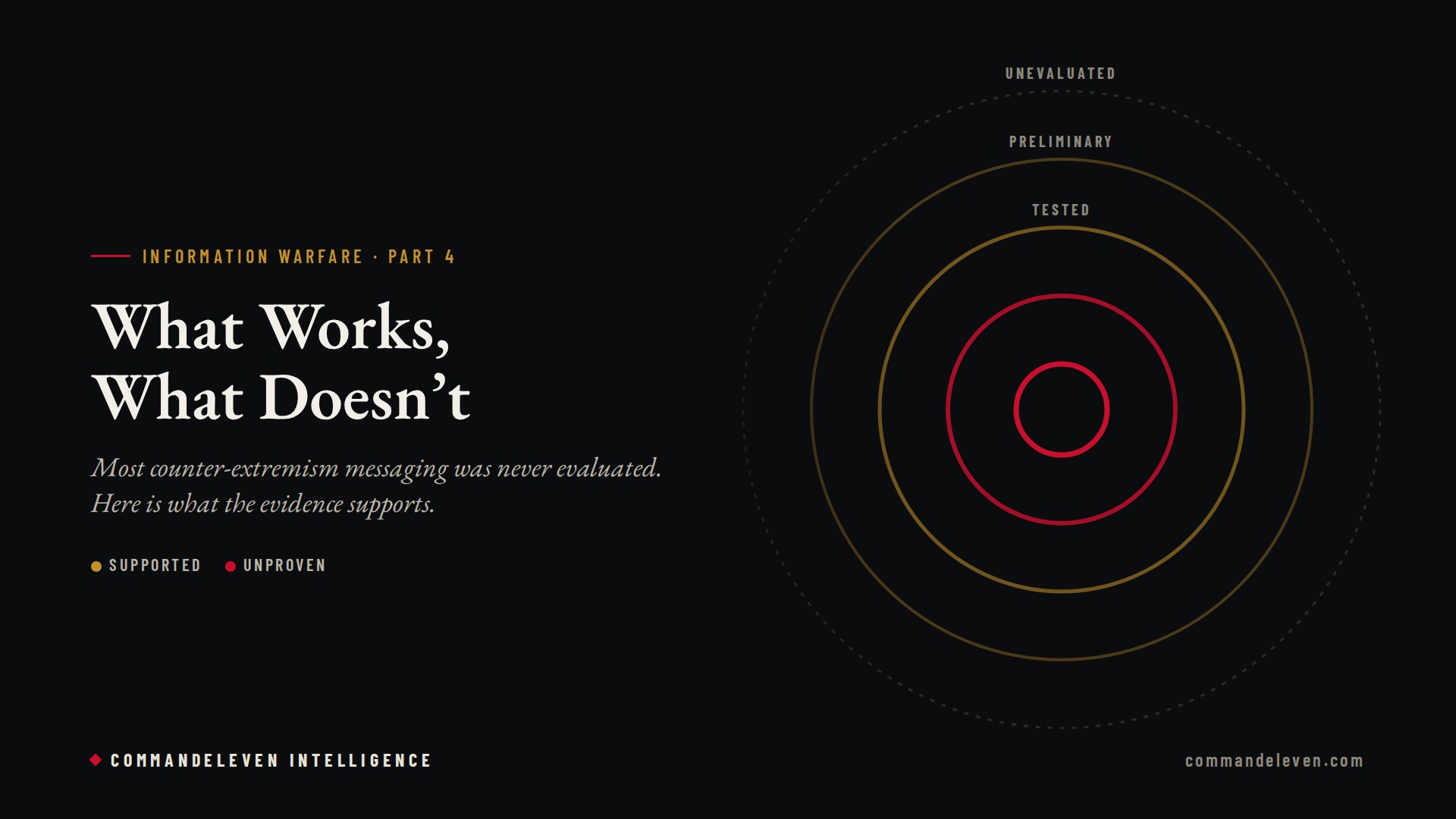
- [CONFIRMED] A substantial body of counter-messaging and counter-narrative research now exists — including a 2024 systematic integrative review of counter-messaging campaigns targeting terrorism and violent extremism — and its consistent, somewhat uncomfortable finding is that most public counter-messaging campaigns to date have been evaluated poorly or not at all, making confident claims of “what works” harder to support than the volume of published campaigns would suggest.
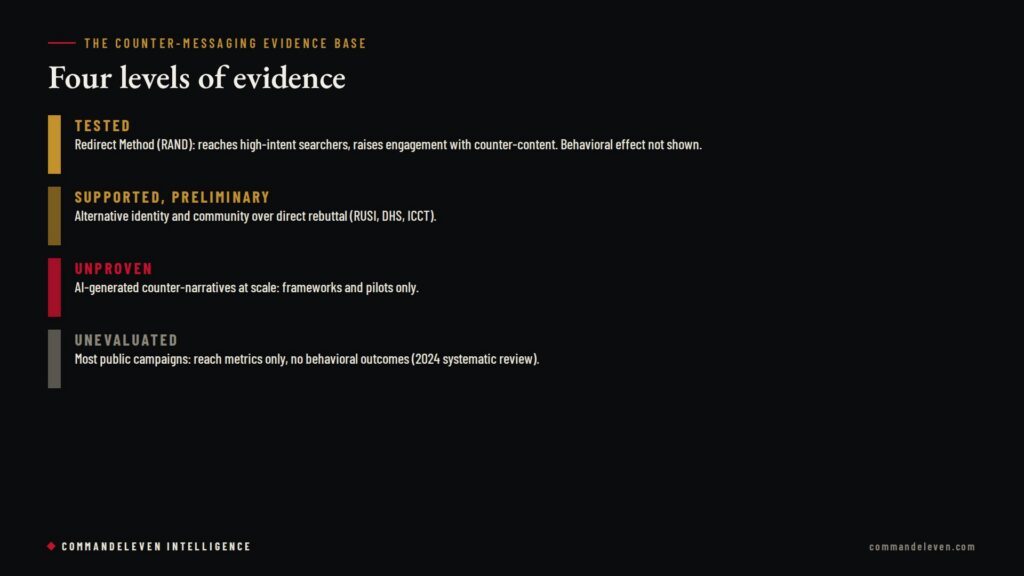
- [CONFIRMED] Google Jigsaw’s Redirect Method — targeted advertising that intercepts individuals actively searching extremist-adjacent terms and redirects them toward curated counter-content — remains the most rigorously, independently evaluated large-scale counter-messaging intervention in the public record, per RAND’s dedicated assessment, and its results are best described as modest and mechanism-specific rather than a universal solution.
- [ASSESSED] The identity-fusion mechanism this series’ Part 1 established implies a specific, falsifiable prediction about counter-messaging design: campaigns built as direct rebuttal or fact-correction of extremist claims should underperform campaigns built around offering an alternative identity and community, because rebuttal addresses the argument while fusion operates on belonging — a prediction broadly, though not uniformly, supported by the practitioner literature reviewed for this chapter.
- [ASSESSED] Emerging AI-assisted counter-narrative generation and refinement frameworks show early promise for producing counter-content at a speed and personalization level that can compete with the AI-accelerated production toolkit documented in Part 2, but remain in early research and pilot stages rather than proven, deployed-at-scale practice.
- [DATA DEFICIT] No source reviewed for this chapter supports a confident, generalizable claim that any specific counter-messaging approach reliably prevents radicalization or de-radicalizes an already-fused individual at meaningful scale. This chapter documents what the evidence supports and does not support; it does not offer a validated solution, and readers should be skeptical of any source, CommandEleven Intelligence included, that claims otherwise.
The Uncomfortable Finding: Most Counter-Messaging Is Unevaluated
Before addressing what works, this chapter has to address a prior problem: most public counter-messaging campaigns were never rigorously evaluated to begin with. The 2024 systematic integrative review of counter-messaging communication campaigns targeting terrorism and violent extremism — the most comprehensive published assessment of the field to date — found that the large majority of campaigns reviewed lacked outcome data sufficient to assess actual behavioral impact, relying instead on output metrics (views, shares, engagement) that measure reach, not persuasion or de-radicalization.
[ASSESSED] CommandEleven Intelligence treats this finding as the single most important caveat governing everything else in this chapter. A field that has produced hundreds of campaigns and a comparatively small number of rigorously evaluated ones is a field where confident public claims of “proven” approaches should be treated with the same skepticism this series has applied throughout to unverified claims elsewhere — the absence of evidence of harm is not evidence of effectiveness, and campaign volume is not a proxy for campaign impact.
What Has Been Rigorously Tested: The Redirect Method
Google Jigsaw’s Redirect Method is the clearest exception to the evaluation gap described above, and for that reason carries more evidentiary weight in this chapter than its modest headline results might suggest. The method works by identifying search terms associated with active interest in joining extremist movements, then using targeted advertising to intercept those searchers and route them toward curated counter-content — existing YouTube videos debunking recruitment narratives, testimony from former extremists, and similar material — rather than attempting to generate new persuasive content from scratch.
RAND’s independent assessment of the Redirect Method’s outcomes found real but bounded effects: the intervention reliably reached its intended audience (individuals actively searching extremist-adjacent terms, a higher-intent population than broad-audience counter-messaging campaigns), and produced measurable increases in engagement with counter-content, but RAND’s own assessment stopped well short of claiming a demonstrated causal reduction in actual radicalization or violent mobilization — a distinction between engagement outcomes and behavioral outcomes that the field as a whole, per Section I above, still struggles to close.
[ASSESSED] CommandEleven Intelligence reads the Redirect Method’s core design insight — intercept at the moment of active search intent, rather than broadcasting to a general audience — as its most transferable lesson, independent of the specific platform or tooling used. Applied to Part 3’s algorithmic-amplification findings, this suggests counter-messaging integrated into the same recommendation-system moment that would otherwise surface extremist content carries more promise than counter-messaging distributed through separate channels the target audience has to seek out.
Why Rebuttal Underperforms: The Identity-Fusion Implication
This series’ Part 1 established that mobilization runs through identity fusion — narrative exposure that collapses the distance between personal and group identity — rather than through persuasion by argument. That mechanism generates a specific, testable prediction for counter-messaging design: a campaign built to rebut or fact-check an extremist claim is addressing the argument layer, but fusion, once underway, does not operate primarily at the argument layer. It operates at the belonging layer. A rebuttal campaign can be factually devastating and still fail to move a fused individual, because the individual’s resistance to the rebuttal is not primarily an evidentiary judgment — it is a defense of identity.
The practitioner literature broadly, though not uniformly, supports this prediction. RUSI’s assessment of communications-based P/CVE activities and DHS’s own published framework for effective counter-narrative design both emphasize alternative-identity and alternative-community framing — offering a competing sense of belonging and purpose — over direct rebuttal as the more promising design principle, while cautioning that evidence remains preliminary rather than definitive. ICCT’s research on countering identity-based disinformation through positive narrative expansion reaches a compatible conclusion from the disinformation side of the literature: expanding a positive counter-narrative tends to outperform direct negation of the harmful one.
[DATA DEFICIT] CommandEleven Intelligence flags that “broadly supported” is not “definitively proven.” Several sources reviewed for this chapter note that alternative-identity campaigns are themselves harder to evaluate than rebuttal campaigns (a successful outcome is an absence — someone who never mobilizes — which is difficult to attribute to a specific intervention), meaning the comparative evidence favoring this approach may partly reflect its resistance to easy negative evaluation rather than proven superior effectiveness. This chapter treats the identity-based design principle as the more theoretically coherent and better-supported approach available, not as a solved problem.
AI-Assisted Counter-Narrative Generation: Early and Unproven
Given Part 2’s documentation of AI-accelerated extremist content production, the obvious defensive question is whether AI can generate counter-narrative content at comparable speed and personalization. Emerging research — including recent multi-stage agentic frameworks for counter-narrative generation and refinement — demonstrates technical feasibility: systems that can generate, critique, and refine counter-messaging content iteratively, in principle keeping pace with AI-accelerated propaganda production.
[ASSESSED] CommandEleven Intelligence assesses this as a promising but unproven direction, not a current operational capability at meaningful scale. The research reviewed for this chapter is overwhelmingly at the framework-development and small-scale-pilot stage; none of it has been validated against real-world deployment outcomes at the scale Part 2’s toolkit is already operating. The structural asymmetry this series’ Part 2 identified — offense-side AI use requiring no coordination and iterating faster than defense-side systems that must be validated before deployment — applies here as much as it does to detection tooling, and CommandEleven Intelligence sees no current evidence that AI-assisted counter-narrative generation has closed, or is close to closing, that gap.
What This Series Does Not Claim
Consistent with the standard CommandEleven Intelligence has applied throughout this series, and closing it out:
- This series does not claim to have identified a proven, generalizable solution to online radicalization. None currently exists in the public evidence base, and any source claiming otherwise should be treated with skepticism.
- This series does not claim algorithmic amplification is the sole or primary driver of radicalization. It is one well-documented mechanism among several (offline social networks, real-world grievance, material circumstance) that the broader radicalization literature treats as interacting factors, not a single-cause model.
- This series does not claim AI-generated content is categorically more persuasive than human-produced content. The evidence reviewed supports a claim about production cost and scale, not about the persuasive quality of any individual piece.
- This series does not claim gaming-platform recruitment is representative of ordinary use of Roblox, Discord, or Minecraft, as stated in Part 3 and restated here for emphasis given the sensitivity of that subject.
Series Synthesis and the GCTA Throughline
Across four chapters, this series has traced a single mechanism from psychological foundation to operational infrastructure to (partial, unproven) countermeasure: narrative exposure produces mobilization through identity fusion, not persuasion (Part 1); AI tooling has collapsed the cost of producing fusion-optimized narrative content at scale (Part 2); algorithmic amplification and gaming-platform ecosystems deliver that content to susceptible audiences with minimal organizational effort, supplying close to a structural precondition for the GCTA’s “Stealth State” to function as a decentralized, narrative-held-together network (Part 3); and the counter-messaging evidence base, while real and growing, has not yet produced a demonstrated solution operating at the same speed and scale as the problem it is meant to address (Part 4).
CommandEleven Intelligence’s assessment, consistent with the GCTA’s own April 2026 framing of the Hard War model having “reached its ceiling of efficacy” against a decentralized adversary, is that this information-warfare dimension is not a peripheral concern to counter-terrorism strategy but a central one: an adversary organized as a Stealth State cannot be disrupted primarily through kinetic or law-enforcement action against individual nodes, because the model’s coordinating mechanism — shared narrative, algorithmically delivered — does not run through any single node that can be targeted. Any durable response has to operate at the same layer the threat does, and this series’ most consequential finding may be how far the public evidence base for doing that still has to go.
Frequently Asked Questions
Does counter-messaging work against extremism?
The evidence is thin. A 2024 systematic review found most campaigns were never evaluated for behavioral impact, only reach.
What is the Redirect Method?
A Google Jigsaw approach that targets people searching for extremist content with ads leading to counter-content. RAND found real but modest effects on engagement, not proven reductions in radicalization.
Is rebuttal or alternative identity more effective?
The practitioner literature broadly favors offering an alternative identity and community over direct rebuttal, but the evidence is preliminary.
Sourcing Base (Confidence-Tiered, with Links)
CONFIRMED — Systematic Reviews & Independent Evaluations:
- Taylor & Francis, “A systematic integrative review of counter-messaging communication campaigns targeting terrorism or violent extremism” (2024)
- RAND Corporation, “Assessing Outcomes of Online Campaigns Countering Violent Extremism: A Case Study of the Redirect Method“
- The Washington Institute, “The Search for Extremism: Deploying the Redirect Method“
- U.S. Department of Homeland Security, “Developing Effective Counter-Narrative Frameworks for CVE“
ASSESSED — Credible Secondary/Academic Reporting:
- RUSI, “Assessing Communications-Based Activities to Prevent and Counter Violent Extremism“
- ICCT, “Countering Identity-Based Disinformation Through Positive Narrative Expansion“
- Springer Nature, “Broader Strat Comms and P/CVE Reflections“
- RTSA, “Evaluating the Effectiveness of Online Counter-Messaging Campaigns“
- arXiv, “A Multi-Stage Agentic Framework for Effective Counter-Narrative Generation and Refinement“
Excluded from this dossier: Any specific vendor or platform’s claimed counter-messaging “success rate” not accompanied by independent, methodology-disclosed evaluation. Consistent with Key Judgment 1 of this chapter, CommandEleven Intelligence treats the evaluation gap across this field as the operative finding, not a footnote.
The Information Warfare Series
Information Warfare & Radicalization in the AI Era: Series Introduction
- Narratives and Strategic Influence: How Story Shapes Mobilization – Part 1
- The Tooling: Encrypted Platforms, Deepfakes and the AI Arms Race – Part 2
- Digital Recruitment Ecosystems and Algorithmic Amplification – Part 3
- Counter-Messaging: What Works, What Doesn’t and What Remains Unproven – Part 4 (you are here)