Bottom Line Up Front (BLUF)
Extremist movements no longer need training camps to turn sympathizers into operatives. They need a story, a community that rewards belief in it, and a distribution system that repeats it. Generative AI has made the story nearly free to produce, and engagement-optimized platforms now do much of the repetition for them. This series traces that mechanism from the psychology of mobilization to the tools, the recruitment pipelines and the counter-measures, and is candid about how much of the defensive side remains unproven.
Why This Series
CommandEleven Intelligence’s April 2026 Global Counter-Terrorism Assessment (GCTA) described al-Qaeda as a “Stealth State”: a decentralized network that licenses its brand and doctrine to regional franchises and is built to “survive the death of any single leader.” A network like that cannot run on orders. It runs on shared narrative. The GCTA also argued that the Hard War model of drone strikes and signals intelligence had reached its “ceiling of efficacy” against fast, digital radicalization.
This series develops both points. It asks how narrative actually produces mobilization, what AI has changed about producing and delivering it, and what the evidence says about stopping it.
What the Series Covers
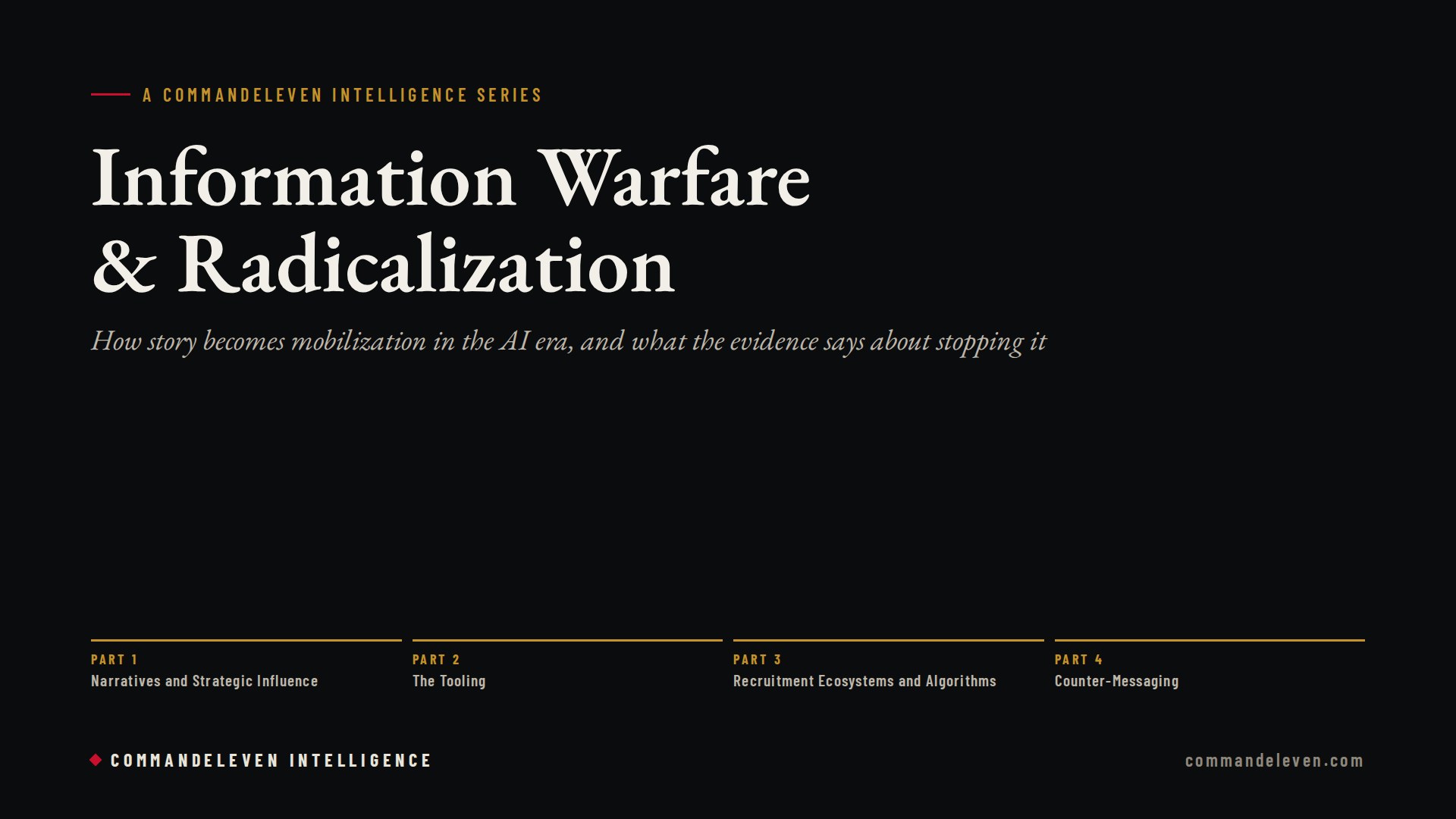
- Part 1 — Narratives and Strategic Influence. Why mobilization runs through identity fusion rather than persuasion, how jihadist media operates as an institution, and why AI is an accelerant rather than a new mechanism.
- Part 2 — The Tooling. Generative AI in propaganda production, deepfakes, Telegram’s crackdown and why it changed behavior more than presence, and the limits of AI-driven moderation.
- Part 3 — Digital Recruitment Ecosystems and Algorithmic Amplification. How engagement-optimized ranking does the repetition work for extremists, how gaming platforms became a recruitment floor for minors, and the 764 network as the fullest documented case.
- Part 4 — Counter-Messaging. What has been rigorously tested, why rebuttal underperforms alternative identity, and why most counter-messaging has never been evaluated at all.
How to Read It
Every claim is confidence-tiered: CONFIRMED where independently documented, ASSESSED where it reflects CommandEleven Intelligence’s analytical judgment, and DATA DEFICIT where the public evidence does not support a confident claim. The series is firm on mechanisms and deliberately cautious on effect sizes. No public source reliably measures how much exposure produces mobilization, how many minors have been recruited through gaming platforms, or how well AI moderation performs against content built to evade it, and the series does not invent those figures.
Related Coverage
- Pakistan-Afghanistan series, Part 3: Hamza bin Laden and Al-Qaeda’s Regional Re-Emergence, the applied case of narrative-held decentralization
- The US Domestic Threat Landscape, including the 764 network
- Algorithmic Amplification Vectors
- Virtual Radicalization Process: Early Detection Indicators
Frequently Asked Questions
What is the Information Warfare & Radicalization in the AI Era series?
A CommandEleven Intelligence assessment of how extremist narratives drive mobilization, how AI and platform algorithms accelerate them, and what the evidence says about countering them.
How does AI change terrorist propaganda?
It collapses the cost of producing polished, personalized content at volume. CommandEleven Intelligence assesses that it changes speed and scale, not the psychology of radicalization.
What is the “Stealth State”?
The GCTA’s term for al-Qaeda’s decentralized structure: a network that licenses brand, doctrine and training to franchises and is built to survive the loss of any leader, held together by shared narrative.
Is there a proven way to counter online radicalization?
Not yet. The best-evaluated intervention, the Redirect Method, shows modest effects, and most campaigns have never been evaluated for behavioral impact.