
CommandEleven Intelligence Desk // Critical Minerals Desk, status as of November 16, 2026
Bottom Line Up Front
China’s export controls on gallium, germanium and graphite are still in force as licensing regimes for every buyer in the world. What is paused is narrower: the US-specific ban on gallium, germanium and antimony, and a package of October 2025 measures that includes graphite anode material. The first pause ends on November 27, 2026, 11 days from this assessment, and we found no published notice extending it. On November 9 China’s commerce ministry extended the suspension of the October 2025 package, which includes graphite anode controls, to January 10, 2027.
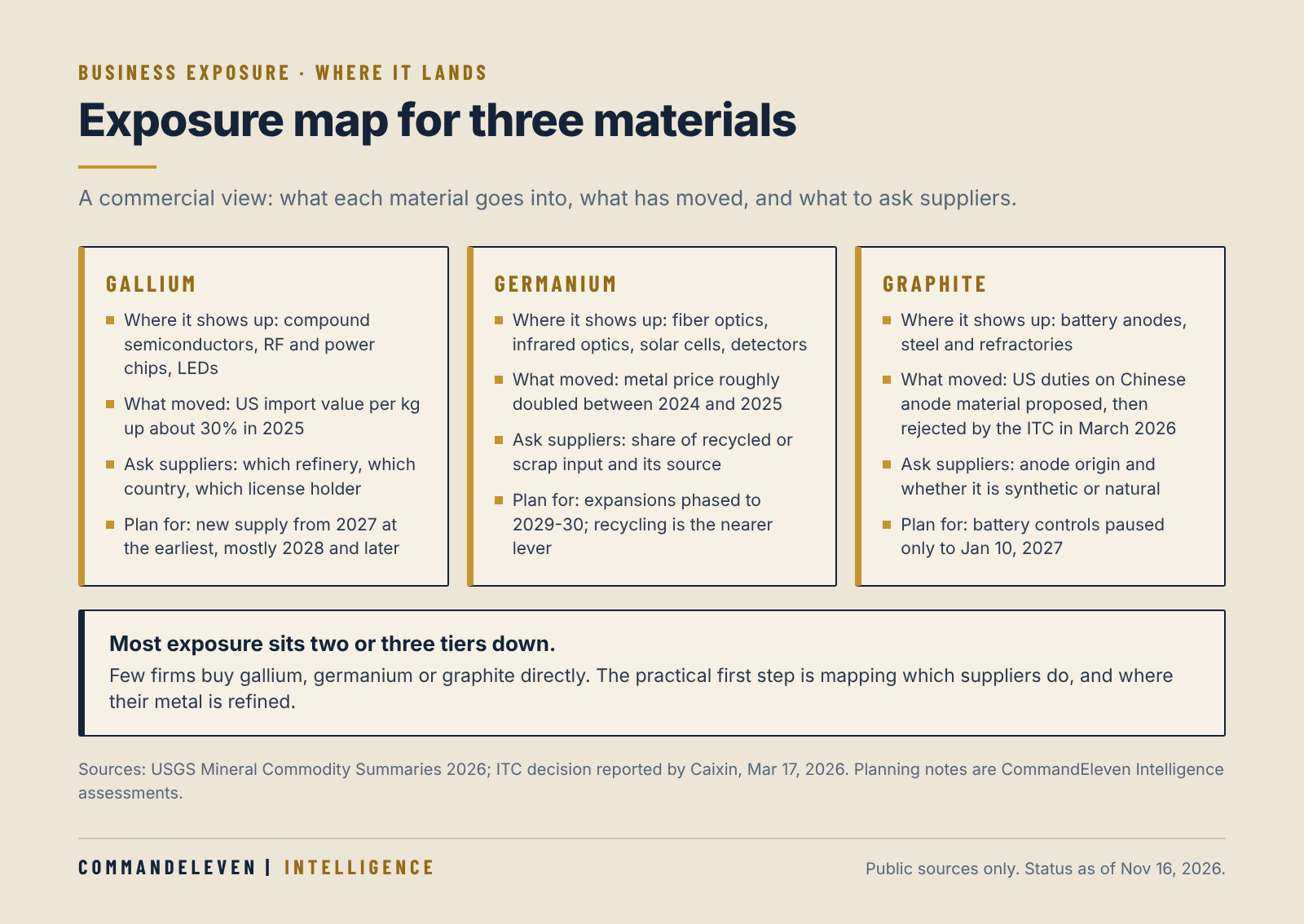
This is a commercial problem before it is a strategic one. Supply is concentrated, prices have already moved, and replacement capacity outside China is a 2027 to 2030 story at best. For most companies the exposure is two or three tiers down the supply chain, in suppliers who buy the metal. The first useful step is to find out which ones.
Key Judgments
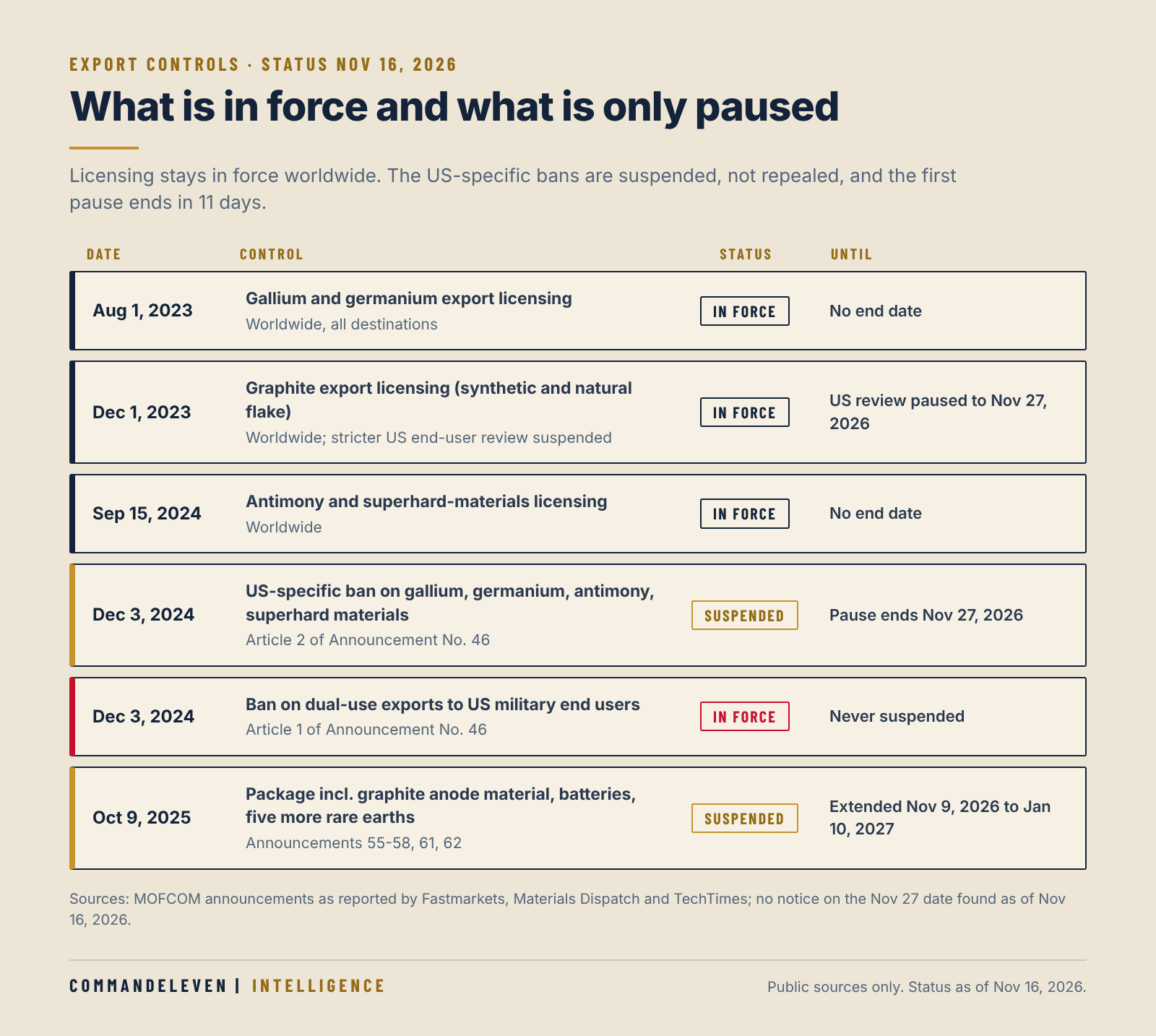
KJ1: Licensing is the standing lever, and the US-specific bans are paused, not repealed. [CONFIRMED that worldwide licensing continues and that the gallium, germanium and antimony pause ends November 27 by its own terms; UNCONFIRMED whether it will be extended] China’s December 2024 order also bars dual-use exports to US military end users, and that part was never suspended.
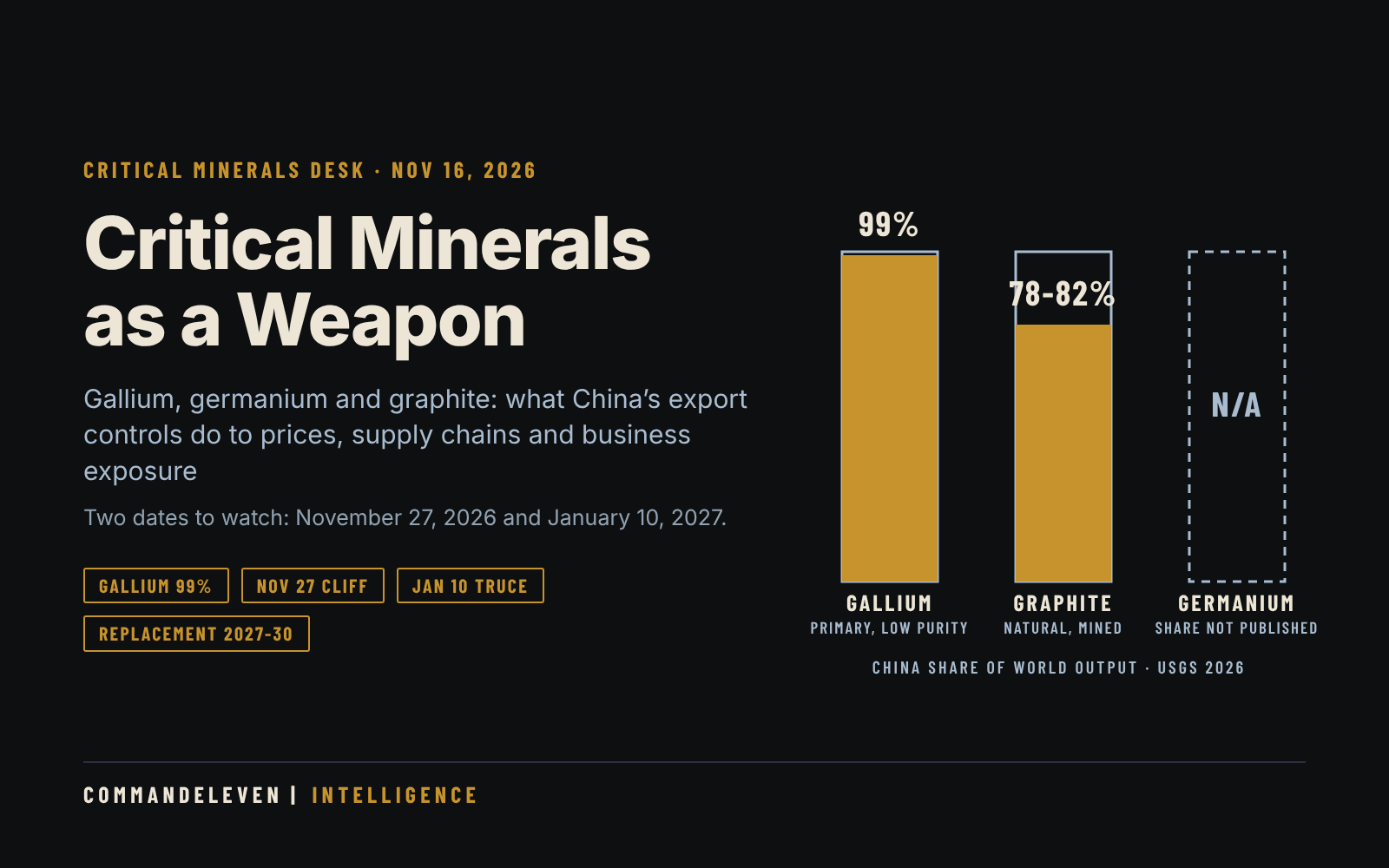
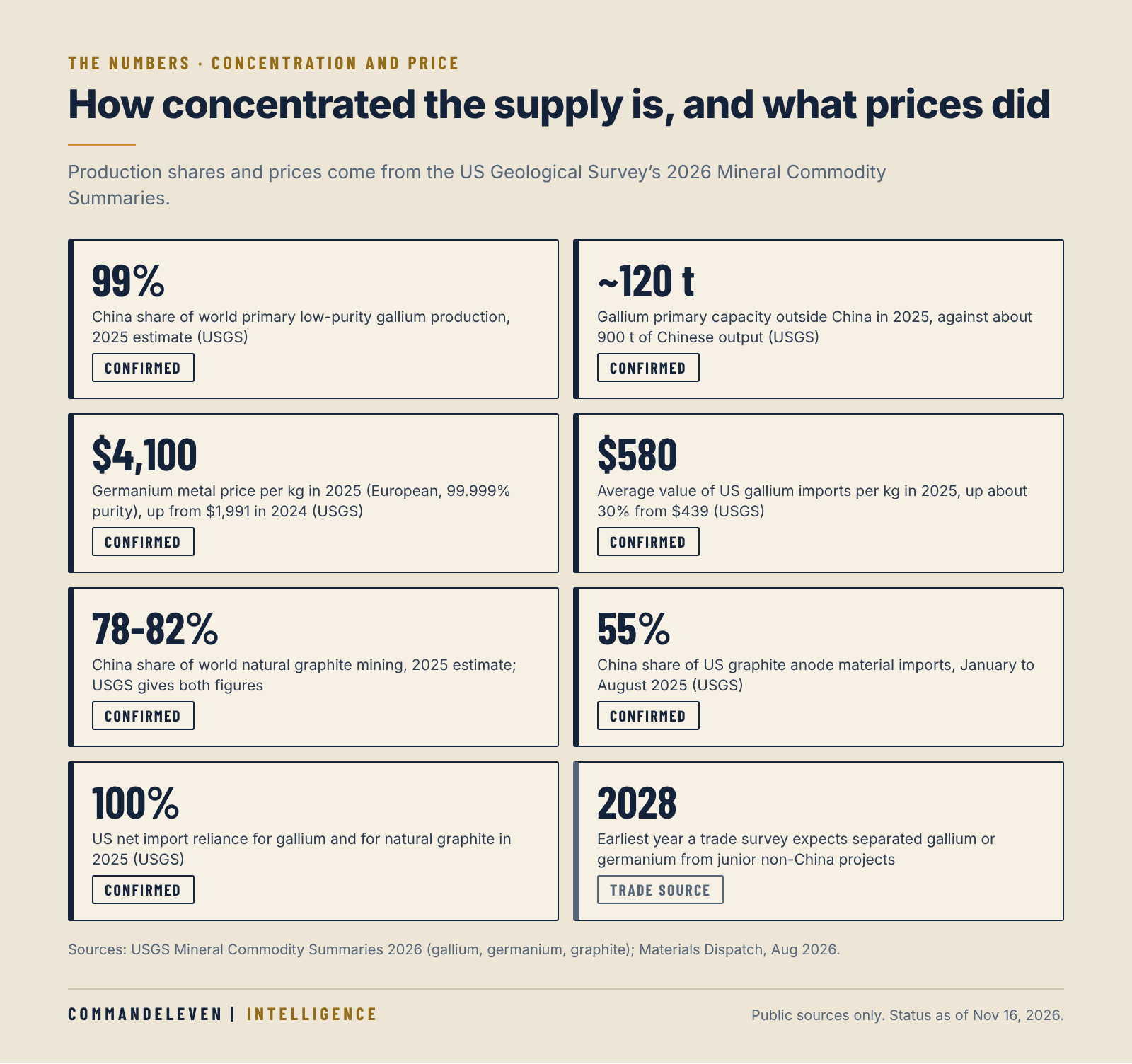
KJ2: Gallium supply is almost entirely Chinese. [CONFIRMED] The US Geological Survey puts China at 99% of world primary low-purity gallium production in 2025, with about 120 tonnes of primary capacity outside China against roughly 900 tonnes of Chinese output.
KJ3: Prices have already moved. [CONFIRMED] The USGS reports the 2025 average European germanium metal price at $4,100 per kilogram, up from $1,991 in 2024, and the average value of US gallium imports at $580 per kilogram, up about 30% from $439.
KJ4: Replacement supply is a plan, not a supply. [ASSESSED] The projects named in public sources start in 2027 at the earliest, and most volumes are dated 2028 to 2030. One trade survey expects no separated gallium or germanium from the junior projects before 2028. If every announced gallium figure held, the projects named here would add roughly 200 tonnes a year, about a quarter of China’s 2025 output.
KJ5: Germanium’s China share is a data deficit. [DATA DEFICIT] The USGS names China as the leading producer but publishes no refinery figures by country, because most producers do not report output. We do not state a percentage.
The Control Stack
The measures stack in layers, and the pauses apply to different layers on different dates. Worldwide licensing of gallium and germanium began on August 1, 2023, graphite licensing on December 1, 2023, and antimony and superhard-materials licensing on September 15, 2024. On December 3, 2024 China added a ban on exports of gallium, germanium, antimony and superhard materials to the United States, and a ban on dual-use exports to US military end users.
After the October 30, 2025 Xi–Trump summit in South Korea, China’s Ministry of Commerce announced on November 9, 2025 that it would suspend the US-specific ban until November 27, 2026. Fastmarkets reported that exporters still need licenses for all three metals during the suspension. A separate October 2025 package covering graphite anode material, lithium batteries, five more rare earths, superhard materials and an extraterritorial 0.1% rule was suspended on November 7, 2025 until November 10, 2026. On November 9, 2026 the ministry said it would keep suspending those measures, and reporting puts the new end date at January 10, 2027. Treasury has said the wider US–China truce runs to the same date.
Gallium
Gallium goes into compound semiconductors, including radio-frequency and power chips, and into LEDs. The USGS reports that the United States imported 100% of its gallium consumption in 2025. Primary capacity outside China was about 120 tonnes, split among Japan and Russia at about 10 tonnes each and about 100 tonnes across Germany, Hungary, Kazakhstan, South Korea and Ukraine. The USGS lists new projects in Australia, Canada, Greece, Kazakhstan and South Korea and gives no timelines.
Germanium
Germanium goes, in descending order of US use, into fiber optics, infrared optics, semiconductors and solar cells, and radiation detectors. The USGS says only the United States, Belgium, Canada, China, Germany and Russia are known to process or recycle it commercially, and that net import reliance for the United States was above 50% in every year from 2021 to 2025. Metal rose from $3,150 to $5,380 per kilogram between January and October 2025. Recycling of scrap from infrared optics, military lenses and fiber manufacturing is a source, but the USGS says there is not enough information to estimate secondary production. A Tennessee mine that produced germanium-bearing zinc concentrates has been suspended since November 2023, and the US Department of Energy announced about $1 billion for critical minerals in August 2025, including germanium refining and recovery.
Graphite
The USGS reports 100% US net import reliance for natural graphite and no domestic mine production in 2025. Its table puts China at 1.4 million tonnes of about 1.8 million tonnes of world mine output, 78%, while its text gives 82%, so we show the range. China supplied 55% of US imports of graphite battery anode material from January to August 2025, which totaled 43,400 tonnes, up from 28,100 tonnes a year earlier.
Trade policy has pulled in both directions. The Commerce Department set preliminary duties on Chinese active anode material of up to 102.72% antidumping and about 66.8% countervailing in February 2026, but the US International Trade Commission voted in March 2026 not to impose final duties, finding that Chinese imports did not materially hinder the establishment of a US industry. Caixin reported that Tesla had lobbied against the duties, arguing US producers could not yet meet automakers’ needs for quality or scale. Capacity outside China is growing: Mozambique restarted the Balama mine in June 2025, Tanzania’s output doubled, and spherical purified graphite plants operate in Illinois and Louisiana.
The Replacement Clock
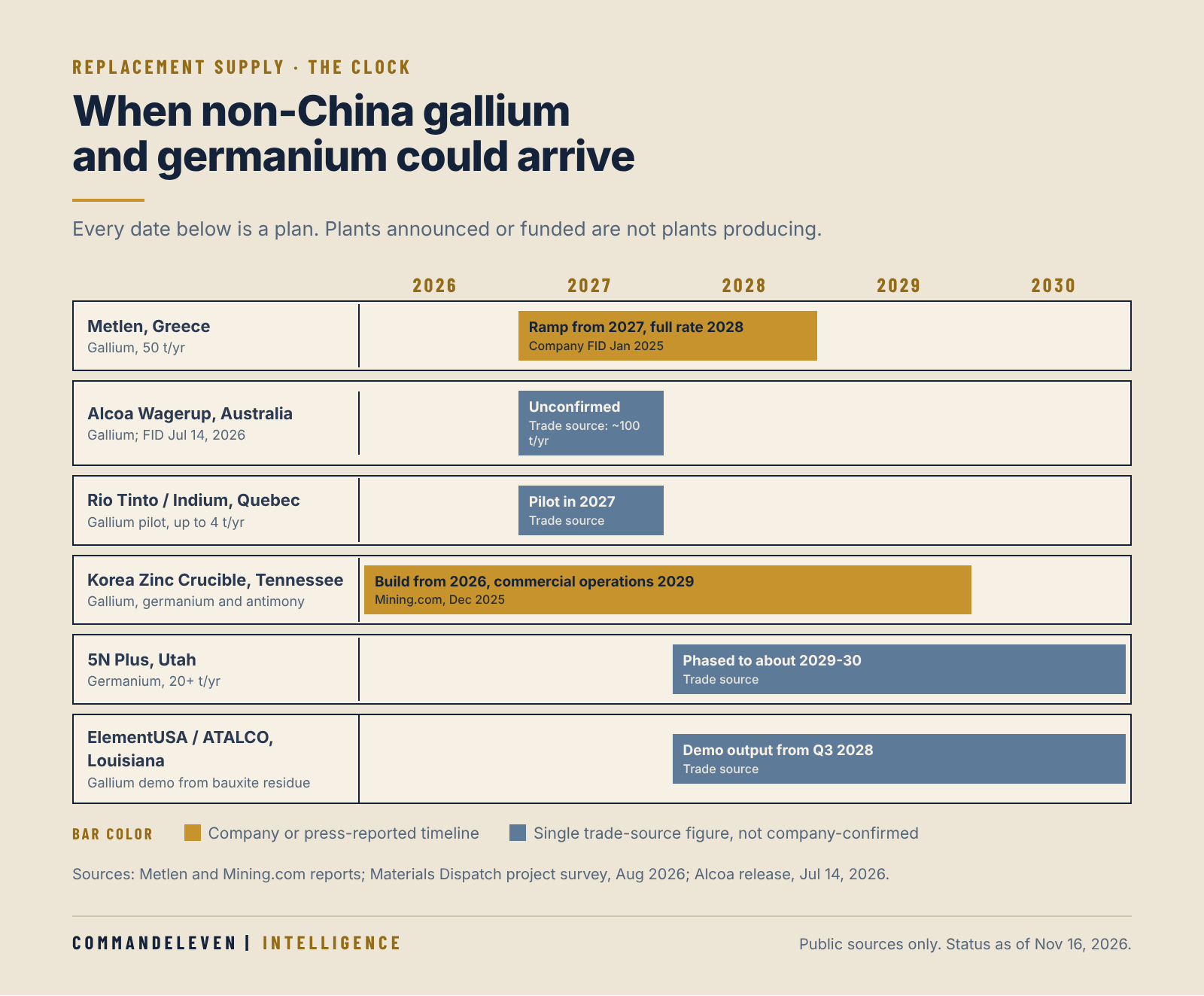
The table of projects below uses company or press reports where we found them and marks figures that rest on a single trade survey. Metlen approved a €295.5 million investment in January 2025 for a 50 tonne a year gallium plant in Greece, with output beginning in 2027 and full operation expected in 2028. Alcoa and the Australian, Japanese and US governments announced a final investment decision for a gallium plant at Wagerup, Western Australia on July 14, 2026. Alcoa’s release gives no capacity or start date. Mining Weekly reported it could supply up to 10% of global gallium, and one trade survey puts it at about 100 tonnes a year from 2027, which we treat as unconfirmed. Korea Zinc’s $7.4 billion Tennessee project is expected to start construction in 2026 and begin commercial operations in 2029, with gallium, germanium and antimony among its metals.
The same trade survey lists a Rio Tinto and Indium Corporation gallium pilot in Quebec of up to 4 tonnes a year in 2027, a 5N Plus germanium expansion in Utah to more than 20 tonnes a year phased to about 2029 or 2030, and a Louisiana gallium demonstration plant with output from the third quarter of 2028. Company capacity figures are guidance and may slip.
What the Numbers Show
The figures below are the ones the USGS publishes for 2025, set beside the single trade-survey date for replacement output. They show concentration and price. They do not show how much of any shortage reaches a particular buyer, which depends on contracts, inventories and licensing outcomes.
What This Means for Business
- Map the tiers. Ask direct suppliers which refinery produced the gallium, germanium or graphite in their inputs, in which country, and who holds the export license.
- Know your use. Gallium matters to compound-semiconductor and RF buyers, germanium to fiber and infrared optics and solar, and graphite to battery and steel buyers.
- Plan for two dates. November 27, 2026 for the US-specific ban on gallium, germanium and antimony, and January 10, 2027 for the battery and graphite-anode package.
- Treat new supply as a 2028 planning assumption, not a 2027 one, and treat recycling and inventory as the nearer levers for germanium.
- Watch license timing as well as bans. Licensing continues for all destinations, so delivery delays can arise without a formal ban.
What to Watch
- A Chinese commerce ministry or customs notice on Announcement No. 72 before November 27, 2026, or the lack of one.
- Whether the January 10, 2027 date is extended or replaced by a trade agreement text.
- The USGS Mineral Commodity Summaries 2027, expected in early 2027, for revised gallium, germanium and graphite figures.
- First output, or slippage, at Metlen in Greece and Alcoa at Wagerup.
Calls We Will Score
| ID | Call | Resolves | What counts |
|---|---|---|---|
| CM-01 | China does not reinstate its US-specific ban on exports of gallium, germanium and antimony before January 31, 2027. [ASSESSED] | January 31, 2027 | A Chinese government notice, or credible reporting of one, that the ban under Article 2 of Announcement No. 46 is back in force, resolves the call against us. |
| CM-02 | China does not reinstate the suspended October 2025 measures, including graphite anode material and lithium battery controls, before January 31, 2027. [ASSESSED] | January 31, 2027 | A Chinese notice, or credible reporting of one, that Announcements 55 to 58, 61 or 62 are back in force. |
| CM-03 | The USGS Mineral Commodity Summaries 2027 put China at 98% or more of world primary low-purity gallium production for 2026. [ASSESSED] | March 31, 2027 | The gallium summary’s production table or text. |
| CM-04 | A gallium plant outside China announces first commercial output by December 31, 2027. [ASSESSED] | December 31, 2027 | A company statement or filing reporting commercial gallium output from a new plant, such as Metlen in Greece or Alcoa in Australia. |
What This Assessment Does and Doesn’t Establish
It establishes what the USGS, Chinese government notices as reported by trade and news outlets, and company announcements state. We did not read the Chinese notices themselves. Their dates and numbers come from Fastmarkets, Materials Dispatch, TechTimes, The Star and a trade-compliance summary, and the description of graphite licensing as subject to a paused US review rests on that last summary alone. We found no published notice on the November 27 date as of November 16, and a notice may exist that we did not find. Project timelines are company guidance or a single trade survey and may change. This is a commercial assessment. It does not assess military uses of these materials.
Frequently Asked Questions
Is China banning gallium, germanium and graphite exports?
Not outright. Exports of all three need licenses from Chinese authorities worldwide. A US-specific ban on gallium, germanium and antimony is suspended until November 27, 2026, and a ban on dual-use exports to US military end users remains in force.
What happens on November 27, 2026?
The suspension of the US-specific ban ends by its own terms. As of November 16 we found no notice extending it, and the January 10, 2027 extension reported on November 9 relates to the October 2025 package. Worldwide licensing continues either way.
Can other countries replace Chinese gallium soon?
Not at scale. Primary capacity outside China is about 120 tonnes a year against roughly 900 tonnes of Chinese output, and the new projects we found start in 2027 at the earliest and mostly reach volume in 2028 to 2030.
Why did germanium prices rise so much?
The USGS reports the 2025 average at $4,100 per kilogram against $1,991 in 2024. It does not attribute the rise to a single cause, and we do not either.
Related CommandEleven Intelligence Reading
Sources
- US Geological Survey, Mineral Commodity Summaries 2026: Gallium, February 2026
- US Geological Survey, Mineral Commodity Summaries 2026: Germanium
- US Geological Survey, Mineral Commodity Summaries 2026: Graphite (Natural)
- Fastmarkets, China suspends export prohibition on gallium, germanium, antimony and superhard materials to the US
- Startup Fortune, China’s one-year pause on critical mineral export bans nears its deadline
- Materials Dispatch, China’s November 2026 export-control cliff, updated October 27, 2026
- Zentriaflow, China export controls 2026: what is paused and until when
- TechTimes, China extends export controls pause on batteries, graphite, diamond saws and rare earths into January, November 10, 2026
- The Star, China extends suspension of rare earth export controls until January, November 9, 2026
- TechTimes, China rare earth export controls pause ends Tuesday in law, November 9, 2026
- Caixin, US scraps tariffs on Chinese graphite anode material, March 17, 2026
- Materials Dispatch, Top 10 non-Chinese gallium and germanium projects to watch, August 2026
- Mining Technology, Metlen €295.5 million investment for bauxite, alumina and gallium production, January 17, 2025
- Alcoa, final investment decision for gallium project in Western Australia, July 14, 2026
- Mining Weekly, Alcoa greenlights Australia gallium plant, July 15, 2026
- Mining.com, US to back Korea Zinc’s $7.4 billion critical minerals plant, December 15, 2025