CommandEleven Intelligence Desk // Cyber and Infrastructure Desk, status as of November 16, 2026
Bottom Line Up Front
An air gap is a real control, but it is not a guarantee. The public record shows state-linked groups building tools whose stated purpose is to cross it, and in nearly every documented case the crossing relies on a person carrying removable media between a connected machine and an isolated one. In 2021 ESET counted 17 malicious frameworks built to attack air-gapped networks, all by advanced persistent threat (APT) groups, and the 2025 and 2026 reporting adds at least four more campaigns attributed to North Korean, Pakistan-nexus and China-aligned actors. US and allied agencies now say so in their own guidance. [CONFIRMED that the tools and the guidance exist; ASSESSED on what they imply]
The record has a limit that matters. Most of the recent reports document capability, meaning code designed to cross an air gap, and not a named, confirmed breach of a specific isolated network. Treating “capable of” as “did” would overstate the case, and treating the air gap as useless would understate it. What the record supports is narrower: isolation is a condition that must be maintained and verified, and the weak point is the media and the people who move it. [ASSESSED]
Key Judgments
KJ1: Crossing an air gap is a documented, repeatable state-level capability. ESET reviewed every publicly known framework built to attack air-gapped networks and counted 17 as of late 2021, counting from Stuxnet in 2010. All were designed for espionage, with at least one (Stuxnet) also used for sabotage. All belonged to APT groups, which ESET says is expected because the work is far more resource-intensive than breaching a connected system. [CONFIRMED on ESET’s count; the count is more than four years old]
KJ2: The bridge is removable media and people, not exotic physics. ESET found that more than 75 percent of those frameworks used malicious shortcut or autorun files on USB drives, either to get into the isolated network or to move inside it. Academic work has shown that data can be leaked across a gap by sound, heat, light and radio emissions, but ESET stated in 2021 that none of these had been used in a real, publicly disclosed attack. We found no later disclosure that changes this. [CONFIRMED on ESET’s statement; DATA DEFICIT after 2021]
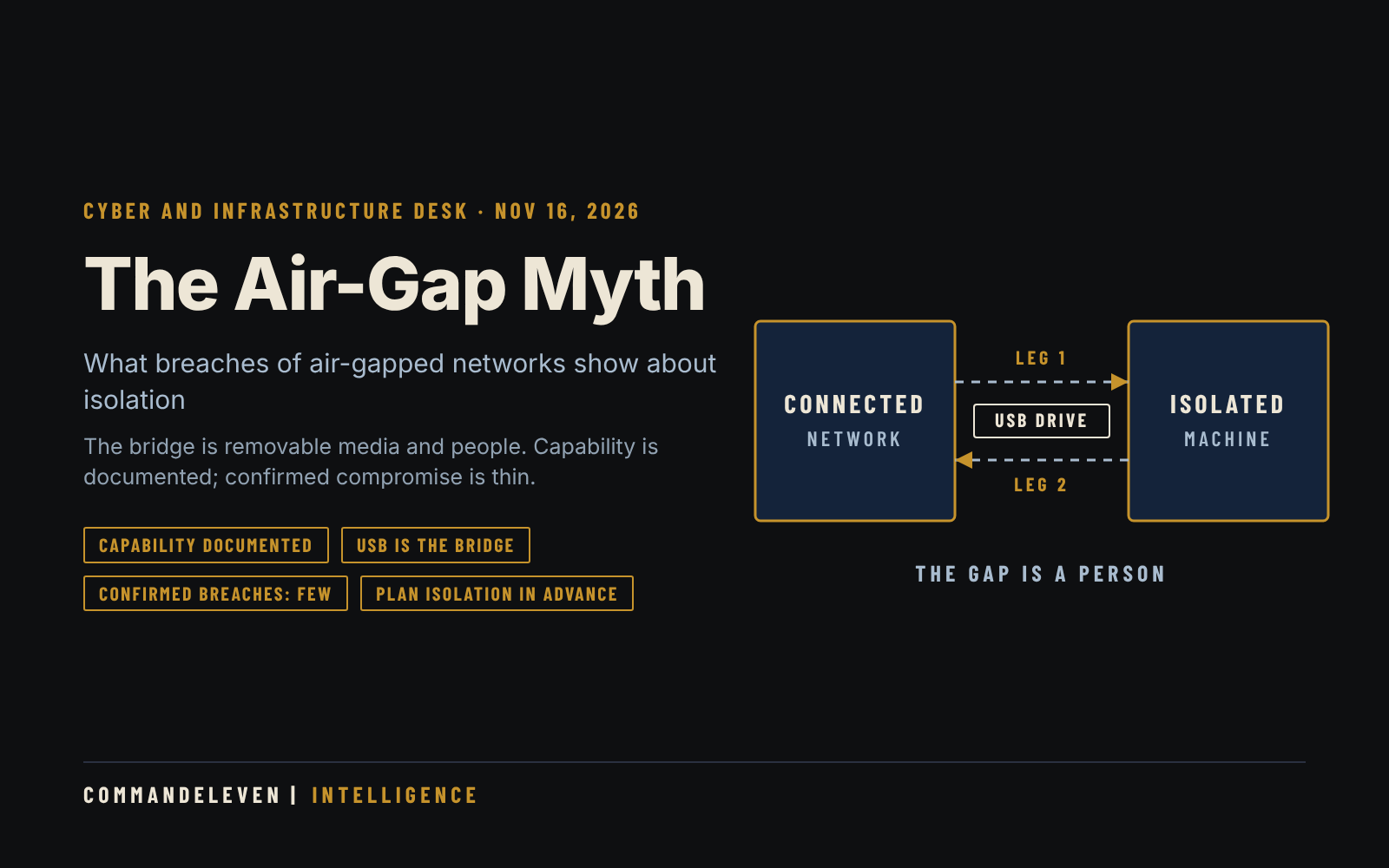
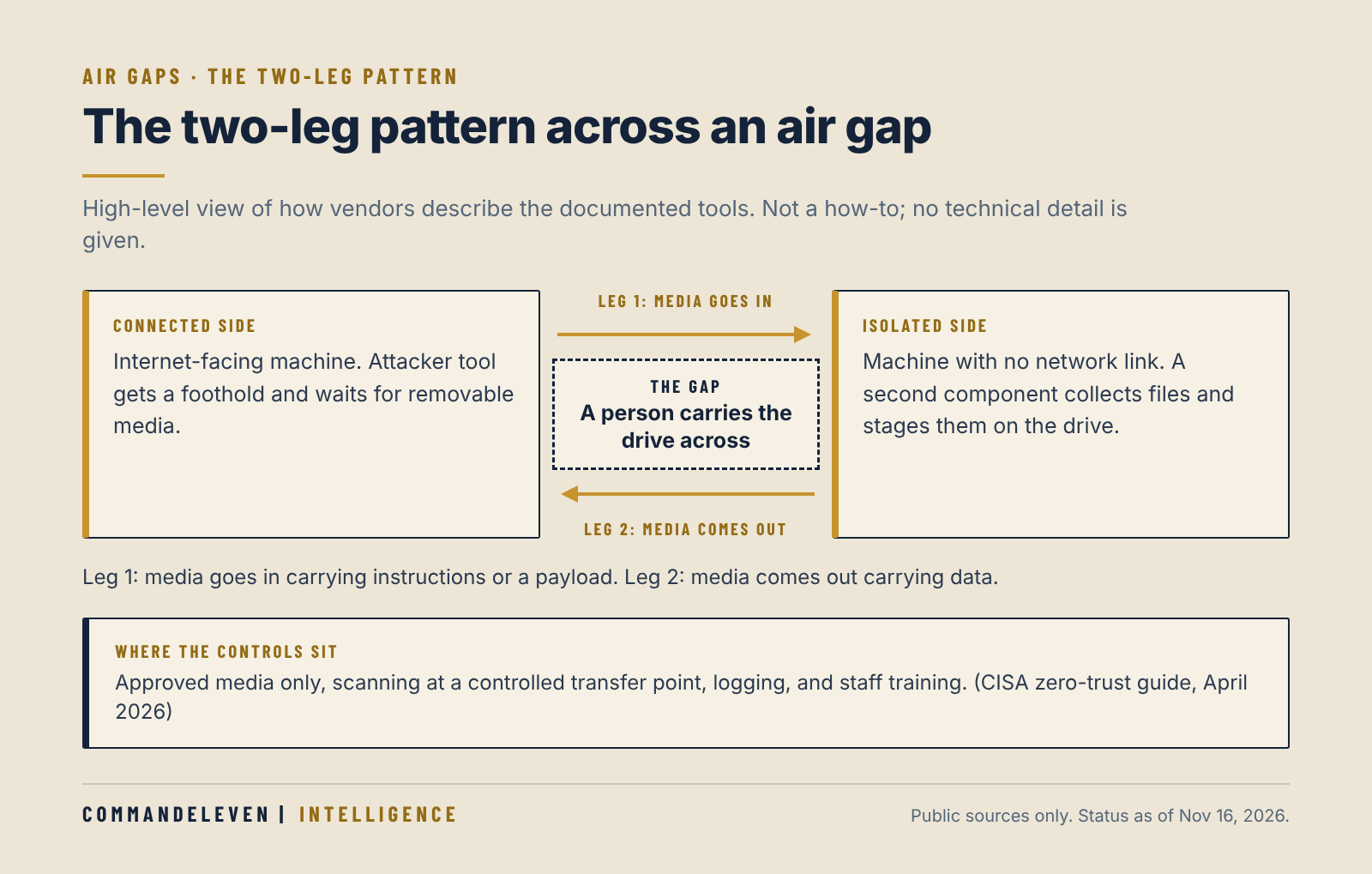
KJ3: The standard pattern has two legs. A tool on an internet-connected machine copies itself or instructions onto a removable drive. When someone carries that drive to the isolated machine, a second component acts, collects files, and writes them back to the drive. When the drive returns to the connected side, the data leaves. GoldenJackal (ESET, 2024), Ruby Jumper (Zscaler, February 2026) and Operation RapidRust (Zscaler, September 2026) all follow this shape. [CONFIRMED that vendors describe it; the attributions are ASSESSED]
KJ4: Documented capability is not documented compromise. For SnakeDisk (Mustang Panda, 2025), Ruby Jumper (APT37, 2025 to 2026) and RapidRust (APT36, 2026), the vendors describe tools built to cross air gaps. None of the reports we read names a specific isolated network that was confirmed breached. GoldenJackal is the closest: ESET says the group deployed air-gap tools against a South Asian embassy in 2019 and an EU government organization from 2022 to 2024, though it has not published the full path to the isolated machines. [CONFIRMED on capability; DATA DEFICIT on confirmed isolated-network compromise in the 2025 and 2026 cases]
KJ5: The most famous cases are less settled than the legend. Agent.btz (2008) is widely told as a thumb drive found in a parking lot. Pentagon officials said the entry was a flash drive in a laptop in the Middle East, and attribution to Russia was contested by people who worked the response. Stuxnet’s route into Natanz is also disputed: a 2024 Dutch newspaper investigation says a recruited Dutch engineer brought it in on installed equipment, while earlier accounts point to infected USB drives and contractors. [REPORTED on both; attribution DISPUTED for Agent.btz]
KJ6: Governments now say the air gap is not enough, and also tell operators to be able to isolate on demand. The April 29, 2026 US guide on zero trust for operational technology (OT) warns that air gaps can be bridged and says not to rely on isolation alone. On July 28, 2026, Australia’s ASD, CISA and partners published CI Fortify, which tells critical infrastructure operators to prepare to physically isolate vital OT during a crisis, and which itself lists infected removable media as a risk of running isolated. These fit together: isolation is a state you must be able to enter and verify, not a property you already have. [CONFIRMED on the two publications; ASSESSED on how they fit]
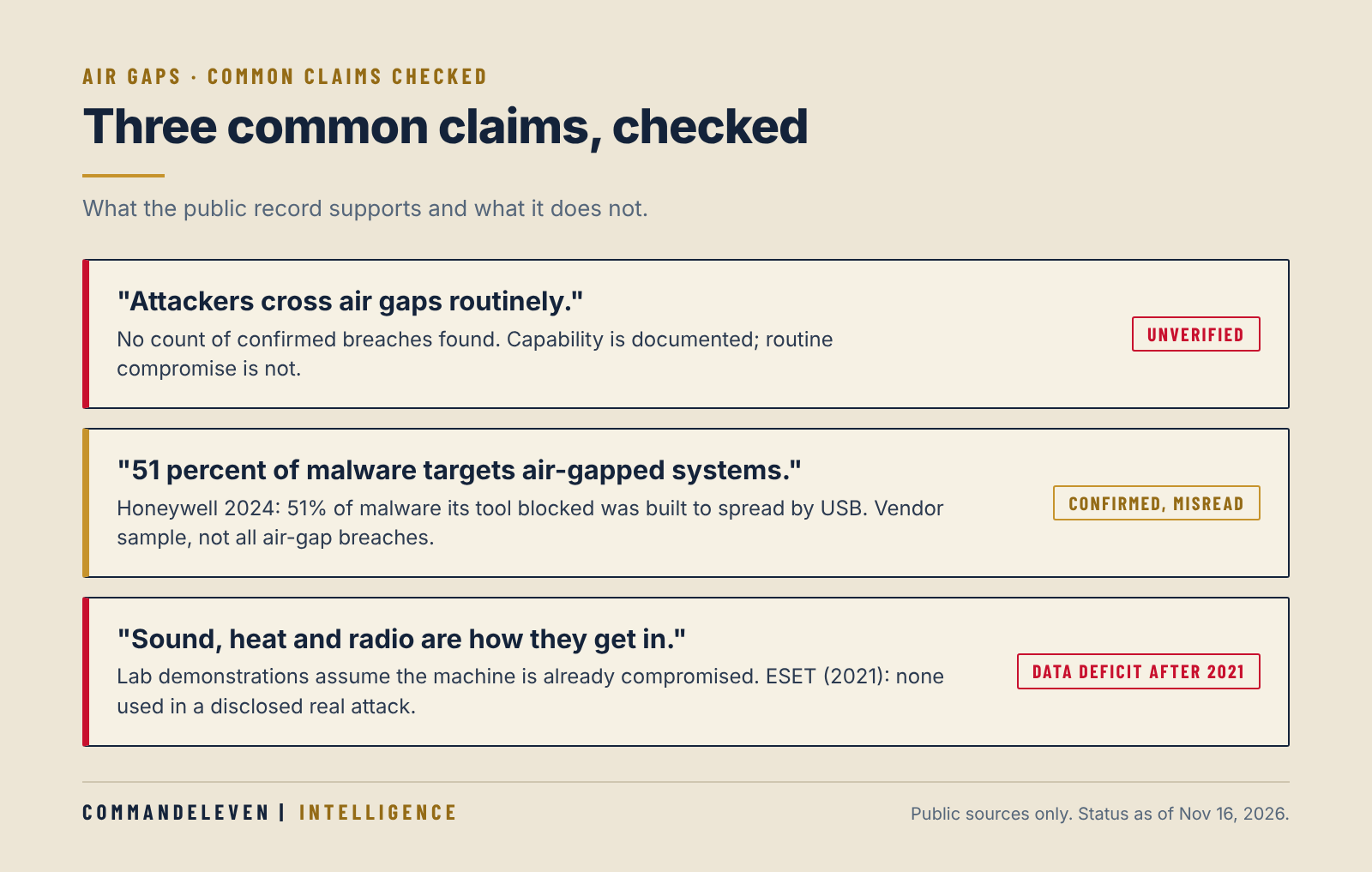
KJ7: Vendor statistics on USB malware are usable but not general. Honeywell’s 2024 report found that 51 percent of the malware its tool blocked was designed to spread via USB, up from 9 percent in 2019. That is Honeywell’s own telemetry from its customers’ industrial sites, and some secondary summaries wrongly describe it as 51 percent of malware targeting air-gapped systems. [CONFIRMED on the Honeywell figure as a vendor sample; the broader reading is UNVERIFIED]
What an Air Gap Assumes
An air gap means a network is physically separated from other networks, including the internet. The security idea is simple: if no connection exists, nothing can reach it remotely. That is true for remote attackers, and it is why air gaps are used for systems such as classified networks, voting systems and industrial controls.
The assumption fails in one place. Isolated systems still need software updates, configuration files, logs and documents, and in practice those travel on removable media or on a laptop that a contractor carries in. The gap is crossed by people on a schedule, so an attacker does not have to defeat the physical separation. The attacker has to get onto something that will be carried across it. Guidance from the US and Australian agencies treats removable media as a significant risk for this reason. [ASSESSED]
The Record
Agent.btz (2008). In late 2008 the US military found a worm on its classified networks, which the Pentagon later called the most serious breach of its classified systems. Deputy Defense Secretary William Lynn wrote in 2010 that it began with a flash drive inserted into a laptop at a US military post in the Middle East, and that the worm spread through the AutoRun function. Cleanup, called Operation Buckshot Yankee, took about 14 months, and the military temporarily banned removable media. Pentagon officials blamed a foreign intelligence service, but people who worked the response told Wired the worm was relatively benign and the attribution was doubtful. [CONFIRMED on the incident and response; attribution DISPUTED]
Stuxnet (about 2007 to 2010). The sabotage worm that damaged centrifuges at Natanz, in Iran, is the case that made the air gap a public subject. Natanz was isolated from the internet, and how the malware got in remains unsettled. Early accounts pointed to infected USB drives carried by staff or contractors. A 2019 Yahoo News report described a recruited insider, and a 2024 investigation by De Volkskrant named a Dutch engineer recruited by the Dutch service AIVD, who it said brought in equipment carrying an early version in 2007. The 2024 account concerns an early version, so it does not settle how later versions spread. [REPORTED; the route is DISPUTED]
The 17 frameworks (to 2021). ESET’s survey is the best public baseline. It found that every framework it counted was espionage-oriented, that every one used USB drives as the physical medium for moving data in and out, and that the theoretical bypass techniques in the academic literature had not appeared in real attacks. [CONFIRMED on ESET’s findings as published]
GoldenJackal (2019 to 2024). ESET reported in October 2024 that GoldenJackal used one custom toolset against a South Asian embassy in Belarus in 2019 and 2021, and a second, newer one against a government organization in an EU country between May 2022 and March 2024. ESET describes components that deliver programs to an isolated machine by drive and others that collect and pass files out the same way. Attribution to a state is not established, and ESET noted some overlap with tools linked to Russian-speaking groups. [CONFIRMED on ESET’s technical findings; the state link is UNATTRIBUTED]
Kaspersky’s industrial cases (2022 to 2023). Kaspersky ICS CERT reported in July 2023 on malware it discovered in April 2022, designed to pull data out of air-gapped networks at industrial organizations in Eastern Europe by infecting removable drives with a worm. Press coverage at the time said a China-linked actor (APT31) was suspected. [REPORTED; attribution is suspected only]
SnakeDisk (2025). IBM X-Force reported in September 2025 that Mustang Panda, a China-aligned group, used a USB worm that only runs on machines with Thai IP addresses, and said this “seems to suggest” an interest in air-gapped government systems. That is the vendor’s inference. We found no report of a confirmed isolated Thai system. [ASSESSED, by the vendor; no confirmed victim]
Ruby Jumper (late 2025 to February 2026). Zscaler ThreatLabz reported in February 2026 that North Korea’s APT37 used a chain that included tools to relay commands and stolen data between connected and isolated systems using drives, and a second tool to infect new drives. Zscaler attributes it with high confidence. Its report does not name an isolated victim. [CONFIRMED on the tools as described by the vendor; ASSESSED on attribution]
Operation RapidRust (August 2026). Zscaler reported on September 16, 2026 that APT36, a Pakistan-nexus group, targeted government and defense organizations in India and Afghanistan with a tool that copies malicious files onto any removable drive it detects, which Zscaler says lets the malware reach air-gapped networks. The report does not give the number of isolated networks reached. [CONFIRMED on the vendor’s description; ASSESSED on attribution; no confirmed isolated-network compromise]
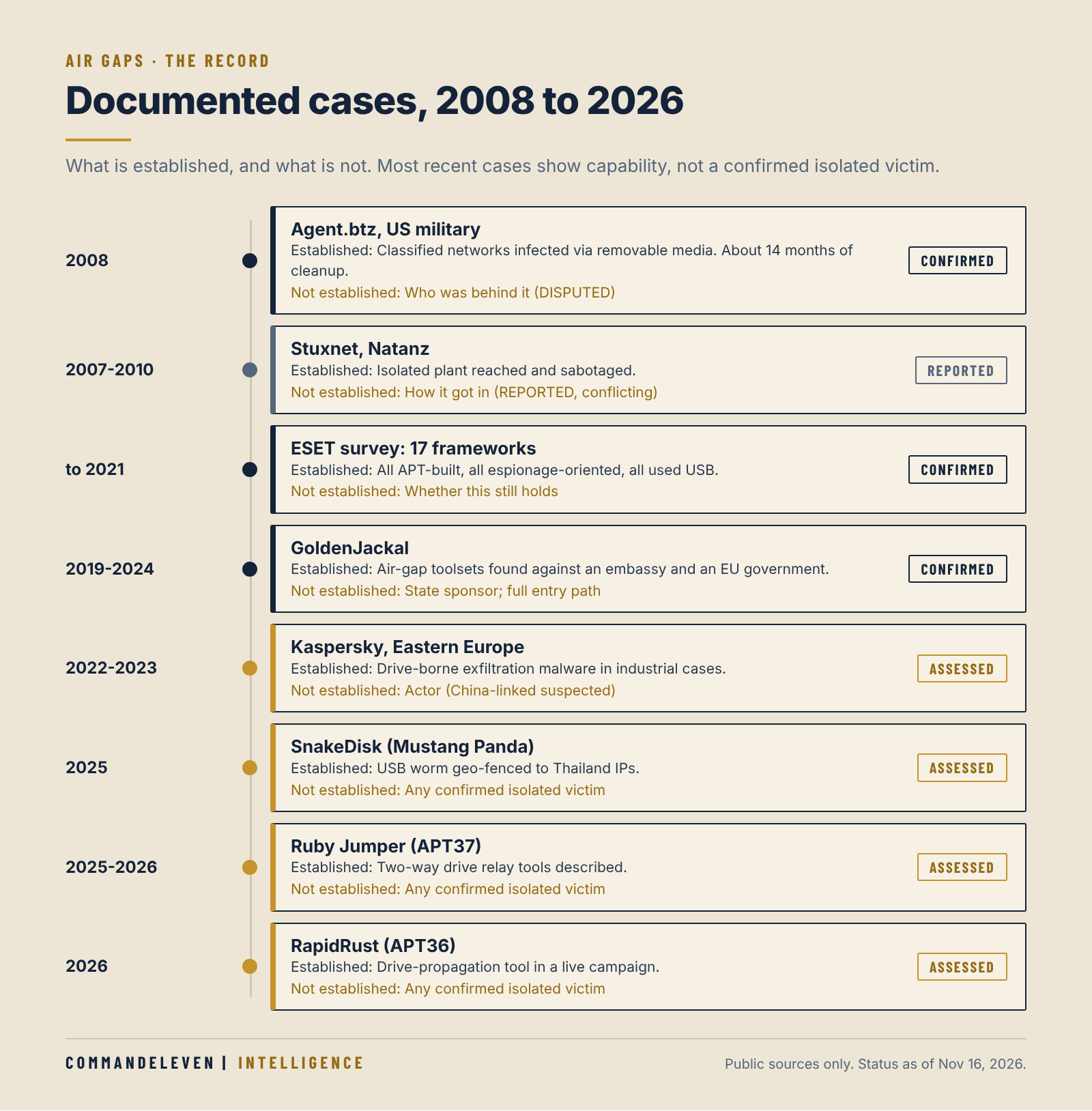
| Year | Case | What is established | What is not |
|---|---|---|---|
| 2008 | Agent.btz, US military | Classified networks infected; about 14 months of cleanup; USB ban | Who was behind it |
| 2007 to 2010 | Stuxnet, Natanz | Isolated plant was reached and sabotaged | How it got in |
| to 2021 | ESET’s 17 frameworks | All APT-built; all used USB; none used exotic channels | Whether this still holds |
| 2019 to 2024 | GoldenJackal | Air-gap toolsets found against an embassy and an EU government | The state behind it; the full entry path |
| 2022 to 2023 | Kaspersky, Eastern European industry | Drive-borne exfiltration malware found | The actor |
| 2025 | SnakeDisk, Mustang Panda | USB worm geo-fenced to Thailand | Any confirmed isolated victim |
| 2025 to 2026 | Ruby Jumper, APT37 | Two-way drive relay tools described | Any confirmed isolated victim |
| 2026 | RapidRust, APT36 | Drive-propagation tool in a live campaign | Any confirmed isolated victim |
The Exotic Channels: Laboratory Versus Field
Researchers at Ben-Gurion University, led by Mordechai Guri, have published a long series of papers showing that a compromised isolated computer can leak data by inaudible sound, electromagnetic emissions, heat changes and indicator-light flicker. A 2024 overview by Guri catalogs these as electromagnetic, electrical, optical, thermal and acoustic channels. The work is serious and has been influential in setting defensive rules, for example banning speakers on some isolated machines.
The point for planners is the order of operations. Every one of these methods assumes the isolated machine is already compromised. They address getting data out, and they are a second-stage problem. ESET’s review found the real-world cases rely on the first stage, which is getting malware onto the isolated machine by media. We read this as a reason to put effort on the first stage first. [ASSESSED]
What Official Guidance Says Now
The April 2026 zero trust guide. On April 29, 2026 CISA, the Department of War, the Department of Energy, the FBI and the State Department published Adapting Zero Trust Principles to Operational Technology, a 28-page recommendation document that does not carry the force of regulation. It says plainly that air gaps can be bridged, warns operators not to assume security from air-gapping or segmentation alone, calls removable media a significant attack vector and recommends controls on its use, and names remote access as a major weakness in OT. [CONFIRMED, from the document text]
CI Fortify (July 2026). On July 28, 2026 the Australian Signals Directorate’s ACSC, with CISA, the FBI, the UK’s National Cyber Security Centre and Canada’s Cyber Centre, published CI Fortify: Advice for Isolating Vital Systems. It asks critical infrastructure operators to be able to isolate vital OT and enabling systems from all other networks, and sets a goal of doing so for three months while critical services keep running. It describes physical isolation as the most effective form of protection, says isolation points must be built in advance, and tells operators to test a graduated isolation plan and keep an offline hard copy. It also warns that isolation will trigger manual processes and interrupt system-to-system communication. Its premise is that state-sponsored actors routinely target critical infrastructure, including to pre-position for disruption in a crisis. [CONFIRMED, from the ASD publication text]
The guide is also candid about the weak point this dossier describes. Among the risks of running isolated, it lists an increased risk of infected removable media, because operators rely on removable media to move data across air gaps and the machines used to scan that media may not receive updates. [CONFIRMED, from the ASD publication text]
The two documents are consistent. The first says an air gap alone is not a control you can trust. The second says the ability to isolate is a control you must prepare, and that isolation brings its own risks. The shared lesson is that the gap has to be an actively managed condition: where the connections are, who carries what across, and whether it can be checked.
What the Numbers Do and Don’t Show
The numbers in circulation come in three kinds. The first is the count of frameworks: ESET’s 17, which is a careful tally of public cases to 2021, and is the best figure available. We have not found an updated total, so any newer count is our own tally and we do not give one. [CONFIRMED on ESET; DATA DEFICIT since]
The second is Honeywell’s USB report. Its 2024 edition says 51 percent of the malware blocked by its media-scanning product was designed to spread through USB, up from 9 percent in 2019. Honeywell says the malware focus suggests it is intentionally using removable media to cross network perimeters. The figure comes from Honeywell’s own customer telemetry, not from a survey of all industrial sites. [CONFIRMED as a vendor sample]
The third kind is the claim that “attackers cross air gaps routinely.” It appears in vendor marketing, sometimes with Honeywell’s 51 percent attached to it. The 51 percent is about USB-spreading malware, not air-gap breaches, and we could not tie the word “routinely” to a count of confirmed breaches. We do not use it. [UNVERIFIED]
What This Means for Business
This section is general guidance for organizations that run isolated or segmented systems. It follows the published agency recommendations and adds no attack detail.
Executive Suite
- Ask your operations and security leads one question: which of our “isolated” systems has a path that someone carries media or a laptop across, and who owns that path?
- Do not count an air gap as a security control on its own. The US agencies’ guidance says it should sit inside layers of defense.
- Fund isolation as a capability you rehearse. CI Fortify’s point is that isolating a system needs planning, testing and acceptance that some automated processes will have to run by hand.
Security and Operations
- Treat removable media and portable laptops as the main entry route and put the strongest controls there: approved devices only, scanning at a controlled transfer point, logging, and staff training, as the April 2026 guide recommends.
- Keep the machines that scan removable media patched and updated. CI Fortify warns that during extended isolation these machines may stop receiving updates.
- Control vendor and contractor access and equipment brought on site. The Stuxnet reporting is a reminder that the carrier may be trusted or recruited.
- Map every connection to your vital systems, including ones nobody remembers. CI Fortify lists this as an early step.
- Keep your isolation plan, including a paper copy, where it can be found when the network is down.
What to Watch
- Any vendor or agency report that confirms an air-gapped network was breached in the 2025 to 2026 campaigns, not just that tools exist.
- The next ESET, Kaspersky, Zscaler or Honeywell publication on air-gap tooling, and whether any real-world use of acoustic, electromagnetic, optical or thermal channels is disclosed.
- Adoption of CI Fortify by operators, and whether national regulators move from advice to requirements.
- Whether the same actors, such as APT36, APT37 and Mustang Panda, reuse removable-media tooling against other regions.
- Updates to the Honeywell report with a new year of data.
Calls We Will Score
These calls rest on public reporting only and will be registered on the Foresight Record at publication.
| ID | Call | Resolves | What counts |
|---|---|---|---|
| AR-01 | At least one new malware framework or tool family designed to cross air gaps via removable media is publicly documented by a named security vendor or government agency. [ASSESSED] | June 30, 2027 | a published report dated after November 16, 2026 that names a new family, not an update to GoldenJackal, SnakeDisk, Ruby Jumper or RapidRust tools. |
| AR-02 | No vendor or government report documents a real-world attack using an acoustic, electromagnetic, optical or thermal covert channel to cross an air gap. [ASSESSED] | June 30, 2027 | absence of any such published report dated after November 16, 2026. A single credible report of such use makes the call a miss. |
| AR-03 | A government agency or a named vendor publicly confirms that a specific air-gapped network was compromised in a campaign using removable-media tools. [ASSESSED] | June 30, 2027 | a published statement or report that an isolated network was breached, naming the victim sector or country. A statement that tools “could” reach isolated networks does not count. |
| AR-04 | At least one national agency outside the CI Fortify authors publishes guidance on physical isolation of vital OT. [ASSESSED] | June 30, 2027 | a government publication dated after November 16, 2026 that refers to isolating or disconnecting OT. Authors of CI Fortify (US, Australia, UK, Canada) are excluded. |
What This Assessment Does and Doesn’t Establish
- It establishes that multiple state-linked groups have built, and vendors have documented, tools designed to cross air gaps, mostly by removable media.
- It does not establish that any specific 2025 or 2026 campaign breached an isolated network. The public reports describe capability.
- It does not establish who ran GoldenJackal or Kaspersky’s industrial cases. Attributions to Mustang Panda, APT37 and APT36 are the vendors’ assessments, not government findings.
- It does not settle how Stuxnet or Agent.btz entered their targets.
- It does not show that air gaps are useless. ESET notes they raise the cost of attack, and the 2026 agency guidance still treats physical isolation as valuable when managed.
- It does not give a current count of air-gap frameworks. ESET’s 17 is the latest we found.
- It is built from public sources only. It does not draw on CommandEleven Intelligence’s own collection.
Frequently Asked Questions
What is an air-gapped network?
It is a network physically isolated from other networks, including the internet. It is used for the most sensitive systems, such as classified networks and some industrial controls.
Can an air-gapped network be hacked?
Yes, but not remotely in the usual way. The documented cases rely on malware carried in on removable media or a portable device, and then used to collect data that is carried back out the same way. The work is expensive, and ESET found it was done only by advanced state-linked groups.
Is the air gap a myth?
The idea that an air gap makes a network immune is a myth. The idea that it raises the cost of attack is not. US and allied agency guidance in 2026 says air gaps can be bridged, and also advises operators to be able to isolate vital systems on demand.
Do hackers use sound, heat or radio to cross air gaps?
University researchers have shown these methods in laboratories. ESET reported in 2021 that none had been used in a real, publicly disclosed attack, and we found no later disclosure.
What is the main defense?
Agency guidance centers on controlling removable media and portable devices, logging and scanning what crosses, limiting remote and vendor access, and not relying on isolation alone.
Related CommandEleven Intelligence Reading
- Critical Infrastructure at Risk: The Cold Chain – Part 7
- State-Backed Hacktivist Groups and Hired Fronts: Who Is Behind the Attacks on Western Infrastructure
- Who Hacked Europe’s Freezers? France Names Iran, Pro-Russian Hackers Claim a Wave
- FAA Ground Stop Update, November 15: What the Briefings Settled and What They Did Not
- Deepfake CEO Fraud: What the Alleged $129 Million Case Shows About Voice-Clone Impersonation
Sources
- Jumping the air gap: 15 years of nation-state effort, ESET Research, December 1, 2021
- ESET Research analyzes malicious frameworks targeting air-gapped networks, ESET press release, December 2021
- Mind the (air) gap: GoldenJackal gooses government guardrails, ESET Research, October 2024
- APT37 Adds New Capabilities for Air-Gapped Networks, Zscaler ThreatLabz, February 26, 2026
- Operation RapidRust: APT36 Deploys RUSTYSHADE, RUSTYMOVE, PSNATCH, and BASHNATCH, Zscaler ThreatLabz, September 16, 2026
- Hive0154, aka Mustang Panda, drops updated Toneshell backdoor and novel SnakeDisk USB worm, IBM X-Force, September 2025
- Common TTPs of attacks against industrial organizations: implants for gathering data, Kaspersky ICS CERT, July 31, 2023
- Adapting Zero Trust Principles to Operational Technology, CISA, Department of War, DOE, FBI and Department of State, April 29, 2026
- CI Fortify: Advice for isolating vital systems, Australian Signals Directorate and partners, July 28, 2026
- CISA, ASD’s ACSC, and Partners Release Joint Guidance on Isolating Vital Operational Technology, CISA bulletin, July 28, 2026
- 2024 USB Threat Report, Honeywell GARD
- Mind The Gap: Can Air-Gaps Keep Your Private Data Secure?, Mordechai Guri, Ben-Gurion University, September 2024
- The cyberattack that awakened the Pentagon, Route Fifty, August 2010
- 2008 malware infection of the United States Department of Defense, Wikipedia, citing Wired reporting on dissent over attribution
- Dutch Engineer Used Water Pump to Get Stuxnet Into Iranian Nuclear Facility: Report, SecurityWeek, January 2024