CommandEleven Intelligence Desk // Cyber and Fraud Desk, status as of November 16, 2026
Bottom Line Up Front
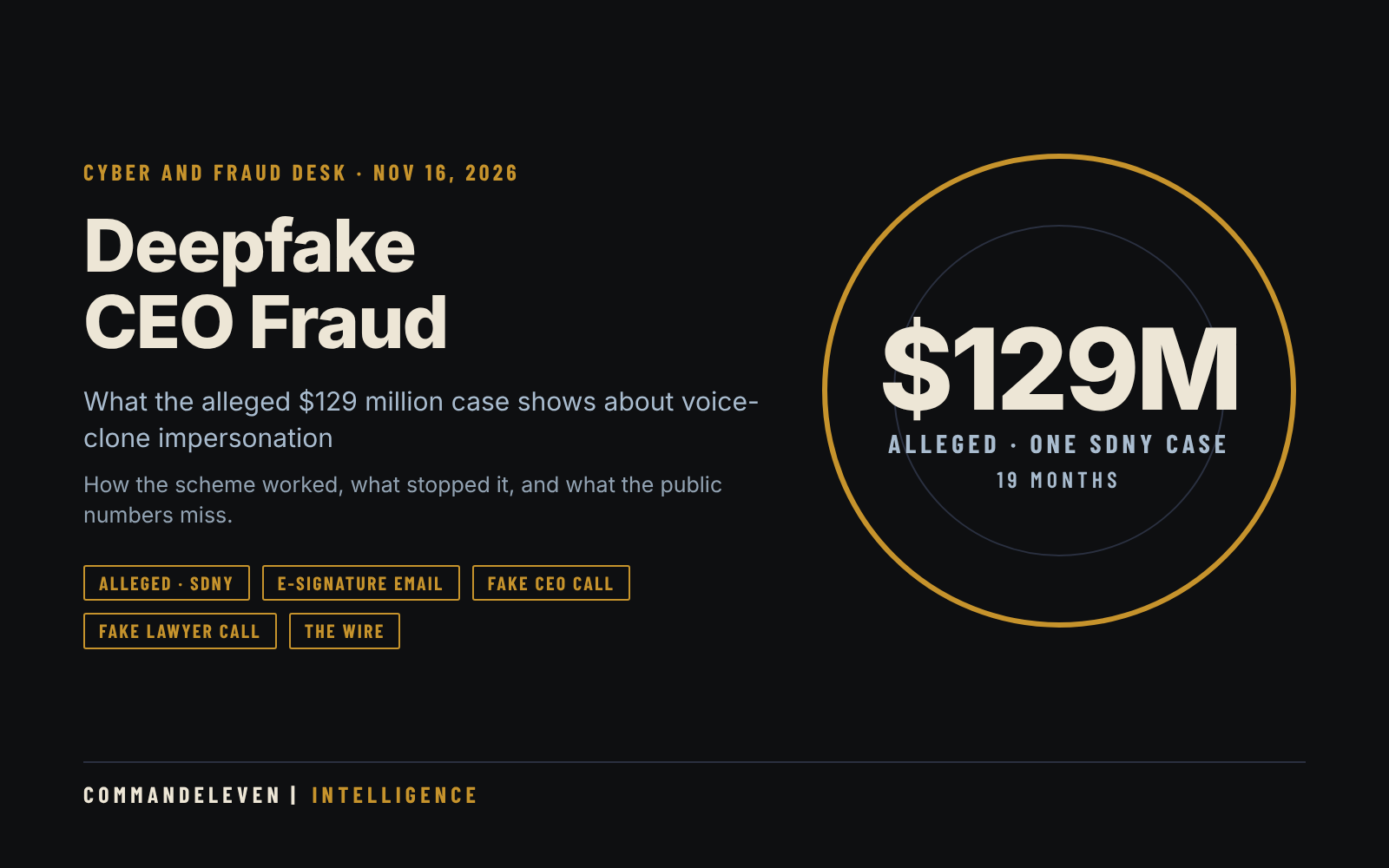
Deepfake CEO fraud is no longer a hypothetical. A US federal indictment unsealed on November 5, 2026 alleges that three men used artificial intelligence to imitate chief executives and law-firm attorneys on calls, and stole at least about $129 million from companies in the US and abroad between July 2024 and February 2026. The same document shows that the fake voice was only one part of a scripted process. The scheme began with an e-signature email, moved to a confidentiality agreement, handed the employee to a second impersonator posing as a lawyer, and ended with a wire. The record also shows what stopped it in at least one case: a back-office check. [CONFIRMED that the indictment exists; ALLEGED on every fact in it]
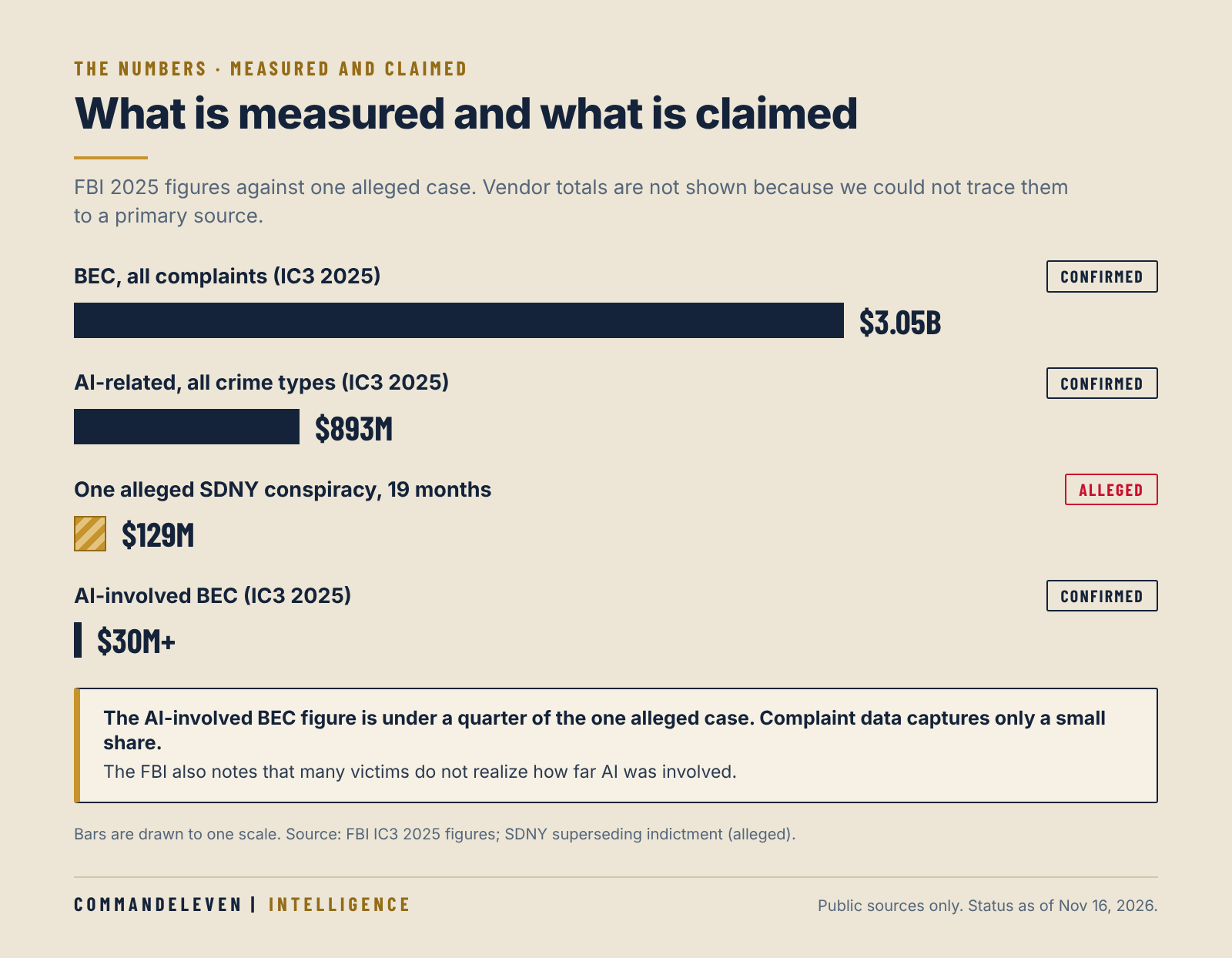
The public numbers are not good enough to size the problem. The FBI’s 2025 report logs $893 million in AI-related losses across all crime types and about $30 million in AI-involved business email compromise (BEC), a category that cost $3.05 billion overall. A single alleged case is more than four times the AI-BEC figure. Widely quoted vendor statistics are not verifiable from the sources we reviewed. [CONFIRMED on the FBI figures; ASSESSED that they undercount]
Key Judgments
KJ1: A nine-figure AI-enabled executive-impersonation case is now before a US court. The Southern District of New York charges Jacob Soall, Sharon Hazan and Guy Sheetrit with wire fraud, aggravated identity theft and money laundering. Soall was arrested in Spain on June 17, 2026, Hazan in Spain on August 5, and Sheetrit in the United Kingdom on September 7. Extradition requests are pending. The charges are accusations, and the defendants are presumed innocent. [CONFIRMED that charges exist; ALLEGED on the conduct]
KJ2: The decisive technique is a second impersonator, not a better fake. The indictment describes a fake CEO who sends the employee to a fake attorney, so the “verification” the employee seeks comes from the same group. The attorney, not the CEO, gives the wire instruction. This defeats the common advice to confirm a request with another person, when the other person is supplied by the requester. [ALLEGED, from the indictment; ASSESSED on the implication]
KJ3: AI appears to be a credibility layer on a social-engineering process. The indictment says AI was used to mimic the CEO’s voice, and “at times” the image, on calls. It does not name the tools, and it does not say how many victims were reached with synthetic voice and how many with ordinary impersonation. The process (a confidentiality demand, a supposed acquisition, instructions not to tell colleagues) did much of the work. [ALLEGED; DATA DEFICIT on the AI’s actual contribution]
KJ4: Process controls have stopped these attacks, and perception controls have been less reliable. In October 2024 the scheme allegedly deceived an employee at a major New York investment bank into authorizing a wire of about $2.85 million, and the bank’s back office prevented it from being sent. Ferrari’s executive reportedly ended a 2024 attempt by asking a question the impersonator could not answer. The $25 million Arup loss in 2024 came from a video call in which every other participant was fake. [CONFIRMED on the indictment detail as an allegation; REPORTED on Ferrari and Arup]
KJ5: Official loss data undercounts, and vendor claims cannot fill the gap. The FBI says AI-involved BEC cost businesses over $30 million in 2025, against $3.05 billion for BEC overall. The FBI also notes that many victims do not realize how far AI was involved. Figures such as “$3.7 billion in deepfake losses” or “three seconds of audio” come from vendors, and we could not trace them to a primary source. [CONFIRMED on FBI data; UNVERIFIED on vendor figures]
KJ6: The law targets the tool more than the fraud. The EU AI Act’s disclosure rules for deepfakes apply from August 2, 2026, according to legal summaries we reviewed, and US prosecutors used ordinary wire-fraud, identity-theft and money-laundering statutes in this case. We found no deepfake-specific offense in the SDNY charges. [ASSESSED; we have not read the regulation text]
KJ7: The same tools serve state and non-financial goals. In July 2026 eleven governments warned that North Korean IT workers use AI to hide their identities, and listed manipulated or artificially generated video feeds as a warning sign in hiring. In 2025 the FBI warned that AI-generated voice messages were impersonating senior US officials, and State Department reporting described a fake Marco Rubio contacting foreign ministers. [CONFIRMED that the alerts exist; the actors behind the Rubio contacts are UNATTRIBUTED]
How the Alleged Scheme Worked
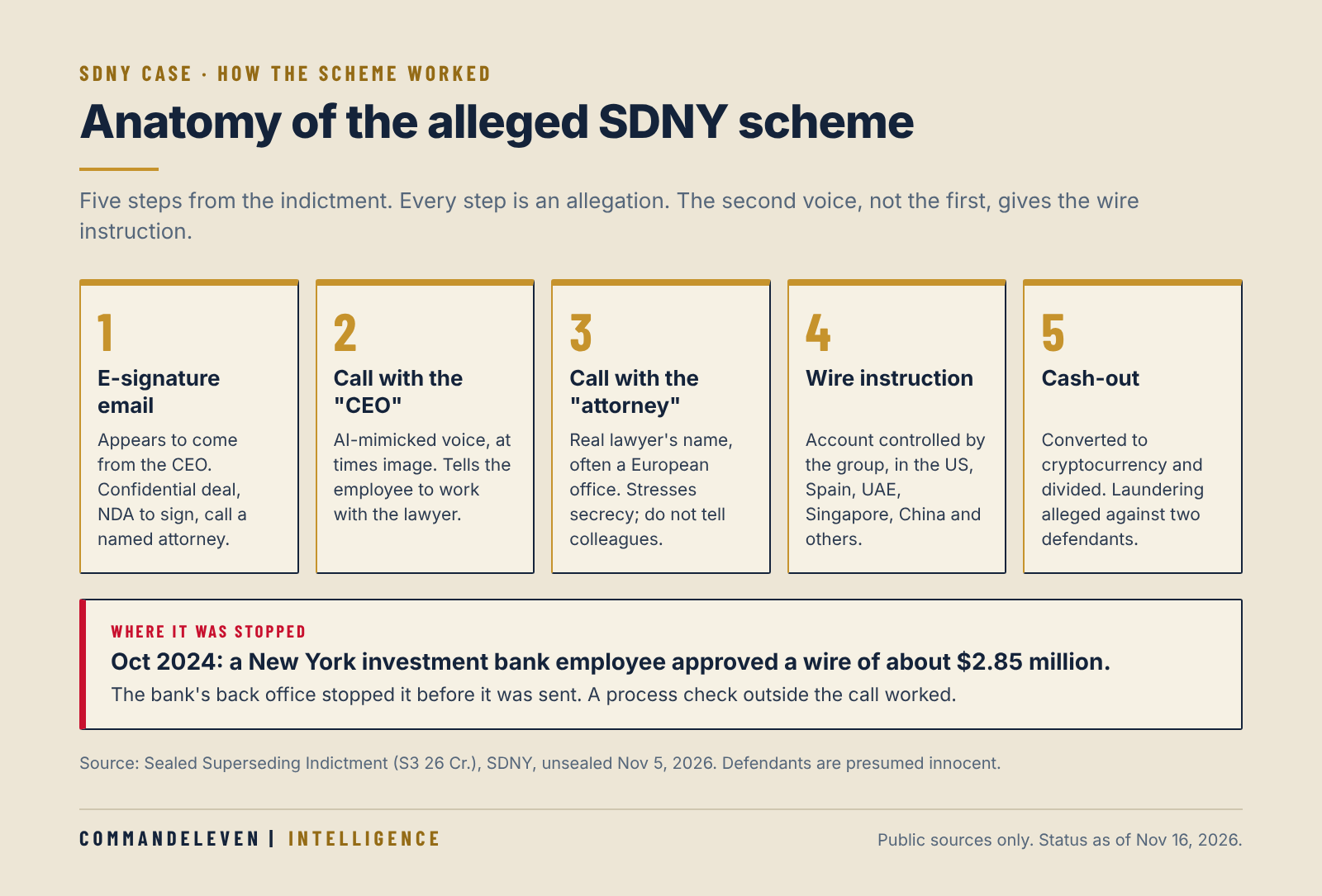
The following comes from the superseding indictment (a third version of the charging document) and the SDNY press release, and every fact in it is an allegation.
The conspirators targeted employees in accounting roles with enough authority to approve a large wire. They typically opened with an email sent through an e-signature service such as DocuSign. The email appeared to come from the CEO, said the company was working on a confidential financial transaction, asked the employee to sign a non-disclosure agreement, and told them to call a named attorney at a named law firm. The indictment quotes one such email, sent on or about October 8, 2024 to the New York investment bank, which tells the employee to call the “legal representative” to schedule a compliance call later the same day. [ALLEGED]
The conspirators then tried to get the employee onto a phone or video call. On those calls, the indictment says, they used AI to mimic the CEO’s voice and sometimes image, and the “CEO” told the employee to work with the attorney. The attorney identities belonged to real lawyers at real firms, often among the 50 largest in the world, and usually lawyers in the firms’ European offices. The attorney explained that the deal, often an acquisition, required secrecy, and then gave the wire instruction to an account the conspirators controlled. [ALLEGED]
Soall is alleged to have played the UK attorneys, working from a handwritten script titled “Lawyer Call.” The indictment says the script included language meant to keep employees from discussing the deal with colleagues, including a line explaining that the target company was publicly listed and that insider-trading concerns required silence. [ALLEGED]
The money was wired to accounts in the United States, Spain, Portugal, Greece, the United Arab Emirates, Singapore, Austria, Slovakia and China, then converted to cryptocurrency and divided among the conspirators. Hazan and Sheetrit are alleged to have laundered the funds. The indictment says Hazan boasted of laundering more than $400 million in three years. That is his reported boast, as quoted by prosecutors, and not a finding. [ALLEGED]
What the filing itemizes. The indictment says the conspirators targeted thousands of companies and stole at least about $129 million. It lists seven named victims, and the six that lost money add up to about $31.9 million:
| Approximate date | Victim (as described) | Amount |
|---|---|---|
| Oct 2024 | Major New York investment bank | $2.85 million attempted; wire blocked by back office |
| Nov 2024 | Missouri hospital system | $4,829,580 |
| Nov 2024 | Rhode Island bank | $2,684,580 |
| Dec 2024 | California hospital system | $2,968,497 |
| Mar 2025 | UK financial technology company | $11,578,474 |
| Apr 2025 | Massachusetts mutual fund company | about $4.64 million |
| Jun 2025 | Florida pet food company | $5,242,747 |
The filing says these are “some of” the victims, so about three-quarters of the alleged total is not itemized in public. The press release and the indictment differ by a few dollars on the mutual fund amount (the release gives $4,639,918 and the indictment $4,639,981), which is why we round it. [CONFIRMED that the filing says this; the amounts are ALLEGED]
The Wider Record
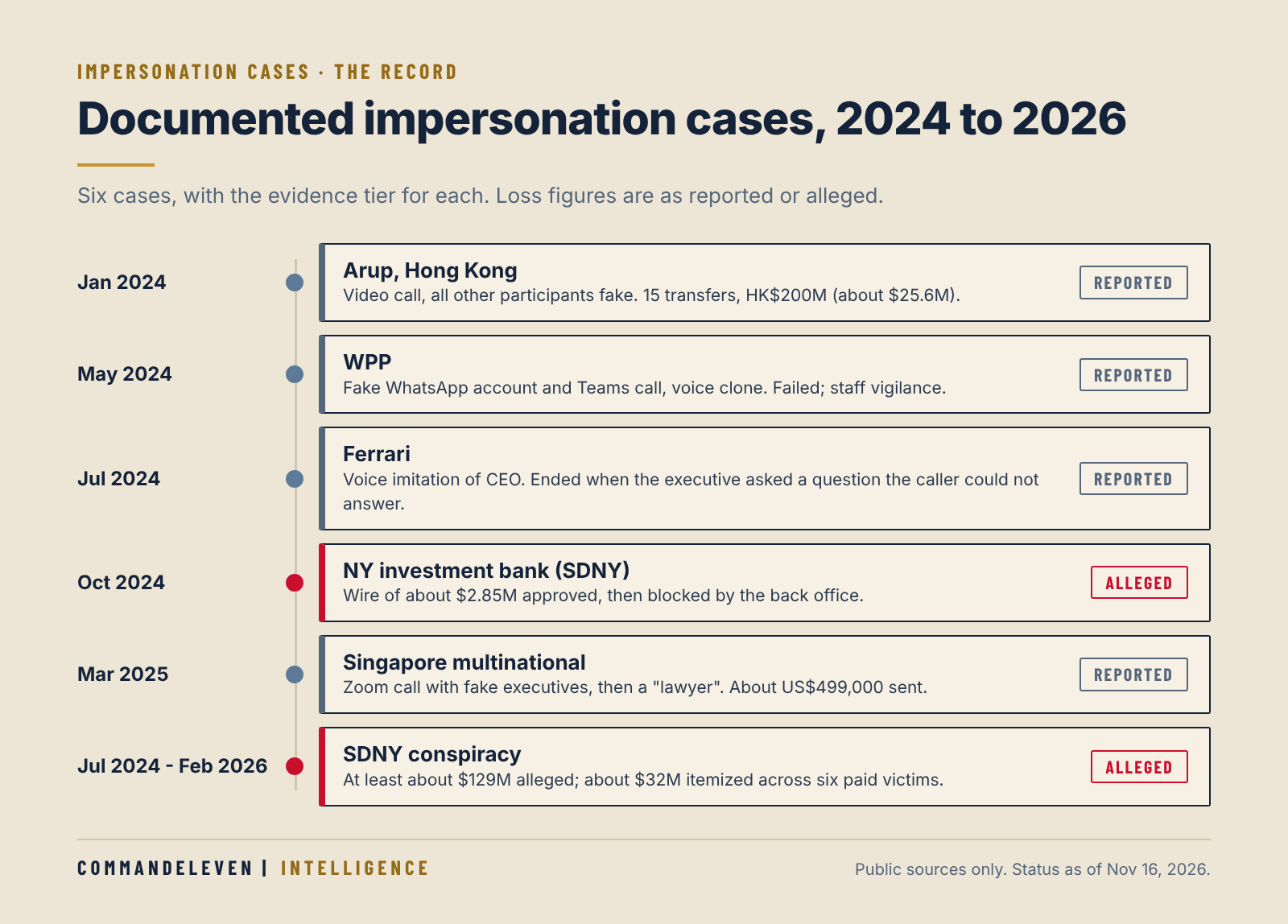
Arup, Hong Kong (January 2024). Hong Kong police said an employee in the Hong Kong office was drawn into a video call with people he believed were the CFO and other staff, and that all of them were deepfakes. He made 15 transfers totaling HK$200 million (about $25.6 million) to five accounts. The firm said it notified police in January and confirmed that fake voices and images were used. Reports say the employee first suspected a phishing email and only discovered the fraud when he checked with headquarters. [REPORTED, from police and company statements relayed by CNN and others; we did not read the primary statements]
Singapore (March 2025). Singapore police said a finance director at a multinational firm received a WhatsApp message from someone posing as the CFO, joined a Zoom call with impersonated executives including the CEO, and was then pointed to a “lawyer,” a structure close to the SDNY pattern. He transferred about US$499,000 and realized it was a scam when the fraudsters asked for another US$1.4 million, at which point he contacted his bank. How much was recovered is not established in the sources we reviewed. [REPORTED; recovery UNVERIFIED]
Ferrari (July 2024). Bloomberg reported that a Ferrari executive received WhatsApp messages and then a call from someone imitating CEO Benedetto Vigna’s voice, and that the executive ended the attempt by asking a question the caller could not answer. Ferrari declined to comment. [REPORTED, through anonymous sources]
WPP (May 2024). The Guardian reported that attackers set up a WhatsApp account using the CEO’s photograph and held a Microsoft Teams meeting using a voice clone and YouTube footage. WPP said the attempt failed because of staff vigilance. [REPORTED; WPP confirmed that the attempt failed]
The pattern across the five cases is consistent: an urgent confidential deal, an authority figure, a channel other than the company’s normal payment process (WhatsApp, a private call or a video link), and pressure not to consult colleagues. The attacks that failed were stopped by a person or a check that sat outside the conversation.
What the Official Numbers Do and Don’t Show
The FBI’s Internet Crime Complaint Center (IC3) received 1,008,597 complaints in 2025 and recorded $20.877 billion in losses. Business email compromise accounted for 24,768 complaints and $3,046,598,558. For the first time the report includes an AI section: 22,364 complaints that reference AI, with adjusted losses above $893 million. Within that, the FBI says businesses reported more than $30 million in losses to BEC scams involving AI, and that voice cloning can be used to request a wire payment. Most of the AI-related money sits elsewhere: investment scams with an AI link exceeded $632 million. The FBI cautions that many victims do not realize how much AI was involved. [CONFIRMED]
Three points follow from those figures. The first is that the AI-BEC number ($30 million) is smaller than the amount the SDNY indictment alleges for one conspiracy over 19 months, which suggests that complaint data captures a small share of executive-impersonation losses, whether because victims do not report, do not detect the AI, or report abroad. The second is that IC3 counts complaints, so it will miss losses that companies absorb quietly. The third is that figures in circulation such as “$3.7 billion in deepfake losses through mid-2026” come from commercial vendors and cannot be tied to a primary source we have read. We use none of them. [ASSESSED]
Other agencies are less specific. FinCEN’s November 2024 alert (FIN-2024-Alert004) focuses mainly on deepfakes used to forge identity documents and defeat verification at financial institutions, and notes that criminals have used generative AI to impersonate executives or trusted employees to trigger large payments. It asks banks to use the key term FIN-2024-DEEPFAKEFRAUD in reports. Europol’s 2026 threat assessment says generative AI adds “enhanced realism” to BEC and CEO fraud, but the report gives no figures for these crimes and does not use the terms “deepfake” or “voice cloning.” [CONFIRMED]
Where Verification Held and Where It Failed
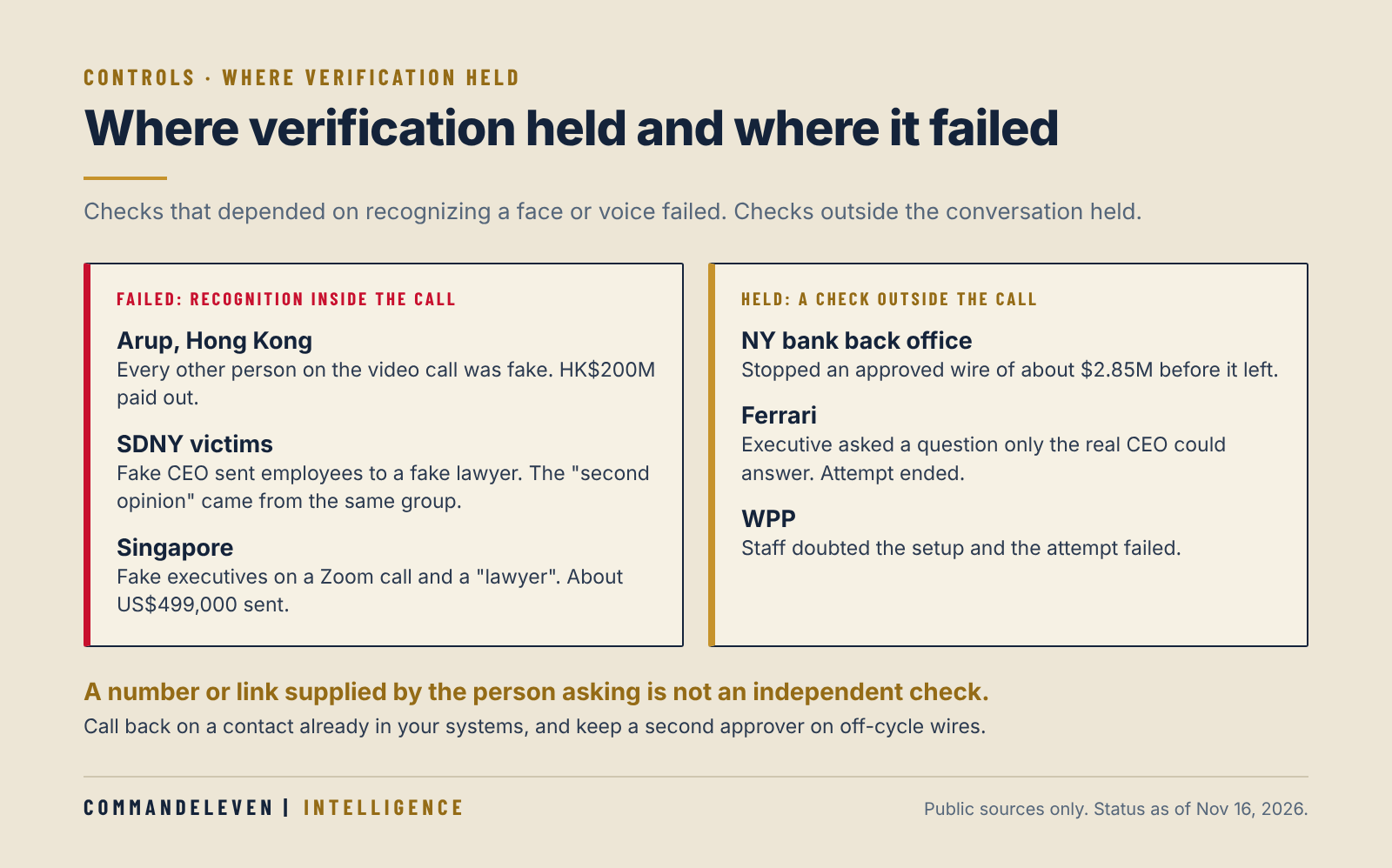
The cases line up with a simple rule. Defenses that depended on a person recognizing a face or voice failed at Arup and in the SDNY cases. Defenses that depended on a check outside the conversation worked: the investment bank’s back office in October 2024, and the Ferrari executive’s question.
Public guidance points the same way. The FBI’s May 2025 advisory on impersonated officials tells recipients to find a known phone number for the person independently and call it, to look for small differences in numbers, email addresses and spelling, and to avoid sending money to unverified people. The SDNY pattern shows why the “independent” part matters: a number supplied in the email or by the caller is not independent. [CONFIRMED that the advice exists; ASSESSED on its relevance]
Detection software is not a substitute. We found vendor claims that real-world detection accuracy drops sharply against lab benchmarks, but could not verify them, so we treat the detection question as open. [UNVERIFIED]
Same Tools, Other Targets
Impersonating officials. On May 15, 2025 the FBI (alert I-051525-PSA) said that since April 2025 malicious actors had impersonated senior US officials with text messages and AI-generated voice messages, mainly to reach current and former officials and their contacts, then move them to another messaging app and steal credentials. In July 2025 a State Department cable, reported by Reuters and the Washington Post, said an impostor using a Signal account named for Secretary Rubio contacted at least five non-Department individuals, including three foreign ministers, a governor and a member of Congress, with AI-generated voice and text. The cable said the aim was likely access to information or accounts. The actor was unknown to US authorities at the time. [CONFIRMED on the FBI alert; REPORTED on the Rubio cable; the actor is UNATTRIBUTED]
North Korean IT workers. A joint alert issued July 31, 2026 by Japan, the United States, South Korea, Australia, Canada, France, Germany, Italy, the Netherlands, New Zealand and the United Kingdom says North Korean IT workers use “increasingly sophisticated methods, including the integration of AI” to hide their identities, and lists video feeds that “appear to be manipulated or artificially generated” among the signs for employers. The text we read does not describe a specific real-time deepfake tool, so statements that it does come from secondary summaries. The goal is revenue and insider access for the North Korean state, not wire fraud, but the verification problem is the same. [CONFIRMED on the alert’s wording; the extent of real-time deepfake use is REPORTED by others and not established by the alert]
Law and Enforcement
The SDNY case used wire fraud (conspiracy and substantive), aggravated identity theft and money laundering statutes. Each of the five wire-fraud and money-laundering counts carries a maximum of 20 years, and each of the two identity-theft counts two years. The case is being handled by the office’s Complex Frauds and Cybercrime Unit, with assistance from Spain’s Policía Nacional and the UK’s National Crime Agency. The press release describes the technology as “super intelligence” (SI), while the indictment says “artificial intelligence”; we use the indictment’s term. [CONFIRMED]
On the regulatory side, legal summaries we reviewed say Article 50 of the EU AI Act, which requires machine-readable marking of AI-generated content and disclosure of deepfakes, applies from August 2, 2026, with fines up to 15 million euros or 3 percent. The same summaries note that it applies to lawful deepfakes and does not itself address fraud. In the US, the federal TAKE IT DOWN Act addresses non-consensual intimate imagery, and no comprehensive federal deepfake law exists. [ASSESSED, from secondary sources]
What This Means for Business
Executive Suite
- Treat “a confidential deal, do not tell anyone” as a warning in itself. In the alleged scheme the secrecy was the mechanism that kept colleagues from catching it.
- Decide in advance who may approve an off-cycle wire for an unannounced transaction, and make clear that no executive instruction by phone, video or messaging overrides that process.
- Brief senior leaders that their public voice and image (earnings calls, interviews, conference video) are available to anyone. This is a reason to harden the payment process, not to stop speaking.
Finance and Security
- Require that any large or unusual payment instruction be confirmed through a contact already in your systems, never one supplied in the request or by the person asking.
- Keep a second approver and a back-office review on wires, because the one documented block in the SDNY case came from such a review.
- Treat e-signature, NDA and “compliance call” requests tied to payments as part of the same social-engineering chain, and train staff to report them.
- Include executive-impersonation scenarios, with a second “attorney” voice, in tabletop exercises.
This is general guidance and not a tailored plan.
What to Watch
- The extradition of Soall, Hazan and Sheetrit, and any plea or trial schedule.
- Whether prosecutors or the defense disclose which AI tools were used, and how much of the loss involved synthetic voice or video.
- A breakdown of the approximately $97 million not itemized in the indictment.
- The FBI’s 2026 report (expected around April 2027) and whether its AI-BEC figure moves.
- New cases that repeat the second-impersonator structure.
- Any US or EU enforcement action that cites deepfake-disclosure rules in a fraud context.
Calls We Will Score
These calls rest on public reporting only and will be registered on the Foresight Record at publication.
| ID | Call | Resolves | What counts |
|---|---|---|---|
| DF-01 | At least one of Soall, Hazan or Sheetrit is extradited to the United States. [ASSESSED] | June 30, 2027 | a Justice Department release or court record confirming the defendant is in US custody. Release or pending status does not count. |
| DF-02 | A new public case, not the SDNY indictment or the Arup incident, alleges that a deepfake or voice-clone impersonation of an executive or trusted person caused a loss of at least $10 million to a single organization. [ASSESSED] | June 30, 2027 | an indictment, charging document, or police or regulator statement published after November 16, 2026. Vendor or media estimates alone do not count. |
| DF-03 | The FBI’s 2026 Internet Crime Report states AI-related complaint losses above $893,346,472. [ASSESSED] | June 30, 2027 | the “AI Related” loss figure in the published report. If the report is not published by the date, the call is unresolved. |
| DF-04 | The FBI, FinCEN, CISA or Treasury publishes a new alert or advisory that specifically addresses AI impersonation of executives to obtain payments. [ASSESSED] | June 30, 2027 | a published alert dated after November 16, 2026. General AI or deepfake advisories without an executive-payment focus do not count. |
What This Assessment Does and Doesn’t Establish
- It establishes that a US grand jury has charged three men with an AI-enabled executive-impersonation scheme, and that the filing describes a specific process.
- It does not establish that any allegation is true. The defendants are presumed innocent, and no defendant is in US custody on these charges.
- It does not establish which AI tools were used, how convincing they were, or how much loss depended on them.
- It does not establish the $129 million total in detail. About $32 million is itemized.
- It does not establish the full scale of the problem. Official complaint data and vendor figures both have gaps.
- It does not show that the Rubio impersonation or the North Korean worker schemes are connected to the SDNY conspiracy, and we found no evidence that they are.
- It is built from public sources only. It does not draw on CommandEleven Intelligence’s own collection.
Frequently Asked Questions
What is deepfake CEO fraud?
It is the use of AI-generated or altered voice, images or video to pose as a senior executive and persuade an employee to send money or information. The US charges in November 2026 describe cloned or imitated executive voices, and at times images, on phone and video calls.
How much money has been lost?
No reliable total exists. A US indictment alleges at least about $129 million in one scheme. The FBI’s 2025 report shows about $30 million in AI-involved business email compromise complaints, and it says most victims do not know how far AI was involved. Higher figures in circulation come from vendors and are unverified.
How did the alleged scheme get past employees?
According to the indictment, a fake CEO said a confidential deal needed the employee’s help, then sent them to a fake lawyer who gave the wire instructions and urged secrecy. The employee’s attempt to check came back to the same group.
Can anything stop it?
Reported cases show that checks outside the conversation have worked: a back-office review stopped one alleged $2.85 million wire, and a Ferrari executive reportedly ended an attempt with a question the caller could not answer. Public guidance stresses confirming requests through independently known contact details.
Is deepfake fraud illegal?
Yes, under existing law. Prosecutors in this case used wire-fraud, identity-theft and money-laundering statutes. Deepfake-disclosure rules such as the EU’s Article 50 apply to lawful deepfakes and do not themselves create a fraud offense.
Related CommandEleven Intelligence Reading
- The Tooling: Encrypted Platforms, Deepfakes and the AI Arms Race – Part 2
- Critical Infrastructure at Risk: Financial Systems – Part 5
- State-Backed Hacktivist Groups and Hired Fronts: Who Is Behind the Attacks on Western Infrastructure
- Terrorist Use of AI and the Younger Recruit
- The Money: How Terrorist and Criminal Finance Share the Same Rails – Part II
Sources
- Three Foreign Nationals Arrested And Charged With Scheme To Use Super Intelligence To Defraud Companies Of $129 Million, US Attorney’s Office, Southern District of New York, November 5, 2026
- Sealed Superseding Indictment (S3 26 Cr.), United States v. Soall, Hazan and Sheetrit, Southern District of New York, as unsealed November 5, 2026
- 2025 Internet Crime Report, FBI Internet Crime Complaint Center
- Senior US Officials Impersonated in Malicious Messaging Campaign (I-051525-PSA), FBI IC3, May 15, 2025
- FinCEN Alert on Fraud Schemes Involving Deepfake Media Targeting Financial Institutions (FIN-2024-Alert004), November 13, 2024
- Internet Organised Crime Threat Assessment (IOCTA) 2026, Europol
- Alert to Countries, Companies, and Other Entities Regarding North Korean IT Workers, joint alert, July 31, 2026
- British engineering giant Arup revealed as $25 million deepfake scam victim, CNN
- Deepfake scam targets CEO of world’s biggest ad firm, The Guardian, May 2024
- Ferrari exec foils deepfake attempt by asking the scammer a question only CEO Benedetto Vigna could answer, Fortune and Bloomberg, July 27, 2024
- Singapore firm nearly lost $500,000 after deepfake video scam: police, HCA Magazine
- “Unknown actor” using AI to impersonate Rubio, State Department cable shows, CBS News
- Rubio impersonator using AI contacted foreign ministers, cable says, Reuters
- Europe’s deepfake rule is now in force, and it lands on the tool, not the fraud, Didit