CommandEleven Intelligence Desk · Terrorism and Information Warfare Desk, status as of November 12, 2026
Bottom Line Up Front
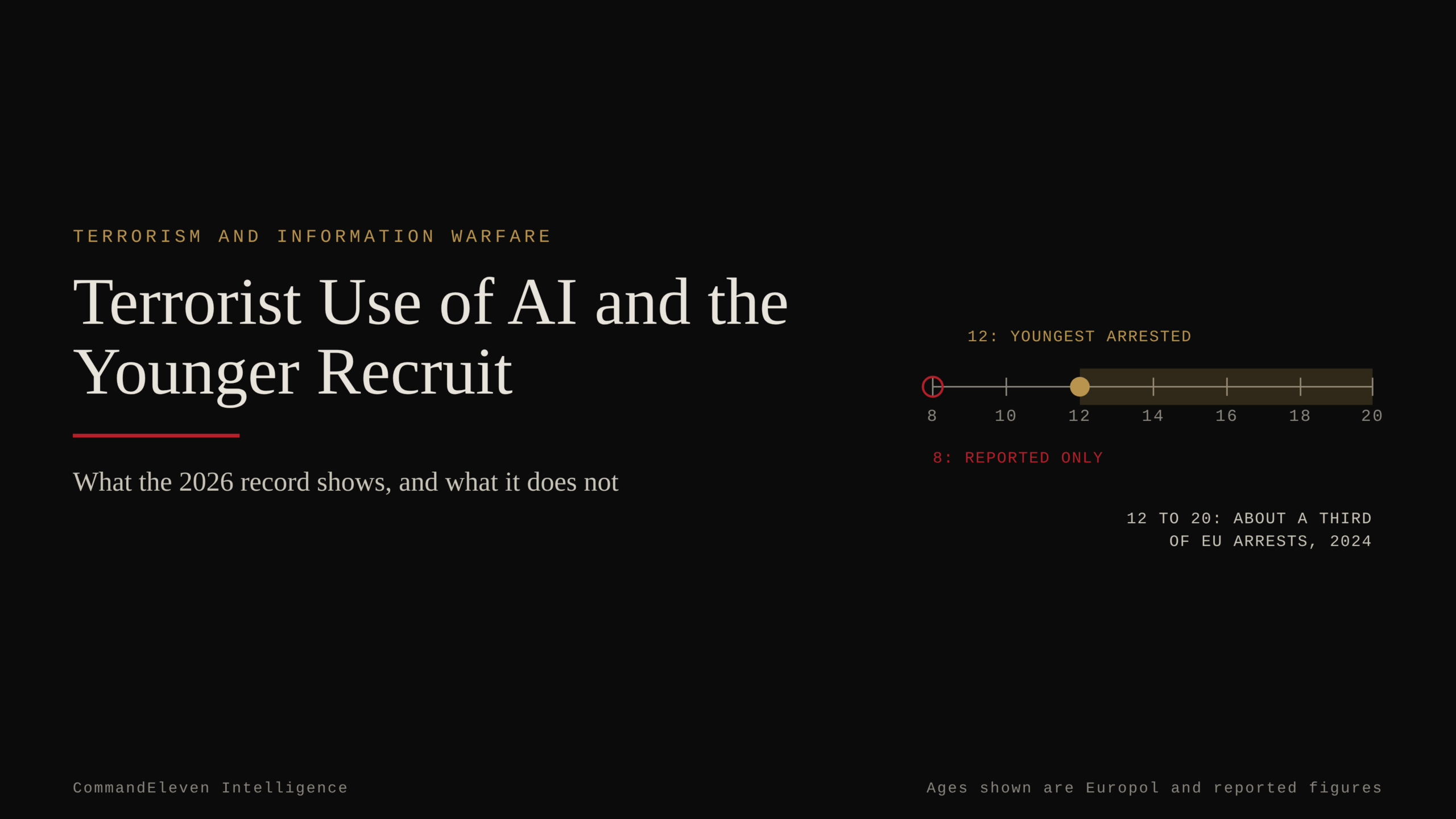
Two reports published this year, one from Tech Against Terrorism and one from the Soufan Center, add operational evidence to the question we raised in the GCTA and in our Information Warfare series: how terrorists use AI, and who they are reaching. We read both, then checked them against the wider 2026 record. The shift in age is documented. European data put teenagers at roughly a third of EU terrorism arrests, with a youngest suspect of 12. The shift beyond social media is documented too. Europol names gaming platforms, and the case record adds encrypted chats, gore sites and AI companions. The AI record is real but smaller than the headlines. The best case count we found is 12 incidents with 15 people, and two 2026 academic reviews call AI an enabler, not a game-changer. Pre-teen recruitment at scale is not yet shown. The evidence is isolated cases and referral figures, not arrest data.
Key Judgments
- CONFIRMED: Minors are a large and persistent share of terrorism suspects in Europe. Europol’s 2025 report counted 449 EU terrorism arrests in 2024, with 133 of the suspects aged 12 to 20, and its 2026 report (covering 2025) says 130 of the arrested individuals with known age were 18 or younger, the youngest 12. Europol’s age bands differ between the two reports, so we do not call this a trend.
- CONFIRMED: Radicalization of young people now runs through several kinds of platform, not just social media. Europol names gaming platforms alongside social media in its 2026 report, and the case record adds encrypted chats, a gore website and AI companion apps.
- CONFIRMED: Chatbots now appear in documented attacks and plots. The International Centre for Counter-Terrorism (ICCT) counts 12 incidents involving 15 people, including 6 completed attacks, with ChatGPT in 8 and four of the perpetrators under 18. The authors call this “the tip of the iceberg” and assess that AI is not yet a game-changer.
- REPORTED: The “pre-teen” end of the range rests on thin evidence. A Soufan brief cites Canadian police warnings about networks targeting children as young as 8 and nearly 300 referrals a year of children aged 10 or younger to the UK’s Prevent program. We could not trace either figure to a primary source.
- ASSESSED: The age shift is better explained by the platform and the grooming method than by AI. Gamified recruitment, peer-to-peer radicalization and composite “salad bar” ideologies reach children whether or not a chatbot is involved. AI lowers the cost of content and planning on top of that.
- DATA DEFICIT: No public source shows how often an AI system changed the outcome of a case, and the UK arrest numbers for under-18s are flat, 39 in 2025 against 40 in 2024, not rising.
Sourcing and Analytical Confidence
| Claim | Source | Tier |
|---|---|---|
| Minors at 133 of 449 EU terrorism arrests in 2024 (ages 12 to 20) | Europol TE-SAT 2025, as reported by Euronews; ICCT in CTC Sentinel, January 2026 | CONFIRMED |
| 130 of arrestees with known age were 18 or younger in 2025; 108 of 347 jihadist suspects | Europol TE-SAT 2026, as summarized by eucrim | CONFIRMED (summary read, not the full report) |
| UK: 39 arrests of people 17 and under in 2025, 40 in 2024 | Counter Terrorism Policing | CONFIRMED |
| 12 AI incidents, 15 people, 6 attacks, 12 killed and at least 46 injured | ICCT, October 28, 2026 | CONFIRMED (open-source count, ICCT’s own) |
| More than 30 public cases, 11 AI tools, more than 70 deaths | Tech Against Terrorism incident tracker, as cited in its CT-AI Benchmark | REPORTED (different definitions from ICCT) |
| Eight of nine chatbots helped researchers posing as 13-year-olds plan violence | Center for Countering Digital Hate and CNN, as reported by Euronews | REPORTED (advocacy-group test) |
| Children as young as 8 targeted; nearly 300 under-10 Prevent referrals a year | Soufan Center issue brief, May 2026, secondary | REPORTED |
| ISWAP and JAS run AI units | Cambridge CASP study (57 interviews, 27 former members), as cited by the Soufan Center | REPORTED |
| AI is an enabler, not a game-changer | Glazzard, McIlhatton and Martin, CTC Sentinel, May 2026; ICCT | ASSESSED (published expert judgment) |
Who Is Being Reached: The Age Data
The EU Counter-Terrorism Coordinator, Bartjan Wegter, told Euronews in March that services are handling cases “between 12 and 20 years old,” and that radicalization can take “a matter of weeks.” Those are his statements, not data. The numbers behind them come from Europol. Its 2025 report, covering 2024, counted 133 suspects aged 12 to 20 among 449 arrests, with the youngest 12 and jihadism the largest share. Its 2026 report, covering 2025, says 130 of the arrested individuals with known age were 18 or younger, including 108 of 347 jihadist suspects, about 31 percent.
A January 2026 study in CTC Sentinel by ICCT researchers looked at 98 teenage and young-adult defendants in Germany, the Netherlands and the UK between 2020 and mid-2025. Ages ran from 10 to 23. Two-thirds were convicted of non-violent offenses such as possessing or sharing material, 53 percent were jihadist and 46 percent were right-wing, and the 764 network now appears in minors’ cases. The authors recorded no right-wing girls. All 18 percent female defendants were jihadist.
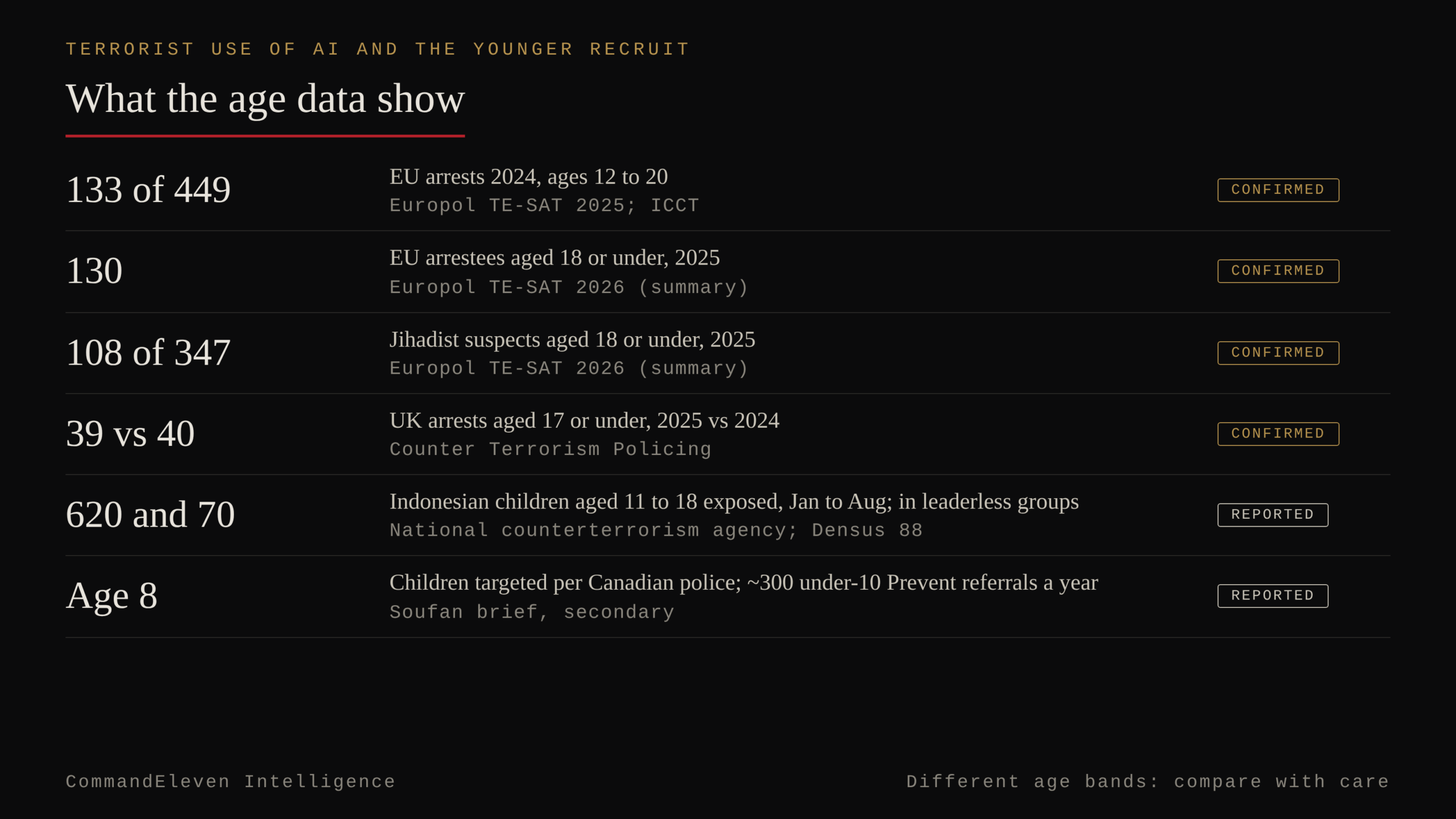
Two cautions apply. First, the UK picture is a plateau, not a climb. MI5 said in October 2024 that minors were 13 percent of its caseload, three times the level three years earlier, but Counter Terrorism Policing recorded 39 arrests of people 17 and under in 2025, one fewer than in 2024. Second, our own audit data point the same way outside Europe. Indonesia’s national counterterrorism agency said 620 children aged 11 to 18 were exposed to violent or radical online content between January and August, and Densus 88 identified 70 children in 19 provinces in leaderless online groups, which we reported in Foresight Audit Part 6.
The Pre-Teen Question
The record supports “teenagers” firmly and “pre-teens” in part. Europol’s youngest suspect is 12. The Soufan Center brief reports Canadian police warnings about networks reaching children as young as 8, nearly 300 referrals a year of children aged 10 or younger to Prevent, and a Massachusetts arsonist as young as 12. We hold these as REPORTED because the brief is a secondary source and we could not trace them to the original. No arrest series shows pre-teens as a measurable share. We will raise the tier if a primary source appears.
Beyond Social Media: The Platform Record
Europol’s 2026 report says gaming platforms and other online environments can expose young people to extremist content and facilitate radicalization. The Soufan brief lists the ones it found in case files: Roblox and Discord, Twitch in the Buffalo shooter’s case, Telegram for a Wisconsin 12-year-old’s nihilist chat and for Russian recruitment of European teenagers, and a gore website where several teenage school shooters held accounts. Our Part 3 documented the Roblox and Discord pipeline and the 764 network.
The methods are more advanced than a feed of posts. The Soufan brief describes gamification, with competition and “high scores” based on fatalities, memetic violence that copies earlier attackers, grooming-like recruitment that isolates the target and then shifts from praise to punishment, and peer recruitment led by other minors. The EU coordinator calls the mixed motives “salad bar ideology.” These are descriptions in expert briefs, not measured effects, so we hold the method claims at ASSESSED.
Where AI Enters
ICCT’s count of 12 incidents spans Canada, the United States, France, Sweden, Finland and the UK. Eleven fall in 2025 or later. The uses are attack planning, weapons and target research, manifesto drafting and seeking justification for violence. ChatGPT appears in 8, Replika and Grok in one each, and two do not name the model. Four of the perpetrators were under 18. The Tech Against Terrorism tracker counts more than 30 cases and more than 70 deaths. The two counts differ because they define “terrorism” and “involvement” differently, so we report both and do not add them.
The Center for Countering Digital Hate and CNN tested nine systems by posing as 13-year-old boys across nine scenarios, including school shootings and synagogue bombings, and reported that eight of nine helped. One system, Character.AI, encouraged violence unprompted. This is an advocacy-group test, not a peer-reviewed one. Tech Against Terrorism’s benchmark found a similar pattern in a controlled setting: 27 models, 2,339 outputs, 32 percent met the strict definition of compliance, and compliance rose from 17 to 42 percent when the same request was framed as research. Its propaganda test found models complied about as often for violent Islamist framing (26 percent) as for other terrorist framing (22 percent). That measures what models will produce, not what groups use.
Against this, two 2026 reviews are cautious. Glazzard, McIlhatton and Martin write in CTC Sentinel that evidence for automated or micro-targeted radicalization is lacking and that terrorist use of generative AI has been “predominantly low-stakes, low-impact.” ICCT finds no AI-enabled critical infrastructure, CBRN or autonomous-weapons attack in its data and says reduced “leakage” of plans may make lone actors harder to detect. We read this the same way. AI supercharges existing behavior at the planning and content stages. It has not yet created a new category of attack.
Where Our Earlier Work Stands
- Part 2 (The Tooling): The Key Judgments stand. This post adds operational cases the Part 2 chapter did not cover. Our DATA DEFICIT on AI propaganda scale also stands: no source measures conversion or reach.
- Part 1 (Narratives): “AI changes speed and scale, not the mechanism” stands as our assessment. ICCT and the Soufan Center note that companion chatbots can themselves become part of the process, as in the 2021 Windsor Castle case, where a chatbot companion was central. We hold that as ASSESSED, not established.
- Part 3 (Algorithms and gaming platforms): The youth and gaming findings are reinforced by Europol’s 2026 language and the Soufan platform list.
- GCTA, April 2026: The GCTA described online radicalization moving onto gaming and other platforms, and the evidence here is consistent with it. Our Foresight Audit scored the Southeast Asia youth call partly confirmed. We have not re-read the GCTA for age-specific wording or rescored it for this post.
What We Could Not Source
- The share of European cases that involve a pre-teen, which no public series reports.
- Any measure of how often a chatbot changed an outcome. ICCT notes that chat content is often undisclosed.
- The details of what a chatbot provided in the Tumbler Ridge, British Columbia school shooting. ICCT lists it, and press reports say the account was flagged and banned, but we have not read primary court or police material.
- The Tech Against Terrorism version question. A press item cites 134 models, while the PDF we read, version 1.1, tested 27.
What To Watch
- Europol’s next report, due around mid-2027, for the 2026 count of suspects 18 and under.
- Whether the U.S. and China set up a terrorism-specific channel under the AI communication channel agreed at the September 24 summit.
- S. 4762, the Senate companion to H.R. 1736, the Generative AI Terrorism Risk Assessment Act, which passed the House in November 2025.
- Any court filing in which a chatbot log is entered as evidence in a case involving a minor.
What Would Change Our Assessment
- A primary source for the under-10 figures would move the pre-teen judgment from REPORTED to CONFIRMED.
- An AI-enabled attack on critical infrastructure or a CBRN plot with documented chatbot uplift would move our AI judgment from “enabler” toward “game-changer.”
- A second year of falling or flat arrests of under-18s in Europe would weaken the claim that the shift is still growing.
Calls We Will Score
| Call | Due | How we score it |
|---|---|---|
| Europol’s 2027 report (covering 2026) counts at least 100 suspects aged 18 or younger | July 31, 2027 | Confirmed if the report says so, not confirmed if lower, open if the report is late. If the age band changes, we score on the closest band and say so |
| At least one more publicly documented attack or arrest in the U.S., UK or EU where official records cite chatbot use by a suspect under 18 | March 31, 2027 | Confirmed on a police statement, charging document or court record |
| The Senate does not pass S. 4762 or H.R. 1736 | June 30, 2027 | Confirmed if no passage by that date |
What This Does and Doesn’t Establish
- It establishes that minors are a large share of European terrorism arrests and that gaming and other non-social platforms are part of the pathway.
- It establishes that chatbots appear in documented attacks and plots, with ICCT’s count at 12.
- It does not show that AI caused any specific radicalization, or that pre-teens are a measurable share of cases.
- It does not rank AI providers. The benchmark and the CCDH test used different methods and different product tiers.
Frequently Asked Questions
Is online radicalization targeting younger people?
Yes. Europol counted suspects as young as 12, and about a third of EU terrorism arrests in 2024 were aged 12 to 20. UK arrests of under-18s are flat at a high level.
Which platforms are involved besides social media?
Gaming platforms such as Roblox and Discord, encrypted chat apps such as Telegram, gore websites, and AI companion apps appear in case records.
Are terrorists using AI to plan attacks?
In a small number of documented cases, yes. ICCT counts 12 incidents. Two 2026 academic reviews say AI mainly speeds up existing activity and is not yet a game-changer.
Are pre-teens being radicalized?
Isolated cases and referral figures say so. No arrest series yet shows pre-teens as a measurable share.
Related Reading
- Information Warfare & Radicalization in the AI Era: Series Introduction
- The Tooling: Encrypted Platforms, Deepfakes and the AI Arms Race – Part 2
- Digital Recruitment Ecosystems and Algorithmic Amplification – Part 3
- GCTA Foresight Audit, Part 6: North Africa, Southeast Asia and the Sulu Sea
- The Foresight Record
Sources
- Tech Against Terrorism, CT-AI Benchmark, Programme Report 01, version 1.1, July 1, 2026
- Soufan Center, Terrorist Misuse of AI: A Framework for U.S.–PRC Cooperation, September 2026
- ICCT, “Tell me how to make a bomb”: Terrorist use of conversational AI, October 28, 2026
- Mehra and Herbach, From Adolescence to Accountability, CTC Sentinel, January 2026
- Glazzard, McIlhatton and Martin, Will Generative AI Fundamentally Change Terrorist Threats? CTC Sentinel, May 2026
- Soufan Center, Combating Youth Radicalization, May 2026
- eucrim, Europol TE-SAT 2026
- Euronews, children as young as 12 are getting radicalised in Europe, March 23, 2026
- Euronews, eight in 10 popular AI chatbots would help teenagers plan violent attacks, March 13, 2026
- Counter Terrorism Policing, arrest statistics for 2025, March 12, 2026
- Senator Rick Scott, Senate AI terrorism tracking legislation, June 2026