CommandEleven Intelligence Desk · Transnational Threats Desk, status as of November 12, 2026
Bottom Line Up Front
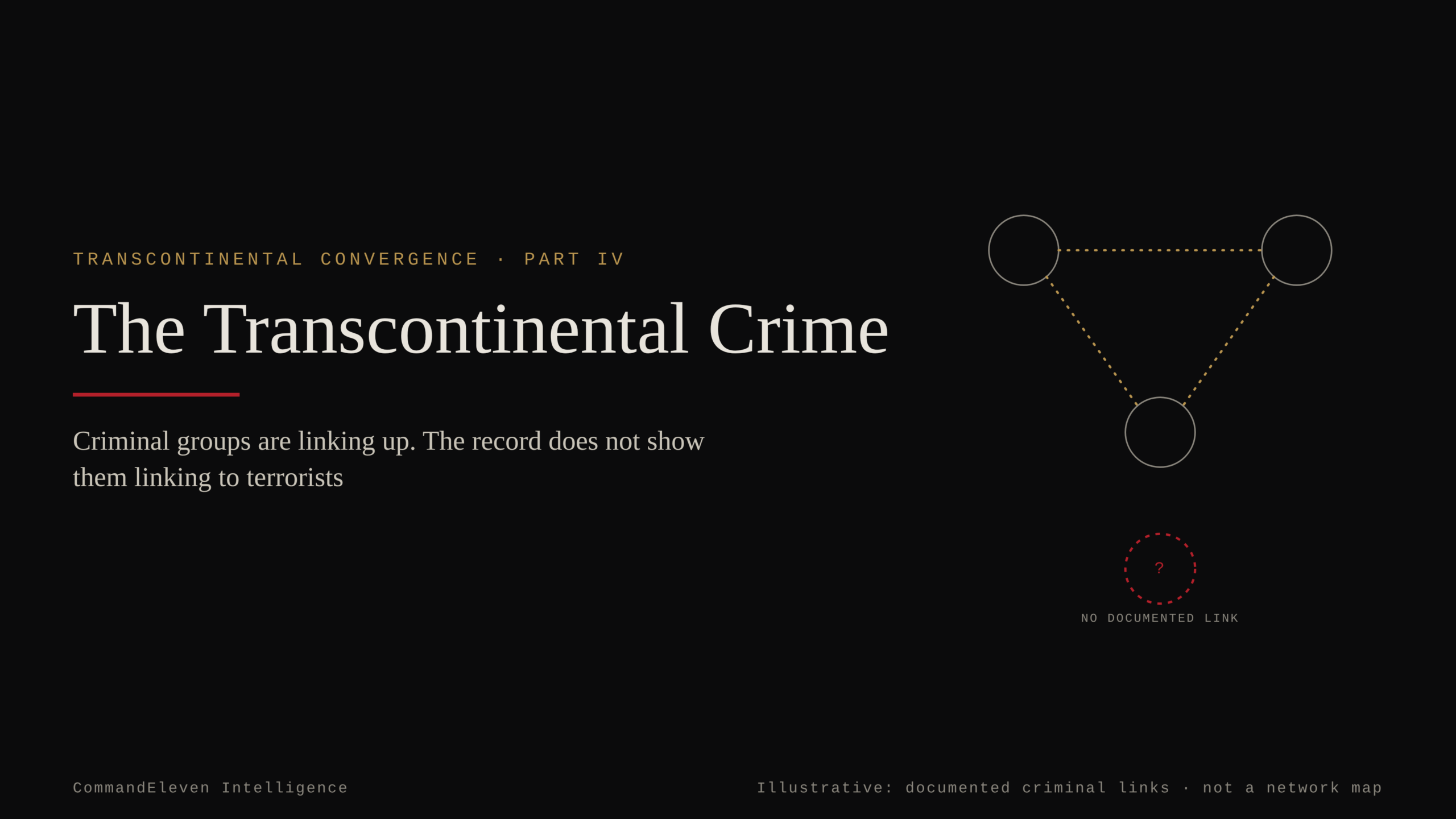
The public record shows large, growing criminal supply chains for cocaine and synthetic drugs, and it shows armed Latin American criminal groups newly labeled as terrorist organizations under U.S. law. It does not show those criminal groups working with jihadist or other terrorist organizations. The documented links are between criminal groups: an Ecuadorian network working with an Albanian one, a Sinaloa cell seeking Italian partners, a Chinese precursor syndicate supplying Mexican cartels. Several widely repeated links, including precursor flows from Southeast Asia to Mexico, a Kinahan “super cartel,” and Triad money clearing for cartels, have no public source that we can find, and we do not carry them. This is Part IV of our Transcontinental Convergence series.
Key Judgments
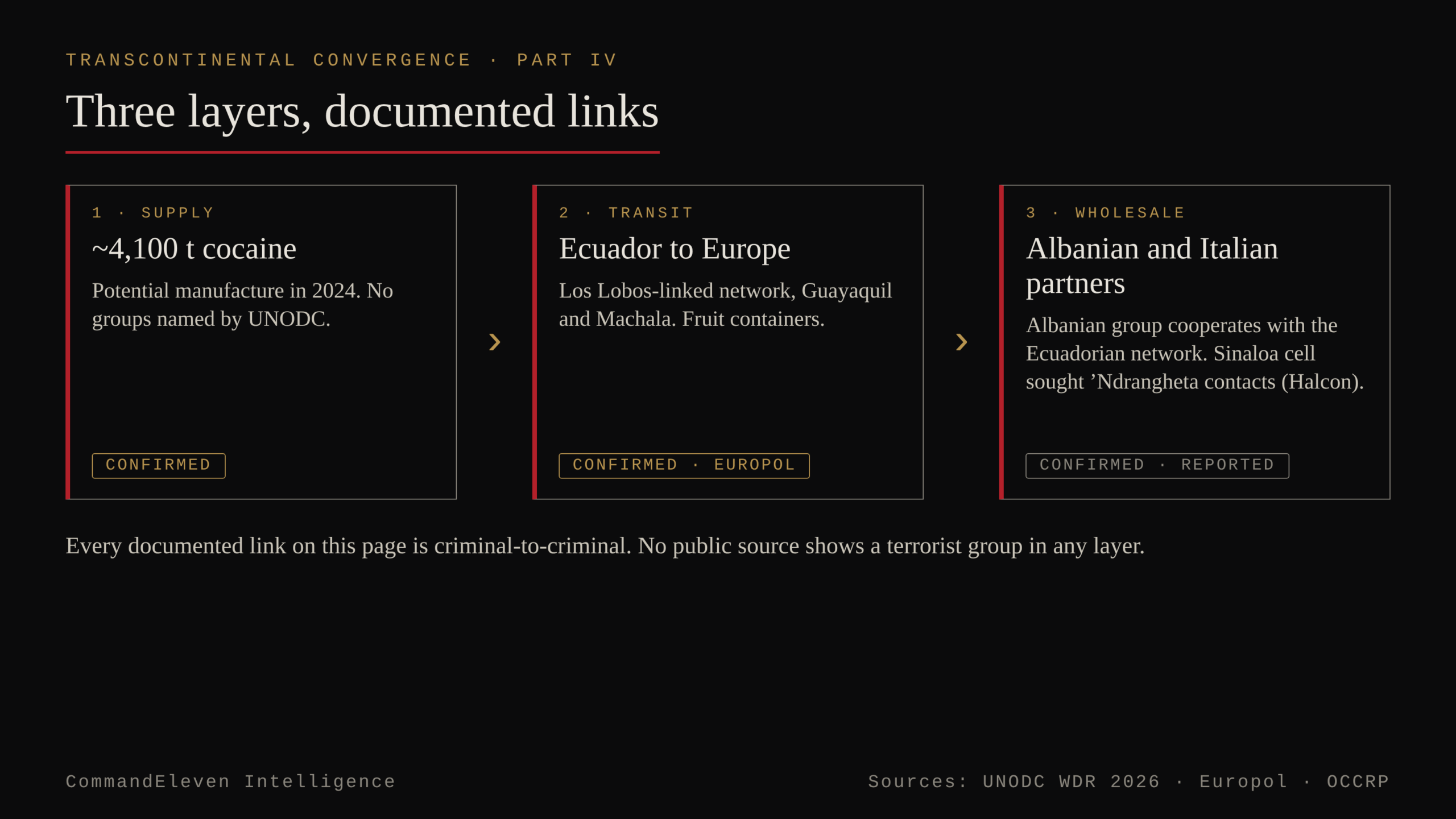
- CONFIRMED: The UN Office on Drugs and Crime (UNODC) estimates potential global cocaine manufacture at around 4,100 tons in 2024 (range 3,800–4,700 tons), more than four times the 2014 low. South America made about 64 percent of global cocaine seizures, the highest share since 1984, and Colombia alone seized 966 tons. The report names no criminal groups.
- CONFIRMED: On March 3, 2026 Europol announced the takedown of an Ecuadorian network linked to Los Lobos, operating from Guayaquil and Machala and concealing cocaine in refrigerated fruit containers. Europol said the investigation showed the network was cooperating with an Albanian drug trafficking organization. This is the best-documented criminal-to-criminal link in the series.
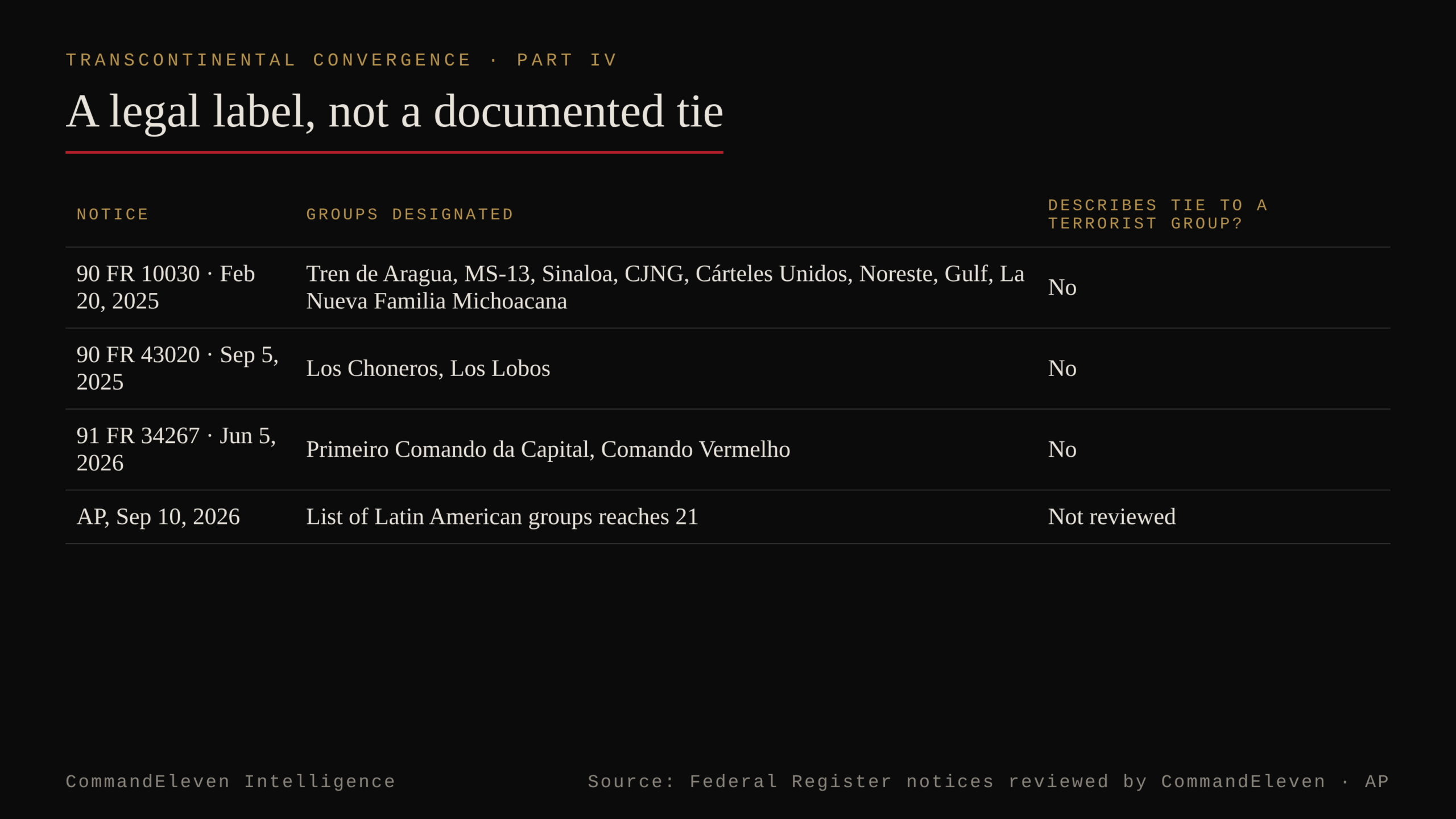
- CONFIRMED: The U.S. Department of State has designated Latin American criminal groups as Foreign Terrorist Organizations in at least four rounds: eight groups in February 2025, Los Choneros and Los Lobos in 2025, and Primeiro Comando da Capital (PCC) and Comando Vermelho in June 2026. AP reports the list now stands at 21. A designation is a legal determination by the Secretary of State. It does not by itself document an operational tie to any other terrorist group.
- CONFIRMED: A U.S. Treasury action on October 3, 2023 sanctioned 28 individuals and entities in a Chinese network supplying fentanyl precursors, and described the network as supplying the Sinaloa Cartel and Jalisco New Generation Cartel (CJNG). This is a documented supplier link between Chinese and Mexican criminal groups.
- REPORTED: UNODC reports that a scam-center site and a methamphetamine lab in Myanmar’s northern Shan State were found about 800 meters apart, and says this “suggests” organized crime groups may be exploiting shared conditions. UNODC also noted Mexican-origin ketamine seized in Cambodia and said Mexican groups “may be” seeking connections in Asia. Both are UNODC inferences, not findings.
- REPORTED: Daniel Kinahan, long identified by U.S. Treasury as a leader of the Kinahan organized crime group, was arrested in Dubai on April 15, 2026, extradited to Ireland on August 9 and charged with directing a criminal organization. He has not been convicted.
- DATA DEFICIT: We found no public source for precursor shipments from Southeast Asia to Mexican ports, for Triad money clearing on behalf of cartels, or for a link between any Latin American criminal group and a jihadist organization.
Sourcing and Analytical Confidence
We grade every claim on one scale. Government statements, indictments and designation notices describe what an authority alleges or decided, not what a court has found. Press accounts of unpublished material are labeled. “(Unconfirmed)” is an inline hold tag only.
| Tier | Meaning |
|---|---|
| CONFIRMED | Documented by an official source, a primary document or multiple independent credible sources |
| REPORTED | Credible outlet or analyst, not independently verified by us |
| ASSESSED | Our judgment from the confirmed and reported record |
| DATA DEFICIT | We looked and the public record does not answer the question |
The Supply Chain Is Real and Growing
Cocaine is the commodity on which every other claim in this part depends. UNODC’s World Drug Report 2026 estimates potential manufacture of pure cocaine at around 4,100 tons in 2024, within a range of 3,800 to 4,700 tons, driven by more coca under cultivation and higher productivity. It says seizures in several destination and transit regions have grown even faster than production, which together with falling wholesale prices in key transit countries suggests that organized crime groups with a global reach are pushing larger quantities toward established and new markets. It names no groups. (UNODC, World Drug Report 2026, Highlights)
The report also describes how the trade moves through legitimate commerce. Drugs are concealed in container structures, and in the case of banana exports from Ecuador the report documents substituting packaged goods in trucks on the way to the loading port. That detail matters because it explains why an Ecuadorian group can supply Europe without owning ships, and why fruit-exporting companies appear in the case below.
Europe: Criminal Partnerships Documented by Police
The best primary source for how the Latin American and European layers connect is Europol’s March 3, 2026 release. Europol supported Belgian, Dutch and Ecuadorian authorities against an Ecuadorian network linked to Los Lobos and led by a person described as a high-value target, operating from Guayaquil and Machala. The operation, which began in January 2025, led to 16 arrests, 26 house searches and the seizure of USD 810,000 in cash. Earlier seizures in the case included 2.6 tons at Vlissingen in February 2025, 1.1 tons at Rotterdam on June 2, 2025, 3.165 tons in Belgium and 572 kilograms in Ecuador. Europol says the investigation revealed the Ecuadorian network was cooperating with an Albanian drug trafficking organization, whose members traveled to Ecuador to negotiate deals, and that shipments were rapidly divided and distributed across several countries. The cocaine was hidden in refrigerated fruit containers, with fruit-exporting companies as cover. (Europol, March 3, 2026)
The release also demonstrates a limit of the public record. Europol reports “around four tonnes” of cocaine seized, while its itemized list adds up to more than seven tons. The release does not explain the difference, and we do not use either total.
A second documented link involves Mexican suppliers. OCCRP’s reporting on Operation Halcon described a Sinaloa-linked cell in Catania, Sicily, working through contacts with ’Ndrangheta, based on an informant, wiretaps and Italian indictments. The case produced two arrests of Guatemalans, and the figure the reporting called El Flaco remained at large. Brookings scholar Vanda Felbab-Brown wrote in 2022 that Sinaloa was probably a premier wholesale supplier to Europe, working with ’Ndrangheta and tied to methamphetamine labs in the Netherlands. Her piece is analysis, so we hold it as REPORTED. (OCCRP, Inside the Sinaloa Cartel’s Move Toward Europe; Brookings, Foreign Policies of the Sinaloa Cartel and CJNG, Part IV)
The Kinahan Case
The Kinahan organized crime group is the most frequently cited European name in convergence commentary, so we state the record narrowly. The U.S. Treasury sanctioned the group’s leadership in April 2022. Daniel Kinahan was arrested in Dubai on April 15, 2026, extradited to Ireland on August 9 and charged with directing a criminal organization at the Special Criminal Court. The case is a prosecution of an alleged organized crime leader, and he is presumed innocent. We found no public document that links the group to a terrorist organization. A claim that the group belongs to a “super cartel” supplying a third of Europe’s cocaine rests on one press source, and we do not carry it. (OCCRP; Khaleej Times)
Chinese Networks and Mexican Cartels
The strongest documented link between Chinese and Mexican criminal groups is a sanctions action. On October 3, 2023, the U.S. Treasury designated 28 individuals and entities in what it called a large Chinese network of illicit drug producers. It named Du Changgen as the head of a syndicate that owns Hanhong Pharmaceutical, said Hanhong advertised fentanyl precursors to Mexican customers, said its sales representatives communicated with people linked to the Sinaloa Cartel, and said the syndicate supplies Sinaloa and CJNG. The action was against criminal suppliers. It does not allege any tie to a terrorist group. (U.S. Department of the Treasury, October 3, 2023)
Our judgment is that the Chinese-Mexican precursor trade is a real supplier relationship, and that it is the part of this story most likely to grow, since supply chains for synthetic drugs depend on chemicals more than on territory.
Southeast Asia: Proximity, Not Proven Partnership
UNODC’s 2026 report on synthetic drugs in East and Southeast Asia documents record methamphetamine seizures of 349 tons in 2025, up 48 percent from 236 tons, almost all in Southeast Asia, with Myanmar the largest source. It also records 52.5 tons of ketamine seized in the region. On the link between drugs and scam operations, it says earlier UNODC studies identified points of convergence, including reliance on underground banking and actors allegedly involved in both. A January 2026 seizure in northern Shan State found a suspected scam site with Starlink terminals and laptops about 800 meters from a clandestine drug manufacturing site, which UNODC says suggests organized crime groups may be exploiting protection and logistics to engage in several criminal activities. It speaks of “potential” cross-investment. (UNODC, Synthetic Drugs in East and Southeast Asia 2026)
The report also records 48.8 kilograms of ketamine of Mexican origin seized in Cambodia in two cases, and says this “could also mean” that Mexican groups are looking to make stronger connections in Asia. That is UNODC speculation from two seizures. Nothing in the report documents a flow of precursors from Southeast Asia to Mexico, and we found no government, UN or court source that does. The documented precursor sources for Mexican synthetic drugs in the public sources we reviewed are Chinese, as in the Treasury action above.
The Legal Label: Terrorist Designations of Criminal Groups
The newest development in this field is legal, not operational. The Secretary of State designated eight groups as Foreign Terrorist Organizations in a notice dated February 6, 2025 and published February 20: Tren de Aragua, Mara Salvatrucha (MS-13), the Sinaloa Cartel, CJNG, Cárteles Unidos, the Cartel del Noreste, the Gulf Cartel and La Nueva Familia Michoacana. Los Choneros and Los Lobos followed in a notice published September 5, 2025, and PCC and Comando Vermelho in a notice dated May 28, 2026 and published June 5. Each notice states the Secretary’s conclusion, in consultation with the Attorney General and the Secretary of the Treasury, that there is a sufficient factual basis under Section 219 of the Immigration and Nationality Act. AP reports that further additions in September 2026, including Ecuador’s Chone Killers and Los Tiguerones, brought the list to 21 Latin American groups. (Federal Register, 90 FR 10030; Federal Register, 90 FR 43020; Federal Register, 91 FR 34267; AP via KSAT, September 10, 2026)
What the designation does is legal: it opens material-support liability and sanctions tools against the group. What it does not do is establish that the group cooperates with al-Qaeda, the Islamic State or any other terrorist organization. The notices we reviewed make a designation finding. They do not describe an operational relationship with a terrorist group. Readers should keep the two ideas apart: a criminal group can be labeled terrorist without the labels ever meeting.
D-Company: These Are Official Allegations, Not Sourced Information
These are official allegations, not sourced information. The case of D-Company, the Mumbai-origin criminal organization associated with Dawood Ibrahim, is the one case in this part where governments have publicly alleged a link between a criminal group and terrorist organizations. We report what each government said and have not independently verified any of it.
- In October 2003 the U.S. Treasury designated Dawood Ibrahim as a Specially Designated Global Terrorist, alleging links to al-Qaeda and Lashkar-e-Tayyiba. (OFAC, October 16, 2003)
- In May 2012 Treasury designated Ibrahim associates Shakeel and Tiger Memon under the Kingpin Act, and its release said Shakeel coordinates with other organized crime and terror groups. (OFAC, May 2012)
- In November 2022 India’s National Investigation Agency filed a charge sheet against Ibrahim and Shakeel under counter-terror and organized crime laws, describing D-Company as a terrorist gang and an organized crime syndicate. Press accounts of the charge sheet name no specific terrorist group. (Free Press Journal, November 2022)
Our position is plain. These are allegations by two governments. None has been tested in a court that we can cite, and we do not hold the terrorist link as established. We include the case because it is the clearest example of how the allegation is made, not because we can confirm it.
Links We Could Not Source
These claims circulate in commentary, including earlier drafts of this series. We looked for a public source for each and are not carrying any of them.
| Claim | What we found | Tier |
|---|---|---|
| Triad networks divert precursors via Myanmar, Laos or Cambodia into Mexican ports | Documented precursor sources in public sources we reviewed are Chinese and Indian. No source for the Southeast Asian route. | DATA DEFICIT |
| Southeast Asian casinos and junkets clear money for cartels | No public source found. | DATA DEFICIT |
| Kinahan group clears scam-compound cryptocurrency | No public source found. | DATA DEFICIT |
| Kinahan group belongs to a “super cartel” supplying a third of European cocaine | A single press source. Not independently corroborated. | DATA DEFICIT |
| ’Ndrangheta traffics Captagon | No public source found. | DATA DEFICIT |
| Russian Vory v Zakone brokers arms for armed groups | No public source found. | DATA DEFICIT |
| PCC acts as a procurement partner for the Kinahan group | No public source found. | DATA DEFICIT |
| Mexican cartels learned drone tactics from Levant or Sahel groups | No public source found. | DATA DEFICIT |
What To Watch
- Any court filing, indictment or government report that documents a criminal group and a terrorist group cooperating, as opposed to coexisting.
- Further additions to the Foreign Terrorist Organization list, and whether any notice describes operational ties rather than a designation finding.
- The Daniel Kinahan proceedings at the Special Criminal Court.
- Any official document describing precursor shipments from Myanmar, Laos or Cambodia to Mexico.
- Follow-up Europol or national prosecutions of Ecuadorian and Albanian networks.
What Would Change Our Assessment
- A court record or primary official document showing a Latin American criminal group and a jihadist group sharing routes, money or personnel.
- A government or UN document documenting precursor shipments from Southeast Asia to Mexico.
- A verdict or filing in the Kinahan case that documents links beyond organized crime.
- Independent corroboration of the D-Company allegations.
Calls We Will Score
| Date | Call |
|---|---|
| March 31, 2027 | No government, UN or court document is published that describes precursor shipments from Myanmar, Laos or Cambodia to Mexican ports. |
| June 30, 2027 | The State Department adds at least one more criminal group to the Foreign Terrorist Organization list beyond the 21 reported in September 2026. |
| June 30, 2027 | The Daniel Kinahan case has not reached a verdict. |
What This Part Does and Does Not Establish
| Establishes | Does not establish |
|---|---|
| Criminal-to-criminal links between Ecuadorian, Albanian, Mexican, Italian and Chinese groups are documented by police and Treasury. | That any of those criminal groups works with a terrorist organization. |
| The U.S. has labeled 21 Latin American groups as terrorist organizations. | That the label reflects an operational tie to al-Qaeda, the Islamic State or any other terrorist group. |
| Scam centers and drug labs sit close together in Myanmar. | That the same groups run both, or that either connects to Mexico. |
| Governments allege D-Company links to terrorist groups. | That the allegation is proven. |
Frequently Asked Questions
Are Mexican cartels terrorist organizations?
Under U.S. law, several are designated as Foreign Terrorist Organizations. That is a legal designation by the Secretary of State. The designation notices do not describe cooperation with groups such as al-Qaeda or the Islamic State.
Do Latin American cartels work with Chinese criminal networks?
One documented example is the October 2023 Treasury action describing a Chinese syndicate that supplied fentanyl precursors to the Sinaloa Cartel and CJNG. Beyond that, the public record is thinner than commentary suggests.
Is the Kinahan group a terrorist group?
No public source we found says so. Its alleged leader is facing a charge of directing a criminal organization in Ireland and has not been convicted.
Why does this part not name the Triads?
UNODC’s Southeast Asia reports and the sources we reviewed do not tie the Triads to Mexican cartels. We do not carry the claim.
Related Reading
Sources
- UNODC, World Drug Report 2026
- UNODC, Synthetic Drugs in East and Southeast Asia 2026
- Europol, Europol supports takedown of cocaine trafficking network linked to Los Lobos cartel, March 3, 2026
- U.S. Department of the Treasury, Treasury Targets Large Chinese Network of Illicit Drug Producers, October 3, 2023
- Federal Register, Designations of Tren de Aragua and seven other groups, 90 FR 10030, February 20, 2025
- Federal Register, Designation of Los Choneros and Los Lobos, 90 FR 43020, September 5, 2025
- Federal Register, Designation of Primeiro Comando da Capital and Comando Vermelho, 91 FR 34267, June 5, 2026
- AP via KSAT, Trump list of U.S.-designated foreign terrorist organizations in Latin America grows to 21, September 10, 2026
- OCCRP, Inside the Sinaloa Cartel’s Move Toward Europe
- Brookings, The Foreign Policies of the Sinaloa Cartel and CJNG, Part IV: Europe’s Cocaine and Meth Markets
- OCCRP, Alleged Irish Crime Boss Charged After UAE Extradition
- Khaleej Times, After extradition from UAE, Daniel Kinahan charged with directing criminal organisation
- OFAC, Recent actions, October 16, 2003
- OFAC, Recent actions, May 2012
- Free Press Journal, NIA files charge sheet against Dawood Ibrahim, Chhota Shakeel