CommandEleven Intelligence Desk · Transnational Threats Desk, status as of November 10, 2026
Why This Series
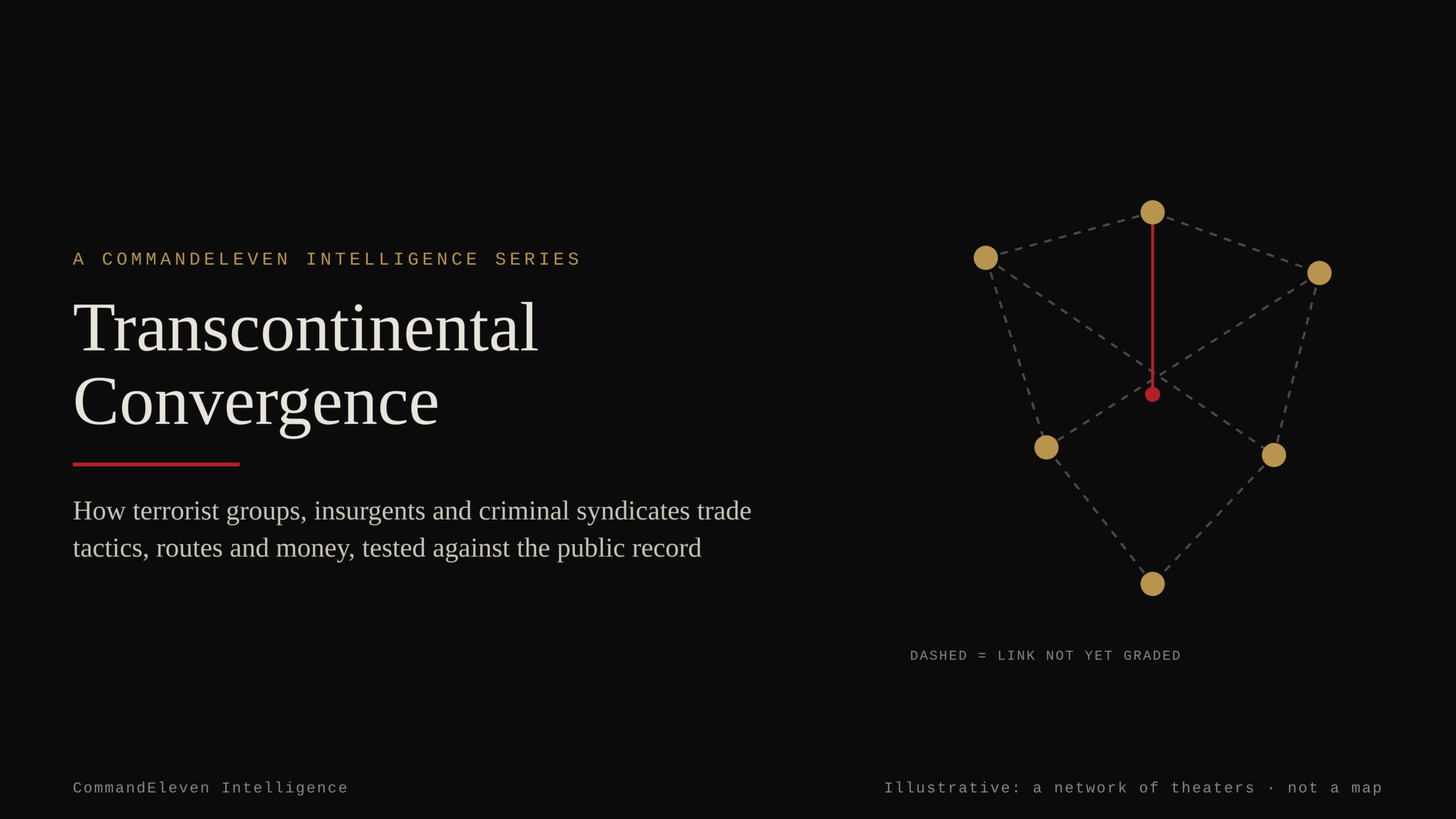
Terrorist groups, insurgents and criminal syndicates used to be treated as separate problems with separate agencies. The old assumption is breaking down. Armed drones appear with the Tehreek-e-Taliban Pakistan, the Sahel’s JNIM and Mexican cartels. Money passes through the same exchangers, crypto channels and shell banks. Smuggling routes carry drugs, weapons and fighters in the same shipments.
It is tempting to say that no one operates alone anymore. This series tests that claim, one link at a time. Convergence is an exchange of access, routes, hardware and money, not a merger of ideologies, and many of the links repeated in commentary do not survive a check against the public record. Where a link is documented, we show it. Where it is not, we say so.
The question the series answers: how do terrorist, insurgent and criminal networks learn from and trade with one another across continents, and what does the evidence actually support?
Bottom Line Up Front
[ASSESSED] Terrorist groups, insurgents and criminal syndicates increasingly operate in the same markets for technology, routes and money, and shared technology spreads their tactics fast. The public record supports exchange and parallel adoption far more often than formal alliance, and it is thinnest exactly where the commentary is loudest. The practical consequence is that disrupting one network does not remove the shared market it uses.
The Series
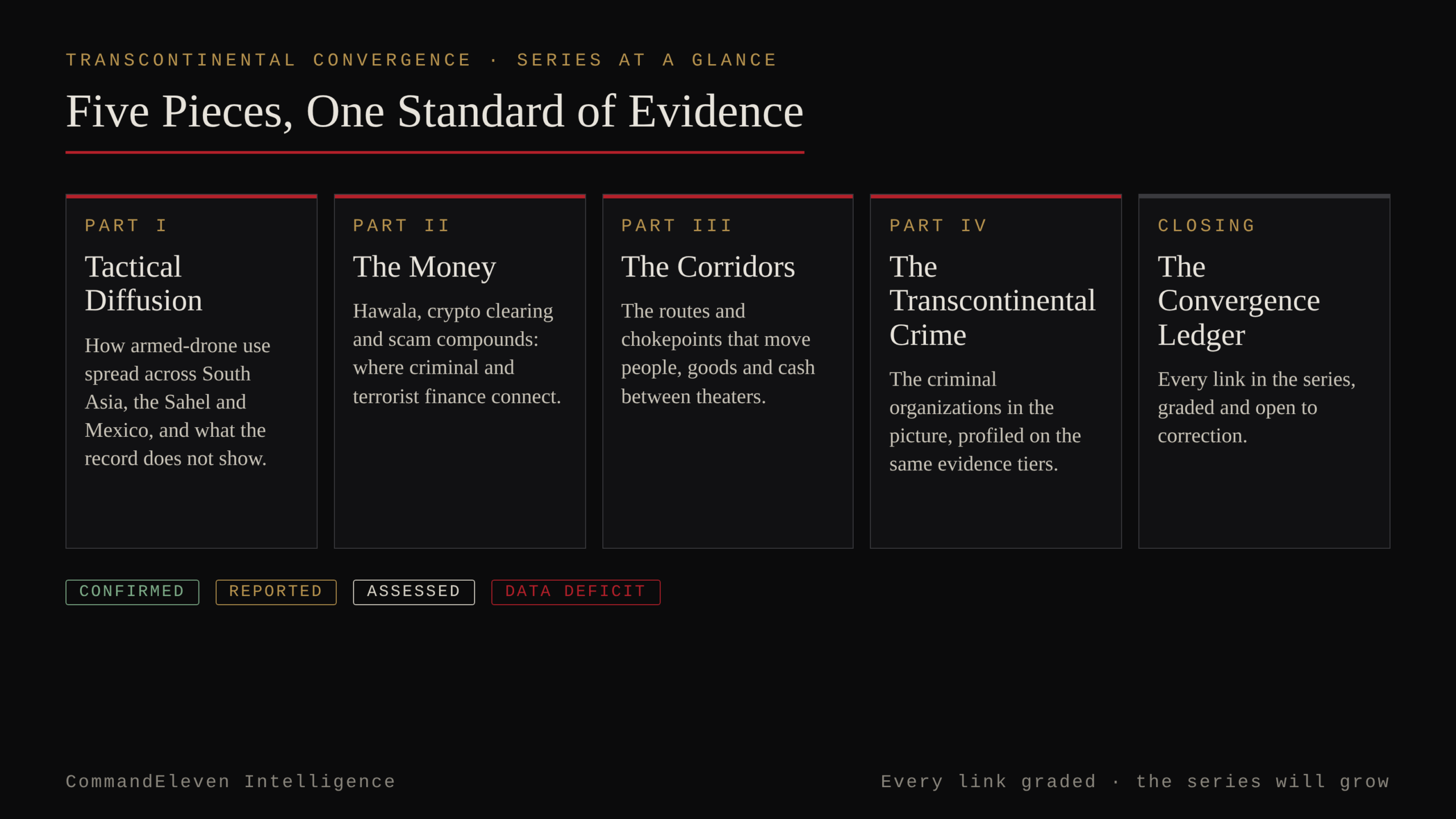
- Part I: Tactical Diffusion. How armed drones and other tactics have spread among militants and cartels in South Asia, the Sahel and Mexico, and what the record shows about why.
- Part II: The Money. Hawala, crypto clearing and criminal money networks, link by link, with each connection to a terrorist group tiered by the strength of its sourcing.
- Part III: The Corridors. The smuggling and supply routes that run through the Sahel, the Middle East and South Asia, who controls them and who pays.
- Part IV: The Transcontinental Crime. The criminal organizations themselves: Southeast Asian syndicates, European and Russian-speaking laundering networks, and the Chinese money-laundering and precursor brokers that serve Mexican cartels.
- The Convergence Ledger. Every claimed link in one table, with its source quality, its tier and what would change our view. The series will grow as new links surface.
How We Built It
- Every claim carries a confidence tag: CONFIRMED, REPORTED, ASSESSED or DATA DEFICIT. “(Unconfirmed)” marks a single claim we are holding.
- Every part names its sources and links to them, and states what it does not claim.
- Militant and criminal claims, propaganda and attack counts from interested parties are treated as claims, not evidence.
- Where a widely repeated link has no public source, we say so and leave it out of the analysis.
- Public output stays at the organizational and strategic level. We do not publish how weapons or devices are built or used.
- Each part ends with dated calls, registered on our Foresight Record and scored on their due dates, hit or miss.
What This Series Does Not Claim
- That terrorist groups and criminal syndicates are merging or share an ideology.
- That any two groups are connected because they use the same tactic or the same route.
- That every link in the series is current. Networks change quickly and each part carries its own status date.
Frequently Asked Questions
What is transcontinental convergence?
It is the exchange of tactics, routes, hardware and money between terrorist, insurgent and criminal networks operating on different continents. It describes commercial and operational overlap, not a merger.
Does this mean terrorists and cartels work together?
Sometimes they use the same suppliers, routes or launderers, and sometimes they copy each other’s tactics. Each part separates documented links from inferred ones.
Why does the series cover criminal networks as well as terrorist groups?
Because the connecting infrastructure, such as laundering, smuggling and technology markets, is mostly criminal, and terrorist groups use it.
Will more parts be added?
Yes. The series expands as new documented links surface, and each new part is listed here.