
CommandEleven Intelligence // Pakistan-Afghanistan Desk. This dossier follows The Afghan Fracture and A Region Under Pressure: The Pakistan-Afghanistan Series.
The Afghan Taliban have no working air force, but since February 2026 they have had a way to reach into Pakistan from the air. Cheap one-way drones, built largely from commercial parts, have hit or been shot down over border posts, Kohat, Quetta and, in March, the garrison city of Rawalpindi. On September 23, Pakistan said it shot down eight more near Torkham and Kohat. Militarily the drones do little damage. Politically they have changed the war: Kabul can now answer Pakistani airstrikes in kind, and Pakistan’s air defenses, built for jets and missiles, were not designed for them.
Key Judgments
- [CONFIRMED] The Afghan Taliban began using armed drones against Pakistan in February 2026. The Taliban claimed 15 drone attacks in Khyber Pakhtunkhwa and Islamabad between February 27 and March 15 alone, and ACLED had recorded at least 12 Taliban drone strikes into Pakistan by mid-June. The Taliban have openly claimed some of them, including strikes on Rawalpindi and Islamabad in March, which Pakistan says it intercepted.
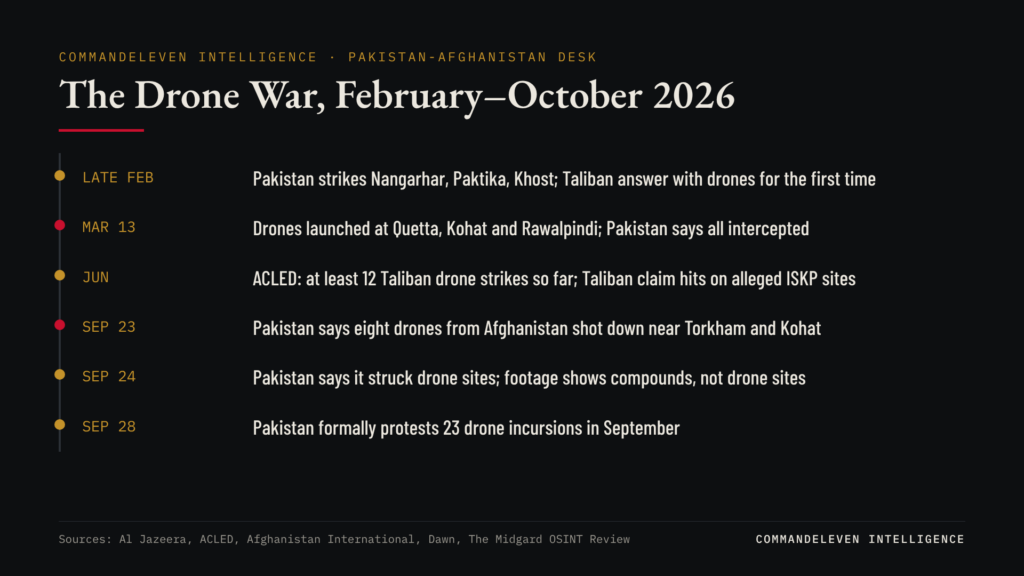
- [CONFIRMED] On September 23, Pakistani security sources said eight drones launched from Afghanistan were shot down, four near Torkham and four near Kohat. Pakistan reported 23 drone incursions from Afghanistan in September and protested formally to Kabul on September 28.
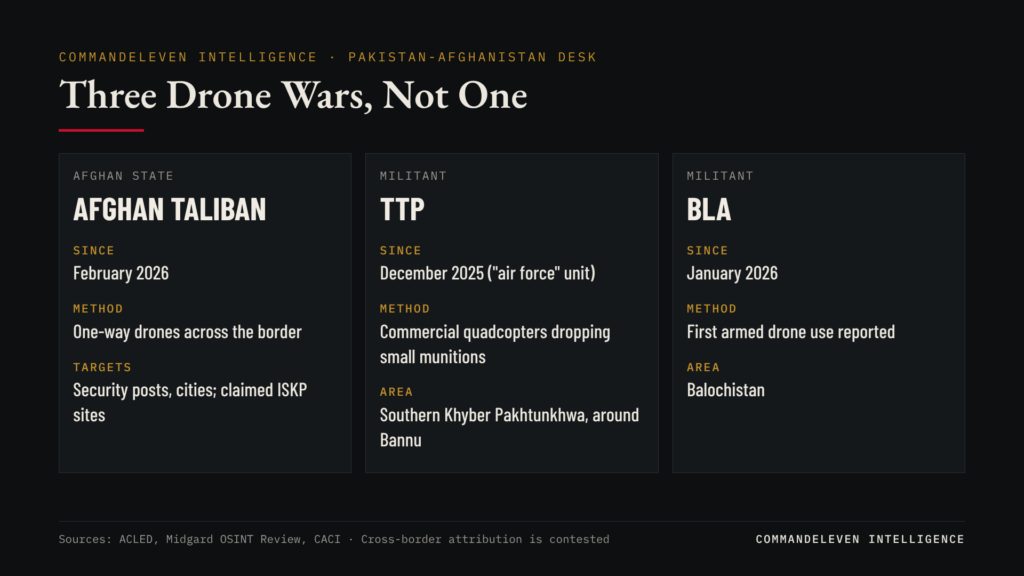
- [CONFIRMED] The Taliban are not the only drone user in this war. The Tehreek-e-Taliban Pakistan (TTP) announced its own “air force” unit in December 2025, and the Balochistan Liberation Army used armed drones for the first time in January 2026. Most drone attacks inside Pakistan are by militants, not by the Afghan state.
- [SINGLE-SOURCE] Dr. Sadia Sulaiman of Quaid-i-Azam University, writing in The Diplomat on October 8, attributes the Taliban’s one-way attack drones to the Haqqani-linked 313th Battalion, launching from Kandahar, Nangarhar, Paktia and Paktika, and reports that the Taliban have acquired anti-drone systems to deploy at the 205th Corps in Kandahar and near Spin Boldak. These details have not been independently corroborated.
- [ASSESSED] The drones matter less for what they destroy than for what they signal. They give Kabul a way to retaliate inside Pakistan without an air force, and they make Pakistani airstrikes politically costlier by guaranteeing a visible response.
- [ASSESSED] Attribution is the central analytical problem. A drone crossing from Afghanistan may belong to the Taliban, to the TTP operating from Afghan soil, or to another group. Both governments have reasons to blur that line, and neither side’s claims can be taken at face value.
How the Drone War Started
The drone war grew out of the air war. In late February 2026, Pakistan struck what it called terrorist camps in Nangarhar, Paktika and Khost. The Taliban answered with artillery and, for the first time, with drones.
The first wave ran from February 27 to March 15, when the Taliban claimed 15 drone attacks, and peaked on March 13. Drones were launched at Quetta, Kohat and Rawalpindi, home to Pakistan’s military headquarters. Pakistan said all of them were intercepted, but falling debris injured civilians, including two children in Quetta. President Asif Ali Zardari said Kabul had “crossed a red line by attempting to target our civilians.” The Taliban claimed to have hit military targets in Rawalpindi and Islamabad; Pakistan’s military called the claim propaganda and described the drones as “rudimentary” and “locally produced.” Pakistan then imposed a nationwide ban on civilian drone flights and briefly restricted airspace over the capital.
In June, the Taliban used drones in a new way, claiming strikes on what they said were ISKP bases in Khyber Pakhtunkhwa and Balochistan. If confirmed, these were the first Taliban drone strikes aimed at claimed militant hideouts inside Pakistan rather than at Pakistani security posts. They mirrored, deliberately, Pakistan’s own justification for striking Afghanistan.
The September round followed the same pattern. Pakistan shot down eight drones on September 23 and, according to its own account, struck 10 locations in Afghanistan the next day that it said were used to launch and store drones. The Taliban said the strikes hit Kandahar, Paktia and Khost and killed four people. Open-source analysts reviewing the published footage say it shows compounds, not identifiable drone sites.
What the Drones Are
The Taliban have used drones since 2016, first for propaganda and later for reconnaissance, surveillance and attacks. The drones now used against Pakistan are improvised, cheap and slow. Reporting and expert analysis describe small fixed-wing aircraft assembled from commercially available components, carrying light explosive loads, with basic navigation. They fly low, which makes them hard to detect, and slowly, which makes them easy to shoot down once they are seen.
That combination defines their use. They are poorly suited to destroying hardened military targets. They are well suited to reaching places Pakistan considers safe, forcing it to spend expensive air defense resources, and producing images of Taliban drones over Pakistani cities. The analyst Mark Grozel told Dawn that their main power is psychological.
On supply, the reporting points to a mix of commercially available platforms, systems obtained through regional networks, and locally modified or assembled equipment, rather than a state supplier. A July analysis for the Central Asia-Caucasus Institute describes the Taliban recruiting engineers and robotics specialists through front companies and using a former military base in Logar province as a test site. Whether any foreign government has helped is unproven. Claims in regional media that Indian money financed Taliban drone purchases rest on a single exile-media report, as we noted in Part 2 of The Afghan Fracture.
CommandEleven Intelligence does not publish technical specifications of these systems.
Three Drone Wars, Not One
Pakistan is facing drones from three directions, and public reporting often merges them:
| Actor | Since | How it uses drones | Where |
|---|---|---|---|
| Afghan Taliban | February 2026 | One-way drones launched across the border at security posts and cities; claimed strikes on alleged ISKP sites | Border districts, Kohat, Quetta, Rawalpindi |
| TTP | December 2025 (“air force” unit announced) | Commercial quadcopters dropping small munitions on police and security posts | Southern Khyber Pakhtunkhwa, especially around Bannu |
| BLA | January 2026 | First armed drone use reported | Balochistan |
The scale differs sharply. The South Asia Terrorism Portal counted about 60 militant drone attacks in Pakistan in the first half of 2026, killing 36 people, most of them in southern Khyber Pakhtunkhwa. Pakistan’s military reported more than 400 quadcopter incidents in 2025. The Afghan state’s own campaign is far smaller in number, but its targets are more strategic.
The overlap creates the attribution problem. Sulaiman describes Pakistan’s challenge as two-pronged: the Taliban’s own use of drones, and the transfer or facilitation of drone technology to the TTP. The TTP operates from Afghan territory. A drone that crosses the border may be a Taliban weapon, a TTP weapon launched with Taliban tolerance, or a TTP weapon launched without it. Pakistan tends to attribute all of them to the Taliban regime; the Taliban deny sheltering the TTP. In the absence of recovered evidence published by a neutral party, CommandEleven Intelligence attributes a drone to the Afghan Taliban only when the Taliban claim it or when the attribution is specific and consistent across sources.
Pakistan’s Counter-Drone Problem
Pakistan’s air defenses were built against India’s air force and missiles: high, fast targets. Low, slow, cheap drones are a different problem, and Pakistani analysts have been blunt about it. Hammad Waleed of the Strategic Vision Institute called the response “reactionary and ad hoc.” A former air commodore, Adil Sultan, said there is no “foolproof system” and that shooting down every drone is not cost-effective.
The response so far has been layered and largely local. The military shoots down drones it detects and uses jamming against higher-value threats. Khyber Pakhtunkhwa police are buying anti-drone and jamming equipment, running a drone training school in Nowshera, and say they have foiled hundreds of attacks. Some police and paramilitary posts have resorted to nets.
The underlying cost imbalance favors the attacker. Each commercial drone costs a few hundred to a thousand dollars. Detection across a long, mountainous border is the hard part, and a determined attacker only needs a few to get through.
Why It Matters
It changes the escalation ladder. Before February, Pakistan could strike Afghanistan with little fear of a response inside Pakistan beyond border fire. The drones end that. Every Pakistani strike now invites a visible reply, which raises the political cost of the air campaign. [ASSESSED]
It reaches the core. A drone over Rawalpindi, even one shot down, is a strategic message. It shows that the war is not confined to the tribal districts. [ASSESSED]
It complicates diplomacy. The Moscow Format talks broke down on October 6 over language on terrorism and cross-border strikes. Drones give each side its own evidence of attacks from the other’s territory to bring to any future table. [ASSESSED]
It will improve. Analysts across the reporting expect the Taliban’s capability to grow, through better navigation, more drones per attack and coordination with ground fire. Anti-drone systems at the 205th Corps in Kandahar and near Spin Boldak, if the Diplomat report is accurate, would suggest the Taliban expect Pakistan to answer in kind. [ASSESSED]
What to Watch
- Swarms. Attacks using many drones at once against a single target, rather than a few drones against several.
- Depth. Further attempts on Rawalpindi, Islamabad or other cities beyond the border districts.
- Attribution evidence. Recovered drones or components published by Pakistan with enough detail for independent analysts to trace them.
- Foreign supply. Any credible, multi-source evidence of a state supplier.
- Pakistani counter-drone purchases. Emergency acquisitions, especially from China or Türkiye, would show the threat is being treated as strategic.
- Taliban air defense. Confirmation of counter-drone or air defense systems along the border.
What This Does and Doesn’t Establish
This record establishes that the Afghan Taliban have used armed drones against Pakistan since February 2026, that they have claimed some of those strikes themselves, and that Pakistan has repeatedly reported shooting down drones launched from Afghanistan, most recently on September 23. It establishes that the TTP and the BLA run their own drone campaigns inside Pakistan.
It does not establish which unit runs the Taliban’s program, where its launch sites are, or whether it has foreign help. The 313th Battalion attribution, the named launch provinces and the Spin Boldak counter-drone report rest on a single analyst’s account. Pakistan’s claim to have struck drone launch and storage sites on September 24 is not supported by the published footage. Casualty figures for the drone attacks come from the parties themselves.
Frequently Asked Questions
Does the Afghan Taliban have an air force?
Not a functioning one. Drones are its main way of striking inside Pakistan from the air.
When did the Taliban start using drones against Pakistan?
In February 2026, after Pakistani airstrikes on Afghan border provinces.
Are all drone attacks in Pakistan carried out by the Afghan Taliban?
No. Most drone attacks inside Pakistan are carried out by militant groups, mainly the TTP in Khyber Pakhtunkhwa. The BLA has also used drones in Balochistan.
Can Pakistan stop the drones?
It shoots down many of those it detects, but detection along the border is difficult and no system stops all of them. Analysts describe Pakistan’s response as improvised so far.
Sources
- The Diplomat, The Afghan Taliban’s Growing Drone War Against Pakistan (Dr. Sadia Sulaiman, October 8, 2026)
- ACLED, Why is the Afghan Taliban launching drone strikes on Pakistan? (Pearl Pandya, June 19, 2026)
- Al Jazeera, Do Taliban’s drone attacks expose a chink in Pakistan’s armour?
- South China Morning Post, Afghan Taliban’s drone attacks on civilians crossed red line, Pakistan warns
- Afghanistan International, Eight Taliban drones shot down near Torkham, Kohat, says Pakistan
- The Express Tribune, Taliban, proxies hit in the air and on the ground
- Dawn, Afghan Taliban’s ‘cheap but deadly’ drone campaign
- Central Asia-Caucasus Institute, The Taliban’s Drone Program and Pakistan’s Counter-UAV Challenge (Umair Jamal, July 28, 2026)
- The Midgard OSINT Review, Pakistan’s Three Drone Wars