CommandEleven Intelligence // The Afghan Fracture, Part 1 of 3.
On October 6, 2026, the eighth round of the Moscow Format Consultations on Afghanistan ended without a joint statement, the first time that has happened since the forum began in 2017. Within a week, Pakistan and the Taliban were trading fire across their shared border, Pakistan’s largest province was under a state of emergency, the International Criminal Court had unsealed arrest warrants for four senior Taliban officials, and a UN Special Rapporteur was calling for an independent war-crimes investigation. This is Part 1 of a three-part series on what actually broke, who is actually involved, and what the record does and does not support about the roles of Russia, India and the West. Part 2 examines where Russia and India actually stand; Part 3 examines what the public record supports on Western intelligence and the Taliban.
Key Judgments
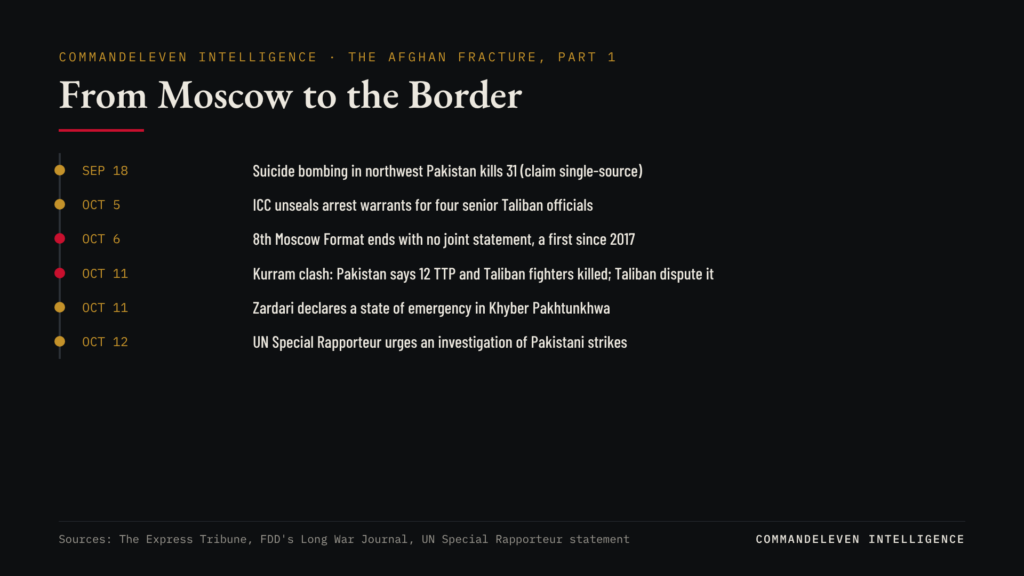
- [CONFIRMED] The 8th Moscow Format Consultations (October 6, 2026) ended without a joint statement for the first time in the forum’s history, after Pakistan and the Taliban could not agree on language linking Afghanistan to terrorism.
- [CONFIRMED] Pakistan’s Special Representative for Afghanistan, Ambassador Mohammad Sadiq, told the Moscow meeting that more than 4,700 Pakistanis had died in three years from terrorism originating in Afghanistan, and named the Tehreek-e-Taliban Pakistan (TTP) directly. Taliban Acting Foreign Minister Amir Khan Muttaqi rejected the accusation and called Pakistan’s cross-border strikes a violation of international law.
- [CONFIRMED] Border clashes followed within days in Kurram district, Paktia province and Dand Patan, including an October 11 incident Pakistan says killed 12 TTP and Afghan Taliban fighters, which the Taliban’s 203 Mansouri Corps disputes.
- [CONFIRMED] On October 11, Pakistani President Asif Ali Zardari declared a state of emergency in Khyber Pakhtunkhwa and suspended the provincial government, run by Imran Khan’s party, over its handling of militancy, against a backdrop of protests demanding Khan’s release.
- [CONFIRMED] The ICC unsealed arrest warrants for four senior Taliban officials on crimes-against-humanity charges on October 5. On October 12, UN Special Rapporteur on Afghanistan Richard Bennett called for an independent investigation into Pakistani cross-border strikes and urged the ICC to act on them as well.
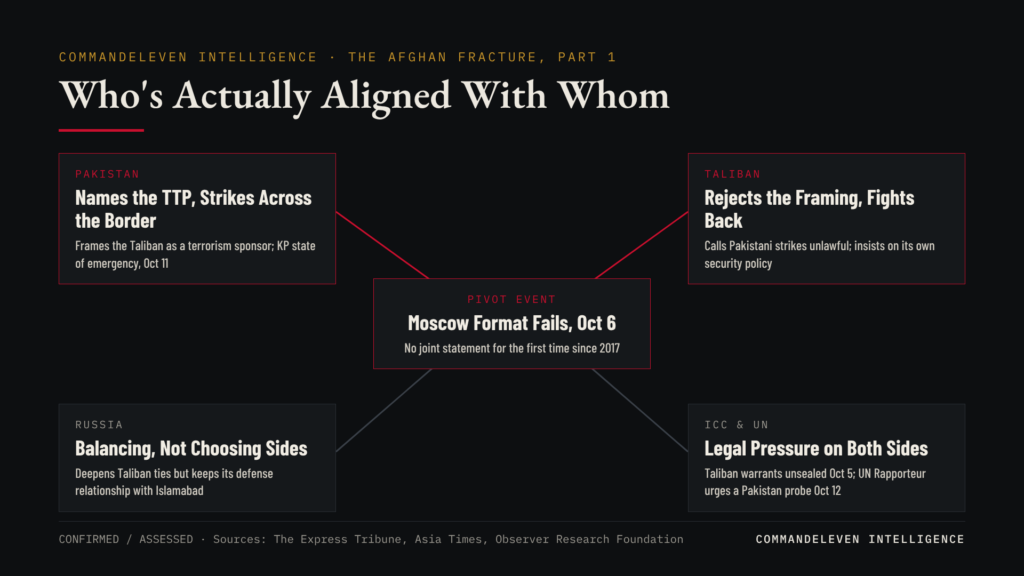
- [ASSESSED] The failure to produce a joint statement reflects a genuine and widening gap between Pakistan’s framing of the Taliban as a terrorism sponsor and the Taliban’s framing of itself as the target of unlawful force, not a routine drafting dispute. Russia’s special presidential envoy for Afghanistan, Zamir Kabulov, said he found the Taliban’s objection to the terrorism language “surprising,” since similar wording had passed in last year’s statement. That suggests the shift originated on the Taliban side rather than from prior Russian-Taliban coordination against Pakistan.
- [SINGLE-SOURCE] Pakistan traces the immediate trigger to a September 18, 2026 suicide bombing in northwestern Pakistan that killed 31 people, claimed by a group called Ittehad ul Mujahideen Pakistan. The claim was reported by one outlet (FDD’s Long War Journal) and has not yet been independently corroborated elsewhere in our sourcing.
- [EXCLUDED] This is not, on the current record, a Russia-Pakistan rupture. Regional analysts (Asia Times, Observer Research Foundation) argue Moscow is balancing its Taliban outreach against a still-active defense and counterterrorism relationship with Islamabad, not abandoning it.
What Broke at Moscow
The Moscow Format has run since 2017 as Russia’s preferred venue for coordinating regional positions on Afghanistan. It brings together Russia, Pakistan, China, Iran, India and the Central Asian states, with the Taliban included as the de facto Afghan government since 2021. The eighth round, held October 6, 2026, was opened by Russian Foreign Minister Sergey Lavrov, who praised the Taliban’s record since 2021 and described their administration as a “national government.” That is consistent with Russia’s formal recognition of Taliban rule in 2025, the first country to extend it.
The breakdown came over text, not atmosphere. Pakistan’s delegation, led by Ambassador Mohammad Sadiq, pushed to name the TTP and quantify Pakistani deaths from Afghan-origin terrorism in the closing statement. The Taliban delegation, led by Muttaqi, rejected the framing as propaganda and insisted any disputes be resolved through dialogue rather than military action, while asserting Afghanistan’s right to set its own security policy. Kabulov said afterward that the Afghan side’s objection to repeated references linking Afghanistan to terrorism was unexpected, given that comparable language had cleared the previous year’s statement without incident. No joint statement was issued, the first time that has happened at this forum.
From Diplomatic Failure to Border War
The diplomatic failure did not stay contained to a communiqué. Within days, fighting broke out along the Pakistan-Afghanistan border. On October 11, Pakistan said its forces killed 12 TTP militants and Afghan Taliban fighters in Kurram district, losing one soldier of its own. The Taliban’s 203 Mansouri Corps gave a different account of a clash in Dand Patan, saying Pakistani forces fired first and that it suffered no casualties. Separate reporting described clashes in Aryob Zazi that displaced local residents.
Pakistan’s internal politics absorbed the shock directly. On October 11, President Zardari declared a state of emergency in Khyber Pakhtunkhwa, the province bordering Afghanistan, and suspended its provincial government, which is run by former Prime Minister Imran Khan’s party. The federal cabinet accused the provincial government of insufficient action against militancy. The move landed amid ongoing protests demanding Khan’s release from custody, layering a domestic political crisis directly on top of the security one. Each side continues to blame the other for the underlying cause. Pakistan accuses the Taliban of sheltering the TTP and other militant groups, pointing to the September 18 suicide bombing that killed 31 people. The Taliban deny this and characterize Pakistan’s cross-border strikes into Afghan territory as the actual escalation.
The Accountability Track: ICC Warrants and a UN Rapporteur’s Warning
A third track opened almost simultaneously. On October 5, 2026, the International Criminal Court unsealed arrest warrants for four senior Taliban officials on charges of crimes against humanity, a case that predates the current border crisis but landed in the same news cycle as the Moscow Format’s collapse. One week later, on October 12, UN Special Rapporteur on the situation of human rights in Afghanistan Richard Bennett called for an independent investigation into Pakistani strikes that he said may themselves constitute war crimes, and urged the ICC to examine them as well.
The effect is that both parties to the border conflict are now facing, or inviting, international legal scrutiny at the same time: the Taliban through an existing ICC case, and Pakistan through a UN official’s call for the ICC to open a new one. Neither case is likely to move quickly, but both raise the diplomatic cost of the conflict continuing and give each side a legal framing to deploy against the other.
What This Does and Doesn’t Establish
This record establishes that the Moscow Format’s consensus-management function has failed for the first time, that the Pakistan-Taliban relationship has moved from diplomatic friction to active border fighting, and that both sides now face international legal pressure arising from it. It does not establish that Russia is abandoning its relationship with Pakistan in favor of the Taliban. The regional-analyst consensus we reviewed (Asia Times, ORF) reads Moscow’s posture as balancing, driven primarily by ISIS-K and Central Asian security concerns rather than by hostility to Islamabad. Part 2 covers this in detail, along with India’s separate, more cautious channel to Kabul. It also does not establish any confirmed role for Western intelligence services in the current crisis; Part 3 sets out exactly what the public record does and does not support on that question.
Readers should treat the September 18 bombing’s attribution to Ittehad ul Mujahideen Pakistan as single-source pending further corroboration, and should note that casualty figures from the border clashes come from the parties themselves and have not been independently verified by a neutral monitor as of publication.
Frequently Asked Questions
Why did the Moscow Format fail to produce a joint statement this year?
Pakistan pushed to name the TTP and quantify Pakistani deaths from Afghan-origin terrorism in the closing text; the Taliban delegation rejected that framing and the two sides could not agree on language. Russia’s envoy said the Taliban’s objection was unexpected, given that similar wording had passed the previous year.
Is Russia siding with the Taliban against Pakistan?
Not on the current record. Russia has deepened its Taliban relationship through recognition in 2025, a 2026 military-technical agreement and Taliban observer status at the Center-2026 exercises. Regional analysts assess this as driven by counterterrorism and Central Asian security concerns, alongside a continuing defense relationship with Pakistan, rather than a strategic choice against Islamabad. We examine this in Part 2.
What triggered the latest round of border fighting?
Pakistan points to a September 18, 2026 suicide bombing that killed 31 people, claimed by a group called Ittehad ul Mujahideen Pakistan, and to the Taliban’s alleged sheltering of the TTP. The Taliban deny sheltering the TTP and point to Pakistan’s cross-border strikes as the actual escalation. Both framings are contested and this piece does not adjudicate between them.
Does this piece cover CIA or MI6 involvement with the Taliban?
No. That question is covered in Part 3, which sets out what the public record confirms, what rests on a single source and what remains speculation.
Sources
- The Express Tribune, Pakistan, Taliban clash at Moscow talks
- FDD’s Long War Journal, Situation update, October 12, 2026
- The Express Tribune, Russia’s Taliban gamble
- Asia Times, Russia courts the Taliban without dropping Pakistan
- Observer Research Foundation, The Strategic Logic Driving Russia’s Taliban Engagement
- UN Security Council, Resolution 2816 (2026) meeting record
The Afghan Fracture Series
Series Introduction: The Afghan Fracture
- The Afghan Fracture: The Moscow Format Collapse and the Pakistan-Taliban War – Part 1 (you are here)
- The Afghan Fracture: Russia, India, and the Taliban’s New Balancing Act – Part 2
- The Afghan Fracture: The CIA, MI6, and the Taliban, What the Record Actually Supports – Part 3