CommandEleven Intelligence // The Afghan Fracture, Part 2 of 3. Part 1 covered the Moscow Format’s collapse and the Pakistan-Taliban border war that followed it. This part asks the question that collapse raised: what is Russia actually doing with the Taliban, where does India fit, and where does the evidence run out.
The honest answer is less dramatic than the headlines suggest. Russia is deepening ties with Kabul without abandoning Islamabad. India is engaging without recognizing. Neither is forming a bloc, and one widely circulated claim about Indian money funding Taliban weapons purchases does not hold up to scrutiny.
Key Judgments
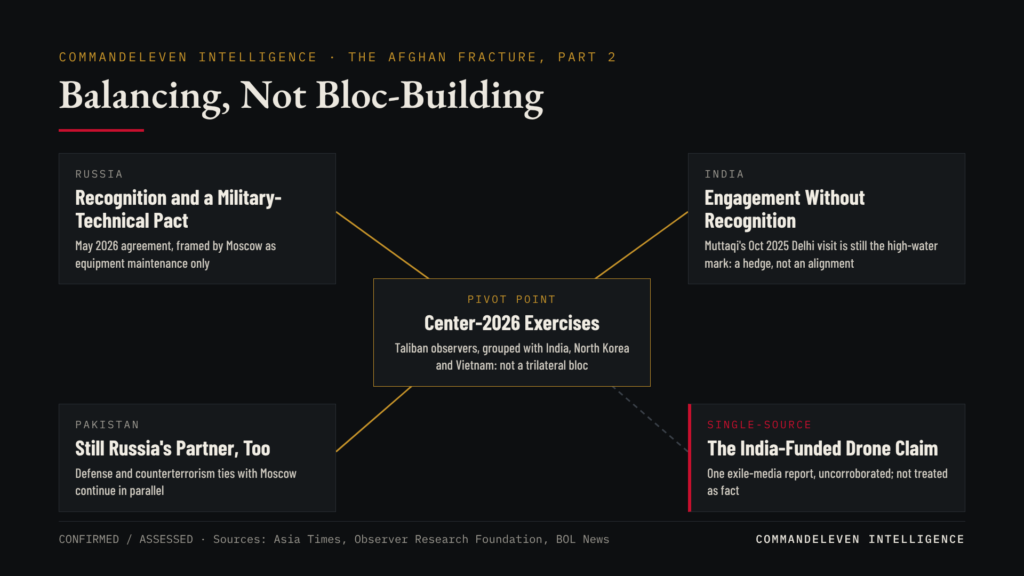
- [CONFIRMED] Russia and the Taliban signed a military-technical agreement in May 2026. Its full text has not been published; Russia’s own envoy has described it as centered on maintaining equipment Afghanistan already holds, not new transfers.
- [CONFIRMED] From September 28 to October 3, 2026, Russia’s Center-2026 exercises in Chelyabinsk included a Taliban military delegation as observers, Moscow’s first such invitation since 2021. The Taliban were grouped with observer delegations from India, North Korea and Vietnam; Pakistani troops took part in the exercise itself.
- [CONFIRMED] Russia formally recognized the Taliban government in July 2025, the first country to do so, and has encouraged other states to follow.
- [CONFIRMED] The most recent high-level Taliban-India contact remains Taliban Acting Foreign Minister Amir Khan Muttaqi’s October 2025 visit to New Delhi, the first by a senior Afghan leader since 2021, taken under a UN travel waiver and following his meetings in Russia. India has not formally recognized the Taliban government. It maintains a limited diplomatic presence in Kabul, reopened in 2022 for aid coordination, while Afghanistan’s own embassy in New Delhi has been closed since 2023.
- [ASSESSED] Regional analysts (Asia Times, Observer Research Foundation) read Russia’s posture as driven primarily by ISIS-K and Central Asian security concerns and by a wish to preserve regional influence as the Western presence recedes, not by a strategic choice of the Taliban over Pakistan. Russia has simultaneously continued defense and counterterrorism cooperation with Islamabad.
- [ASSESSED] India’s engagement reads as hedging rather than alignment: maintaining a channel to Kabul mainly to avoid ceding influence there to Pakistan or China, while withholding the legitimacy of formal recognition.
- [SINGLE-SOURCE] One Afghan exile-media report, cited secondhand in regional press, alleges Indian financing behind Taliban purchases of Belarusian drones and other weapons. The claim is unproven: it rests on a single outlet’s reporting, is not corroborated by any other source we reviewed, and is treated by the regional analysts citing it as an open lead rather than an established fact. We report it only to flag that it is circulating, not as something CommandEleven Intelligence assesses to be true.
- [EXCLUDED] There is no sourced basis for treating Russia-Taliban-India contact at Center-2026 as a coordinated bloc. The three were present in the same observer category alongside North Korea and Vietnam; no joint statement, communiqué or trilateral engagement has been reported.
What Russia Is Actually Doing
Moscow’s Taliban outreach did not begin with the Moscow Format’s collapse; it has been building since the Taliban were delisted and then formally recognized in 2025. The May 2026 military-technical agreement extended that relationship into the security domain, though Russia’s own description of it, helping Afghanistan maintain equipment it already possesses, is considerably narrower than unverified Afghan reporting, which claims Kabul has also requested air-defense systems and help reviving grounded aircraft. CommandEleven Intelligence treats the broader request as unconfirmed; the maintenance framing is the only part Russian officials have put on record.
The Center-2026 exercises added a visible, if limited, military dimension. A Taliban delegation observed the drills from September 28 to October 3, grouped with observers from India, North Korea and Vietnam, while Pakistani troops participated directly. Regional analysts caution against reading too much into the seating chart: observer status is not an alliance, and Russia’s own envoy has continued to describe Islamabad as a partner on defense and counterterrorism even as Moscow’s Taliban ties grow. The pattern that emerges is balancing, not bloc-building. Russia wants influence in Kabul, primarily to contain ISIS-K and prevent instability from reaching Central Asia, without writing off a still-functional Pakistan relationship.
Where India Actually Stands
India’s Taliban policy has moved in small, deliberate steps since 2021: a limited technical presence in Kabul from 2022 to coordinate humanitarian aid, and Muttaqi’s October 2025 visit to New Delhi under a UN-granted travel waiver. That visit is still the highest-level contact between the two sides and, notably, followed Muttaqi’s own meetings in Moscow rather than preceding them. India’s Ministry of External Affairs welcomed the visit in the language of dialogue, not partnership, and formal recognition has not followed. Observers in both New Delhi and Islamabad read the engagement primarily as India positioning itself to counterbalance Pakistani influence in Afghanistan, rather than as a strategic embrace of the Taliban government.
The one claim that would meaningfully change this picture, that Indian money is financing Taliban purchases of Belarusian drones, does not currently clear CommandEleven Intelligence’s sourcing bar. It traces to a single Afghan exile-media report, has not been corroborated by any other outlet or official source in our review, and is treated even by the regional analysts who cite it as an unproven lead rather than a documented fact. We are naming it because it is circulating, not because we assess it to be true.
What This Does and Doesn’t Establish
This record establishes that Russia has built a real, multi-track relationship with the Taliban, through recognition, a military-technical agreement and exercise-observer status, and that India maintains a separate, more cautious channel built around aid coordination and occasional high-level dialogue. It does not establish that either Moscow or Delhi has chosen the Taliban over Pakistan, that the three were coordinating at Center-2026, or that Indian financing is behind any specific Taliban weapons purchase. The military-technical agreement’s scope beyond equipment maintenance, and the drone-financing claim specifically, should both be read as open questions rather than settled facts. Part 3 turns to the question this series held back: what the public record supports on Western intelligence and the Taliban.
Frequently Asked Questions
Is Russia arming the Taliban?
Confirmed reporting describes a May 2026 military-technical agreement focused on maintaining equipment Afghanistan already has. An unverified Afghan report claims a broader request for air defense and aircraft support; Russian officials have not confirmed that broader scope.
Does India’s Taliban outreach mean it is aligning with Russia and the Taliban against Pakistan?
No sourced evidence supports that. India’s engagement predates and is separate from the current Pakistan-Taliban crisis, has not produced recognition, and analysts read it as a hedge against Pakistani influence rather than an alignment with Moscow or Kabul.
Is India funding Taliban weapons purchases?
That claim comes from a single Afghan exile-media report and has not been corroborated elsewhere. We report that it is circulating; we do not assess it as established.
Sources
- Asia Times, Russia courts the Taliban without dropping Pakistan
- Observer Research Foundation, The Strategic Logic Driving Russia’s Taliban Engagement
- The Express Tribune, Russia’s Taliban gamble
- BOL News, Taliban FM begins first visit by senior Afghan leader to India since 2021
- World Politics Review, India Makes Nice With the Taliban
The Afghan Fracture Series
Series Introduction: The Afghan Fracture
- The Afghan Fracture: The Moscow Format Collapse and the Pakistan-Taliban War – Part 1
- The Afghan Fracture: Russia, India, and the Taliban’s New Balancing Act – Part 2 (you are here)
- The Afghan Fracture: The CIA, MI6, and the Taliban, What the Record Actually Supports – Part 3