CommandEleven Intelligence Desk // Tradecraft Desk, Tradecraft Primer. Part of the series How CommandEleven Intelligence Thinks.
Bottom Line Up Front
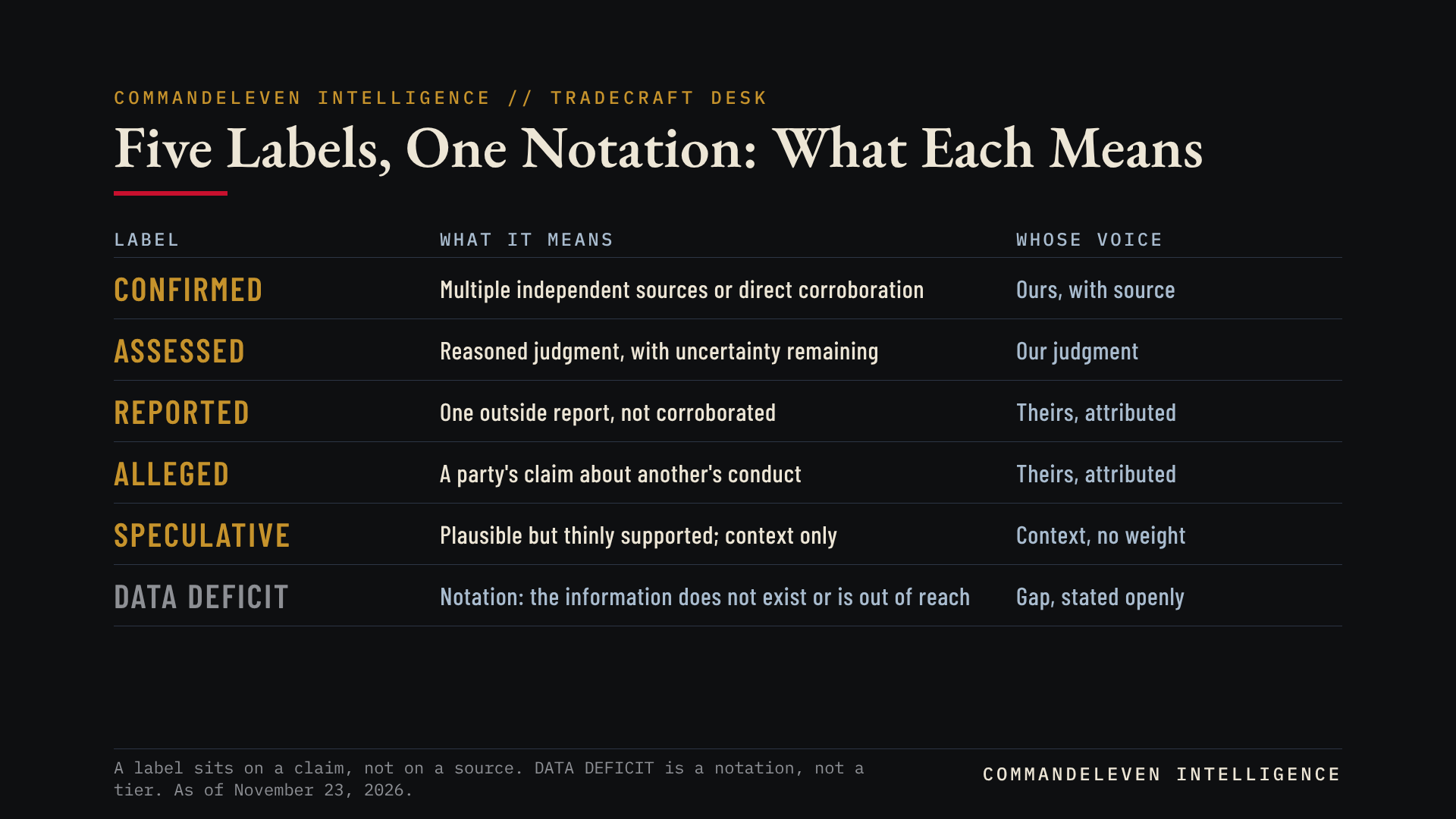
A confidence tier is a label on a claim that tells the reader how much weight it can bear. Every claim in a CommandEleven Intelligence dossier is meant to carry one: CONFIRMED, ASSESSED, REPORTED, ALLEGED or SPECULATIVE, with DATA DEFICIT used as a notation when the information does not exist or cannot be reached. The labels separate what we can document from what we judge and from what someone else has claimed.
The tier is not decoration. It is the reader’s way to check us. If a statement reads as certain, the label should show that it is. If it rests on one report or one accusation, the label should say so, and no graphic, headline or summary is allowed to sound more certain than the text it rests on.
Why Label Confidence at All
An assessment that does not show its confidence forces the reader to guess. Two sentences can sound the same and rest on very different ground: one on a document anyone can read, the other on a single unverified account. US intelligence standards deal with this directly. Intelligence Community Directive 203 asks analysts to separate underlying information from their own assumptions and judgments, to describe the quality and credibility of their sources, and to explain how uncertain their major judgments are and why.
We follow the same logic in public. The tiers keep three things apart that are easy to blur: what the evidence shows, what we conclude from it, and what others say.
The Tiers
Each label has a specific meaning, and the meaning stays the same in every dossier.
CONFIRMED
Supported by multiple independent sources or direct corroboration. A confirmed claim has been checked, typically against a primary document or against sources that do not depend on one another. It is stated as fact, with its source. Reporting from a major established news organization, such as CNN, the New York Times or the Wall Street Journal, is labeled CONFIRMED on that outlet’s credibility, not ours, and we name the outlet.
ASSESSED
A reasoned judgment based on available evidence, with remaining uncertainty. This is our own analysis. It is marked as judgment so that nobody mistakes it for a documented fact, and it is paired with what would change our mind.
REPORTED
A claim that rests on a single outside report that we have not corroborated, from a source without that standing. We say who reported it and we do not vouch for it. A reported claim can still matter, but the reader should know that it stands on one leg.
ALLEGED
A claim made by a party to a dispute or a legal case, such as prosecutors, a government or a group, about someone else’s conduct. We present it as that party’s claim and attribute it, and we do not treat an accusation as an established fact. Where a group denies an allegation, we note the denial.
SPECULATIVE
Plausible but thinly supported, offered for context only. A speculative claim is never folded into the key judgments and never carries weight in the conclusion.
DATA DEFICIT
DATA DEFICIT is not a confidence level. It is a notation that the information we would need does not exist or is not available. Saying so openly is more useful than filling the gap with a guess.
How a Rating Becomes a Tier
The tier is the end of a chain. Before a claim is promoted into analysis, the Vetting Matrix grades the source for reliability (A to F) and the information for credibility (1 to 6), and the claim must pass Triple-Node Verification. Single-source publication is prohibited, so a claim that rests on one report or one accusation does not stand alone. If the source is a major established news organization, we label the claim CONFIRMED on that outlet’s credibility and name it. Otherwise it carries the REPORTED or ALLEGED label, with its source named.
Put simply, the ranks grade what comes in, and the tier is the label a reader sees on the finished claim.
Tier and Likelihood Are Different Things
Two ideas are often run together. Confidence is how much weight the evidence and reasoning can bear. Likelihood is how probable an event is. A forecast can be highly likely and rest on thin evidence, or unlikely and rest on solid evidence. ICD 203 notes that confidence depends on the logic and the quantity and quality of the sources, and it tells analysts not to combine a stated confidence level and a degree of likelihood in the same sentence. We keep them apart for the same reason.
For likelihood, the standard reference is the scale in ICD 203, which attaches words such as “unlikely,” “likely” and “very likely” to probability ranges.
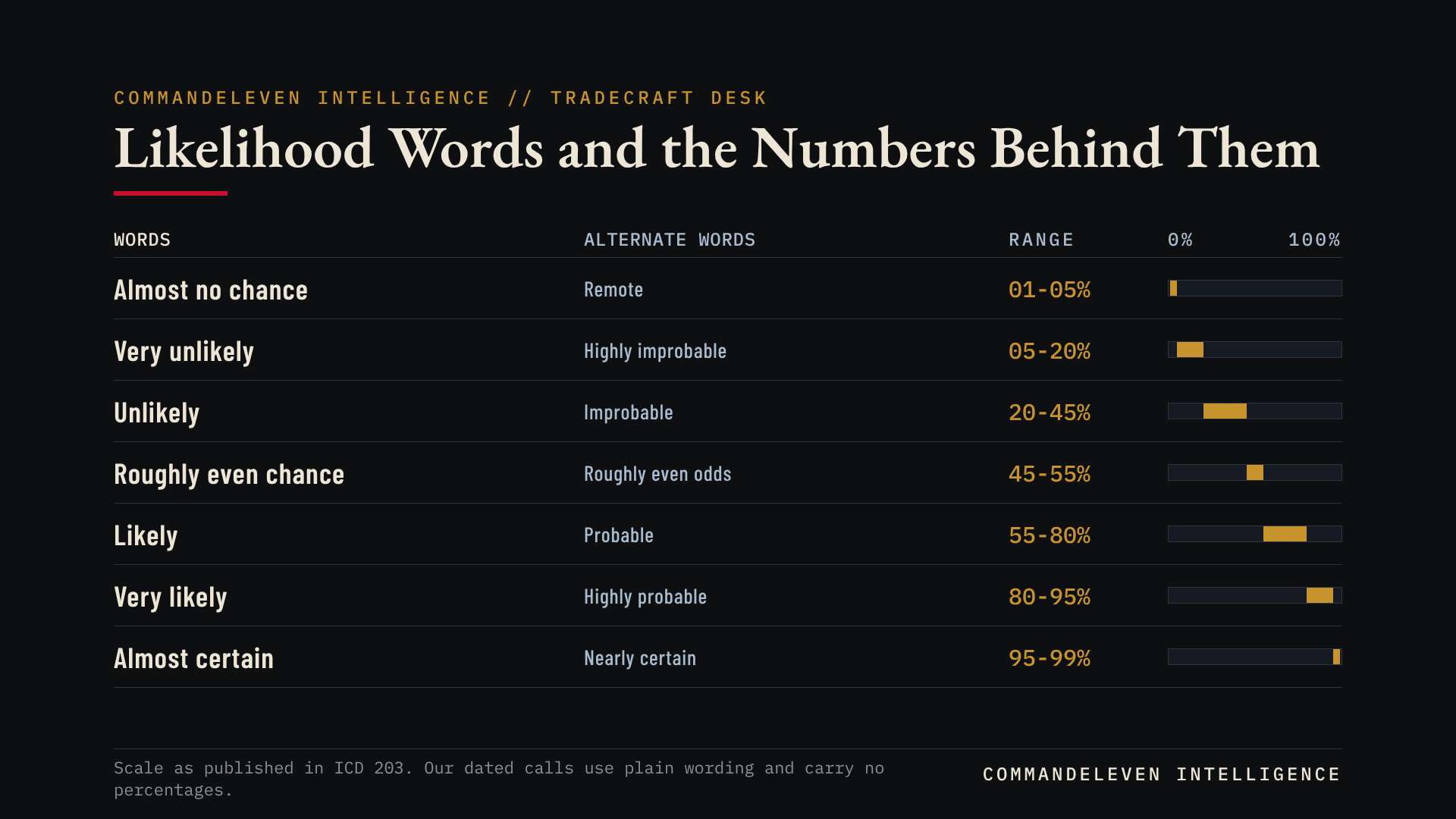
Our dossiers use plain wording in the same spirit, such as “most likely” and “could,” and the dated calls we register on the Foresight Record carry no percentages. The point of a call is the date and the outcome, which we then score against what happened.
Rules We Hold Ourselves To
- A single source without established credibility is never CONFIRMED. One report or one accusation from such a source is labeled REPORTED or ALLEGED, with its source named. A major established outlet is CONFIRMED on its own credibility, and we name it.
- The label matches the text. A graphic, headline or summary is never more certain than the paragraph it illustrates.
- Judgment is marked as judgment. Anything that is our analysis rather than a documented fact carries ASSESSED.
- Speculation stays out of the conclusions. SPECULATIVE material is context only and never appears in the key judgments.
- Tiers change when evidence changes. If events contradict an assessment, the tier changes and the correction is shown in a Revision Annex, not buried.
- Gaps are stated. Where the information does not exist, we write DATA DEFICIT instead of guessing.
How to Read the Labels in a Dossier
Every dossier ends with a short legend, “How to Read Our Labels,” that defines each label. In the key judgments, a CONFIRMED claim comes with its source, an ASSESSED claim comes with its reasoning and what would change it, and a REPORTED or ALLEGED claim names who said it. For a worked example, see Al Qaeda Aviation Threat: What the FBI-DHS-TSA Warning Means for US Air Travel.
Frequently Asked Questions
What is a confidence tier?
A label on a claim that tells the reader how much weight it can bear. Ours are CONFIRMED, ASSESSED, REPORTED, ALLEGED and SPECULATIVE.
What is the difference between REPORTED and ALLEGED?
REPORTED is a claim that rests on a single outside report we have not corroborated, from a source without established standing. ALLEGED is a claim made by a party, such as a prosecutor or a government, about someone else’s conduct. Both are attributed to their source and neither is treated as established.
Is ASSESSED the same as probable?
No. ASSESSED marks a judgment that is ours, based on the evidence, with uncertainty remaining. It tells you the claim is analysis, not a documented fact. Likelihood is a separate question.
Why does a claim sometimes get no tier at all?
It should not. Where the information does not exist, we say so with the notation DATA DEFICIT, and where it is thin we use SPECULATIVE.
Do you give probabilities?
Not on dated calls. We use plain wording and register each call on the Foresight Record, where it is scored against what happened.
What should I read next?
Structured Analysis: Testing Our Own Thinking explains the techniques behind our ASSESSED judgments.
Related CommandEleven Intelligence Reading
- How CommandEleven Intelligence Thinks: the series this primer belongs to, with every primer listed.
- Collection Disciplines and Source Reliability: the ratings that sit beneath the tiers.
- Analytical Methodology and Source Validation: the intelligence engine and the Vetting Matrix in full.
- Editorial Standards: the rules that govern what we publish.
- Foresight Record: where our dated calls are scored.
Sources
- Intelligence Community Directive 203, Analytic Standards, Office of the Director of National Intelligence: the standards on source quality, uncertainty, and separating information from judgment, and the likelihood scale.