CommandEleven Intelligence Desk // Tradecraft Desk, Tradecraft Primer. Part of the series How CommandEleven Intelligence Thinks.
Bottom Line Up Front
The Military Decision Making Process, usually shortened to MDMP, is the US Army’s structured method for turning a problem into a tested plan. A commander and staff work through a fixed sequence: understand the mission, develop several options, test each option against a thinking enemy, compare them, and only then choose and write the order. Intelligence is built into the process from the start and is one of its main inputs.
It matters outside the military because the logic is general. Any decision under uncertainty has the same parts: a clear statement of the problem, an honest picture of the environment, more than one option, a test of each option against what could go wrong, and a list of what would make you change course. This primer explains the process as Army publications describe it, where intelligence enters, and how our own service modules follow the same logic.
What MDMP Is
Army lessons-learned publications describe MDMP as a systematic process that lets commanders and their staffs apply critical and creative thinking to a problem and set up an effective decision. It is iterative: the staff goes back and refines earlier work as it learns more. It is also not a staff exercise run in isolation. The process is the means by which staffs turn the commander’s vision into a plan, and it works only when the commander is involved.
The current doctrinal source is the Army’s FM 5-0, Planning and Orders Production, dated May 2022. The Center for Army Lessons Learned publishes handbooks that supplement it with practical advice. We rely on those handbooks and on recent Army writing for the description below, and we say so in the sources.
The Steps
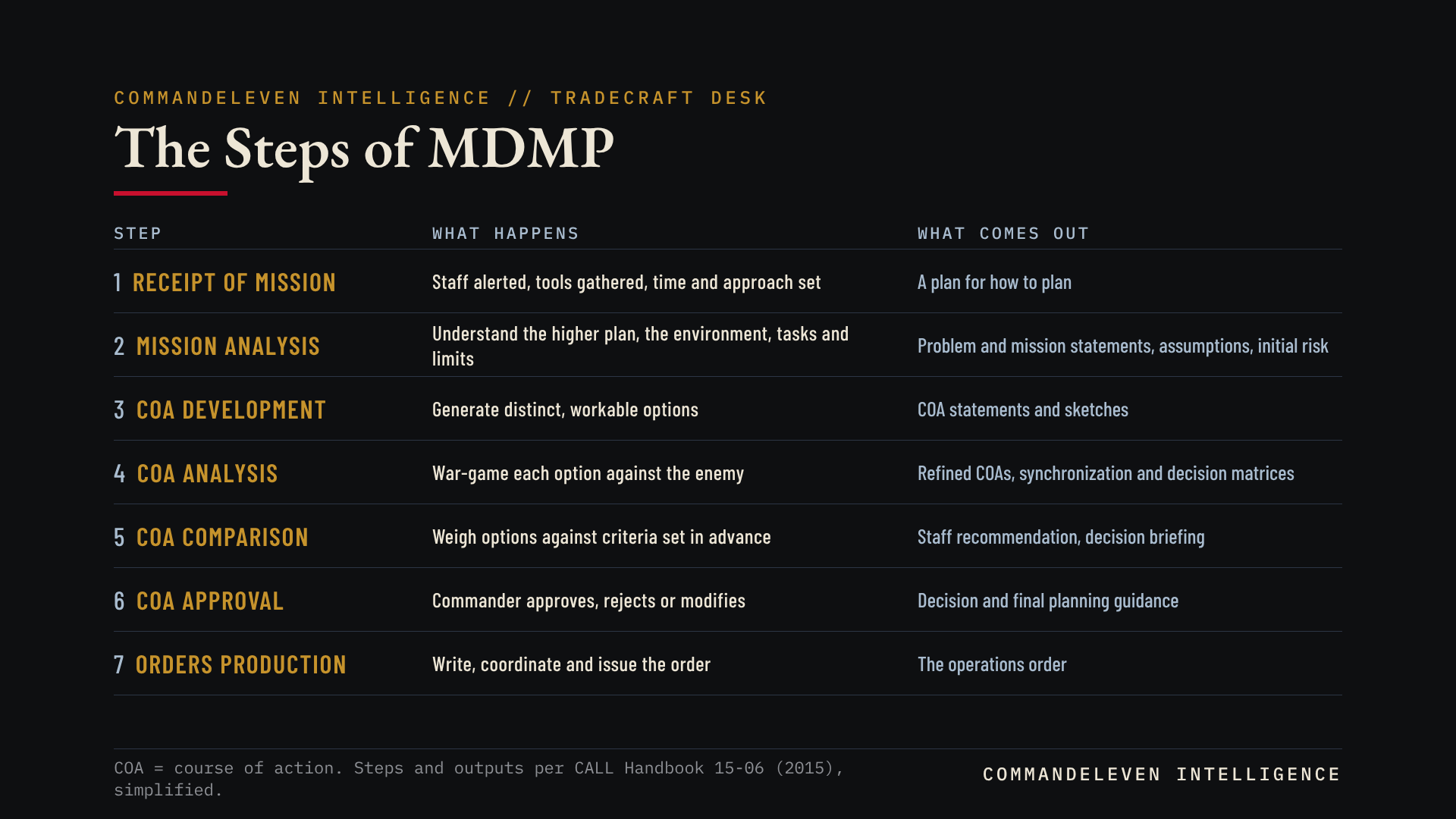
The Army’s handbook walks through the process in this order. Each step has a purpose and produces something the next step needs.
Receipt of Mission and Mission Analysis
On receipt of a mission, the staff is alerted, gathers its planning tools and works out how much time it has and how it will plan. Mission analysis then defines the problem. The staff studies the higher headquarters’ plan, the operational environment and the tasks, constraints and resources that apply. Its outputs include a problem statement and mission statement, the key facts and assumptions, an initial risk assessment and an initial plan for collecting information, along with the commander’s initial intent and planning guidance.
Course of Action Development
A course of action, or COA, is a way of accomplishing the mission. The staff builds several that are distinct from one another and workable, each with a statement, a sketch and a broad concept. The aim is real alternatives, not one plan with cosmetic variations.
Course of Action Analysis
Each COA is war-gamed: the staff plays it forward against the enemy’s likely actions to expose problems, likely outcomes and decisions that will have to be made. The outputs include refined COAs, a synchronization matrix that lines up actions in time and space, and decision support templates and matrices that show where the commander will have to choose.
Comparison, Approval and Orders
The staff then compares the COAs, independently and against criteria the commander approved in advance, and briefs a recommendation. The commander may approve a COA, reject all of them, which sends the staff back to development, or modify one, which the staff must war-game again. After approval the commander issues final planning guidance, and the staff produces the order and issues it to subordinates.
Where Intelligence Enters
Intelligence is not a separate stage of MDMP. It runs through it. The Army handbook describes intelligence preparation of the battlefield, which analyzes the enemy, terrain, weather and civil considerations, as part of mission analysis and calls it “arguably the most important portion of the MDMP.” Its products, including models of what the threat could do, are what the staff uses to build and test its own COAs.
The war-game is where the enemy gets a vote. A plan that is only tested against what the enemy is expected to do is not tested. The handbook also ties the process to what comes after the decision: decision points come from the decision support template, and at a decision point the commander either continues with the current COA or selects a branch. That is the same idea as the indicators in our previous primer, applied to action: decide in advance what you will watch for, and what you will do if it appears.
How Our Services Follow the Same Logic
Our Intelligence as a Service modules are built around the same questions a planning staff asks. The mapping is ours, not doctrine, and the descriptions come from our own Services pages.
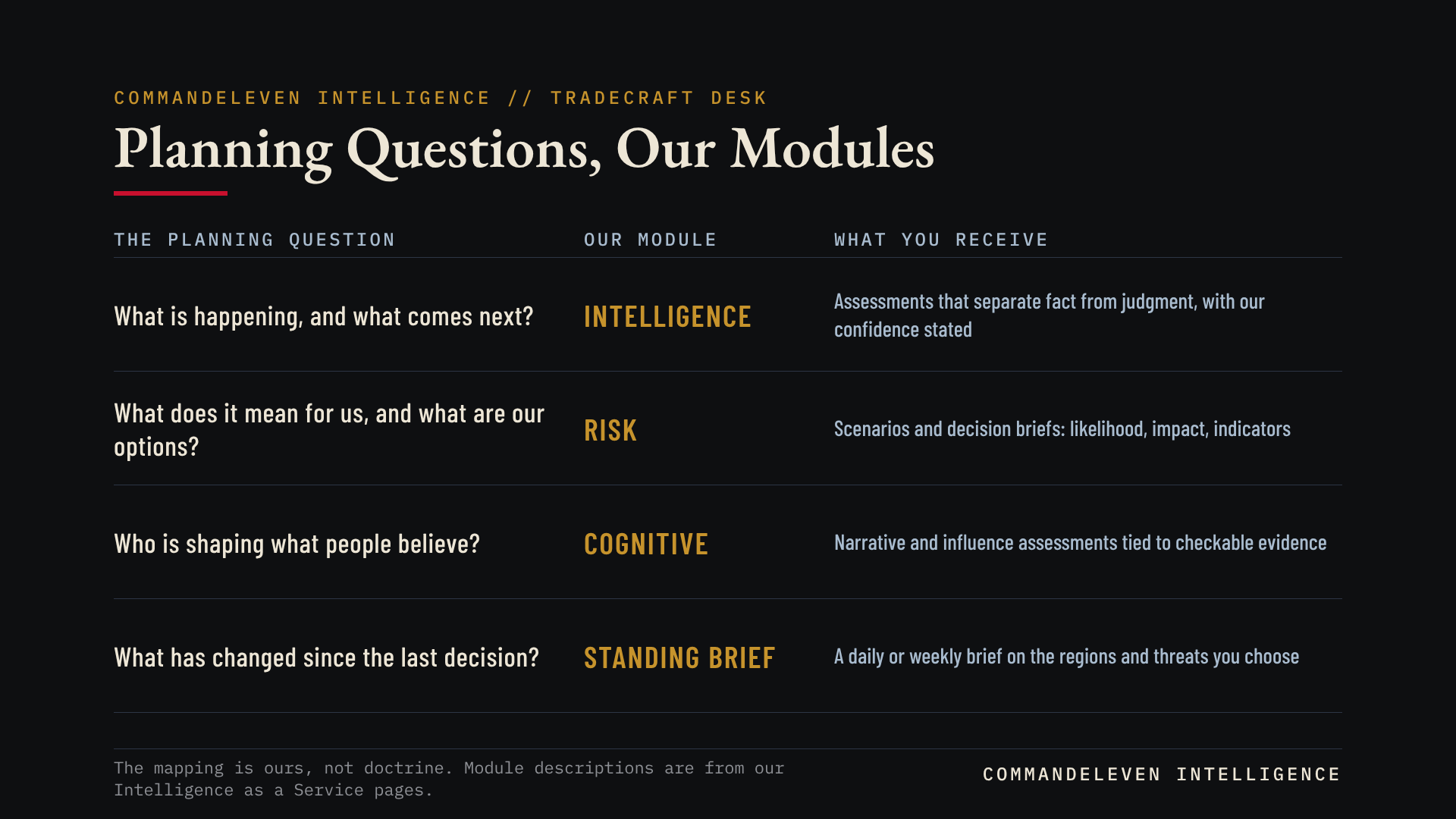
The Intelligence module answers what is happening and what is coming next, and every product separates confirmed fact from judgment and states our confidence. The Risk module answers what it means for the client and what to do about it, with scenario analysis and decision briefs that state likelihood, impact and the indicators that would change our view. The Cognitive module covers the part of the environment that is about belief and influence, which a plan also has to reckon with. All three can be delivered as a standing brief that keeps the picture current, which is the monitoring that comes after the decision. The Intelligence as a Service overview explains how the modules combine.
The same logic is why AI-enabled targeting and planning matter to us. Tools that compress the steps above change who decides and how fast, which our forthcoming AI in Warfare series examines.
A Worked Example: A Shipping Decision Run Through the Steps
This is an illustration of the logic, not a military plan and not a recommendation. Suppose a shipping operator must decide how to route cargo through the Red Sea region next quarter.
Mission analysis. The problem is not “is the region dangerous” but what the operator must decide, by when, and with what constraints on cost and delay. The intelligence picture comes in here. Our published work on the Bab al-Mandab and the Red Sea separates territorial gains from control of the passage, which is the kind of distinction mission analysis needs.
Options. The operator has at least three: keep the current route, reroute, or hold and decide in stages. Each is a real option with its own costs.
War-game. Each option is tested against what could go wrong: an escalation, a pause, a change in a key actor’s behavior. The test is not whether the favored route survives the expected case but where each option breaks.
Comparison and decision. The options are compared against criteria set in advance, such as safety, delay and cost, and a decision is made with the risk stated openly.
Decision points. The plan lists the indicators that would trigger a change, and what the operator would do if they appeared. That list is the bridge between planning and monitoring.
Common Planning Mistakes
A recent Army article on planning lists errors that apply well beyond the Army.
- Shallow mission analysis. Restating the order instead of finding the real problem. If analysis did not shape options for the commander, it did not do its job.
- Weak or one-time guidance. The commander gives direction once and does not refine it as the staff learns.
- Superficial war-gaming. The war-game defaults to “no change” and leaves the plan’s gaps untested.
- Misreading the adversary. Relying on generic threat diagrams or lessons from a different environment.
- Poor time management. The article notes that FM 5-0 suggests spending roughly 30 percent of the available time on mission analysis and 20 percent on COA development.
- Inflexible plans. No branches, no sequels, and no way to respond when the adversary does something unexpected.
Frequently Asked Questions
What is the Military Decision Making Process?
A structured US Army method in which a commander and staff define a problem, develop and test several courses of action, compare them, and issue an order.
What are the steps of MDMP?
Receipt of mission, mission analysis, course of action development, course of action analysis, course of action comparison, course of action approval, and orders production.
What is a course of action?
A way of accomplishing the mission, described in enough detail to be tested, compared and, if approved, turned into an order.
What is war-gaming in planning?
Playing a course of action forward against the enemy’s likely actions to find problems, likely outcomes and decisions that will have to be made.
Where does intelligence fit in MDMP?
Throughout. Intelligence preparation of the battlefield is part of mission analysis, and its products are used to build and test every course of action.
Is MDMP only for the military?
The process is military doctrine, but its logic of defining the problem, developing options, testing them against what could go wrong and listing what would change the decision applies to any decision under uncertainty.
What should I read next?
Writing for the Decision-Maker explains how an assessment is written so that the person who has to decide can use it.
Related CommandEleven Intelligence Reading
- How CommandEleven Intelligence Thinks: the series this primer belongs to, with every primer listed.
- Indicators and Warning: Knowing What to Watch For: the decision points that planning depends on.
- Threat, Vulnerability and Risk: Why a Threat Is Not a Risk: how a threat judgment becomes a statement of risk.
- The Intelligence Cycle: how intelligence is produced for the decision.
- Intelligence as a Service: our service modules and how they are delivered.
Sources
- Military Decisionmaking Process, CALL Handbook No. 15-06, Center for Army Lessons Learned, March 2015: the steps, their purposes and outputs, intelligence preparation of the battlefield, and decision points. This handbook predates the 2022 edition of FM 5-0.
- Military Decision-Making Process: Organizing and Conducting Planning, Center for Army Lessons Learned, November 2023: the purpose of MDMP, the role of the commander, and its relation to FM 5-0, Planning and Orders Production, May 2022.
- Planning: Preventing Preventable Problems in Military Decision-Making Process, Esli Pitts, US Army, April 2025: common planning mistakes and the time guidance in FM 5-0.