CommandEleven Intelligence Desk // Tradecraft Desk, Tradecraft Primer. Part of the series How CommandEleven Intelligence Thinks.
Bottom Line Up Front
Structured analysis is a set of methods that force an analyst to show their reasoning and try to break it. They exist because experienced people reach conclusions faster than they test them, and because an analyst who is sure of an answer tends to notice only the evidence that agrees. The methods make assumptions visible, set rival explanations side by side, and ask what would prove the favored view wrong.
Our methodology names three of these techniques: Analysis of Competing Hypotheses, Red Teaming and Indicator Monitoring. They sit between collection and the label a reader sees, and the aim is that an ASSESSED claim has had its reasoning tested, not merely stated. The methods do not guarantee a correct answer. They make a wrong one easier to catch before it is published.
Why Analysts Need a Method
Analysts work with incomplete, ambiguous and sometimes deliberately false information, and they do it with ordinary human minds. Doctrine describes this plainly. People build mental models of how the world works, and those models decide what gets noticed and remembered. Information that fits is accepted. Information that does not fit is often overlooked or explained away. Common habits make this worse: expecting what one already believes, anchoring on an early estimate, and assuming other people think the way we do.
None of this is a character flaw, and training alone does not remove it. The practical answer is to build the checks into the process, so the analysis does not depend on the analyst noticing their own blind spot.
Three Families of Technique
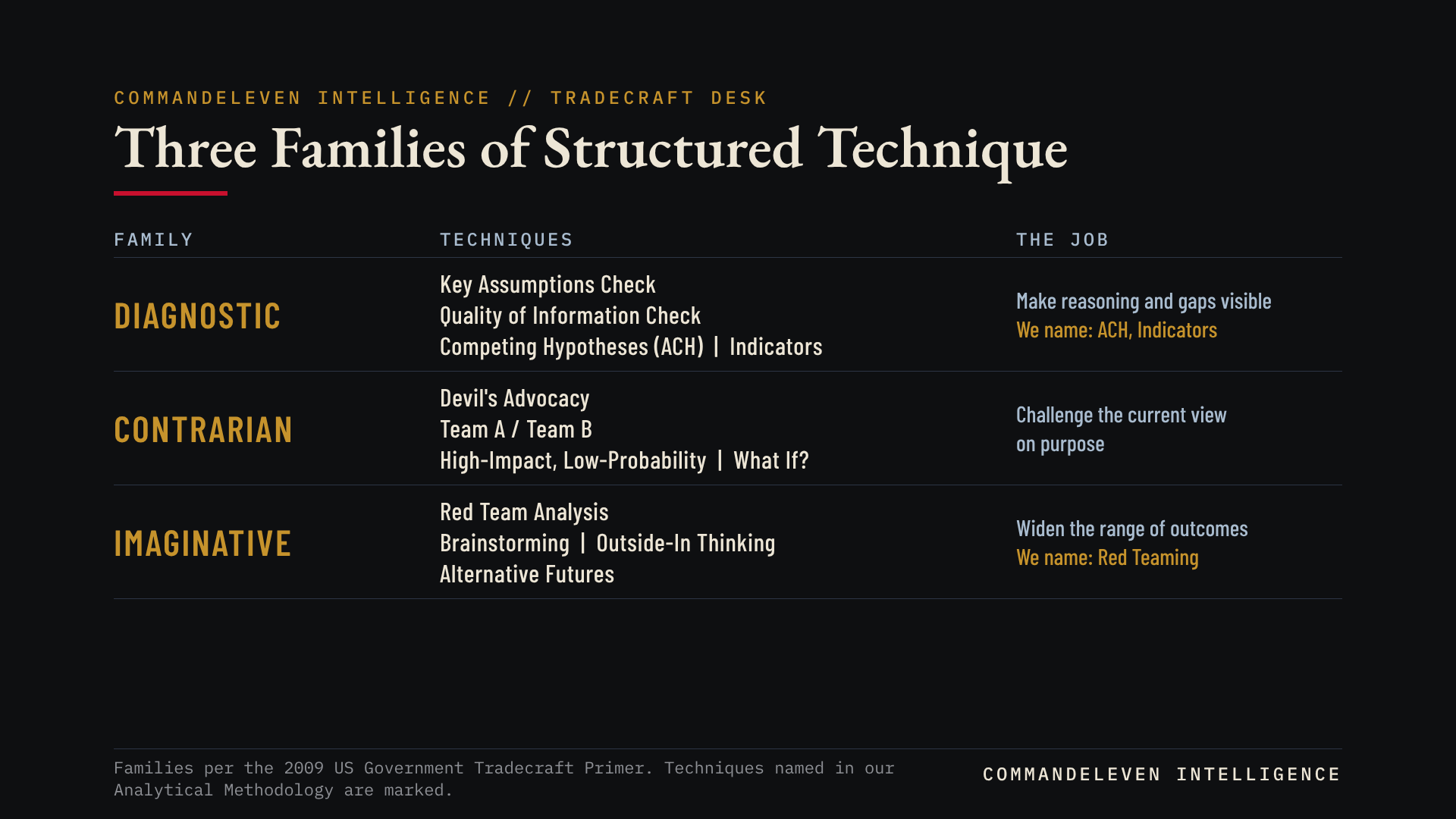
US analytic doctrine groups structured techniques by the job they do.
Diagnostic Techniques
These make arguments, assumptions and gaps in the evidence visible. A Key Assumptions Check lists what a judgment takes for granted and tests each item. Analysis of Competing Hypotheses compares rival explanations against all the evidence. Indicators or Signposts of Change list the observable events that would show a situation is moving.
Contrarian Techniques
These challenge the current view on purpose. Devil’s Advocacy builds the strongest case against a settled judgment. Team A and Team B have separate groups argue competing positions. High-Impact, Low-Probability Analysis examines an unlikely event whose consequences would be large.
Imaginative Thinking Techniques
These widen the range of possibilities. Red Team Analysis asks analysts to take an adversary’s culture, organization and incentives, so that they stop assuming the adversary reasons as they do. Alternative Futures Analysis and brainstorming produce outcomes nobody had written down.
Analysis of Competing Hypotheses
Analysis of Competing Hypotheses, usually shortened to ACH, was developed by Richards Heuer for CIA analysts. Its central idea is simple and counterintuitive: do not look for evidence that supports your favorite explanation, because such evidence is easy to find for almost any reasonable explanation. Look for the evidence that cannot be squared with a hypothesis, and rank the hypotheses by how much evidence works against them.
The procedure runs in eight steps. The analyst lists every plausible hypothesis, lists the evidence and arguments, and builds a matrix that scores each item against each hypothesis. The analyst then removes evidence that does not help tell the hypotheses apart, draws a tentative conclusion by looking at what is inconsistent, and checks how sensitive that conclusion is to a few key items, including the possibility of deception. The final steps are to report the relative likelihood of all the hypotheses and to set milestones for what would change the picture.
Two points matter most. Evidence that fits every hypothesis proves very little, and evidence that contradicts one of them is the most useful kind. And the matrix informs judgment. It does not replace it.
A Worked Example: What the Aviation Warning Does and Does Not Show
This is an illustration of the method, simplified to fit a page. It is not our full assessment, which is in Al Qaeda Aviation Threat: What the FBI-DHS-TSA Warning Means for US Air Travel.
Three rival explanations of the November 2026 warning can be set against four items of evidence.
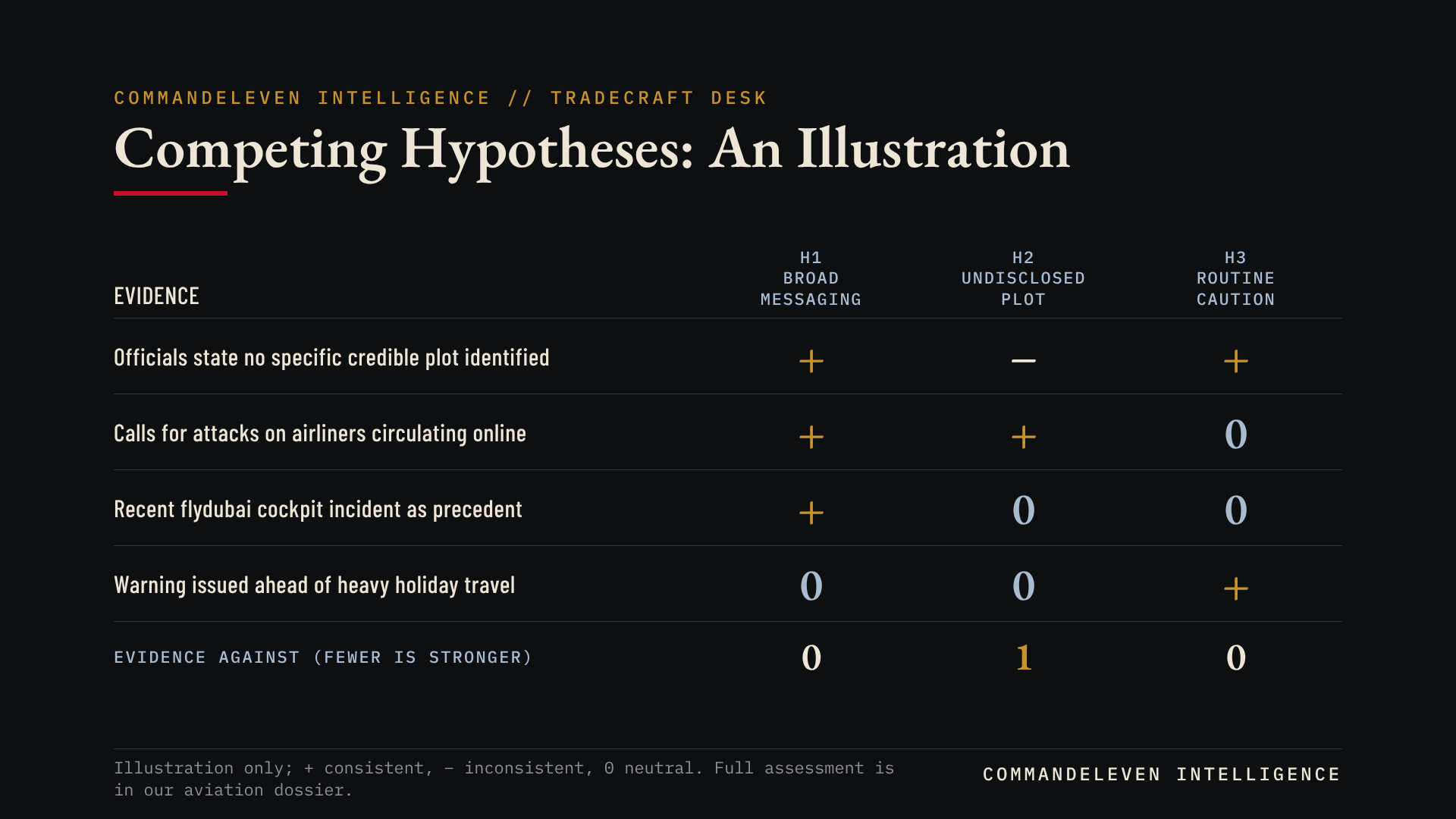
- H1: The warning reflects a broad rise in threat messaging, with no specific plot.
- H2: The warning reflects a specific, credible plot that officials have not disclosed.
- H3: The warning is mainly routine caution ahead of a heavy travel period.
Most of the evidence fits more than one explanation. Calls for attacks, the recent flydubai incident and the holiday timing are consistent with several hypotheses at once, so they do little to separate them. The item that separates H2 from the others is the statement that no specific credible plot has been identified. That makes it the most diagnostic evidence in the set, and it counts against H2.
A sensitivity check then asks the awkward question: what if officials are withholding what they know? That one assumption decides the outcome, so the honest conclusion is a judgment with a stated limit. H2 is the least supported on the public record, but it cannot be ruled out, and we list the developments that would change it. That is what an ASSESSED label should carry.
Red Teaming
Red Team Analysis fixes a different failure, mirror-imaging, which is the habit of assuming an adversary would act as we would. The analyst adopts the adversary’s view of the situation: their goals, their constraints, their organization and what they think we will do. It is most useful when the actor operates by different rules, such as an authoritarian leadership or a terrorist group. For public analysis, it also helps to ask what the opposing side’s own account of events would say, and why a reader on that side would find it persuasive.
How We Use Them
Our Analytical Methodology lists Analysis of Competing Hypotheses, Red Teaming and Indicator Monitoring among its analytical techniques. The intended use is as a check before a judgment is published: the hypotheses are written down, the evidence is scored against them, and the strongest alternative is argued. The result is a label and a plain statement of what would change our mind. Indicators carry that forward after publication, and the next primer, Indicators and Warning, covers how.
If events later contradict an assessment, the Revision Annex records the change and the Confidence Tiers label is revised.
Where Structured Analysis Goes Wrong
- Treating the matrix as a calculator. Counting marks gives a starting point. The analyst still has to judge how much each item weighs.
- Writing hypotheses that cannot lose. A hypothesis too vague to be contradicted teaches nothing.
- Leaving out the uncomfortable alternative. If the list of hypotheses omits the one the analyst dislikes, the method has already failed.
- Skipping deception. Evidence planted by an interested party looks, on the matrix, like any other evidence. The sensitivity check is where that gets tested.
- Doing it once. An analysis that is never revisited when new evidence arrives has stopped being structured.
Doctrine is candid about the limit: these techniques do not guarantee accurate judgments. What they improve is rigor, transparency and credibility, and the usefulness of the result to the person who has to decide.
Frequently Asked Questions
What is structured analysis?
A set of techniques that make an analyst’s assumptions and reasoning explicit and challenge them, so a conclusion is tested before it is published.
What is Analysis of Competing Hypotheses?
A method that compares several explanations against all the available evidence and ranks them by how much evidence contradicts each one, not by how much supports it.
Why look for contradicting evidence instead of supporting evidence?
Because supporting evidence is easy to find for nearly any plausible explanation. Evidence that cannot be reconciled with a hypothesis is far better at telling explanations apart.
What is red teaming in intelligence analysis?
Taking an adversary’s perspective, including their goals and constraints, to avoid assuming they would think and act as we do.
Do these techniques make an assessment correct?
No. They improve rigor and transparency and make errors easier to catch, but they do not guarantee accuracy.
What should I read next?
Indicators and Warning explains how a judgment is monitored after it is made.
Related CommandEleven Intelligence Reading
- How CommandEleven Intelligence Thinks: the series this primer belongs to, with every primer listed.
- Confidence Tiers: How We Label What We Know: the labels that structured analysis feeds.
- The Intelligence Cycle: where analysis sits in the wider process.
- Analytical Methodology and Source Validation: the techniques named in our methodology.
Sources
- A Tradecraft Primer: Structured Analytic Techniques for Improving Intelligence Analysis, prepared by the US Government, March 2009: the three families of technique, the techniques in each, and the caveat that they do not guarantee accuracy.
- Psychology of Intelligence Analysis, Richards J. Heuer, Jr., CIA Center for the Study of Intelligence, 1999: mind-sets and mental models, and Chapter 8 on Analysis of Competing Hypotheses.