CommandEleven Intelligence Desk // Tradecraft Desk, Tradecraft Primer. Part of the series How CommandEleven Intelligence Thinks.
Bottom Line Up Front
Threat, vulnerability and risk are three different things, and mixing them up is one of the most common errors in security writing. A threat is something that could cause harm. A vulnerability is a weakness that lets harm reach a target. Consequence is how much harm results. Risk is what you get when you consider all three together: the potential for an unwanted outcome, shaped by how likely it is and how bad it would be.
The practical rule is simple. A threat statement does not tell you the risk. A credible threat against a well-defended target can carry less risk than a vague one against an exposed target. This primer explains the three parts, how government frameworks define them, and how a threat judgment becomes a statement of risk.
The Three Parts
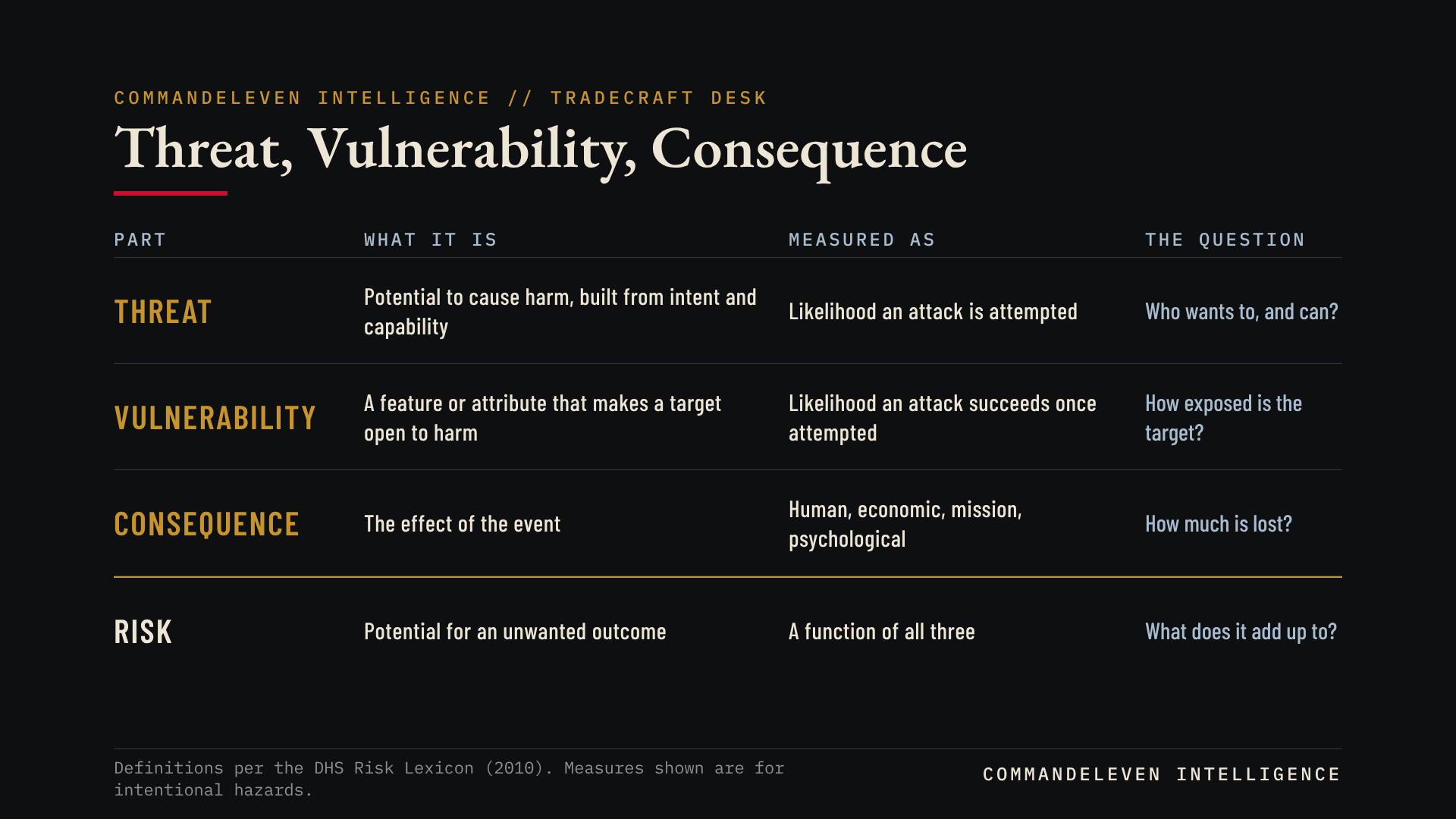
The US Department of Homeland Security defines risk as a function of threats, vulnerabilities and consequences associated with an event. Each part answers a different question.
Threat
DHS defines a threat as a natural or man-made occurrence, individual, entity or action with the potential to harm life, information, operations, the environment or property. For an intentional hazard, such as terrorism, the threat is usually estimated as the likelihood that an adversary attempts an attack, which in turn depends on two things: the adversary’s intent, meaning the desire to attack a type of target, and the adversary’s capability, meaning the means to do it. An adversary may have intent without capability, but a threat has both.
Vulnerability
DHS defines a vulnerability as a physical feature or operational attribute that makes an entity, asset, system, network or area open to exploitation or susceptible to a given hazard. For an intentional hazard, vulnerability is commonly measured as the likelihood that an attack succeeds once it is attempted. It describes the target, not the attacker.
Consequence
DHS defines consequence as the effect of an event, incident or occurrence. It is commonly measured in human, economic, mission and psychological terms. Consequence says how much it matters if the event happens.
Risk Is the Combination
DHS defines risk as the potential for an unwanted outcome resulting from an event, as determined by its likelihood and associated consequences. For intentional attacks, the likelihood splits in two: the chance that an attack is attempted (the threat) and the chance that it succeeds (the vulnerability). Put together with consequence, that gives the three parts.
The National Institute of Standards and Technology uses slightly different words for the same idea. Its risk assessment guide, written for information systems, defines risk as a function of the likelihood that a threat event occurs and the adverse impact if it does. It adds the idea of predisposing conditions, such as a facility in a flood-prone area, that raise or lower the chance that a threat event does damage. The vocabulary differs. The logic does not: who or what could cause harm, how exposed the target is, and how much is lost.
Same Threat, Different Risk
The reason to separate the parts is that the combination changes the answer.
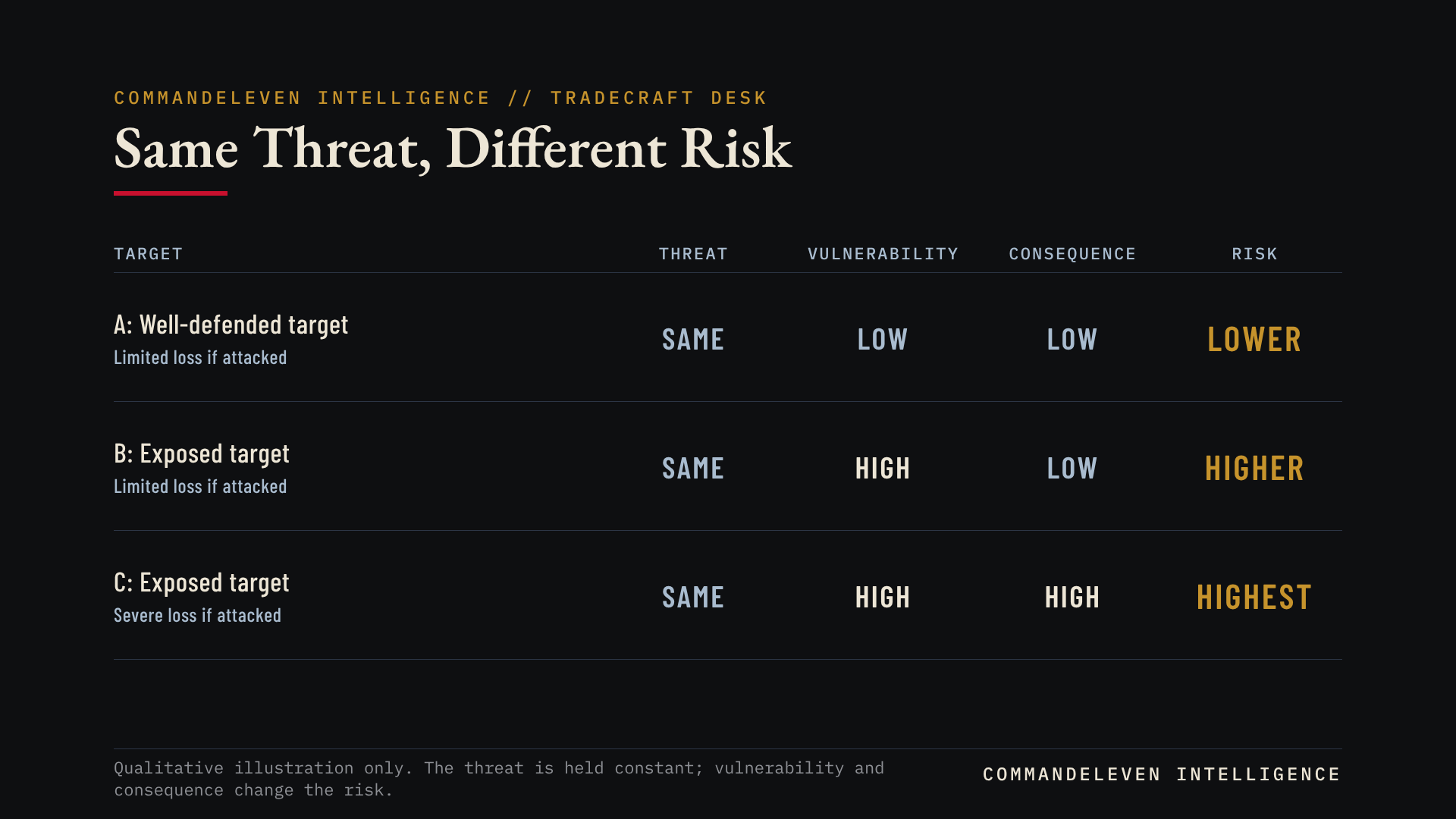
A single threat can produce very different risk depending on where it lands. It is lower against a hardened target with limited consequences, higher against an exposed target, and highest against an exposed target where the loss would be severe. A risk judgment that only looks at the attacker misses two of the three variables. One that only looks at weaknesses ignores whether anyone intends to exploit them.
A Worked Example: Reading the Aviation Warning as Risk
This is an illustration, continuing the example from the earlier primers. It is not our full assessment, which is in Al Qaeda Aviation Threat: What the FBI-DHS-TSA Warning Means for US Air Travel.
The threat question is whether an actor intends to attack aircraft and has the means to do it. That is what the structured analysis and indicators primers deal with, and it is where our ASSESSED judgments sit. The vulnerability question is how exposed air travel is to that kind of attack, which depends on defenses that a public article should not itemize. The consequence question is what a successful attack would cost in lives, money and confidence.
The warning itself speaks mostly to the first question. By itself it does not say the risk is high, because risk also depends on how likely an attempt is to succeed and how much would be lost. This is why we avoid turning a threat statement into a risk headline. We state what the evidence supports about intent and capability, say plainly where it stops, and keep the vulnerability and consequence questions separate.
How We Use the Distinction
In our work the three questions are kept apart on purpose. What an actor wants and can do is a threat judgment and carries a confidence tier like any other claim. How exposed a target is, and what would be lost, are separate judgments with their own evidence. When we describe risk, we say which part is doing the work, so that a reader can see whether a high rating comes from a capable adversary, an exposed target or a severe consequence.
Common Errors
- Calling a threat a risk. A threat says something could cause harm. Risk also needs exposure and consequence.
- Counting weaknesses without a threat. A long list of vulnerabilities means little if no one has the intent and means to exploit them.
- Assuming high consequence means high risk. A severe outcome that is very unlikely can carry less risk than a modest one that is very likely.
- Treating intent as capability. Wanting to attack and being able to attack are different judgments, and they need different evidence.
- Hiding the weakest part. If one of the three is a guess, the combined rating is no better than that guess. Say so.
- Forgetting that risk changes. Defenses, adversaries and targets all move, so a risk statement has a date.
Frequently Asked Questions
What is the difference between a threat and a risk?
A threat is something that could cause harm. Risk is the potential for an unwanted outcome, taking into account how likely it is and how severe it would be.
What is a vulnerability in security analysis?
A physical feature or operational attribute that makes a target open to exploitation or susceptible to a hazard.
How is risk calculated?
Government frameworks describe risk as a function of threat, vulnerability and consequence. It is a structured judgment and not a single formula, and it should say which part drives the result.
What are intent and capability?
Intent is the adversary’s desire to attack a type of target. Capability is the means to do it. A threat requires both.
Is a credible threat always a high risk?
No. Risk depends on how likely an attack is to succeed and how much would be lost, as well as on the threat.
What should I read next?
The Military Decision Making Process shows how a commander turns an assessment of threats and terrain into a decision.
Related CommandEleven Intelligence Reading
- How CommandEleven Intelligence Thinks: the series this primer belongs to, with every primer listed.
- Indicators and Warning: Knowing What to Watch For: how threat judgments are monitored after they are made.
- Confidence Tiers: How We Label What We Know: the labels that sit on each judgment.
- Structured Analysis: Testing Our Own Thinking: how competing explanations are tested.
Sources
- DHS Risk Lexicon, 2010 Edition, US Department of Homeland Security, September 2010: the definitions of risk, threat, vulnerability, consequence, intent and capability, and how likelihood divides into threat and vulnerability for intentional hazards.
- Guide for Conducting Risk Assessments, NIST Special Publication 800-30 Revision 1, National Institute of Standards and Technology, September 2012: risk as a function of likelihood and impact, threat events and predisposing conditions.