CommandEleven Intelligence Desk // Tradecraft Desk, Tradecraft Primer. Part of the series How CommandEleven Intelligence Thinks.
Bottom Line Up Front
The intelligence cycle is the standard model for how a question becomes a finished product and how that product shapes the next question. It has six steps: planning and direction, collection, processing, analysis and production, dissemination, and evaluation and feedback. The model is a useful map, not a literal description of daily work, because real teams overlap the steps and loop back constantly.
We use the cycle as a checklist for finding where a product could go wrong. A dossier is only as strong as its weakest step, and the step that fails most often is the first one: a vague question produces collection and analysis aimed at the wrong target.
What the Cycle Is
The cycle describes intelligence as a continuous process rather than a single act of analysis. A decision-maker has a need, collectors gather information against it, specialists turn the raw material into something usable, analysts make sense of it, the result reaches the customer, and the customer’s reaction sets the next need. The Office of the Director of National Intelligence presents it as six steps, and US joint doctrine uses a closely matching set of six categories. The names differ slightly, but the logic is the same.
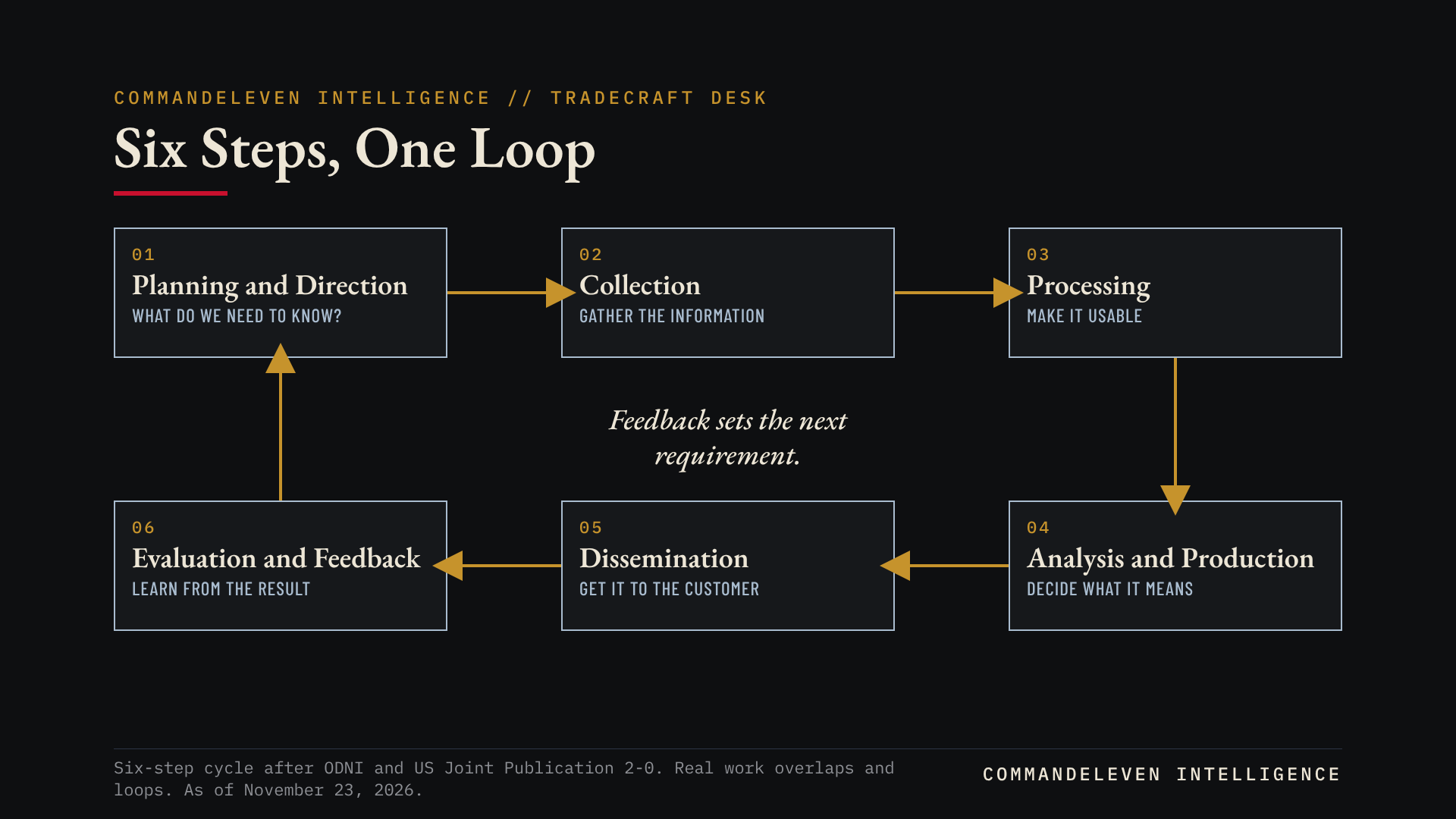
The cycle matters because it makes the work inspectable. Each step has an input, an output and a way to fail. When a product misses, the cycle lets us ask where: was the question wrong, was the information thin, was it misread, was it badly explained, or did it arrive too late?
The Six Steps
1. Planning and Direction: Deciding What We Need to Know
Everything starts with a requirement. Planning and direction sets what the customer needs to decide, which questions matter most, and which gaps in knowledge are worth filling. In doctrine, these priorities are often written as priority intelligence requirements tied to the commander’s decision points. A good requirement names the decision, the time frame and the level of the customer. See The Three Levels of Intelligence for how the level shapes the question.
This is where most failures begin. “Tell me about aviation security” is a topic. “What should airline security directors change for the Thanksgiving travel period?” is a requirement.
2. Collection: Gathering the Information
Collection gathers raw information against the requirement. Our methodology collects across three layers: human intelligence (HUMINT), open-source intelligence (OSINT) such as official releases, court filings, satellite imagery and public records, and signals and technical collection (SIGINT). Collection is limited by access, time and law, and it is always incomplete. The next primer, Collection Disciplines and Source Reliability, covers the main types of source and how to weigh them.
3. Processing: Making the Material Usable
Raw information is rarely ready to analyze. It has to be translated, decoded, organized, filtered and stored so analysts can find and use it. Doctrine calls this processing and exploitation. For open-source work, processing means reading documents closely, extracting the claims that matter, recording where each one came from and discarding duplicates. It is unglamorous, and mistakes here, such as a mistranslated phrase or a figure copied from a digest instead of the original, travel straight into the final product. We call our version of this step Narrative De-Noising: incoming material is screened for manufactured narratives, influence operations and institutional or regional bias before it reaches analysts.
4. Analysis and Production: Deciding What It Means
Analysis turns processed information into judgment. Analysts weigh the evidence, test competing explanations, state how confident they are and identify what is still unknown. Before a data point is promoted into the analysis, it must pass Triple-Node Verification: a redundancy scan against independent field assets, technical correlation against open-source and signals data, and temporal authentication of when the report was made. Single-source publication is prohibited. Analysts then use techniques such as Analysis of Competing Hypotheses and Red Teaming, and our Vetting Matrix grades each source for reliability (A to F) and each piece of information for credibility (1 to 6). Production then puts the judgment into a form the customer can use. Analysis is also where gaps surface, and each gap becomes a new collection requirement. The primers on Confidence Tiers and Structured Analysis cover how we do this step.
5. Dissemination: Getting It to the Customer
An assessment that does not reach the right person in time and in a usable form has not done its job. Dissemination means choosing the right product for the customer: a short alert for someone who must act this morning, a full dossier for someone planning the year. Our release formats include the SitRep, the Strategic Briefing and the Assessment, with Flash Alerts for fast-moving warnings. Release rules matter here, because some information can be shared widely and some cannot. See Writing for the Decision-Maker.
6. Evaluation and Feedback: Learning From the Result
Evaluation asks whether the product was relevant, accurate, timely and useful, and whether the process behind it can be improved. The customer’s feedback, and later the facts themselves, show what to change. All of our reports undergo continuous longitudinal review, and an assessment that events contradict triggers a Revision Annex. US joint doctrine treats this as one of the six categories, and a joint-force focus paper notes that it is often the least observed. We score our own dated forecasts on the Foresight Record for this reason: it is how our own cycle closes.
How the Cycle Maps to Our Engine
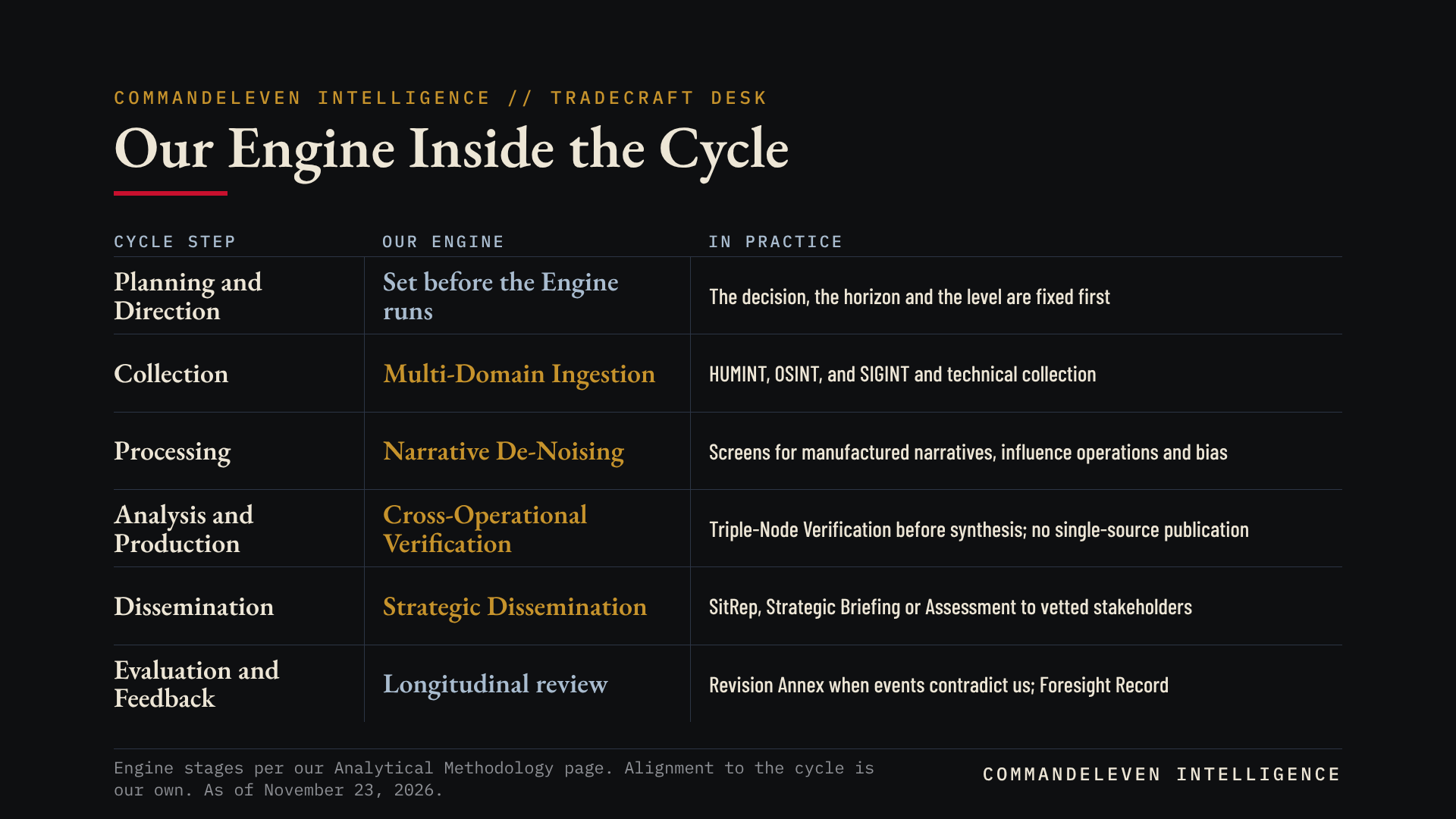
The cycle is the general model. Our own working method is the intelligence engine described on the Analytical Methodology page, which has four stages: Multi-Domain Ingestion, Narrative De-Noising, Cross-Operational Verification and Strategic Dissemination. The engine sits inside the cycle. Planning and direction happen before it starts, and the review of results happens after it finishes.
Where Each Step Breaks
Every step has a typical way to fail, and knowing it is how we guard against it.
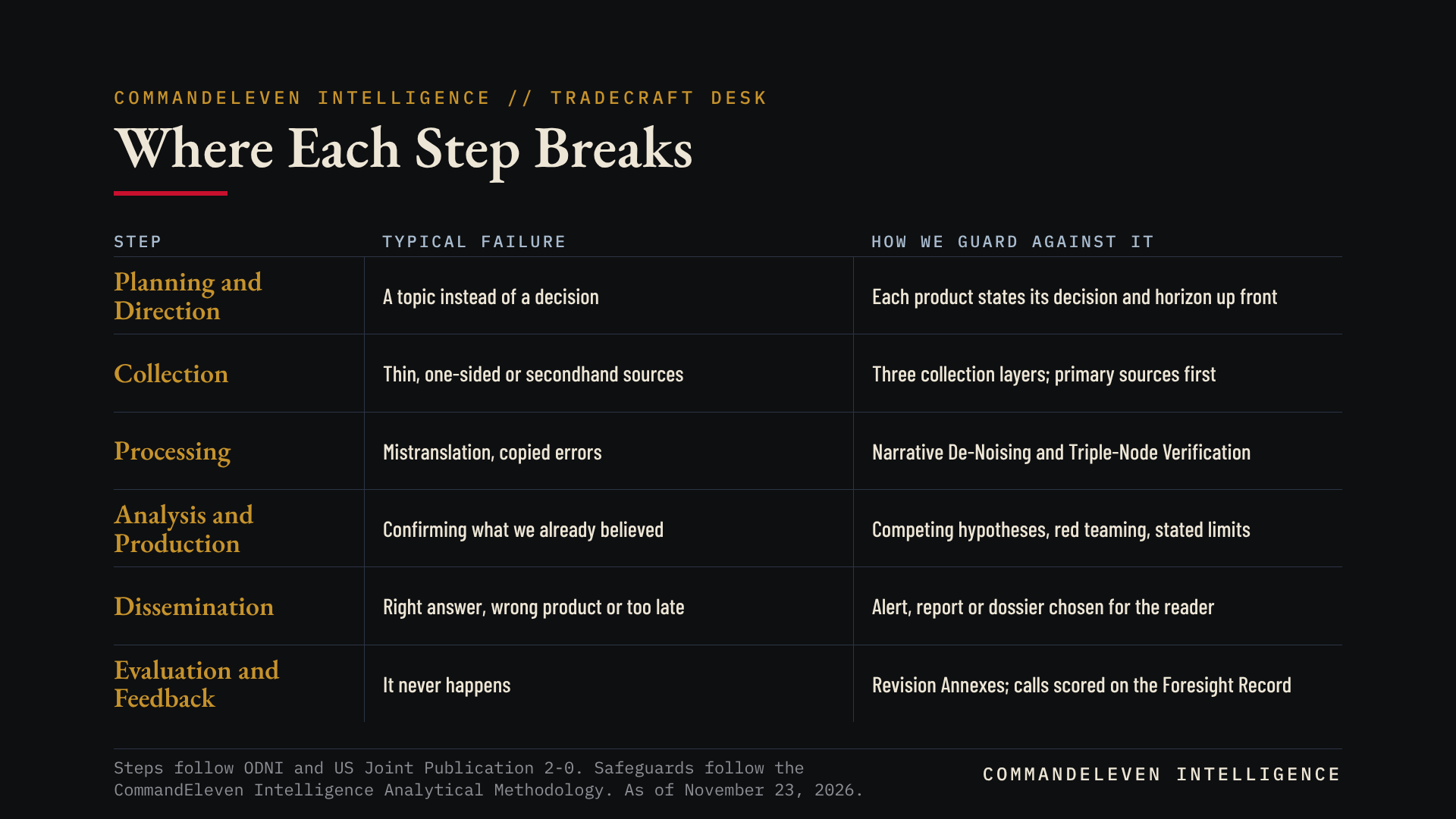
The failures cluster around two themes. The first is poorly defined questions at the start. The second is feedback that never happens at the end, so the same mistakes repeat. The middle steps break in more familiar ways: thin or biased sources, misread material, and analysis that confirms what the team already believed.
A Worked Example: One Warning Through the Cycle
The warning that the FBI, DHS and TSA sent to the aviation industry in November 2026 shows the cycle in motion. Our full assessment is in Al Qaeda Aviation Threat: What the FBI-DHS-TSA Warning Means for US Air Travel.
- Planning and direction. The question was what the warning means for US air travel and what airline and airport security leaders should watch during the Thanksgiving period. That question set the product and its horizon.
- Collection. We started from the warning itself and other public reporting, treating the government document as the primary source rather than a news summary of it.
- Processing. Each claim was traced to its source, with duplicates and secondhand repetitions set aside.
- Analysis and production. Claims were tiered by confidence, an explicit section stated what the warning does and does not establish, and a “What To Watch” list set out the developments that would change the assessment.
- Dissemination. The same analysis was packaged as a Flash Alert for readers who needed it fast, a full dossier for those who wanted the reasoning, and a downloadable reference card of warning signs for frontline staff.
- Evaluation and feedback. Where a dossier makes dated calls, they are registered for scoring, and new developments prompt an update that reopens the loop.
How the Model Falls Short
The cycle is a simplification, and it helps to say so. Real work does not move neatly from step to step. Analysts begin writing while collection is still running. A surprising piece of information sends the team back to refine the requirement. Customers often do not know what they need until they see a first draft. Doctrine itself describes its categories as interrelated rather than strictly sequential, and some of the most useful work happens when analysts push back on the question or ask for different collection. We treat the six steps as a list of questions to ask about any product rather than a conveyor belt it must pass along.
Frequently Asked Questions
What are the steps of the intelligence cycle?
Planning and direction, collection, processing, analysis and production, dissemination, and evaluation and feedback. Some agencies combine or rename steps, but the sequence of need, gathering, preparation, judgment, delivery and review is the same.
Is the intelligence cycle used outside government?
Yes. Corporate security teams, law enforcement analysts and risk consultancies use the same logic, often with simpler names for the steps.
Why does the cycle start with a requirement?
Because without a defined question, collection has no direction and analysis has no standard of success. Most wasted effort in intelligence work traces back to an unclear requirement.
Is the cycle accurate to how analysts really work?
Only partly. It is a useful model of the logic, but real work overlaps and loops. Treat it as a map, not a timetable.
Where does a CommandEleven Intelligence dossier start?
With a decision a reader needs to make and the time horizon they are looking at. That sets the requirement, and the rest of the dossier follows from it.
How does the cycle relate to the CommandEleven Intelligence engine?
The engine is our working version of the cycle. Multi-Domain Ingestion covers collection, Narrative De-Noising covers processing, Cross-Operational Verification covers verification and analysis, and Strategic Dissemination covers delivery. Planning before and review after complete the loop.
What should I read next?
Collection Disciplines and Source Reliability explains the main ways information is gathered and how to judge a source.
Related CommandEleven Intelligence Reading
- How CommandEleven Intelligence Thinks: the series this primer belongs to, with every primer listed.
- The Three Levels of Intelligence: how the level of the decision shapes the requirement.
- Collection Disciplines and Source Reliability: the next step in the cycle, in depth.
- Analytical Methodology and Source Validation: the intelligence engine, the Vetting Matrix and the analytical techniques we use.
- Foresight Record: where our own forecasts are scored.
Sources
- How the IC Works, Office of the Director of National Intelligence: the six steps of the intelligence cycle.
- Joint Publication 2-0, Joint Intelligence (Intelligence Series), US Joint Chiefs of Staff: the joint intelligence process and its six categories.
- Insights and Best Practices Focus Paper on Intelligence, US Joint Chiefs of Staff: how the categories are applied, and the note that evaluation is often the least observed.