CommandEleven Intelligence Desk // Tradecraft Desk, Tradecraft Primer. Part of the series How CommandEleven Intelligence Thinks.
Bottom Line Up Front
Intelligence is organized by the decision it serves. Strategic intelligence supports long-range choices by senior leaders. Operational intelligence supports campaigns and sustained programs. Tactical intelligence supports action that is happening now. Each level answers a different question, over a different time horizon, for a different customer, and excellent analysis delivered at the wrong level is of little use.
We use the three levels to settle what a product is for before we write it. A reader who knows the level can tell what a CommandEleven Intelligence product is built to do, and what it is not.
What Each Level Is
Strategic Intelligence: The Big Picture
Strategic intelligence serves the people who set long-term priorities and make policy. US joint doctrine defines it as the intelligence needed to form strategy, policy and military plans at the national and theater levels. Its customers are national leaders, boards and executive teams.
The time horizon runs from months to years. The questions are about direction: what is changing, why it is changing, and what we should prepare for. The products are threat outlooks, estimates and long-form assessments. Strategic intelligence has to tolerate uncertainty, because its job is to describe plausible futures rather than current facts, so it speaks in probabilities and ranges.
Operational Intelligence: The Bridge
Operational intelligence connects strategy to action. Doctrine defines it as the intelligence needed to plan and conduct campaigns and major operations within a theater or area of responsibility. Its customers are commanders, program managers and security directors running a sustained effort.
The time horizon runs from weeks to months. The questions are about how things will unfold: how an adversary is organized and positioned, what has to happen for the campaign to work, and what the teams on the ground need to know. The products are network analyses, target packages and campaign estimates. Operational intelligence turns strategic priorities into plans, and it tells collectors what tactical teams will need.
Tactical Intelligence: Right Here, Right Now
Tactical intelligence supports the action in front of you. Doctrine defines it as the intelligence needed to plan and conduct tactical operations, meaning battles, engagements and individual missions. Its customers are operators, responders and officers on shift.
The time horizon is hours to days. The questions are concrete and immediate: where the threat is, what it is doing, and what the team needs to know to carry out the task. The products are short alerts, warnings and spot reports written for quick reading under pressure. Its value decays fast, because the situation it describes keeps changing.
Beyond the Battlefield
The same logic applies in law enforcement and business. The OSCE’s guidance on intelligence-led policing describes strategic analysis as work on long-term aims and emerging trends, and operational analysis as support for specific investigations and shorter-term tasks. A company uses the three levels the same way. Strategic intelligence asks how regional instability will affect its supply chain over the next five years. Operational intelligence asks how a protest campaign near a plant will affect next quarter’s shipments. Tactical intelligence asks whether the road to the plant is safe this morning.
How the Levels Differ
The levels differ in customer, purpose and time horizon, and those three differences shape everything else about the product.
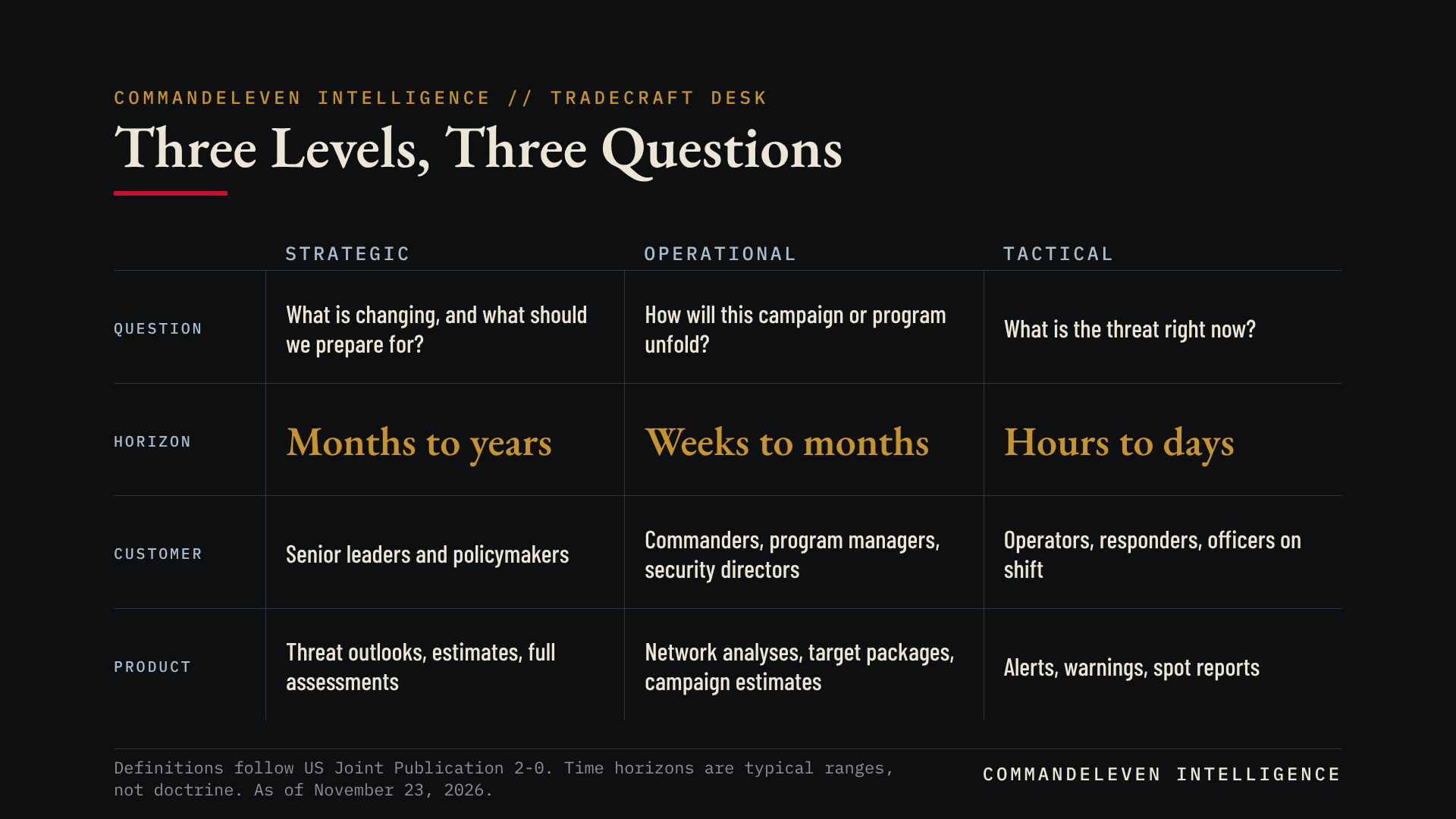
They also trade certainty for speed in different proportions. Strategic work has time to draw on research, specialist analysis and all available sources, and it accepts that the future cannot be known. Tactical work leans on current reporting and what the team can see for itself, and it has to be fast enough to matter. A level describes the decision being supported, not the rank of the person reading or the size of the event.
How the Levels Connect
The levels form a loop, not a ladder. Strategic priorities flow down and shape what operational planners look at, and operational plans create the requirements that tactical teams collect against. Evidence flows back up. What tactical teams see on the ground adds up to the operational picture, and the operational picture confirms or challenges the strategic assessment.
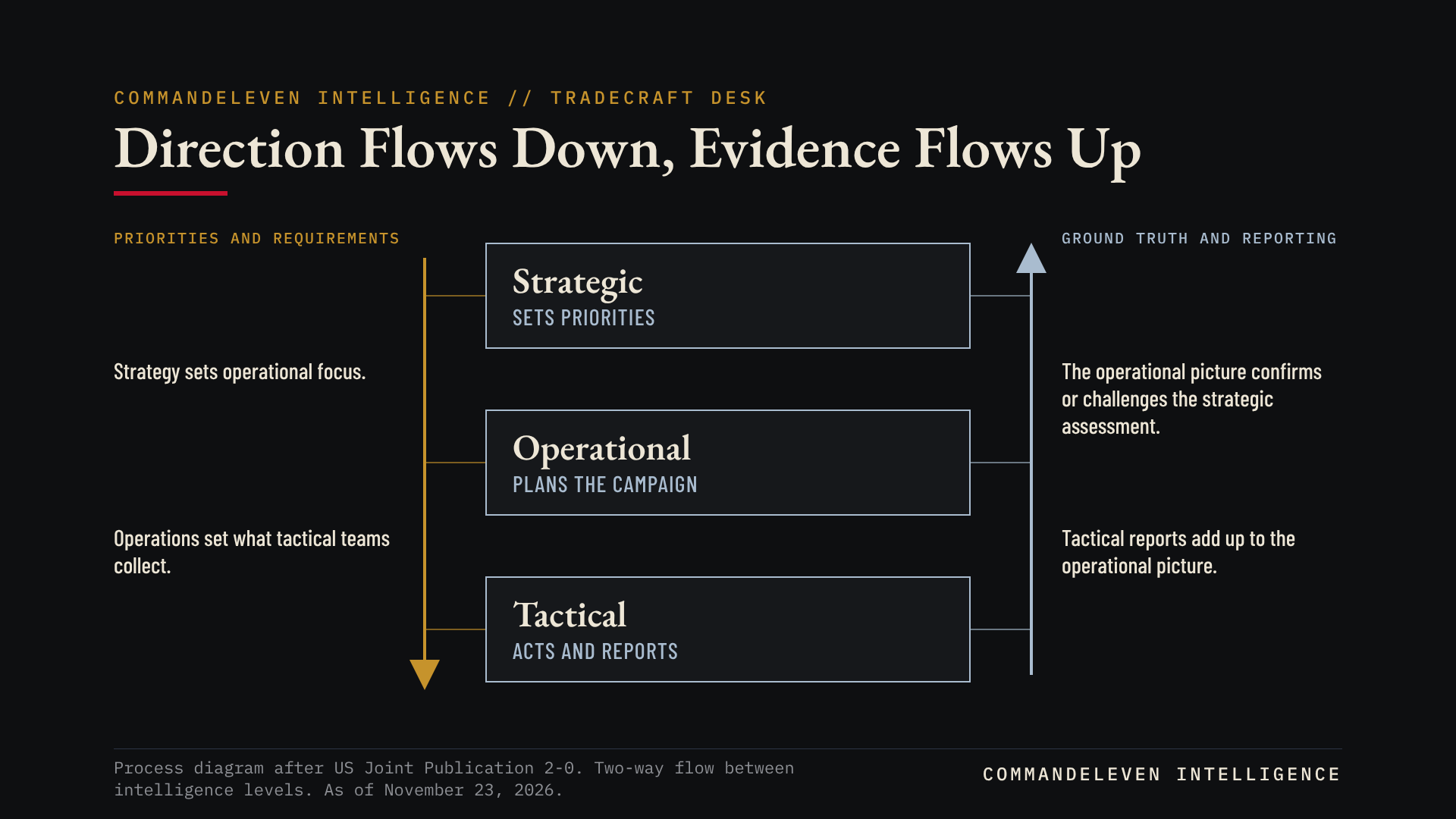
When the loop works, each level sharpens the others. When it breaks, strategic assessments drift away from the facts and tactical teams chase noise.
A Worked Example: One Threat, Three Levels
The warning that the FBI, DHS and TSA sent to the aviation industry in November 2026 shows how one subject produces three different questions. Our full assessment is in Al Qaeda Aviation Threat: What the FBI-DHS-TSA Warning Means for US Air Travel.
- Strategic. Aviation has been al Qaeda’s signature target for more than 30 years, and calls to copy a recent attack came from across the network. The question for senior leaders is whether the industry should change its approach to insider risk over the coming year. The product is an assessment that states a direction, not a date.
- Operational. The Thanksgiving travel period is the window of greatest exposure. The question for security directors is how to adjust vetting, staffing and reporting for that period, and what developments would change the picture. The product is a “What To Watch” list.
- Tactical. An employee notices a missing badge or behavior that does not fit, and has to decide within the hour whether to report it. The product is a plain list of warning signs, which we published as a downloadable reference card for exactly that moment.
How CommandEleven Intelligence Uses the Levels
Every product we publish is built for one level first. Broadly, a Flash Alert is tactical: what has happened and what to do now. A SitRep is operational: where an ongoing story stands and what is moving. Strategic Briefings, Assessments, dossiers and series are strategic and operational: the structure behind events and where they are heading. The Foresight Record tests our strategic calls against what actually happened. Each dossier states its decision and horizon in the bottom line, so a reader knows from the first lines what it is for.
Getting the Level Wrong
Three mistakes account for most failures of fit:
- A strategic answer to a tactical question. The customer needed to act this morning and received a thoughtful essay. The analysis may be right and still arrive too late and too general to use.
- A tactical answer to a strategic question. One incident is presented as a trend. Leaders then plan for a pattern that does not exist, or miss one that does.
- Mixing levels in a single product. When a product tries to serve the board and the shift supervisor at once, it usually serves neither.
Where the Levels Blur
The levels are not sealed compartments. A single tactical event, such as a failed hijacking, can reshape strategy overnight. Cyber events move at machine speed and can pass through all three levels in a day. One analyst often covers more than one level, and one fact can matter at all three. The levels are a way to ask what a product is for, and they are most useful when applied that way.
Frequently Asked Questions
What is the difference between strategic and tactical intelligence?
Strategic intelligence looks months to years ahead and supports policy and long-term planning. Tactical intelligence looks hours to days ahead and supports action in progress. Operational intelligence sits between them and supports campaigns and programs.
Who uses each level?
Senior leaders and policymakers use strategic intelligence. Commanders, program managers and security directors use operational intelligence. Operators, responders and officers on shift use tactical intelligence.
Are the levels the same outside the military?
The names come from military doctrine, but law enforcement and private-sector teams use the same logic, with the terminology adjusted to their work.
Which level is a CommandEleven Intelligence dossier?
Most are strategic and operational. Flash Alerts lean tactical. Each product states its decision and horizon in the bottom line.
What should I read next?
The Intelligence Cycle explains how a requirement at any of these levels becomes a finished product.
Related CommandEleven Intelligence Reading
- How CommandEleven Intelligence Thinks: the series this primer belongs to, with every primer listed.
- The Intelligence Cycle: how requirements, collection, analysis and dissemination fit together.
- Al Qaeda Aviation Threat: What the FBI-DHS-TSA Warning Means for US Air Travel: the worked example above, in full.
Sources
- Joint Publication 2-0, Joint Intelligence (Intelligence Series), US Joint Chiefs of Staff: the definitions of strategic, operational and tactical intelligence.
- Guidebook on Intelligence-Led Policing, Organization for Security and Co-operation in Europe, 2017: strategic and operational analysis in law enforcement.